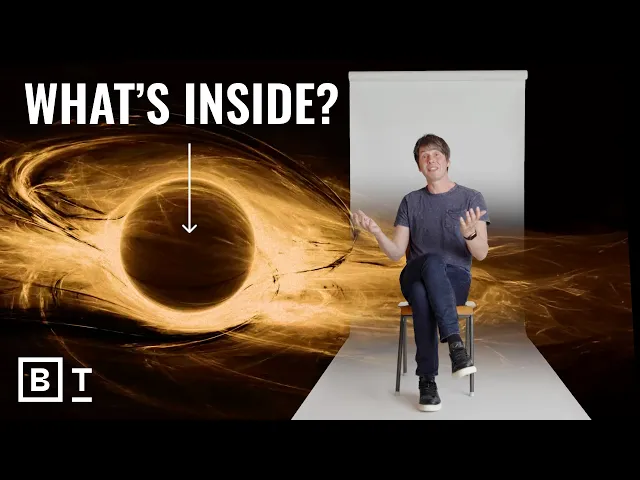
Brian Cox: Why black holes could hold the secret to time and space | Full Interview
Big Think
0:00 I'm Brian Cox, I'm a professor of particle physics at the University
0:04 of Manchester and the Royal Society professor for public engagement in science.
0:08 And amongst other things, I'm the author of several science books,
0:12 including "Black Holes: The Key to Understanding the Universe".
0:21 [Narrator] Chapter one, Black Holes and the Edge of Physics.
0:25 Could black holes be the key to a quantum theory of gravity,
0:29 a deeper theory of how reality, of how space and time works?
0:35 Well, I think so.
0:37 It's interesting.
0:39 These objects, which have been known, I would say, for 40 or 50 years,
0:46 but theoretically for the best part of a century, have always been fascinating.
0:50 They're odd things.
0:52 The simplest way to describe a black hole would be
0:55 a region of space from which even light can't escape.
0:59 Predictions that such objects existed go all the way back
1:03 to the beginnings of relativity back at the turn of the 20th century.
1:07 But actually really I would say into the 1960s, perhaps even into the 1980s,
1:14 many physicists felt that because of the intellectual
1:18 challenges that these predicted objects pose,
1:22 many physicists felt that maybe nature would not create them.
1:26 I even saw that the great physicist Steven Weinberg say that he,
1:31 in some sense, hopes that these things
1:34 would not exist because they're so confusing,
1:37 but we now know that they do exist and so
1:40 we have to face the challenges that they pose.
1:44 Black holes are interesting,
1:47 because going back to the work of Stephen Hawking in the 1970s,
1:51 it turns out that they demand that we
1:56 think about both quantum theory and general relativity together.
2:02 And the quest to unify those two great pillars
2:06 of 20th and 21st century physics into what's often
2:10 referred to as a quantum theory of gravity is
2:12 in some sense a holy grail for theoretical physicists.
2:16 But the problem has always been, well,
2:18 is there anywhere in nature that we can look to observe
2:23 something that requires us to merge those two theories together?
2:28 And black holes really are the unique place, as far as we can tell, in nature,
2:34 where we can see a thing just sitting there in the sky that demands
2:40 that we consider those two theories working
2:43 together to hopefully reveal a deeper theory.
2:47 The idea of black holes goes back a long way actually,
2:50 back into the 1780s and 1790s.
2:53 There were two physicists, mathematicians, natural philosophers,
2:56 whatever you want to call them, working at the time that had
3:00 the same idea apparently independently of each other.
3:03 One was a clergyman, an English clergyman called Mitchell,
3:06 and the other was the great French mathematician Laplace.
3:09 And they were both thinking in terms of an idea called escape velocity.
3:14 So the escape velocity is the speed you have to travel
3:18 to completely escape the gravitational pull of something, a planet or a star.
3:22 For the Earth, for example, the escape velocity from the surface
3:26 of the Earth is around eight miles a second, 11 kilometers a second.
3:32 If you go bigger, you make a bigger, more massive thing, let's go to a star,
3:37 for example, like the Sun, then the escape velocity increases because
3:41 the gravitational pull at the surface increases.
3:44 And actually for the Sun, it's somewhere in the region of 400 miles a second.
3:49 It's really fast.
3:51 What Mitchell and Laplace thought, and I think it's a very beautiful idea,
3:54 is they imagined in their mind's eye, well, can you go bigger?
3:58 Can you imagine more and more massive stars, giant stars,
4:03 such that the gravitational pull is so large at the surface
4:07 that the escape velocity exceeds the speed of light?
4:11 And then you wouldn't be able to see them.
4:13 There's a wonderful quote actually in Laplace's
4:16 paper where he says that the largest
4:18 objects in the universe may go unseen by reason of their magnitude,
4:23 and this is back in the 1780s or 1790s.
4:26 So he's imagining stars where the gravitational pull is so
4:29 vast that even light can't escape and you couldn't see it,
4:32 dark stars, I think he referred to them as.
4:34 Now, now we know that such objects do not exist in the universe in that sense,
4:42 in the sense that Mitchell and Laplace meant, but actually they miss something,
4:48 which is not surprising 'cause it sounds almost paradoxical.
4:51 But you can also increase the escape velocity,
4:55 the surface of an object by squashing it.
4:58 And it turns out that if you take the Earth and you squash it
5:02 down and squash it down and squash it down until it's about that big,
5:07 the radius just less than a centimeter,
5:10 then the gravitational pull at the surface
5:12 would be so great that light couldn't escape,
5:15 and that is essentially the modern concept of a black hole.
5:21 Now, Mitchell and Laplace's calculations or imaginings
5:25 were based on Newtonian physics, so pre-Einstein.
5:28 We come forward to 1915, Einstein published his general theory of relativity,
5:34 which is a different model, a better theory of gravity.
5:38 And it turns out that black holes also exist in general relativity.
5:44 Now, if we come forward to 1915,
5:47 Newton's theory of gravity is replaced by a better model,
5:50 a better theory, which is Einstein's general theory of relativity.
5:53 But the idea that there can be objects that can be
5:58 compressed such that they trap light is also present in Einstein's theory.
6:03 The first physicist to predict such a thing,
6:08 or at least derived the mathematics that describes such a thing as a black hole,
6:13 although he didn't know that they existed, was a man called Karl Schwarzschild.
6:18 What Schwarzschild did was provide an exact solution
6:23 to Einstein's equations that describes space and time,
6:29 the distortion of space and time,
6:31 in the region of a star or at least an idealized star,
6:37 which is a perfectly spherical, non-spinning ball of matter,
6:41 it's a simple model of a star.
6:43 Now, Schwarzschild described or discovered the solutions to Einstein's equations
6:49 that describes what happens to space-time outside such a thing way back,
6:54 actually 1916, just after the theory was published.
6:57 What Schwarzschild's solution also describes, though,
7:01 although he didn't think in these terms at the time,
7:03 was what that space looks like if you completely remove the star,
7:09 but leave its imprint in the fabric of the universe behind,
7:14 and that is essentially the theoretical description
7:18 or the model of a modern relativistic black hole.
7:23 Now, while Schwarzschild's solution, and by solution,
7:28 I mean we're to picture a distortion in space and time,
7:32 a distortion in the fabric of the universe,
7:34 while Schwarzschild's solution does indeed describe the simplest possible
7:39 black hole that we can model in the universe,
7:42 people didn't really think in those terms at all until later.
7:46 You see in the 1930s, Einstein and a colleague of his, Rosen, for example,
7:51 exploring that space-time and building models
7:54 of what that space-time might look like.
7:57 But I think it's true to say
7:59 that really certainly until the late 1930s and actually,
8:03 arguably, post-war until the 1960s,
8:07 most physicists thought that such things would not exist in nature.
8:10 So they were theoretically interesting, perhaps not practically interesting.
8:15 The reason is that you have to create such a thing.
8:19 So it's one thing to have a model of space and time that describes
8:24 this object called a black hole from which not even light can escape,
8:29 but it's another thing for nature to actually make it.
8:33 So if you go through the 1930s, there's a lot of papers, actually,
8:36 Robert Oppenheimer and a student of his, Snyder,
8:39 a very famous paper just before the war,
8:41 which explored whether a real star in the universe at the end
8:47 of its life could collapse and collapse without limit to form this geometry,
8:54 this thing that we call a black hole.
8:56 Just before the war,
8:56 Oppenheimer and Snyder showed that under certain assumptions
9:00 a star could behave in such a way, but it wasn't really until the work of people
9:06 like Roger Penrose and Stephen Hawking and several
9:09 others in the 1960s that it really began
9:13 to look as if nature would build these things.
9:17 There's this great quote I remember with some fondness, actually,
9:20 Arthur Eddington, a colleague of Einstein's, he was very English,
9:25 very proper physicist, and he said,
9:28 "Nature will prevent such absurdities from existing." Just,
9:32 that's it, nature will prevent it.
9:35 Well, it turns out nature doesn't prevent it.
9:37 We now know, and we've observed them,
9:39 that stars do collapse to form black holes,
9:41 and then theoretical physics moves on.
9:44 So people accept that these things should exist.
9:47 Although it's true to say that we
9:49 haven't actually imaged one until the 21st century,
9:52 but in any case, people accepted these things should exist.
9:56 More and more evidence mounted that they do exist
9:59 at the centers of galaxies and at the sites of collapsed stars,
10:03 but then we have to face the consequences.
10:05 What does it mean for our understanding of the universe if there
10:10 are these objects where space and time behave in a very strange way,
10:14 where light is trapped, and where it would seem that anything that falls in is
10:20 at the very least locked away from the universe forever?
10:24 So to understand the conceptual problems that are faced if these things exist,
10:30 then it might be worth just describing very briefly the Einsteinian description,
10:34 the pure description in general relativity.
10:37 A black hole, what do you see from the outside?
10:39 Well, there's an event horizon surrounding the black hole.
10:44 In some sense, it defines the boundary between
10:46 the external universe and the interior of the black hole.
10:50 The event horizon is, very simply and a bit handwavingly,
10:55 but it's a reasonable description,
10:58 it's just if you can imagine a sphere in space,
11:03 and if you go across the boundary into the interior of this sphere,
11:08 then even if you can travel as fast as the speed of light, you can't escape.
11:12 So the event horizon separates the interior
11:15 of the black hole from the external universe.
11:18 We'll see a bit later why that's a bit of a handwavy description.
11:22 But another description of the event horizon,
11:24 which confused people all the way through
11:27 the history of black hole research, actually,
11:29 certainly to the early papers in the 1930s and perhaps even post-war,
11:35 was the idea that the event horizon when viewed
11:38 from the outside is a place in space where time stops.
11:43 And that's a direct prediction of Einstein's theory of relativity.
11:47 From the external perspective, if you watched, for example,
11:51 an astronaut falling in towards the black hole,
11:55 then from your external perspective,
11:57 you'd see their time pass more slowly, slower and slower and slower,
12:03 as the astronaut approached the black hole,
12:06 until on the horizon, you would see their time stop.
12:11 That suggested to many people in the early days that a star
12:14 couldn't collapse to form a black hole, it confused them.
12:17 They thought, well, if the star's collapsing,
12:19 then does it not freeze forever in some sense on the horizon?
12:23 So all sorts of initial early conceptual problems which ultimately were solved.
12:28 The thing about relativity, just the one-sentence thing to understand,
12:32 is that time can stop from one perspective,
12:36 but time can pass at the usual rate from another perspective.
12:39 And indeed, from the perspective of an astronaut falling into a black hole,
12:44 then for a sufficiently large black hole,
12:47 the ones that we find at the centers of galaxies,
12:50 the astronaut would notice nothing at all as they fell
12:54 across the horizon into the interior of the black hole.
12:58 So time passes at one second per second on the watch
13:02 of an astronaut falling in, but from the external perspective,
13:05 time freezes on the horizon.
13:07 So black holes are full of these apparent conceptual challenges,
13:12 which are actually not conceptual challenges at all,
13:15 they're just a central part of Einstein's general theory of relativity.
13:18 So that confusion was eventually dealt
13:21 with and solved and people understood certainly
13:24 by the 1960s what these things are and how general relativity models them.
13:29 There is a central problem, though, which is still not solved,
13:33 which is, you put it this way,
13:35 what lies at the center, and I'll be careful with my language,
13:39 what lies at the center of a black hole?
13:41 Now, in pure, just in Einstein's general theory of relativity,
13:46 actually it's not right to talk about the center of a black hole, really.
13:51 So, what are we picturing?
13:52 It's this thing called the singularity.
13:54 You might think of it,
13:55 an infinitely dense point to which this massive star collapses,
14:00 it's kind of the natural way to think of it.
14:02 But actually, just even in pure general relativity,
14:06 when you look at a nice map of a black hole,
14:09 so-called Penrose diagram named after Roger Penrose,
14:11 what you see is that the singularity is not really a place in space at all,
14:18 it's a moment in time, and actually it's the end of time.
14:22 So one way of picturing what's happened when a star collapses to form a black
14:26 hole is that space and time is so distorted that in a sense their roles swap.
14:33 And so what we thought of as an infinitely dense point,
14:37 a place in space at the center of the collapse of the star, if you like,
14:43 actually becomes a moment in time and the end of time, the singularity,
14:49 but the nature of that thing was not and is still not understood.
14:56 So that's a great mystery, and it's been long accepted that we
15:00 will need a so-called quantum theory of gravity,
15:03 a deeper theory of gravity in order to explain the singularity.
15:07 And for many, many years, actually, until quite recently, then people thought,
15:11 well, there we are, we have a problem with the singularity,
15:14 we don't really have any access to it,
15:16 we don't have the conceptual tools to explore it,
15:19 so it may remain a mystery for a century to come.
15:23 It's not clear what to do.
15:25 The great revolution in black hole research was to notice,
15:30 and it began with Stephen Hawking's work in the mid-1970s,
15:35 was to notice that actually there are conceptual
15:39 problems at the event horizon of the black hole,
15:42 not in this extreme place, not only in this extreme place at the singularity,
15:47 whatever that might be, but at the horizon.
15:50 Now, that was a real challenge and extremely interesting because we think,
15:57 we strongly expect the laws of nature that we understand now,
16:02 laws of nature that we have full mathematical
16:05 and conceptual control of, to apply at the event horizon.
16:10 And so that's why black holes have become so interesting,
16:15 is because we have a place where we think,
16:18 we assume, and indeed, we're right to assume, it seems,
16:22 that we have full control of the physics, we understand what's happening,
16:27 but there is a fundamental clash of principle
16:32 between our two basic theories of nature,
16:36 general relativity and quantum mechanics.
16:38 And that is ultimately why the event horizon of a black
16:41 hole and black holes themselves have become so fascinating and so important.
16:47 The modern revolution in our thought, which is still ongoing by the way
16:53 in understanding black holes and quantum gravity,
16:57 really does begin with the work that Stephen Hawking did in the mid-1970s.
17:03 Stephen Hawking, in his own words, showed that black holes ain't so black.
17:07 So we've described them as prisons in a sense,
17:11 we're picturing them as a region of space from which nothing can escape.
17:16 What Stephen Hawking showed in a landmark couple of papers,
17:21 a tour de force of calculation actually, is that if you consider quantum theory,
17:28 quantum mechanics, in the vicinity of the horizon of a black hole,
17:32 then you find that they glow, they produce particles, they have a temperature.
17:39 This thing that we pictured in Einstein's theory is pure geometry,
17:46 is just distorted space and time,
17:50 actually emits particles, it's called Hawking radiation.
17:54 And one way to picture that, and Stephen in his 1974 paper gives this, he says,
18:02 it's a handwavy description, so it's not a full description,
18:06 you need the mathematics for that, but he gives this handwavy description,
18:10 which is kind of a nice way to picture what's happening.
18:12 The idea is to imagine,
18:14 to zoom in on space in the vicinity of the event horizon of a black hole.
18:20 If you zoom in on any piece of space,
18:22 the piece of space in front of your nose right now,
18:24 if you could you zoom in and slow time down with a big microscope,
18:29 you can picture what's happening as a series of particles
18:33 coming in and out of existence all the time, so-called entangled particles.
18:39 So it's a picture of what the vacuum of space looks like.
18:44 Just to emphasize, again, it's not a complete picture,
18:47 it's not supposed to be precise,
18:49 but it's a reasonable model of what's happening.
18:51 So particles in and out of existence all the time,
18:54 and that's happening everywhere, in space, everywhere that you look,
18:58 in the most empty piece of space you could imagine, that's what's happening.
19:02 In the vicinity of the horizon of a black hole,
19:05 you can have the situation where one of those particles,
19:08 those pairs of particles,
19:11 is on the inside of the event horizon and one is on the outside,
19:14 and then it can happen that the one on the outside,
19:18 instead of merging back with its partner again, can escape into the universe.
19:24 It's essentially made real by the presence of the black hole.
19:28 So the other partner is interior to the black
19:31 hole and this particle heads off into the universe,
19:36 removing energy from the black hole as it goes.
19:39 This rain of particles, this glow of particles is called Hawking radiation.
19:44 That has profound implications.
19:47 So it's kind of a simple picture of what's happening.
19:50 But the upshot is imagine this thing,
19:53 it's a black hole, it's glowing, it's just space-time geometry,
19:59 but it's emitting particles, losing energy, therefore it's shrinking,
20:04 which means that one day it will be gone.
20:07 So black holes are not eternal prisons, they have a lifetime.
20:11 One day whatever's in there is returned to the universe.
20:16 The question was, the central question
20:18 that was immediately raised by those calculations
20:22 is this, what happened to all the stuff that fell in?
20:26 The way I've described it, the way Einstein's theory describes it is
20:30 somehow that stuff goes to the singularity, whatever that thing is,
20:34 the end of time, the region of space-time that's so convoluted
20:37 and distorted that we don't understand how to describe it at all.
20:41 But then one day the whole thing is gone.
20:44 All that's left in the far, far future is Hawking radiation,
20:50 those particles that were produced in the vicinity of the event horizon.
20:54 The question is, is it possible if you could collect all that radiation,
21:00 all the Hawking radiation through the whole life of the black hole,
21:03 is it somehow possible, in principle,
21:07 that the information about everything that fell into the black hole
21:13 throughout its history is imprinted in that radiation in the far future?
21:18 Is that true or is it not true?
21:21 You might say, why did I ask that question?
21:23 Seems like a bit of a random question.
21:25 It's a very important question.
21:27 Let's say that I take anything here in this room, a book, a table,
21:34 the camera, right, anything at all, and I set fire to it, I incinerate it,
21:40 I destroy it anyway that I can, could throw it into a furnace,
21:45 I could put it in the heart of a nuclear bomb and explode it,
21:48 whatever, just completely incinerated it.
21:51 In physics, in basic fundamental physics,
21:56 then it turns out that if you could collect
22:00 every piece of that thing that I detonated or incinerated,
22:04 every quantum of radiation,
22:07 every photon, every particle, everything, in principle,
22:10 if I could just collect it all and I was clever enough,
22:15 then I could reconstruct the thing that I had destroyed.
22:19 Information is conserved in the universe as far as we know.
22:25 So every law of nature that we have says that information is conserved.
22:29 The problem was that Stephen Hawking's initial calculation of the way
22:35 those black holes evaporate away said that information is not conserved,
22:39 said that black holes are erasers of information.
22:43 To put it very bluntly, the calculation said that once that black hole had gone,
22:49 then even in principle there is absolutely no way you could learn anything,
22:55 reconstruct anything about the things that fell
22:58 in, including the star that collapsed to form it.
23:02 So information erasers, the only information erasers that we know of in nature,
23:09 that was the initial picture of black holes as Stephen
23:12 Hawking understood them back in the 1970s and 1980s.
23:16 This became known as the black hole information paradox.
23:21 So we have a situation, the 1980s, 1990s, 2000s,
23:26 where it appears that there's a fundamental
23:30 problem with our understanding of something.
23:33 Black holes, quantum mechanics, general relativity, when you put them together,
23:39 you have this apparent prediction
23:41 that these things erase information from the universe.
23:45 Some physicists, Stephen Hawking initially actually,
23:48 felt that that was the case, that maybe these things do erase information.
23:53 Maybe we don't care about that, maybe that's
23:55 the way the quantum theory of gravity is.
23:58 And other physicists, people like Leonard Susskind initially,
24:02 for example, Gerard 't Hooft,
24:04 the great Nobel Prize-winning particle physicist and others,
24:07 felt that, no, there's something wrong with our understanding,
24:10 that there's no way in which we can
24:13 allow these things to erase information from the universe,
24:16 thus challenging our understanding of the basic laws of nature.
24:19 So that debate was vigorous and went on for decade after decade after decade.
24:25 The reason is interesting, is because there's a very precise problem posed.
24:31 So it's not some kind of thing like trying to understand a singularity
24:35 or understand the big bang or where you can just say, well,
24:39 we are miles away from understanding,
24:41 the challenges were posed in a region of space,
24:46 the vicinity of the event horizon,
24:48 where we thought we had control of the physics.
24:52 And so that's really useful because it means that it
24:55 should be the case that calculations can be performed to resolve.
25:00 The reason this challenge, this apparent contradiction,
25:05 this fundamental problem gained so much attention is because it occurred,
25:13 the problem came from physics that everybody thought they understood.
25:20 So calculating in a region of space under conditions in the universe where we
25:26 thought and assumed that we had full
25:29 control of the mathematics, of the theories.
25:31 That's really interesting because it means you have a chance catching
25:35 a glimpse of some kind of deeper theory by resolving this contradiction.
25:40 So that's why more and more people
25:41 got interested in the black hole information paradox.
25:44 It turns out if we fast forward to the present
25:47 day and a series of papers are still being written,
25:50 so there's still research that's happening as we speak,
25:53 but it turns out now that the general view,
25:56 I would say the generally accepted view,
25:58 is that black holes do not erase information from the universe.
26:04 So in principle, if you could collect
26:07 all that Hawking radiation emitted over eons, right,
26:12 the lifetimes of some of these black holes, by the way,
26:15 10 to the power 120 years-plus for some of the big ones,
26:20 it's one with 120 naughts after it,
26:22 and the universe is only one with 10 naughts after it years old at the moment,
26:25 10 billion years old or so.
26:27 So we're talking about timescales vastly longer
26:31 than the current age of the universe, but when they've gone, then in principle,
26:35 we now think you could collect all that radiation,
26:38 in principle, put it into some quantum computer,
26:42 carry out some operations on all that radiation
26:45 and reconstruct the information about everything that fell in.
26:49 But the implications of that, the mechanism by which
26:53 that happens I would say is profoundly exciting
26:58 because it really does seem to be given
27:00 as a glimpse of a deeper theory of gravity.
27:03 The simple way to say it, it seems that space and time are not fundamental.
27:09 So one view, and I emphasize that there are other views,
27:14 we're at the cutting edge of research now,
27:15 but one view is a field which has become known as emergent space-time.
27:22 So, what does that mean?
27:23 It means that space and time themselves are not fundamental.
27:28 In Einstein's picture,
27:29 we assume there is such a thing as space-time, this four-dimensional surface,
27:35 manifold is the technical term, but you assume it, it's part of the model.
27:39 There are such things as space and time
27:43 woven together into the fabric of the universe.
27:45 What they are, Einstein has no nothing to say.
27:49 It seems that there is a deeper theory
27:53 underlying what we think of as space and time, which is a quantum theory.
27:57 And so the idea is that space and time themselves emerge from, what?
28:04 From quantum entanglement, from some kind of smaller parts or pieces.
28:11 We don't know what those things are, we don't know the nature of them,
28:15 but it does seem that there's a deeper
28:18 underlying theory from which space and time emerge.
28:21 That is what we call the quantum theory of gravity.
28:24 But the key thing is, the key thing to understand is we've been
28:29 driven to that picture by asking very clearly defined,
28:34 precise questions about how black holes behave,
28:39 which goes all the way back, well, to Einstein and then to Stephen Hawking
28:44 and many others' calculations through the '70s and '80s.
28:48 Well, the super massive black holes are fascinating things.
28:51 So these are the black holes that we have images of, radio telescope images.
28:57 We have two images from a collaboration called the Event Horizon Collaboration.
29:02 One of a black hole,
29:03 it was the first one they acquired of a black hole in a galaxy called M87,
29:08 which is about 55 million light-years away.
29:10 This is a big galaxy, something like a trillion suns,
29:14 and the center of that we've long suspected there was a black hole.
29:18 Now we have an image of the black hole.
29:21 It's a black hole that is so super massive,
29:24 so over 6 billion times the mass of our Sun, a big black hole by any measure.
29:30 We also have an image, by the way,
29:31 of this rather smaller super massive black hole
29:35 at the center of the Milky Way galaxy,
29:37 which is only about just over 4 million times the mass of our Sun,
29:41 so it's a little one, but still big.
29:43 We think that virtually every galaxy has
29:48 a super massive black hole at its heart.
29:51 Caveat a little bit because there a couple of papers have been released recently
29:56 suggesting that there may be galaxies observed
29:58 where there are no super massive black holes.
30:00 There are lots of galaxies in the universe, maybe there are exceptions,
30:04 but it's fair to say that virtually every galaxy has a black hole at its center.
30:08 That's an interesting observation because we don't know how those form.
30:11 One of the reasons is we don't really fully
30:14 understand how the first galaxies formed in the first place,
30:17 it's current research, live research.
30:20 One of the goals of the James Webb Space Telescope
30:24 is to observe the formation of the first stars and galaxies.
30:30 It can do that because it can detect very faint, very long-wavelength light,
30:36 which is what you need to detect if you want to look far out into the universe
30:41 and therefore far back in time towards
30:43 the origin of the first stars and galaxies.
30:47 So the JWST, new instrument that's looking at that.
30:50 There are also a series of new radio telescopes being built.
30:54 The Square Kilometre Array, for example, in Australia and South Africa,
30:58 which is a radio telescope array aimed at observing
31:02 the formation of the first stars and galaxies.
31:05 So this is live research, it's a fundamental question,
31:08 how does structure form in the early universe?
31:13 Not only are black holes interesting from a theoretical perspective,
31:19 allowing us to peer or uncover deep questions or ask
31:25 deep questions about the structure of space and time itself,
31:28 but they're also key to understanding how galaxies
31:31 form and how structures form in the early universe.
31:34 How many black holes do we know of?
31:37 So direct observation, in terms of radio telescopes,
31:42 we have a direct observation of two
31:44 of them from the Event Horizon Collaboration,
31:47 the one in our galaxy, the Milky Way, and the one in the galaxy M87.
31:52 We also have what I would call direct observation of black hole collisions.
31:58 So this is a completely different technology,
32:00 a different approach, so gravitational wave astronomy.
32:04 So gravitational waves are ripples in the fabric of the universe,
32:08 let's describe them like that.
32:10 Although I once said Kip Thorne called it a storm in time,
32:13 which I think is also a very beautiful idea.
32:16 And so the idea is that, what is a ripple in space and time?
32:21 They'd be passing through everywhere now, so through you and me,
32:25 through the space in which we sit.
32:27 And they're ripples in space and time,
32:29 so time speeds up and slows down a bit as these things go through,
32:33 distances kind of shrink, can expand a little bit as well.
32:37 So they're real distortions in space and time and they're caused by, well,
32:44 actually pretty much everything that happens in the universe at some level,
32:47 but they're very, very faint and difficult to detect.
32:51 The ripples we've been able to detect come from the collisions
32:55 of black holes or the collisions of neutron stars.
33:00 So these are highly energetic events in the universe.
33:04 And then the observatories called LIGO, Virgo,
33:08 these are essentially laser beams, so-called laser interferometers,
33:12 about two and a half miles actually long,
33:15 four kilometers long at right angles to each other.
33:19 And they can detect little shifts in the distance
33:23 between the mirrors between which the laser beams bound far,
33:28 far smaller than the diameter of the nucleus of an atom.
33:32 So tiny, tiny ripples in the fabric of the universe.
33:37 By observing those ripples, we can see the collisions of black holes.
33:41 We tend to see the collisions of big ones,
33:43 and that's what's called the selection effect.
33:45 The big ones are more energetic and so
33:48 the gravitational waves are easy to detect.
33:50 But the collisions we're seeing in between black holes that are,
33:53 for example, around 30 times the mass of our Sun,
33:57 and the number of those collisions is, I think it's fair to say larger than
34:01 anyone would've imagined before the observations were made.
34:05 So it seems there are quite a lot
34:07 of these black holes floating around that are very massive indeed,
34:12 30, 40 times the mass of our Sun and upwards.
34:16 And I think it's fair to say the formation of those things is a mystery as well.
34:20 It's presumably that they're formed from the collapse of very massive stars,
34:25 but the number of them, I think it's fair to say, took everybody by surprise.
34:31 So we've detected, I don't know what the current number is actually,
34:35 I'm speaking now in June,
34:38 2023, that there are collisions being detected reasonably often,
34:42 but it's tens of collisions, maybe more actually.
34:45 But we have multiple observations of collisions of black holes with black holes,
34:50 and indeed, black holes and neutron stars as well, so it's quite a few.
34:56 So we are very certain now,
34:58 as certain as we can be, that these things really exist,
35:02 is that we have images and we have
35:04 these wonderful observations of the collisions of them.
35:07 Now, how many black holes might there be out there?
35:10 There'll be billions of them, billions.
35:13 So all massive stars, stars that are three, four,
35:19 five, six, seven, 10 times the mass of the Sun.
35:24 There are lots of stars there that are above the limit beyond which we
35:31 understand that at the end of their lives when they run out of nuclear fuel,
35:35 they will collapse without limit.
35:37 Nothing will stop the gravitational collapse
35:40 and they will inextricably form black holes.
35:43 So black holes are the natural, we used to say,
35:47 end point in the lives of stars above three, four times the mass of our Sun.
35:54 We now know, of course,
35:55 that ultimately those black holes will evaporate away again,
35:58 but that really is an in principle statement in the far future.
36:03 So the way to think about black holes is that any star more than, let's say,
36:10 three or four times the mass of our Sun and at which will form
36:14 a black hole when it runs out of nuclear fuel at the end of its life.
36:18 The numbers are kind of debated,
36:20 but let's say something like 2 trillion galaxies,
36:23 large galaxies and smaller galaxies in the observable universe.
36:27 It's 2,000 billion galaxies, pretty much every one of those will have
36:32 a super massive black hole at its center as well.
36:35 So we're talking about, not to steal Carl Sagan's phrase,
36:39 but billions and billions of black holes.
36:42 Carl Sagan said, I never said that.
36:44 So I'm not stealing Carl Sagan's phrase actually 'cause
36:46 he says that he never said billions and billions.
36:51 Let me give you some glimpses into why black
36:54 holes are so fascinating and so perplexing and wonderful.
36:59 So if we go back right to the beginning
37:00 of the work on black holes in the 1970s, Jacob Bekenstein,
37:05 a colleague of Stephen Hawkings, actually,
37:08 one of the first researchers to really begin working
37:11 on black holes alongside greats like John Wheeler, for example.
37:15 Bekenstein noticed in a simple calculation,
37:19 which was initially pretty much a back-of-the-envelope calculation, actually,
37:25 he noticed that you can ask the question,
37:27 you can answer the question, how much information can a black hole store?
37:33 That's a strange thing to say because the model
37:36 of a black hole is pure geometry, pure space-time.
37:41 So you might think, well, it's not capable of storing any information.
37:45 Now, how does some of this store any information?
37:47 You need some structure, you need atoms,
37:48 or something that can store bits of information.
37:52 Well, it turns out that you can calculate that a black hole stores information,
37:59 and how much, this is the fascinating thing.
38:04 So it stores in bits, the information content is equal to the surface
38:11 area of the event horizon in square Planck units.
38:17 What's a Planck unit?
38:19 It's a fundamental distance in the universe that you can
38:22 calculate by putting together things like the strength of gravity,
38:26 Planck's constant, speed of light.
38:28 It's the smallest distance,
38:30 often described as the smallest distance that we can talk
38:34 about sensibly in physics as we understand it, the Planck length.
38:38 This is a bizarre result.
38:40 There's so many things that are bizarre about that, the questions it raises.
38:45 But what's storing the information?
38:46 How is information stored?
38:48 Why is the information content of a region of space equal to, why does it have
38:55 anything at all to do with the surface
38:57 area surrounding that region rather than the volume?
39:02 If I asked you, how much information can you store in your room,
39:05 the room that you're sitting in now, just say it's a library,
39:08 then you would say, well, it's to do with how many books I can fit
39:11 in the room or hard drives or whatever it is, right?
39:14 It's to do with the volume of the room, the space.
39:18 But black holes seem to be telling us
39:21 that there's something about the surface surrounding a region,
39:25 which is fundamental.
39:27 This is the first glimpse, I think, of an idea called holography,
39:32 which now seems to be correct in a sense.
39:36 So holography, what is that?
39:39 It's the idea that there are different descriptions of our reality.
39:44 There's one description, which is the description that we're all
39:48 comfortable with and familiar with, I would say,
39:50 which is that we live in this space,
39:52 the three dimensions of space, and time is a thing that ticks.
39:55 And Einstein told us that they're kind of mixed up,
39:58 but still you have this picture of space being this, right,
40:01 the thing in which we exist.
40:04 There's an equivalent description, it seems, it's been proved, by the way,
40:09 for a very specific model called AdS/CFT by a physicist called Maldacena.
40:15 There's an equivalent description which is of a theory that lives
40:20 purely on the boundary of the space and it's absolutely equivalent.
40:24 It's an absolute perfect description,
40:28 a dual theory of the description of the space
40:32 itself in the interior of this region.
40:35 That's called holography because that's, if you think about what a hologram is,
40:38 then at the very simplest level, it's a piece of film,
40:42 but that piece of film contains all
40:45 the information to make a three-dimensional image.
40:48 So all the information about a three-dimensional image
40:50 is contained on a two-dimensional piece of film, it's basically a hologram.
40:55 And it seems from our study of black holes,
40:58 and the hints go all the way back to the 1970s to Jacob Bekenstein's work,
41:02 that our universe is like that in a way that's not fully understood yet.
41:08 The picture is that, and physicists, I always like to joke,
41:12 when they don't really know or the language isn't present,
41:15 then physicists often say in some sense and wave their hands.
41:19 So in some sense, there's an equivalent description
41:23 of our reality which lives on a boundary surrounding, it's perfectly equivalent.
41:28 And you might ask the question, well, what's the real description of reality?
41:32 And the answer is we don't know, but they're equivalent.
41:35 So it's strongly suggestive that there's a, let me say a deeper theory,
41:40 but at least a different theory of our experience of the world,
41:44 of space and time, that does not have space and time in it.
41:49 And that's one of the wonderful surprises that's really
41:55 emerged from, at least in part from the study
41:59 of black holes in the attempt to answer
42:02 the very well posed questions that black holes pose.
42:06 I should say that the work done by Maldacena,
42:09 the AdS/CFT correspondence, was purely mathematical.
42:14 So it wasn't framed in the study of black holes,
42:18 although the questions ultimately seem to be intimately related.
42:23 So that's number one.
42:24 So the study of black holes seems
42:27 to be strongly suggesting that these ideas of holography,
42:31 holographic universe, which came from a different region of physics,
42:36 actually, from trying to understand other things,
42:39 those descriptions may be valid, may be useful, may be, in some sense, true.
42:45 The other remarkable thing for me, I think,
42:48 in the study of black holes is an intimate
42:52 relationship between black hole physics and quantum computing.
42:55 This was wholly unexpected, I think it's fair to say.
42:59 The relationship comes by saying, okay,
43:02 so there's a theory on a boundary, a quantum theory,
43:07 which is a perfect description,
43:09 a dual description of the physics of the interior of a region of space.
43:13 You might say then, well, how is information encoded on this boundary?
43:19 How does that relate to the physics of the interior space and time?
43:23 And it seems that we're beginning to glimpse an answer,
43:26 at least in very simplified models.
43:29 And it seems that the information is stored on the boundary redundantly,
43:36 which means that you can lose a bit of it
43:38 and still fully specify the physics of the interior,
43:42 redundant storage of information.
43:45 Now, if we go to quantum computers,
43:47 there's an engineering challenge in building quantum computers.
43:51 And just to emphasize, we have these things,
43:54 they're not theoretical, they exist in labs across the world.
43:58 There's a challenge,
44:00 which is how to store information in the memory of the quantum computer safely,
44:07 robustly, because quantum computer memory is notoriously
44:12 susceptible to any interference from the outside environment.
44:16 If any of the environment in which the memory
44:19 sits interacts with the memory in any way, then the information is destroyed.
44:24 So it's a tremendous challenge.
44:26 And there are deep problems associated with the fact
44:29 that you can't copy information in quantum mechanics,
44:33 which is basically the way that your iPhone,
44:35 or whatever it is, stores information and prevents errors entering
44:40 into the memory of the computers that we're all familiar with.
44:43 It's basically copying information, you can't do that in quantum mechanics.
44:47 Fundamental, it's called the no-cloning theorem.
44:49 Engineers have had to develop very clever algorithms and ways of trying to store
44:56 information in quantum computer memory and build
44:58 the memory such that it's resilient to errors.
45:01 And it turns out that the solutions that are being proposed and explored look
45:06 like the solutions that nature itself uses
45:11 in building space and time from the theory,
45:16 the quantum theory that lives on the boundary.
45:18 It's really strange.
45:19 And I just emphasize,
45:21 you are not meant to understand what I've just said because I don't
45:25 understand what I've just said because
45:27 nobody understands what I've just said, right?
45:30 We are catching glimpses of this theory,
45:33 and that's where the research is at the moment,
45:35 it's why it's tremendously exciting.
45:37 There's papers being published all the time that are digging more deeply.
45:40 They're suggesting pictures of reality,
45:44 physical pictures of what's happening, but there's no sense,
45:48 and I emphasize it, in which everybody agrees on these pictures.
45:51 So I'm giving you an interpretation, and there will be other people who
45:56 have different interpretations, but it does seem,
45:59 it does seem that whatever this quantum theory is that underlies our reality,
46:06 then there's some redundancy in the way
46:09 the information is stored in that quantum theory.
46:12 And it does seem that that's akin to or similar to the way that we will
46:18 in the future encode information in the memory
46:21 of quantum computers to protect them from errors,
46:23 called a quantum error correction code in the jargon.
46:27 And I find that fascinating, it is tantalizing,
46:31 it's a glimpse of something Einstein said.
46:34 There's a beautiful phrase, which actually the physicist Sean Carroll used
46:38 as a title of one of his books on this.
46:41 Einstein said that if you look at nature
46:45 really carefully and keep pulling at the intellectual threads
46:49 and keep going and just keep delving down
46:52 into what nature seems to be trying to tell us,
46:56 then if you're lucky and persistent,
46:59 you can catch a glimpse of something deeply hidden.
47:02 It's beautiful that, isn't it?
47:03 A glimpse of something deeply hidden,
47:05 which is the deep, underlying structure of nature.
47:08 And it does seem that we're beginning to glimpse
47:11 something deeply hidden from the study of black holes.
47:14 The related, surprisingly, field of quantum computing and quantum information,
47:20 we're glimpsing something deeply hidden,
47:22 the deep, underlying structure of reality itself.
47:25 And I think it's very beautiful.
47:27 No one really knows, I think it's fair to say,
47:29 where this is going, but they're hints of something deeply hidden.
47:35 Black holes may well help us understand a different but related question,
47:42 which is what happened at the beginning of the universe.
47:44 So I think black holes are, at the moment,
47:48 the most interesting naturally occurring objects
47:52 in the sense that they're helping us
47:55 understand or forcing us into a deeper understanding of what space and time are.
48:00 And my view is that if we're gonna talk about the origin of the universe,
48:04 even ask questions such as, did the universe have a beginning in time,
48:08 which we don't know the answer to, then it
48:11 surely seems to me that we have to understand
48:14 what space and time are before we can
48:17 ask and have any chance of answering such questions.
48:20 And blank holes, it turns out, are the objects that we can see,
48:26 that we can observe, that actually exist in nature,
48:29 that force us down that route to ask questions, sharp,
48:34 well-defined questions, actually, about the nature of space and time themselves.
48:38 It surely must be the case that as we get a deeper understanding of what,
48:45 let's call it the fabric of the universe is,
48:47 then we can begin to get a rather deeper understanding or more insight
48:53 into questions about the origin of the universe itself, should it have one.
48:57 I mean, why do I keep saying, should it have one, by the way?
48:59 'Cause you might be watching this saying, well, it's a big bang.
49:02 We know there's a big bang, and that's true,
49:04 we do know there was a thing called the big bang.
49:06 What do we mean by that, though?
49:08 We mean that 13.8 billion years ago,
49:11 the universe was very hot and very dense everywhere.
49:14 The region of space that now forms the room in which
49:18 you sit was very hot and very dense 13.8 billion years ago.
49:23 We know that all the galaxies are receding from each other at the moment.
49:26 And just put very simply,
49:28 if we make the measurements of how they're receding and run time backwards,
49:32 then you find that they're all on top of each other 13.8 billion years ago.
49:37 So we know something interesting happened back then,
49:40 we have a measurement to it, it's not up for debate.
49:43 Often when people say, well, how do you know about this big bang thing?
49:46 The vast amount of evidence that such a thing happened,
49:51 the best evidence probably is you can see it.
49:54 So we see something called the cosmic microwave background radiation,
49:59 which is the universe as it was about 380,000 years after the big bang.
50:04 What we see there, we have a photograph of it,
50:07 is a universe that was very different from the one we see today.
50:10 There were no stars, no planets, no galaxies.
50:13 It's just a hot, glowing mass of gas,
50:16 primarily hydrogen and helium, and we have a photograph of that.
50:20 So we know something interesting happened,
50:22 but do we know that that was the origin of the universe?
50:26 No, we don't.
50:28 We have theories, strong physical pictures of the universe before the big bang,
50:35 in a very precise sense,
50:37 before the universe was hot and dense, theories called inflation,
50:41 which say that space was still there and it was expanding very fast.
50:46 And then that fast expansion drew to a close
50:48 and all the energy driving that expansion got dumped into space,
50:52 made particles, and that's what we call the big bang,
50:54 the so-called hot big bang as we term it today.
50:57 What happened to start inflation off?
51:00 The answer is we don't know.
51:02 When did inflation start?
51:04 We don't know.
51:05 We have a minimum time that it needs to go on for, but we
51:09 don't know what or even if that phase of the universe constitutes a beginning.
51:15 There are so many reasons to study black holes.
51:18 There's fascinating, beautiful things that we know to exist
51:21 in the universe pose fundamental questions.
51:23 But one of the reasons that we are really
51:26 interested in them is that, put it this way,
51:29 there's singularities at the end of time, right?
51:33 The Einstein description says that inside
51:35 a black hole there's a singularity, and locally,
51:39 at least in that region of the universe, that constitutes the end of time.
51:43 There's a singularity, maybe, at the beginning of time,
51:48 the other end of time, if you like, that we're also interested in.
51:52 You might call it the big bang singularity, the origin of the universe.
51:56 And it seems to me to understand that singularity at the beginning of time,
52:02 the big bang singularity,
52:03 then we need to understand the singularities at the end of time.
52:06 And the great benefit is we can see
52:09 those, so we can watch them bump into each other,
52:11 we can see them at the centers of galaxies,
52:14 we can make observations of them and we can do calculations.
52:18 Understanding black holes, I think,
52:21 will be the key to a deeper theory of our universe.
52:27 So in that sense, I think it is fair to say
52:31 that black holes are the keys to understanding the universe.
52:37 (lively music)- [Narrator] Chapter two, Alien Life and the Fermi Paradox.
52:45 Enrico Fermi is one of the great physicists, legendary Italian physicists,
52:49 who laid many of the foundations of modern 20th century physics,
52:53 so-called Fermi-Dirac statistics, and all sorts of things.
52:57 If you do a degree in physics, then you will spend a lot of time
53:01 revising equations and theories that Fermi did.
53:04 One of the great legends.
53:05 The Fermi paradox is probably the thing he spent least time on, actually,
53:11 is almost one throwaway remark that he delivered.
53:17 And the question is, where are they?
53:20 By they, I mean aliens.
53:23 The heart of the Fermi paradox is this.
53:26 We know that we live in a big, old galaxy in a big, old universe.
53:34 And let's, for the purposes of this discussion,
53:37 confine ourselves to the Milky Way galaxy.
53:40 The Milky Way galaxy we now know has something like 400 billion suns,
53:46 and we now know that most of those suns have planetary systems around them.
53:51 So trillions of planets.
53:53 The galaxy's been around for pretty much the age of the universe,
53:56 10 billion years-plus, and so there's a lot of real estate and there's
54:01 been plenty of time for civilizations to develop in the galaxy.
54:07 The Fermi paradox at its heart is the statement that not withstanding the fact
54:15 that there have been billions of years
54:18 on billions of worlds for civilizations to arise,
54:24 we see no evidence of any of them in the galaxy at all.
54:29 So the paradox is, why?
54:31 It's a paradox.
54:32 And I think it's a very good question,
54:35 it's an extremely good question, and there can be many answers.
54:38 And the great fun, or the great,
54:41 I would say the intellectual value of the Fermi paradox.
54:44 So if we accept that we haven't seen any,
54:46 so let's accept that, let's accept that there isn't a UFO
54:50 sat in some warehouse in Roswell or something like that.
54:53 Let's accept that we haven't seen any.
54:55 Let's accept, well, we have to accept the picture that I've just given you about
54:59 the Milky Way galaxy and its age 'cause that's a measurement, so we know that.
55:02 The question is then, why?
55:04 How do we resolve these apparent contradictions and paradoxes?
55:10 So one answer to the Fermi paradox is the idea that we don't seem to see anyone,
55:16 is that no one ever evolved, right, so life didn't get complex.
55:22 Why might we think that?
55:25 Well, what did we need to produce our civilization on this planet?
55:30 Well, on this planet, one thing we needed was time.
55:34 We have good evidence that life was
55:37 present on this planet 3.8 billion years ago, perhaps even earlier.
55:42 The planet is four and a half billion years old.
55:45 So we know, as a matter of fact, as an observation on this planet,
55:51 that life was present 3.8 billion years ago, but it took 3.8 billion years,
55:57 give or take a few tens of thousands of years,
56:01 to go from the origin of life to a civilization,
56:03 let's say from cell to civilization, four billion years.
56:07 That's 1/3 of the age of the universe.
56:10 So a possible answer to the Fermi paradox,
56:14 the question of why there are no civilizations,
56:17 is because the Earth is pretty much unique in the Milky Way galaxy,
56:23 in that it was stable enough, the climate,
56:26 the conditions on Earth were stable enough for long
56:30 enough for life to go from cell to civilization.
56:35 If you think about it, that's a big ask.
56:37 What I'm saying is on this planet an unbroken
56:41 chain of life existed for almost four billion years,
56:45 not withstanding the fact that we live in a violent universe.
56:48 The Sun must have been stable enough for long enough.
56:53 We know the output of the Sun has changed over those billions of years,
56:56 but it's not changed so radically that it managed to erase,
57:02 destroy life on Earth.
57:03 We know that we live in a violent universe,
57:06 we know there are supernova explosions all over the place.
57:09 It turns out that there have been no stars
57:13 massive enough to explode as a supernova in a way
57:18 that would damage life on Earth or erase life
57:21 on Earth in this vicinity for four billion years.
57:24 We know that nothing has happened,
57:26 like we know that there've been impacts on the Earth, right?
57:29 We know the famous impact that wipes out the large dinosaurs.
57:35 There's been no impact being enough to destroy the unbroken chain
57:38 or break the unbroken chain of life for four billion years.
57:42 So maybe, maybe it's the case that whilst there are
57:47 billions of planets which may have liquid water on the surface,
57:51 may have oceans that can support life,
57:54 it may be that none of those planets in the Milky Way
57:57 galaxy have been stable enough for long enough to produce a civilization.
58:01 So that would be a property of the planet itself,
58:04 the so-called Rare Earth hypothesis.
58:07 Actually, I should say it's a property of a solar system,
58:09 it's not really just a property of the planet.
58:12 It's a property of the parent star.
58:14 You could ask the question, well, if it was a binary system,
58:17 for example, a binary star system, many stars are binary star systems,
58:21 is it possible to have a planet with a stable climate,
58:26 stable enough orbit in a binary star system,
58:30 to support an unbroken chain of life for four billion years?
58:33 Perhaps not.
58:34 When we talk about rare Earth,
58:37 I think I would like to talk about rare solar system.
58:40 Another possibility with the Fermi paradox is
58:43 that it's not a paradox, they are here.
58:45 So there are intelligent civilizations out there
58:48 and they are present in the solar system.
58:50 It's possible.
58:51 Let's think, for example, what such an intelligence might look like.
58:55 Well, who knows?
58:56 They could have sent nano machines to our solar system.
59:01 There could be probes all over the place in the solar system,
59:03 but if they're the size of an iPhone, then we'd have no way of detecting them.
59:08 So it could be the technology
59:11 of a sufficiently advanced alien species, a civilization,
59:15 is so beyond anything we can comprehend or detect that we haven't seen it
59:21 and we've been fooled into thinking that there
59:23 are no advanced civilizations in the galaxy,
59:25 and that's certainly entirely possible.
59:30 Another possibility, another possible resolution to the Fermi paradox,
59:34 is just that the galaxy is so big, the distances between stars are so great
59:41 that if you imagine there's another civilization,
59:43 let's say on the other side of our galaxy,
59:45 let's say 20 million, 30 million, 40 million light-years away,
59:50 even if they had the most powerful radio transmitters you could
59:54 imagine or even if they'd spread out to neighboring solar systems,
59:58 then it may just be that the distances
1:00:01 are so great that the signals are diluted,
1:00:03 that we can't detect them because they're too weak, or that it's just very,
1:00:09 very, very difficult in an engineering sense to build interstellar spacecraft.
1:00:15 Now, perhaps you can build a spacecraft that can
1:00:17 hop a few light-years away to the nearby solar system,
1:00:20 four light-years, in our case, to Alpha Centauri,
1:00:23 but you can't build spacecraft that can traverse a galaxy.
1:00:28 That's a possibility.
1:00:30 One of the arguments against that for me is the argument,
1:00:34 it's called the space travel argument
1:00:35 against the existence of extraterrestrial life.
1:00:39 And it's often framed in terms of self-replicating machines,
1:00:42 so-called Von Neumann machines.
1:00:44 So imagine it's possible for us, for a civilization,
1:00:48 to build a machine, some kind of AI,
1:00:51 that's sufficiently smart and capable that it can fly to a nearby solar system,
1:00:58 reproduce itself, copy itself,
1:01:01 and then send the copy out to the next solar system and so on.
1:01:04 So you have, if you build one successful replicator,
1:01:11 you have an exponentiation of replicators, you have one and then two and then
1:01:17 four and then eight and so on, exponential growth.
1:01:20 And you can show that even given our rocketry technology,
1:01:25 you can cover a galaxy like the Milky Way in a reasonably short space of time.
1:01:31 By reasonably short I might even mean 100 million years, right?
1:01:36 That's reasonably short on galactic timescales.
1:01:39 But the key point is once a single successful replicator has been launched,
1:01:46 then it is inevitable that over a few tens of millions of years,
1:01:52 the galaxy will be covered with replicators,
1:01:54 and we don't see any evidence of them.
1:01:57 It's possible that we can infer that if we assume that we could detect them,
1:02:02 then the absence of them may allow us to infer
1:02:07 that no civilization has ever got to that point.
1:02:10 And I think that's quite a persuasive argument.
1:02:13 Now, it's possible that there are many civilizations out there,
1:02:17 but the advanced civilizations choose to remain hidden,
1:02:21 something that's called a dark forest hypothesis, a quarantine hypothesis.
1:02:26 We've been asked to make moral judgements
1:02:28 or judgements on how a civilization will behave,
1:02:33 what they will choose to do, and that's of course, impossible to judge.
1:02:37 But let's imagine civilizations, when they get technologically advanced,
1:02:42 also get intellectually, morally advanced.
1:02:45 And let's say that they choose perhaps for good reason,
1:02:48 let's say they choose to remain hidden because
1:02:50 they don't want to draw attention to themselves.
1:02:53 Let's say it's inevitable that if you think about it
1:02:57 carefully and you think there are other advanced civilizations out there,
1:03:01 then you choose to remain silent, you hide yourself as best you can.
1:03:06 It's possible that that's the way that a civilization would think,
1:03:09 maybe that's a logical thing to do.
1:03:11 I find it difficult to believe, given human history,
1:03:19 that that's the way the intelligent civilizations behave.
1:03:23 We certainly haven't made any attempt to remain hidden so far.
1:03:28 We've broadcast radio signals out to the stars,
1:03:32 the Arecibo message, for example, albeit weak ones.
1:03:35 We've launched on our space probes,
1:03:38 like Voyager, maps, pulsar maps in that case,
1:03:42 which shows the location of our solar
1:03:44 system should any other civilization find it.
1:03:47 So at least at the moment, we haven't come to the view,
1:03:51 which may be a wise view,
1:03:52 but we haven't got there, that we should remain silent.
1:03:55 Quite the opposite, we've tried at every opportunity to broadcast our existence.
1:04:02 Maybe that's 'cause, Carl Sagan argued,
1:04:05 I think, that a sufficiently advanced civilization,
1:04:09 a civilization that can build interstellar
1:04:11 spacecraft and communicate across interstellar distances,
1:04:15 perhaps is wise enough to have overcome those primitive instincts,
1:04:20 the instinct to cause trouble, to fight wars,
1:04:25 to colonize, to walk over other civilizations.
1:04:28 Perhaps it's inevitable that with technological advance ultimately comes wisdom.
1:04:33 But it's a hypothesis.
1:04:34 Maybe it is, maybe it's just anybody
1:04:37 sufficiently clever to build an interstellar spaceship
1:04:40 will be also sufficiently clever to hide
1:04:42 it and not draw attention to themselves.
1:04:44 Maybe it's a moral, maybe it's like "Star Trek", maybe it's the prime directive.
1:04:48 Maybe it's morally certain that if you're sufficiently advanced,
1:04:53 you decide to take the position that you
1:04:56 will never introduce yourself or interfere with another civilization.
1:05:00 Maybe that becomes a kind of law of nature for sufficiently intelligent beings,
1:05:05 maybe that's conceivable as well.
1:05:07 Another explanation for the Fermi paradox
1:05:09 might be that civilizations live and die, they rise and then they fall.
1:05:15 And because of the sheer timescales involved and the sheer size of the galaxy,
1:05:22 no two civilizations ever overlap.
1:05:24 I once had the great pleasure of meeting Frank Drake,
1:05:29 the Drake equation, a legend, in his house.
1:05:32 And he also grows orchids.
1:05:35 And I arrived at his house just coincidentally
1:05:38 on the day that this rare orchid flowers, and it flowers for, I think,
1:05:43 one or two days and then goes away again for the year,
1:05:46 and then flowers again the next year for one or two days.
1:05:49 And he used it as an analogy, he said, "Well,
1:05:52 maybe civilizations are like that." So maybe civilizations are like rare
1:05:55 orchids and so they flower and die and flower and die.
1:05:58 And just because of the sheer timescales involved, none of them ever overlap.
1:06:02 And so there could be the wreckage, the ashes,
1:06:06 the fossils of civilizations out there, but of course,
1:06:09 we'd have no way of knowing until we explore
1:06:13 the galaxy and maybe find the ruins of these other civilizations.
1:06:17 Who knows?
1:06:18 I mean, it's quite plausible if you think about it.
1:06:20 Are we gonna exist in 10,000 years time?
1:06:23 It's to a large extent in our hands.
1:06:26 Maybe we're sufficiently stupid that we won't exist beyond the next century.
1:06:32 There's an idea in this field trying
1:06:35 to explain the Fermi paradox called the Great Filter.
1:06:38 Now, the great filter can lie in our future or our past.
1:06:42 So let's think about what it would mean for a great filter to lie in our future.
1:06:46 That would mean that civilizations do arise in the Milky Way galaxy
1:06:53 and get to somewhere like the position that we are at now,
1:06:58 so they develop rocketry,
1:07:00 they develop nuclear power, nuclear weapons, for example,
1:07:03 they industrialize, but then there's a filter
1:07:07 in the future that stops them becoming true spacefaring civilizations,
1:07:12 so stops them becoming multi-planetary species and stops them ultimately
1:07:17 traveling between solar systems to begin to colonize a galaxy.
1:07:21 So, why might that be?
1:07:23 Why might there be a filter waiting for us in our not too distant
1:07:29 future that's gonna stop us going onto
1:07:32 Mars and stop us escaping our solar system.
1:07:34 What might stop us from becoming an interplanetary
1:07:38 species and ultimately traveling out beyond our solar system?
1:07:41 I don't think it's technology.
1:07:43 As far as I can see, I don't see anything in the laws of nature
1:07:47 in principle that would stop us from becoming an interstellar species.
1:07:52 Might be 1,000 years in the future, 10,000 years in the future,
1:07:57 might be 100,000 years in the future, even that, right,
1:08:01 100,000 years, it's a blink of an eye in the lifetime of the universe,
1:08:05 in the lifetime of a galaxy.
1:08:07 So I don't see any reason in principle why we couldn't become an interplanetary,
1:08:12 interstellar species, other than potentially our own stupidity.
1:08:17 And I think that probably,
1:08:19 it could be one of the reasons why we don't see any other civilizations around.
1:08:25 It could be that our knowledge,
1:08:28 our scientific prowess exceeds our wisdom, exceeds our political skill.
1:08:35 It could be that once a civilization develops
1:08:38 the means to destroy itself in the form, for example,
1:08:43 of nuclear weapons or biological weapons or maybe some
1:08:47 kind of a lack of control of AI, who knows,
1:08:52 it may be that once a civilization acquires that technical know-how,
1:08:57 then it goes ahead and destroys
1:09:00 itself essentially inexorably because it's just too
1:09:04 difficult politically to run a civilization
1:09:06 that has the power to destroy itself.
1:09:09 If you look back through our recent history,
1:09:10 there've been several occasions that we know about,
1:09:13 that I know about and you know about,
1:09:16 where we came very close to destroying ourselves
1:09:18 or at least setting us back to the stone age, basically.
1:09:21 The Cuban missile crisis, well-documented events in the 1980s,
1:09:26 for example, where there could have been nuclear launches and weren't,
1:09:29 and I'm sure there are many others that we don't know about.
1:09:32 There's the challenge of climate change.
1:09:34 We're completely incapable of coming together at the moment
1:09:40 as a global civilization to address that challenge.
1:09:43 That could set our civilization back.
1:09:45 Biological weapons, the threat of AI,
1:09:49 we seem to be completely incapable of regulating those threats.
1:09:53 So it might just be almost a law of nature.
1:09:55 Things like us, things that can build an industrial civilization are
1:10:01 just inherently too stupid to get out there to the stars,
1:10:05 and I wouldn't put that past us.
1:10:07 My favorite's the other one, so I'll do the other great filter.
1:10:11 If I was to guess, and this is a guess,
1:10:13 if I was to guess why we see no evidence of other civilizations out there,
1:10:19 the so-called great silence is what astronomers call it,
1:10:23 is because there aren't any and there never have been any.
1:10:26 That's my guess.
1:10:27 The reason I guess that, and I emphasize it's a guess, is biology.
1:10:32 So if you look at the history of life on Earth,
1:10:34 then we see that life began 3.8 billion years ago, let's say.
1:10:39 But then we see for the best part of three billion years
1:10:43 on this planet that there's nothing more complex than a single cell,
1:10:46 three billion years.
1:10:48 It's only in the last billion years or so, perhaps a little bit less,
1:10:52 that multicellular life has existed on this planet,
1:10:55 and there could be good biological reasons for that.
1:10:58 One that springs to mind is the evolution of what's called the eukaryotic cell,
1:11:03 which is the cell with the cell nucleus and all
1:11:06 little organelles and chloroplasts in plants and all those things,
1:11:09 which form all multicellular living things on the planet.
1:11:12 Those cells, which seem to be prerequisite for complex multicellular life,
1:11:18 evolved once on this planet as far as we can tell.
1:11:22 It's pretty widely accepted, it's called the fateful encounter hypothesis.
1:11:27 And so it seems that there was a very
1:11:29 unusual evolutionary event at some point, maybe a billion,
1:11:34 a billion and a half, even two billion years ago,
1:11:36 that laid the foundations for us.
1:11:39 If that's typical, if it typically is the case
1:11:43 that it takes four billion years from cell to civilization,
1:11:47 then I think there may be very few planets in a typical
1:11:50 galaxy which is stable enough for long enough for that process to proceed.
1:11:56 And we could be, for all we know,
1:11:58 on the fortunate end of evolutionary timescales, we don't know.
1:12:02 Let's imagine that actually we were on the lucky side,
1:12:05 and really on a typical planet, if there is such a thing,
1:12:10 then it takes three or four times as long,
1:12:13 that would exceed the current age of the universe.
1:12:16 My guess is that whilst I think there might be microbes all over the place,
1:12:20 I wouldn't be surprised, I'd be delighted, but I wouldn't be surprised if we
1:12:24 found evidence of microbes on Mars, Europa, Enceladus,
1:12:30 even in the subsurface oceans of places
1:12:33 potentially even as far out as Pluto, right?
1:12:36 In subsurface lakes, if they exist, liquid water below the surface, who knows?
1:12:41 I wouldn't be surprised if we find microbes all over the place.
1:12:43 But a galaxy full of complex living things,
1:12:47 other planets with not only complex life, but sentient life,
1:12:51 things as smart as us,
1:12:53 things smart enough to build rockets and head out to the stars,
1:12:57 my guess is that typical a galaxy may have less than,
1:13:03 on average, less than one civilization per galaxy, let's put it that way.
1:13:08 But actually just to say there's a very famous book,
1:13:09 I strongly recommend Barrow and Tipler,
1:13:12 called "The Anthropic Cosmological Principle".
1:13:13 It's a great book, one of the books I grew up with.
1:13:16 And in that book, Barrow and Tipler say that in their view,
1:13:20 there might be one civilization in the observable universe,
1:13:27 which should be us, right?
1:13:29 So who knows whether we should go that far,
1:13:32 but I think civilizations are very rare and I think it's the biology.
1:13:36 So I'm guessing, I'm giving you guess, I'm saying that in my opinion,
1:13:40 I think there's one civilization in the Milky Way galaxy and there
1:13:44 only has ever been one and there might only ever be one,
1:13:47 and that's us, which by the way means that we
1:13:50 have a tremendous responsibility not to mess this up.
1:13:53 Because as I said to the, I was asked
1:13:55 to give a video introduction to the Climate Summit,
1:13:57 the COP26 Climate Summit in Glasgow recently.
1:14:00 "Give the world leaders one minute," they said.
1:14:02 "You've got a video, say something to them." And I said, I think,
1:14:05 "Let's assume that we're the only
1:14:08 civilization currently in the Milky Way galaxy,
1:14:10 perhaps the only civilization there will ever be.
1:14:13 That means the Earth is the only island of meaning in a sea of 400 billion suns.
1:14:18 And so if we destroy this, we might destroy meaning in a galaxy forever.
1:14:22 Discuss." So that's my guess.
1:14:26 However, that's a hypothesis.
1:14:29 I will be delighted if it turns out that's not true.
1:14:33 And that's not just because it removes some
1:14:36 responsibility from me and you and everybody else
1:14:38 to preserve intelligence in a galaxy of 400
1:14:42 billion suns or the weight of responsibility is heavy,
1:14:46 but also every scientist should be delighted if they are shown to be wrong.
1:14:53 Because the moment you are shown to be wrong,
1:14:55 it means you've learned something, and that's the way that knowledge progresses.
1:14:58 So nobody should be worried about making a guess,
1:15:02 advancing a hypothesis, an educated guess, or even an uneducated guest.
1:15:07 Don't worry about doing that as long as the moment
1:15:11 it turns out you're wrong, and me being wrong,
1:15:13 by the way, would constitute a flying saucer landing
1:15:17 and some aliens coming out like ET and saying hello.
1:15:20 So that would be brilliant, but it would be doubly brilliant because it would
1:15:25 turn out that I'd learned something about the universe,
1:15:27 which is that complex civilizations are not as rare
1:15:29 as I think they are or civilizations aren't as rare.
1:15:32 So that would be a good thing.
1:15:33 So there's a lesson.
1:15:35 I think the biggest questions are in physics.
1:15:41 How does space and time emerge from a deeper theory
1:15:46 if indeed space and time emerge from a deeper theory?
1:15:50 I want to know what time is and I want to know what space is.
1:15:55 I want to know how likely it is that life
1:15:58 begins on a planet that has the potential to support it.
1:16:02 So I think a deep question is the question of the origin of life.
1:16:07 How does a planet, which is geologically active, but devoid of biology,
1:16:13 become a planet that it has biology on it.
1:16:17 What is the transition from geochemistry to biochemistry?
1:16:21 How does that happen?
1:16:22 How likely is it?
1:16:24 I want to know how likely it is that given microbes on a planet,
1:16:29 those microbes will get together into complex multicellular things.
1:16:33 I want to know how something as complex
1:16:35 as the human brain evolves in the universe,
1:16:38 how common are brains in the universe.
1:16:41 I'd like to know what it is.
1:16:44 How does this little blob of matter, which is just a pattern of atoms,
1:16:49 it's just a temporary pattern of atoms,
1:16:52 how does that give rise to the feeling of existence,
1:16:57 the feeling of consciousness?
1:16:59 It's often called the hard problem in neuroscience and it's a very hard problem.
1:17:03 So I want to know the origin and nature of consciousness.
1:17:08 I want to know whether it is possible for a computer to be conscious,
1:17:14 not only to pass the Turing test, but actually to be conscious.
1:17:18 And what do I mean by that question?
1:17:20 My guess is that it is possible, but I don't know.
1:17:23 I wanna know whether the universe has
1:17:25 a beginning in time or whether it's eternal.
1:17:28 I want to know what the origin of the laws of nature is.
1:17:33 Why is gravity so much weaker than all the other three forces of nature?
1:17:38 Why does the Higgs field produce masses for top
1:17:42 quarks and up quarks and down quarks, but not photons?
1:17:48 I mean, I know the answer to the question,
1:17:49 it doesn't interact with photons, but why?
1:17:52 Right?
1:17:53 What's the origin of those laws of nature?
1:17:55 Is there only one way the universe can be?
1:17:57 Is there only one logical construct for a universe and it's this one?
1:18:03 Are there other possible universes?
1:18:05 Do other possible universes exist?
1:18:07 Is it possible that you can have universes which do not support life?
1:18:11 Is it possible?
1:18:13 How rare are universes that have laws of nature that can support living things?
1:18:17 I could go on.
1:18:18 (Brian laughs) (lively music)- [Narrator] Wanna support the channel?
1:18:23 Join the Big Think members community where
1:18:25 you get access to videos early, ad-free.