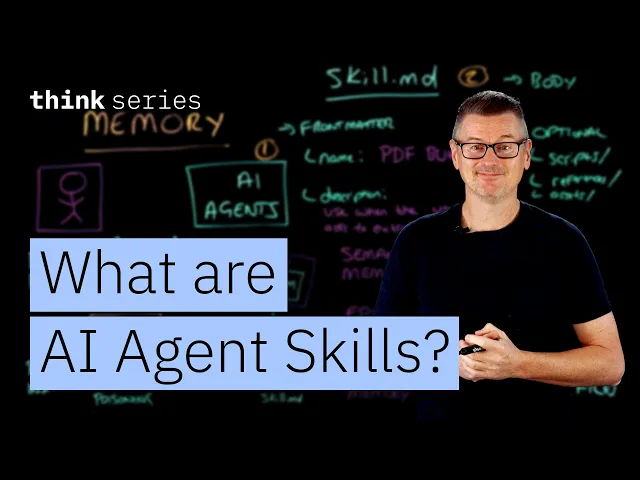
What AI Agent Skills Are and How They Work
IBM Technology
0:00 What are AI agent skills and why have they become
0:03 an open standard adopted by practically every major AI coding platform?
0:09 Well, because skills address a specific problem with agents.
0:14 Now AI agents, they're pretty good reasoners and LLMs
0:20 or large language models already know a lot of facts.
0:24 They can tell you about Kubernetes architecture or the the history
0:29 of SQL or the airspeed velocity of an unladen swallow,
0:33 that part is covered but they lack something.
0:36 They lack procedural knowledge.
0:41 The stuff that's specific to how work actually gets done,
0:47 like let's say a 47-step workflow for generating a compliant financial report.
0:57 Yeah, that would be fun.
0:59 An AI agent that is running a large language
1:04 model when it encounters a task like generating this report,
1:10 it basically has two options.
1:12 Either somebody needs to prompt it with every single step, all 47 of them,
1:18 and they need to do that every time, or worse still,
1:22 the agent is just going to take a guess at it.
1:26 Now a skill is how you actually add in that procedural knowledge
1:34 into the agent and the format of a skill is almost comically simple.
1:41 It's simply a skill.md file.
1:46 That's a markdown file in a folder.
1:50 So let me draw out what a skill actually looks like.
1:55 So at the top.
1:58 Skill.md file is some YAML front letter.
2:04 So let's have a look at what is defined in the front letter?
2:09 Well, at a minimum, there are two things.
2:13 So there is a name and there is description.
2:21 These are the two mandatory fields.
2:24 Now the name identifies the skill, the description that tells the agent what
2:31 this skill does and when it should be used.
2:35 Now this description is pretty important because it's the trigger
2:41 condition that tells agent exactly when this skill applies,
2:45 so maybe the skill name is PDF Builder.
2:50 And the description here that says something like,
2:53 use this when the user asks to extract a PDF.
2:57 Now there are some other fields you can
2:59 put into the front matter like author and version,
3:02 but it's name and description that are mandatory.
3:05 Now below the front mater, we also have a field.
3:12 Now these are the actual instructions.
3:16 These are the step-by-step workflows, the rules,
3:18 the examples of input and output,
3:20 whatever the agent needs to know to do the job.
3:23 And it's just written in plain markdown.
3:27 And then the skill folder can contain some optional folders as well.
3:32 So you don't have to have these, but you can add them.
3:36 One of those optional folders is the scripts.
3:42 And this has executable JavaScript or Python
3:46 or bash that the agent can actually run.
3:51 There's also a references directory that contains additional documentation
3:57 that gets loaded if the agent determines it needs it.
4:02 And finally, the other optional directory is the assets
4:07 directory that contains static resources like templates and data files.
4:12 That's what an agent skill looks like,
4:16 but agents can have lots of skills defined for them.
4:20 So what happens when there are like hundreds of these skills?
4:25 Loading all of them into the LLM context window at startup would
4:29 blow through the token budget before anyone even gets to ask a question.
4:34 So skills use something called progressive disclosure.
4:41 And progressive disclosure works in three tiers.
4:46 So tier one is metadata only, and that applies.
4:53 So at startup, the agent loads just the name and description from each skill.
4:58 So that's just a handful of tokens per skill.
5:01 So even if there are a hundred skills installed,
5:04 the overhead isn't gonna fill the context window.
5:07 And this is kind of essentially akin to a skills table of contents.
5:12 Now tier two, this relates to the full instructions.
5:17 When the agent sees a request that matches this skill's description,
5:21 it reads the complete skill.md body into context.
5:26 And this tells the agent what to do, the skill we are teaching it.
5:31 And that identification,
5:32 the matching of a given requirement for a task to the skill
5:37 available is something that happens through the LLM's own reasoning.
5:41 The model decides when it can make use of the skill,
5:45 which is why a good skill description is so important.
5:50 Then tier three, that's these optional folders here.
5:54 So these are the resources that maps
5:57 to the scripts and references and the assets folders.
6:00 And they only get loaded when a specific task actually needs them.
6:04 So the agent starts with a lightweight index of everything it can do.
6:09 That's the name and description.
6:11 It pulls in the detailed instructions when they're relevant,
6:14 the body, based on matching the trigger condition.
6:18 And it grabs resources only at the point of need.
6:21 Now skills bring a type of knowledge to agents.
6:26 There are several ways to incorporate knowledge into an agent.
6:28 So let's just briefly compare them because they handle different things.
6:34 And the first one I just want to mention is MCP.
6:39 That's Model Context Protocol.
6:42 What sort of knowledge does MCP give you?
6:45 Gives you tool access.
6:47 It gives agents the ability to call out
6:50 to external APIs and to interact with services.
6:53 MCP is about what the agent can reach,
6:57 but it doesn't tell the agent when to reach for it or what to do once it has.
7:03 So that's MCP.
7:04 Another one is RAG, Retrieval Augmented Generation,
7:10 and RAG that handles factual knowledge, so it pulls in...
7:15 Relevant chunks from our knowledge database at run time,
7:18 which is pretty handy when the agent needs to look something up.
7:22 But RAG doesn't teach an agent how to do something.
7:24 It's reference material.
7:27 What about another one?
7:28 How about fine tuning?
7:32 What can that do for us?
7:33 Well, fine tuning bakes knowledge directly into the model's weights.
7:40 Now that's something that's permanent, but it's expensive.
7:43 And if the model changes the fine-tuning has to be redone.
7:46 Now skills don't really do any of this so
7:53 what knowledge do skills bring to agents?
7:58 Well skills handle as I mentioned right up front procedural knowledge.
8:05 It's how to do things in what order and with what judgment,
8:10 and because they just files Well, they can be version control,
8:14 they could be easily updated and you can easily move them between platforms.
8:19 Now, in practice, skills will often use
8:22 some of these other forms of knowledge like, well, MCP for example.
8:27 So MCP provides the capability to invoke something externally and the skill
8:33 provides the judgment for when and how to do that.
8:37 Now, one more thing to say about skills.
8:41 Is that the skill.md format is an open standard,
8:45 and it's published at agent skills.io and that's an Apache 2.0 license project,
8:56 and it was adopted across a bunch of AI platforms
9:00 like Claude Code and OpenAI Codex and many other tools.
9:05 So a skill built for one platform works on any platform that supports this spec.
9:11 Now there's a useful way to think
9:13 about skills and it comes from cognitive science.
9:16 Now humans have distinct types of memory.
9:19 There's semantic memory, which are facts.
9:22 So Rome is the capital of Italy.
9:25 There's episodic memory, which are experiences.
9:29 So, uh, I went to Rome last summer.
9:33 Actually I did, and it was lovely.
9:35 Uh, and then there's procedural memory,
9:37 which are skills like how to ride a scooter
9:40 on the streets of Rome and live to tell the tale, which I also did barely.
9:47 Now agent architectures are starting to mirror this.
9:52 So semantic memory, that maps pretty closely to retrieval,
9:59 augmented generation and knowledge bases.
10:02 Episodic memory.
10:03 Well, that really maps to conversational.
10:08 Logs and interaction history and procedural memory.
10:12 Well, yep, that maps quite nicely to skill files.
10:20 Now, one thing that does need mentioning is that skills can include
10:28 executable scripts with access to file
10:32 systems and environment variables and API keys.
10:37 That's what makes them powerful, but it's also what makes trust so important.
10:45 Because when an agent runs one of these scripts,
10:50 it's typically executing commands locally on your machine and audits have
10:55 found publicly available skills frequently
10:58 contain bad stuff like prompt injection,
11:03 bad stuff like tool poisoning, bad stuff like hidden malware.
11:10 Basically the usual suspects for any open ecosystem.
11:13 So, so treat skill installation the way
11:16 that any responsible team treats installing any software dependency,
11:21 which is to say, review it and understand what
11:25 it does before using it on your local machine.
11:28 So, So where does this leave us?
11:30 Well, skills are procedural memory for AI agents.
11:34 They're defined in a markdown file that lives in a folder
11:38 that teaches an agent how to do a specific job.
11:42 Skills are conditionally triggered and they load efficiently through
11:48 progressive disclosure and the format is an open standard.
11:52 So an agent that already knows the airspeed velocity of an unlaid and swallow,
11:58 African and European,
11:59 can now also learn how to perform any repeatable task you define for it.
12:05 So that's AI agent skills.
12:07 If you're using them, let me know in the comments.