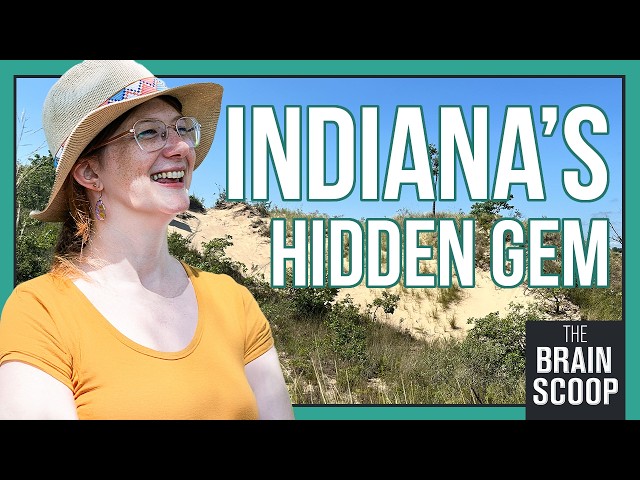
Why these beaches near Chicago almost disappeared
thebrainscoop
0:01 So I have lived in the Chicago area for more than ten years at this point,
0:05 and I am a little embarrassed to admit that even
0:07 though it's only about 45 minutes outside of the city,
0:11 Indiana Dunes state park and national parks are
0:14 not places I've really been to that much.
0:16 And I think partially it's because I don't really know what's here.
0:19 I mean, I know there's sand, I know there are dunes,
0:23 but beyond that, I have so many questions about
0:26 these grasses and the other plants and the birds.
0:29 And there is somebody right up ahead that will have the answers.
0:33 I just gotta hike through the sand, and it's so hard.
0:35 Indiana Dunes State Park is located along Lake Michigan,
0:39 about 47 miles southeast of Chicago.
0:41 Founded in 1925, the state park is surrounded by Indiana Dunes National Park,
0:47 which grew from being a national lake shore in 1966 to a national park in 2019.
0:53 It's a whole thing we'll get into later, but for now,
0:55 I'm headed to the beach to meet with national park ranger and dune doctor,
1:00 Erin Argyilan, to learn more about how this dynamic landscape came to be.
1:04 You went to school for geology, for dune science.
1:07 You're interested in trying to figure out what is happening
1:09 here at the park from kind of a scientific background.
1:12 I actually went to graduate school to study the Great
1:16 Lakes and more specifically what we call coastal geomorphology— so
1:20 how are the land forms and the landscapes along the Great
1:24 Lakes actually formed in response to changes in lake level.
1:27 So this is like a perfect place for you to be.
1:30 You are actually working in a living laboratory.
1:32 I'm living the dream.
1:34 And that's cool from like a geologic standpoint.
1:36 'cause when you think about— when I think about geology,
1:38 we're talking about things happening thousands
1:41 and thousands if not millions of years ago.
1:43 But we're on the shoreline watching geology happen here.
1:47 Every day.
1:47 Every day, the landscape is being made,
1:50 it's being eroded, it's being changed every day, every minute.
1:54 And then here at Indiana Dunes National Park,
1:58 our geologic history sort of starts with the basin
2:01 being carved out by the Laurentide Ice Sheet,
2:03 which was the continental scale glacier that covered
2:06 this area during the last Ice Ages.
2:09 But then after that glacier retreated, the meltwater filled in the basins,
2:13 and lake level has sort of changed and responded ever
2:16 since as the whole evolution of the Great Lakes took place.
2:19 (Emily) But then here today,
2:20 when we mention geology kind of happening in real time,
2:23 we are standing on would you call this a baby dune?
2:27 I'd call it a baby dune, a proto dune, something like that, yeah.
2:32 Our story is kind of starting at the beach and we're moving
2:35 further and further into the past as you move away— is that correct?
2:39 Yes.
2:39 Now, most of the Indiana Dunes is actually on landscapes
2:42 that have been forming about 4,500 years ago to present.
2:47 I mean, that's where our biggest dunes kind of are, in that age range.
2:50 And again, our shoreline is still forming
2:53 today in response to lake level and wind.
2:55 So how does the dune actually form?
2:58 There are kind of three things that you need a lot of sand,
3:01 you have to have wind, and then the other piece here that is different
3:05 from some other dune landscapes is you have to have vegetation.
3:08 (Emily) So, you have these grasses that we're standing in and around.
3:11 they're literally taking root and trapping the sand
3:14 as it's being blown up off the water?
3:16 Correct.
3:16 They have a really intricate root system.
3:18 We call them rhizomes.
3:20 And so this marram grass actually enjoys being buried.
3:24 It thrives.
3:25 They'll grow upward as they get buried,
3:27 which then stabilizes and anchors the dune sand.
3:30 Sand is pretty simple.
3:32 It's just a mineral, right?
3:33 And so once the grass comes in, it will add nutrients,
3:37 it will trap water, it will trap more sand.
3:40 And so then you'll start to develop soil.
3:43 So...
3:44 That's where dirt comes from?
3:45 That's where soil— Sorry, that's a different video,
3:49 the difference between dirt and soil.
3:50 I know, it totally is.
3:52 It's really cool because this is the basic precursor,
3:55 and then it sets the stage for the next type of vegetation that can
3:58 come in that needs conditions that are
4:00 slightly tweaked and a little bit different.
4:01 And so that's the science of ecological succession.
4:05 And that's what made Indiana dunes
4:07 such an important landscape for scientific discovery.
4:11 (newsreel narrator) Scientists have been interested in this series
4:13 of dunes because they can be dated
4:15 from 0 to 3000 years depending on how far they are away from the present beach.
4:20 [soft piano] (Erin) Sand is the key to our entire landscape here.
4:25 Bedrock is at least 80 feet below us.
4:27 Wow.
4:28 Sand, you've mentioned— sand is a mineral, but what is sand actually?
4:32 Is it just like billions of tiny rocks?
4:34 So, sand itself is just a size, okay?
4:37 So, two millimeters to a little bit smaller,
4:40 about one 16th of a millimeter is what we technically call sand.
4:43 And it can be made out of anything.
4:45 So, if you were to head down to the Caribbean,
4:47 you would have sand that's made out of coral.
4:49 You go to Hawaii and it's made out of lava.
4:51 Here in Indiana, we are again very spoiled because most
4:54 of our sand is made out of the mineral quartz.
4:58 So we have quartz, we have feldspar,
5:00 we even have some magnetic iron-rich minerals here.
5:03 It's been both a blessing and a curse to be made out of quartz.
5:07 Quartz is the mineral that's in glass,
5:09 so early on with the development of railroads and industry,
5:13 the dunes were in threat of being completely
5:15 mined away because it was such a valuable mineral,
5:17 and they're so, so pure and quartz rich.
5:20 Oh, wow.
5:21 So when we think about like habitat destruction,
5:23 you would look at sand and think maybe it's not that valuable of a resource.
5:27 Yeah, a lot of people think that, but there's a huge
5:30 aggregate industry is what we call it, rocks and sand.
5:32 Just think about all the roads that are made,
5:34 all the building materials you need.
5:35 And again, it was really popular to lay
5:37 this as part of the railroad construction.
5:40 Okay.
5:41 (Emily) The surrounding industry of Indiana plays a vital role
5:43 in both how the dunes have been altered and later
5:45 protected over the years with the national park slowly
5:49 acquiring additional land to help restore this beautiful landscape further.
5:52 Today, the dunes are home to more than 1100 species of native plants,
5:57 hundreds of birds, mammals, and other vertebrates,
6:00 and at least a thousand different kinds of insects.
6:03 To better understand how the national and state
6:05 parks collaborate together and with local industry, I met with Becky Hughes,
6:10 resource management technician for Indiana Dunes State Park.
6:13 So, we know that this area that we're in outside of Gary, Indiana,
6:16 there's a lot of industry, there's the national park, there's the state park.
6:21 How does all of that stuff fit together?
6:24 That's a really good question.
6:25 It's a big question.
6:26 First, you have the state park in the middle.
6:29 I kind of think of it like a bullseye.
6:31 And the state park was developed or established in 1925.
6:36 And the national park was not established until 1966.
6:42 If you look at a map, their land surrounds the state park.
6:45 And it's not all continuous,
6:48 but there are dunes all the way from Gary through Michigan City.
6:53 So, that's where it's like you talk about Indiana Dunes,
6:56 you're talking about a geologic formation,
6:58 but you're also talking about a lot of these other agencies,
7:01 You're you're working with sort of the same goals that the National Park is.
7:05 Absolutely, yes.
7:06 (Emily) Introduced species are a pervasive problem around the dunes with rangers
7:10 like Becky working tirelessly to mitigate their impact on the landscape.
7:14 National Park biologist Laura Brennan,
7:16 AKA the most passionate plant person I have ever met,
7:20 is another who is committed to alleviating some
7:23 of the stress those plants can cause in the dunes.
7:26 So, Laura, the ecologist here at Indiana Dunes,
7:30 invited us to go with her and her team to do some plant management,
7:35 maybe see what they do behind the scenes
7:37 to help with the conservation here at the parks.
7:41 Oh, I'm so excited.
7:42 Yeah, Laura, let's go.
7:44 Let's go look at some plants.
7:45 Let's do it.
7:46 So, what is the goal for today?
7:50 So today we are going to explore Miller Woods and get to know
7:56 some of the cool things that are growing and living out here.
8:00 I'm curious, how do invasive species— like how do they get here and how
8:06 is it that they're able to spread
8:09 so extensively and powerfully throughout the park?
8:12 Oh, a number of different ways.
8:14 Sometimes intentionally.
8:16 Some invasive species we've brought over because they taste good,
8:22 they look good, or they do something really good.
8:26 And sometimes it's unintentional, you know?
8:29 It's not uncommon for people to hop on a plane and be on one side
8:33 of the world one day and then be on the other side of the world the next day.
8:37 And maybe you took a hike and got some seed in the cleats
8:41 of your shoes or stuck to your sleeping bag or your dog.
8:46 And then next week, you're back
8:48 in your neighborhood natural area and take a hike,
8:52 and unknowingly you're introducing a non-native species.
8:56 So in Miller Woods, we say this is 1,000 acres contiguous,
9:02 high-quality Savannah, right?
9:07 But it's not really contiguous because you can see railroad tracks.
9:12 And right over there is an active steel mill.
9:15 This is an old rail bed that we're driving
9:17 on just to access what our work site today.
9:20 And we have a right-of-way bisecting this area.
9:24 There's another set of railroad tracks,
9:26 and then another set of railroad tracks that are
9:29 all punctuating this area and all those vectors.
9:32 That's another source for invasive species because they really like those edges
9:37 where they can hop on the train and travel across the country.
9:42 (Emily) Surrounding businesses are working with the park to restore the right
9:45 of way for pollinators and lessen their impact on adjacent wetlands.
9:49 So, Laura took me to see how the restoration team's efforts are paying off.
9:53 -Close your eyes.
9:54 -Okay.
9:55 (Laura) Imagine you're surrounded by a sea of hybrid cattail.
10:00 -Okay.
10:01 -And nothing else.
10:02 -That's not ideal.
10:03 -It's really not.
10:04 Oh, you can open your eyes now.
10:06 I can do the rest of the interview with my eyes closed.
10:09 That is what you would've seen here just a couple years ago.
10:13 So hybrid cattail is a non-native invasive plant species.
10:17 It's very aggressive, and in this area, that's all you would've seen.
10:21 And so our restoration team set out to restore this wetland.
10:26 And after a few years of invasive plant control, man,
10:30 were we surprised because the native plants were here in the seed bank,
10:35 and they just needed us to remove that pressure,
10:39 that stress of those invasive species.
10:41 So, even if you're not a botanist, diversity's great, right?
10:44 I mean the colors, the shapes, the textures, I like to look at it,
10:49 but if you think like you're the wildlife
10:51 out here that depends on that for their home,
10:54 for their food, for their shelter...
10:56 This is so much of a better,
10:59 rich, more sustainable environment than a single monoculture.
11:03 It's never over.
11:04 It's kind of like cleaning your house.
11:06 Like, just because you mop the floors one day doesn't mean you're not
11:09 gonna have to mop the floor again in a couple weeks or days,
11:13 depending on your situation.
11:14 -That's how that works?
11:15 -It is kind of.
11:16 Oops!
11:20 (Emily) So, we were walking and you picked this plant.
11:22 You don't normally pick the plants when you're on a nature hike.
11:24 This plant doesn't belong here.
11:26 It's a non-native invasive species called purple loosestrife.
11:31 Okay.
11:32 It's pretty.
11:33 You know, it is really pretty, but it's also very aggressive,
11:39 and it can produce, like, millions of seeds per plant.
11:45 Oh wow.
11:46 So, it's really, really good at what it does.
11:48 So, this is one species that we're actively managing,
11:52 but in kind of a different way.
11:54 Hmm.
11:56 So there is a very effective bio control agent,
11:59 a beetle actually that herbivorizes these plants.
12:05 The beetles actually eat so much of this plant
12:08 that it prevents it from flowering and producing seed.
12:10 Wow.
12:11 And so that's reducing both our time and use of chemicals.
12:17 It's not that I wouldn't say I don't care about plants,
12:20 but is it the plant blindness is a real thing, right?
12:23 Oh, for sure.
12:24 So how you as a botanist, an ecologist, what do you see when you look at this?
12:30 -Magic.
12:31 -[both laughing] (Laura) I see so many different plant species,
12:36 and even though I can't see it, I know that there's so many insects
12:40 and different birds that make their home here.
12:43 I just see abundance in life and diversity...
12:47 -Yeah.
12:48 -and magic.
12:49 -Yeah.
12:49 -This place has changed me.
12:51 Can I read you one of my favorite quotes?
12:53 Please do.
12:54 So, this is a quote from Carl Sandberg in a letter to Paul Douglas,
13:01 who was one of the founding fathers of protecting this very place.
13:06 So, Carl Sandberg wrote,
13:09 [typewriter clacking] "Those dunes are to the Midwest "what
13:12 the Grand Canyon is to Arizona "and the Yosemite to California.
13:16 "They constitute a signature of time and eternity.
13:19 Once lost, the loss would be a revocable." [typewriter
13:22 bell dings] Does that not give you the chills?
13:24 I mean, it really, it actually does give me the chills.
13:29 It's an amazing to me that you can be in Chicago,
13:33 hop on the South Shore Line, and there is a Miller Wood stop.
13:38 Like, you can get off on the train and walk here.
13:41 (Laura) You walk all the way to Lake Michigan.
13:43 (Emily) That's wild.
13:45 (Emily VO) I could happily spend the entire
13:47 day walking around the dunes with Laura,
13:49 but there was work to be done, so we headed out to meet the rest of her team.
13:54 -Claire, Emily.
13:54 -Hi, I'm Claire.
13:56 -It's nice to meet you.
13:57 -I'm a fan.
13:57 I've watched you since the Brain Scoop's first video.
14:00 Oh my God!
14:01 OG brain scoop.
14:03 Wow.
14:03 And Mike and Madeline.
14:05 (Laura) These are three of the people that are doing
14:09 actual on the ground hard work to protect this place.
14:13 In a little bit, we'll see what they're up to.
14:16 (Emily) As the crew gets to work
14:17 treating non-native species around the wetlands,
14:19 I stole Zach Lindeman to get his take on habitat conservation in the parks.
14:24 So I am considered a biological science technician,
14:28 which means that I am part of the crew that goes out
14:30 into the units of the park and gets to go and restore them.
14:34 So you're like boots on the ground, like literally...
14:36 Boots on the ground.
14:37 -Boots on the ground.
14:37 -Boots in the water.
14:38 -Yeah.
14:39 -Everywhere.
14:39 That's awesome!
14:40 And what is this contraption that you're working with?
14:43 So this is a backpack sprayer.
14:45 And one of the tools that we use
14:47 in this line of work is backpack sprayers with herbicide.
14:51 And what we do is we go around and we spray invasive species.
14:56 So you're not just taking this and indiscriminately just like,
15:00 boom, like pesticide everywhere.
15:02 No, Miller Woods and the park itself are just filled with rare species,
15:07 flora, fauna, everything.
15:09 So, everything we do, we want to do and do it carefully.
15:12 How have you seen this work change?
15:14 I've been coming to the park for probably around 12 years now,
15:18 but it has gone from areas that wetlands
15:22 that are filled with phragmites and cattail.
15:24 It's just being filled with different varieties of species.
15:28 Just to be a part of that is really, really cool.
15:30 And to go and actually do the work and to then come
15:33 back like two weeks later and see that you've made a difference,
15:37 and that the following year you might even have more success...
15:40 -That's awesome.
15:41 -Nothing better.
15:41 Is this work that you've always wanted to do?
15:45 So, actually no, I wanted to be a person working in business.
15:51 -Yeah?
15:51 -In a cubicle.
15:53 You were like, that's the life for me.
15:55 -Are you serious?
15:56 -My dream to have a cubicle, that came to fruition, and I hated it.
16:02 (Emily) Yeah, wow.
16:03 I was looking out a window at a parking lot,
16:05 and just decided that I needed to switch it up.
16:08 For me, often it feels so overwhelming this idea that you're ever going
16:12 to get a handle on the invasive species or the impacts of climate change.
16:17 It feels very exhausting.
16:19 Do you experience that at all?
16:21 Yeah, I would say like most people, I think at this point, yeah, I do.
16:26 But I do see the benefit of it, and I do feel— or you could see in areas
16:31 that maybe are not touched by our program so
16:34 much that they might not be as filled with natives
16:38 or they might have more invasive species in them.
16:41 And I just know that what we're doing is worth it.
16:44 -Yeah, it gives me chills.
16:45 -Yes, I just got them too.
16:47 I know it's the reason that we come out
16:49 and do this because you are not working alone.
16:52 You're working within the capacity of a greater vision,
16:55 not just with the national park, the state park.
16:58 You've got your partners in the industry around you.
17:01 And yeah.
17:02 I mean, that must be really gratifying.
17:04 It really gets a lot of done.
17:05 Yeah, come to Indiana Dunes!
17:07 -Woo.
17:07 -It's not just sand.
17:10 I love that.
17:11 When I moved to Chicago 11 years ago,
17:13 I said goodbye to the Great Plains of South Dakota and the majestic
17:17 mountains of Western Montana and while I still miss those places a lot,
17:21 I've come to better appreciate the complete unlikelihood of this wild landscape.
17:27 Despite a century of industry and development,
17:29 shifting values over time have allowed the Indiana Dunes to persist.
17:34 And I think that makes it a really special place worth visiting.
17:39 [upbeat music] Accessibility provided by the U.S.
17:43 Department of Education.
17:47 It still has brains on it.