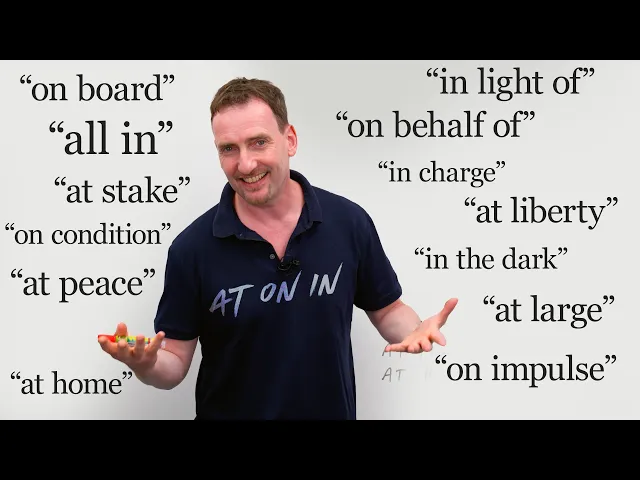
“on board”, “in charge” “at large” – English PREPOSITION COLLOCATIONS with AT, ON, IN
Adam’s English Lessons · engVid
0:00 Hi, everybody.
0:00 Welcome back to www.EngVid.com.
0:02 I'm Adam.
0:03 In today's video, I want to give you
0:06 some collocations with the prepositions "in", "on", and "at".
0:10 Now, again, just to review, what is a collocation?
0:13 This is a commonly joined grouping of words, sometimes two words,
0:18 sometimes three, that have very specific functions or meanings.
0:23 And in the case of the examples I'll show you here, most of...
0:27 Almost all of them have an idiomatic function,
0:30 meaning that the two words together mean
0:33 something different than the two words separated.
0:36 And you'll understand as I get into them.
0:39 Now, the main thing I want to get across here is
0:43 that "in", "on", "at" is not limited to talking about time or dates,
0:48 because in most English classes,
0:49 when they teach you these prepositions, that's what they focus on.
0:54 But you're going to see that they have a lot of different uses,
0:57 and I also made a previous video
0:59 explaining how to learn prepositions in collocations.
1:03 You have to study them like vocabulary,
1:05 and you can see that video, there's a link up there for that.
1:09 So, let's get started with the collocations with the preposition "in".
1:13 "All in", "in charge", "in the dark", "in light of", and "in all likelihood".
1:19 So, what does it mean to be "all in"?
1:22 So, if any of you play poker, you know,
1:24 the card game where you're betting, if you think you have a very,
1:28 very good hand, you're going to take all of your money and put it into the pot.
1:33 You're "all in".
1:34 So, we also use this expression to mean fully committed to something.
1:40 So, if you have a project at work or if you have...
1:42 Your friend wants to do something, like, exciting, like an adventure,
1:46 and they say, "Are you into it?" "Yeah, I'm all in.
1:50 I'm 100% committed to doing this thing",
1:53 or "I'm going to put 100% of my efforts into that".
1:58 "In charge".
1:59 "In charge" means having control, being the authority.
2:03 So, in most countries, the president or the prime minister or whoever
2:08 is in charge makes the major decisions, right?
2:12 In a company, the CEO is in charge.
2:15 In a classroom, in theory, the teacher is in charge of the classroom.
2:20 In some places, the students are in charge, but we won't talk about that today.
2:25 So, to be in charge, to be in control, authority.
2:28 In the dark.
2:30 In the dark, if you imagine being in a dark place,
2:33 you don't really know what's going on, right?
2:35 Because you can't see anything.
2:37 So, that's what this expression means.
2:38 To be in the dark means to not know, or somebody's keeping a secret from you,
2:44 or any situation like that, where you're not
2:46 aware of what's going on, what people are doing, what people are thinking, etc.
2:52 And then you have "in light of", which is
2:55 not related or not opposite to "in the dark".
2:58 "In light of" means knowing what we know now,
3:02 and then whatever the result or the next action will be.
3:06 So, you'll hear this a lot, like, for example, in legal cases.
3:10 "In light of the evidence, we believe that this person committed murder."
3:16 "In light of"- because we can't see it, right?
3:19 So, it's not like a secret, here,
3:21 but it's based on information that you have, in light of this information.
3:27 "In all likelihood" basically means probably, right?
3:32 That's all it means.
3:33 In all likelihood, something will happen,
3:35 means there's a very good chance it will happen, it will probably happen.
3:40 So, there you go.
3:40 So, all of these collocations with "in" have nothing to do with time,
3:45 or date, or place, so make sure
3:48 you understand them as individual vocabulary units.
3:52 That's the easiest way to think about this.
3:54 A few with "on" and "off"...
3:56 With "on", sorry.
3:58 We're going to start with "on" and "off".
3:59 And you notice I have the hyphens, because these are all working together.
4:04 So, some...
4:05 Like, my friend comes to visit me on and off whenever he's in town.
4:09 Sometimes "yes", sometimes "no".
4:11 If a machine is working on and off,
4:13 it means sometimes it just turns off, sometimes it turns on.
4:17 So, the light...
4:17 The lights sometimes are on and off.
4:20 Sometimes they're on, sometimes they're off, so basically not regular.
4:25 "On board", so, of course, I am writing "on the board",
4:29 but that's a completely different collocation.
4:33 "On board" means you've joined something or you agree with something.
4:37 So, we have a company meeting, and I say, "Okay, this is what we plan to do,
4:43 and I hope all of you are on board with this plan.
4:46 I hope all of you are willing to participate and agree with this plan." Right?
4:52 And it doesn't have to be business situations;
4:55 you're on board with anything that needs some sort of agreement
4:58 or a group decision to work together and do something.
5:03 "On behalf of", this is a very common expression.
5:06 "On behalf of" means for somebody else.
5:10 So, if I...
5:12 If I decide to represent my school at a conference,
5:16 I speak on behalf of my colleagues.
5:20 Instead of each teacher or each person working there saying something,
5:24 one person will speak for everybody.
5:27 So, one person will speak on behalf of the whole group.
5:34 "On condition", I will help you on condition that you...
5:39 Or on one condition, or on two conditions.
5:42 Basically, "on condition" means there's something else that needs
5:45 to be done for me to do something else.
5:48 Right?
5:49 So, if you want me to help you study for the IELTS exam,
5:53 I will do it on condition that you do
5:56 your homework and do everything that I ask you to do.
5:58 If you're not going to work hard, I'm not going to help you.
6:02 So, that's the condition.
6:04 "On impulse", now, I don't know about you,
6:07 but sometimes I go to the store and I...
6:10 You know, I'm buying my groceries, like bread, and meat,
6:13 and vegetables, and whatnot, and sometimes I'll purchase a snack on impulse.
6:17 On impulse means without thinking about it before.
6:20 It's a sudden decision to do something.
6:23 That's the impulse.
6:25 So, an action taken on impulse is
6:27 one that wasn't planned or thought about before.
6:30 Now, we have a few with "at", starting with "at large".
6:36 So, "at large" means generally.
6:40 So, for example, using less plastic helps the entire society,
6:45 or helps society at large.
6:48 Generally, everybody.
6:50 That's what it means.
6:51 Another use of this is that "at large" means a little bit like "free".
6:59 So, a prisoner escaped from jail, and now he's at large.
7:04 The police are looking for him.
7:06 So, "at large" means he's...
7:07 We don't know where he is, he's free somewhere, and we need to capture him.
7:12 So, that's another expression, use.
7:15 "At stake".
7:16 "At stake" means at risk of being lost, or damaged, or whatever.
7:22 So, something is at stake means you can lose it,
7:26 you can damage it, it can do something to you.
7:31 So, for example, if I invest in the stock market,
7:34 and I put $1,000 in the stock market, what is at stake is that $1,000.
7:40 I can lose it if my investments go bad.
7:42 So, anytime you do something,
7:44 you have to consider what is at stake, what is at risk.
7:48 And "at risk" is a synonym to this you can use as well.
7:53 "At liberty" means free to do or say, or have permission to do or say.
8:00 So, let's say I'm the lawyer of a criminal, and the media,
8:03 the reporters come to me and say, "What's going on in the court?
8:07 What do you think is going to happen next?" And I can say,
8:11 "I'm not at liberty to discuss the trial.
8:13 I'm not free to, I don't have permission
8:15 from the judge to say what's happening here." Right?
8:18 So, "liberty" basically means freedom.
8:21 So, "at liberty", "at freedom", "permission".
8:25 "At peace".
8:26 A couple of things to...
8:28 A couple of ways to use this expression.
8:30 If you're at peace, generally speaking, you're comfortable,
8:33 you don't have any worries, you're okay with your situation.
8:38 If you make a decision and you're at peace with that decision,
8:42 it means you're comfortable with it, you don't have any doubts.
8:46 We often use this when we...
8:48 When somebody also died.
8:49 So, somebody died, we say, "Rest in peace", but we hope this person is at peace.
8:56 I mean, or he died at peace,
8:58 without any worries, without any regrets, or anything like that.
9:02 "At home".
9:03 So, there's the literal meaning, which is "at home",
9:06 like at your house or apartment or wherever,
9:08 but if you're at home, if you feel at home,
9:12 you're very comfortable wherever you are or with whatever you're doing.
9:16 You can also say "at home with".
9:19 "I'm at home with this decision" means I'm comfortable with it,
9:22 I feel that it's the right thing to do.
9:25 If somebody comes to my house, I say, "Make yourself at home.
9:30 Feel like it's your house.
9:31 Do whatever you want.
9:32 Don't worry about trying to be polite
9:35 or clean up after yourself or whatever." I mean,
9:37 it's nice if you do, but if you're dirty in your house,
9:41 be a little bit dirty here, that's okay, too.
9:43 So, comfortable.
9:45 Now, this is just a small sample of all the different
9:48 types of collocations you can have with "in", "on", and "at".
9:53 And if you want to see a bunch more,
9:55 you can also go to my website, www.writetotop.com.
9:59 I have a few videos on this, and there's a book coming out soon
10:04 full of all these collocations that you can purchase on my website as well.
10:09 Now, if you have any questions about any of this, please
10:12 go to www.EngVid.com and ask in the quiz section, in the comment section,
10:16 and there's a quiz you can test
10:18 out your knowledge of these particular collocations.
10:23 And if you like the video,
10:24 don't forget to give me a like and subscribe to the channel,
10:27 and come back next time.
10:28 I'll give you some more useful expressions
10:30 and tips to speak like a native speaker.
10:33 Okay?
10:34 Until then, bye-bye.