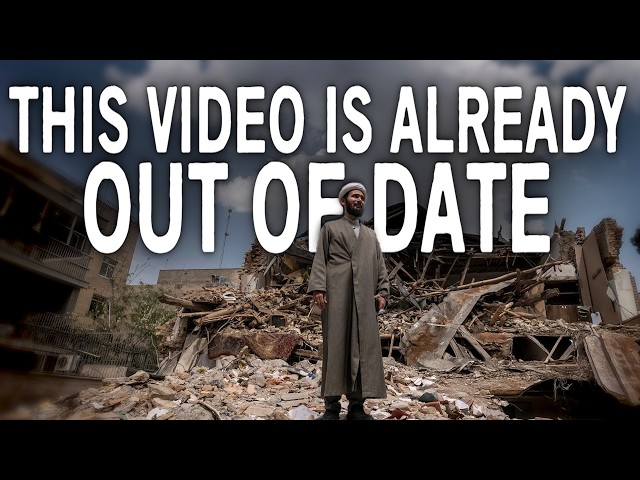
Why We (Probably) Shouldn't Give Iran $300 Billion Dollars
How Money Works
0:00 Early last week with the second signing of the Treaty of Versailles,
0:04 the world uh presumably put an end to the conflict in Iran.
0:08 This memorandum of understanding included a 14-point checklist with conditions
0:11 with none of them being particularly favorable to average Americans.
0:14 But the one that stood out most was an allocation for at least $300 billion
0:19 to be paid by the US and its regional partners for the reconstruction of Iran.
0:25 Now, assuming that our unnamed regional partners
0:28 can't be convinced to pay for our mistakes,
0:30 this would work out to almost $2,000 for every current American taxpayer,
0:33 which has a lot of people raising a lot of very valid questions.
0:37 Chief amongst which is where could all of this money possibly be going.
0:42 For context, the Marshall Plan that rebuilt the entirety of Western Europe after
0:46 the Second World War cost America
0:48 around $150 billion when adjusted for inflation.
0:51 Back then, that was enough money to restore the economies of 16
0:55 countries after 6 years of the most devastating war in human history.
0:59 Today, we are supposedly going to be putting up twice that amount to a single
1:04 country after less than 6 months of what
1:07 was technically never a war to begin with.
1:09 Additionally, unlike the Marshall Plan, Iran is unlikely to become an ally,
1:13 raising other questions about the less savory
1:15 operations that this money might end up financing.
1:18 It sounds bad, but to be fair, the big flashy headlines have either
1:22 maliciously or incompetently misguided most people
1:24 on where this money is coming from and where it is actually going.
1:28 If you take the time to do
1:30 this and understand the actual mechanics of this plan,
1:32 it actually just ends up making the whole
1:35 thing look even dumber than it already sounds.
1:37 The US and Iran signed a deal to end their war.
1:42 We're not investing any money.
1:43 We have the right to what we want, but we're not investing.
1:46 President Donald Trump said the Straight of Hormuz
1:48 will reopen when the memorandum is signed this Friday.
1:50 What What do you make of of this of the idea of just even
1:54 allowing for such a vast amount of money to be poured into this country?
1:57 Iran is forcing some oil tankers to pay millions of dollars.
2:01 The shipping route once again a tension point in negotiations
2:04 as the fighting in Lebanon threatens to derail the deal.
2:08 So the first thing to make clear is that according
2:10 to tallies from most major news outlets following this issue,
2:13 this is the 38th peace deal to be announced over the last 4 months.
2:17 So the reality is we have absolutely no way
2:19 of knowing if this will play out as intended.
2:22 And only once there is a mutually beneficial status quo established is
2:25 this latest agreement worth anything more than the fancy paper it is printed on.
2:30 But assuming this whole thing actually does go ahead as intended,
2:33 it's important to actually read the words
2:36 of this agreement because they theoretically should have some meaning.
2:39 The actual wording of the section of the released is the US and regional
2:44 partners will develop a reconstruction plan
2:46 for Iran worth at least $300 billion.
2:49 Now, right off the bat, at least is doing a lot of heavy lifting
2:53 in that sentence because what $300 billion actually means in this context
2:57 is less a price tag and more of a marketing
2:59 figure for a deal that hasn't been constructed yet.
3:01 It also means that theoretically $300 billion is the minimum amount
3:05 of money that will be flowing into Iran as part of this agreement.
3:09 To put that number in perspective,
3:11 Iran's entire GDP before the war was around well $300 billion.
3:15 So this plan is proposing an investment commitment
3:18 worth more than the country's total annual economic
3:20 output into a country whose economy was actively
3:23 collapsing even before any damage from this conflict.
3:26 The letter itself is also just a framework.
3:29 A memorandum of understanding is by definition non-binding.
3:33 Either side can walk away until a final
3:35 agreement is reached within the 60-day negotiation window,
3:38 which is basically just a polite way
3:39 of saying the deal doesn't really exist yet.
3:42 And that 60-day window is extendable with mutual consent,
3:44 which if you have been following any of the other 37 deals,
3:48 may not fill you with confidence.
3:50 But all right, let's assume for a moment that everyone keeps
3:53 their word and this deal actually goes ahead as written out here.
3:56 If that is actually the case, there are two things that stand out about
4:00 where this $300 billion is supposed to come from.
4:03 The first is that in theory this burden will be
4:06 shared by regional partners which
4:08 realistically means countries like Saudi Arabia,
4:10 the UAE, Qatar, Kuwait, Bahrain and Oman.
4:13 They are however not co-signers of this deal and it is
4:16 unclear if they were even consulted on their checkbooks being offered up.
4:20 Their economies have also been struggling partly because of this war.
4:24 The World Bank downgraded its 2026 GDP growth forecast
4:28 for the Gulf region from 4.4% to just 1.3%.
4:31 And some think tanks are now predicting that certain GCC
4:34 economies will enter recession in the second half of the year,
4:38 which is pretty impressive for countries basically
4:40 playing Sim City with infinite money hacks on.
4:42 Food prices across the Gulf have spiked
4:44 by as much as 120% since the conflict started.
4:47 And these governments are dealing
4:48 with their own domestic pressures that are going
4:50 to make throwing money at Iran a pretty hard sell to their own populations.
4:55 So yeah, that's where we're at with those regional partners.
4:58 But the second and much more important detail
5:00 in this particular clause is that it is not an agreement
5:03 for the USA or some combination of these countries
5:06 to actually hand Iran a check from public funds.
5:08 The president, for what it's worth these days,
5:11 does not actually have the power to send money
5:13 like this to another country without appropriating it through Congress.
5:15 It's in the Constitution.
5:17 Power of the purse belongs with Congress.
5:19 And as I'm making this video at least, there is not a single bill in either
5:23 chamber that allocates a dollar towards Iran's reconstruction.
5:26 So despite what the headlines might suggest,
5:29 Uncle Sam will not be cutting a check.
5:31 What this actually is is a legal loophole that will allow
5:34 private businesses to invest into Iran to finance their reconstruction efforts.
5:38 The fund even has a name now, the Reconstruction and Development Fund.
5:42 And the idea is that private companies from the US,
5:46 Gulf States, Asia, South America, and Africa would commit capital across energy,
5:50 logistics, manufacturing, petrochemicals, transport,
5:52 mining, agriculture, and tourism.
5:54 The private businesses making those investments would be allowed to sidestep
5:58 the usually incredibly strict sanctions that come from doing business with Iran.
6:02 And in return, Iran gets money to rebuild its
6:05 economy without the US government having to write a check.
6:08 In theory, that $300 billion of private loans
6:10 and investments would go towards the reconstruction of refineries,
6:14 airports, the Mubaraka steel complex, power grids, telecom's infrastructure.
6:17 Basically, everything that was either bombed during the conflict
6:20 or left to decay under decades of sanctions and under investment.
6:23 Now again, in theory, this is a win-winwin.
6:26 Iran gets money to rebuild.
6:28 The American taxpayer doesn't have to foot the bill.
6:30 And some private companies can make some money
6:32 in a market that has traditionally been off limits.
6:35 Sounds great, right?
6:36 But there is one simple problem, and that is who in their right mind would
6:40 want to make a strategic international investment into Iran.
6:44 So, it's time to learn how money works to find out where
6:47 this money is actually coming from and where it is actually going.
6:50 If you have watched this channel for any amount of time,
6:52 you already know that most companies do not actually care about your privacy.
6:56 They sell your data, they lose your data,
6:58 and they treat it like a line item on a balance sheet,
7:00 which is why this video is sponsored by Cape.
7:02 We have worked with Cape before,
7:04 and they have shipped a few new features worth catching you up on.
7:07 Cape is a privacy focused mobile carrier that gives you unlimited talk,
7:11 text, and data, plus a stack of security features no other carrier includes.
7:15 They recently rolled out IMSI rotation which
7:17 swaps the static subscriber ID your phone broadcasts every 24 hours so carriers
7:22 and advertisers cannot track you across time.
7:24 They have also launched secondary numbers,
7:26 two extra real phone lines built into your plan so you can
7:29 hand them out for banking or shopping and keep your mainline private.
7:32 And finally, disappearing call logs which autodeletees your call and text
7:36 metadata after 24 hours so there is nothing to leak or sell.
7:40 Cape normally runs $99 a month,
7:42 but right now they are honoring early adopters with a rate of $70
7:45 a month locked in for life for anyone who signs up this year.
7:49 That price stays with you as long as you are a customer.
7:52 On top of that, use code how many works
7:54 33 for 33% off your first 6 months of Cape.
7:57 Cape is available on Apple, Google Play,
7:59 and the Acrescent store with the link in my description.
8:03 Okay, so the riskreward trade-offs of investing in Iran under
8:06 these terms can only really be described as catastrophically bad.
8:10 For starters, remember that non-binding.
8:13 That 60-day negotiation window can, and let's be honest,
8:17 probably will fall apart at any point.
8:19 If the final deal falls apart,
8:20 the sanctions are back on and every dollar of private capital committed to Iran
8:25 is effectively trapped inside a country you
8:27 can no longer legally do business with.
8:29 We know this because it's literally already happened.
8:31 The JCPOA, the original Iran nuclear deal,
8:33 was supposed to open the country up to international investment.
8:37 European companies in particular started moving back in.
8:40 Total signed over $20 billion in oil and gas contracts.
8:44 Airbus had a deal to sell 100 aircraft.
8:46 Pujo reopened a factory.
8:47 Altogether, it was billions of euros in commitments.
8:50 But then when the US pulled out,
8:52 sanctions were reimposed and every one of those companies
8:55 had to abandon their investments and eat the losses.
8:57 That was a formally ratified deal backed by the UN Security Council.
9:01 The legal framework was as solid as international agreements get,
9:05 and it still wasn't enough.
9:06 This time around, we are working with a non-binding memorandum.
9:10 Speaking of sanctions snapping back, in September 2025, just nine months ago,
9:15 the UN Security Council formally re-imposed all
9:17 previous sanctions on Iran after France, Germany,
9:20 and the UK triggered the snapback mechanism,
9:22 determining that Iran had been violating
9:24 its nuclear commitments for years and had
9:26 accumulated a stockpile of highlyenriched uranium
9:29 that lacked any credible civilian justification.
9:32 So the sanctions environment right now is
9:34 actually at its most restrictive in years.
9:36 And the snapback mechanism was specifically designed so
9:39 that no single country can veto it, including America.
9:42 If any participant in the original deal triggers it,
9:45 sanctions return automatically within 30 days.
9:47 There is no appeals process.
9:49 There is no negotiation.
9:50 They just come back.
9:51 On top of that, Iran's entire banking system
9:54 is effectively cut off from the global financial network.
9:57 The major Iranian banks are sanctioned,
9:58 which means moving money in and out of the country through normal channels is uh
10:02 complicated and any private company that gets it
10:05 wrong faces secondary sanctions from the US Treasury.
10:08 In a choice between doing some business
10:10 with Iran and doing some business with the USA,
10:12 the largest capital and consumer market in the world,
10:15 Iran is generally not going to be seen as worthwhile.
10:18 The idea that a non-binding memorandum of understanding
10:20 is going to provide enough legal clarity
10:22 for private companies to commit hundreds of billions
10:24 of dollars into this environment is uh optimistic.
10:27 Oh, and by the way, Iran's access to this fund
10:31 is supposed to be conditional on Tyrron dismantling its nuclear program,
10:35 eliminating its stockpiles of enriched uranium,
10:37 and accepting a stringent inspection regime.
10:39 So, as an investor, even if you were comfortable with all of the other risks,
10:43 you would also be betting that the Iranian government
10:45 is going to voluntarily give up its nuclear program,
10:48 which has historically not been a winning bet.
10:51 They agreed to limit enrichment under the JCPOA and then
10:54 blew past those limits the moment it became convenient.
10:58 By mid 2025, the International Atomic Energy Commission confirmed
11:01 Iran had accumulated enough enriched uranium for multiple nuclear weapons.
11:06 Okay.
11:06 Okay.
11:07 But let's say all of that somehow works out and the deal sticks.
11:10 You are also now investing into a country that has
11:13 a pretty well doumented history of just taking stuff.
11:17 Following the 1979 revolution,
11:19 the new government nationalized nearly every major industry in the country.
11:23 Banks, insurance companies, steel,
11:24 copper, aluminum, mining, automobile manufacturing.
11:26 All of it was seized on July 5th of that year.
11:31 Foreign joint ventures were voided overnight.
11:33 Contracts with decades left to run were
11:36 simply declared invalid by the revolutionary courts.
11:38 And if Iran decides to do it again, what exactly are investors going to do?
11:42 We've already tried using force,
11:44 and that's kind of how we got into this whole mess in the first place.
11:48 Huh.
11:48 Now, even setting aside the political risk in this riskreward analysis,
11:52 it's also worth pointing out that the reward isn't exactly that great either.
11:57 Iran's economy is not exactly uh what you'd
12:00 call a particularly attractive investment market right now.
12:03 According to the IMF, Iran's GDP is expected to contract by 6.1% this year,
12:08 and inflation is projected to hit 68.9% with food
12:11 prices already running 99% higher year-over-year as of February.
12:15 The real has depreciated by 44% year-over-year and was
12:19 already at record lows before the war even started,
12:23 trading at 1,750,000 to1 US as of late 2025.
12:28 Its oil infrastructure has been deteriorating for years,
12:31 declining reservoir productivity, aging equipment being cannibalized for parts,
12:34 and virtually no investment in enhanced recovery.
12:36 And this was all before a war further damaged it.
12:40 Even if that infrastructure is fully rebuilt,
12:42 there are still limits in place on who Iran can sell this oil to.
12:46 According to Iran International,
12:47 86% of the tankers transporting Iranian oil over the past
12:50 year have themselves been sanctioned by the United States.
12:53 And Iranian crude is currently priced about
12:55 $11 to $12 per barrel below comparable benchmarks,
12:58 significantly cutting into Tyrron's net revenue.
13:01 Even outside of fossil fuels,
13:03 the local market is dominated by government-controlled businesses,
13:05 limiting opportunities to generate returns inside the domestic economy.
13:09 Allowing investors to put money into Iran is kind of like the government
13:12 giving investors the green light to invest
13:14 in Logan Paul's latest crypto project.
13:16 I mean, it's technically nice that you're allowed,
13:19 but history would suggest it's probably not a good idea.
13:22 Now, I realize that might sound like I'm being overly harsh,
13:25 and look, every emerging market comes with risk.
13:28 That's literally why the returns are supposed to be higher.
13:31 Investors take calculated bets on unstable countries all the time.
13:34 But the difference here is that in a normal emerging market investment,
13:37 you have some kind of legal framework to protect your capital.
13:41 Bilateral investment treaties, world bank arbitration, or international courts.
13:44 In Iran, under the current sanctions regime,
13:47 most of those protections either don't apply or can't be enforced.
13:50 You'd be investing with essentially zero legal recourse if something goes wrong.
13:54 And it's not like reconstruction investments have a great track record to begin
13:57 with, even when the US has far more control over how the money is spent.
14:01 In Iraq, the US put over $60 billion into reconstruction grants.
14:05 The special inspector general found that at least $8 billion was outright
14:09 wasted and another 10% of the total couldn't be accounted for at all.
14:13 The whole thing resulted in 87 fraud indictments.
14:15 In Afghanistan, it was worse.
14:17 $144 billion spent over 20 years with somewhere
14:20 between 26 and $29 billion wasted on ghost schools,
14:24 ghost teachers, ghost police forces,
14:25 and buildings that collapsed almost immediately after they were built.
14:28 And those were countries where the US had boots on the ground.
14:32 An inspector general's office running constant audits and at least
14:35 some degree of political alignment with the reconstruction goals.
14:38 In Iran, you would have none of that.
14:40 private capital going into a country with no friendly military presence,
14:44 no oversight infrastructure, a hostile government,
14:46 and a legal system that has historically treated
14:48 foreign assets as, to put it generously, negotiable.
14:51 And remember, those were also situations where the US government
14:55 was spending its own money with inspectors reporting to Congress.
14:58 This deal is asking private companies to take
15:01 that risk with shareholders money and even less oversight.
15:04 But okay, fine, fine, fine, fine.
15:06 Let's play devil's advocate.
15:07 Anyway, the one piece of good news is that the structure
15:10 to do these deals is kind of already in place.
15:13 Say you wanted to invest $100 million into Iran.
15:16 What you would typically do is commit that money to an offshore
15:20 specialurpose vehicle or SPV that you control in a neutral jurisdiction.
15:24 Typically, an accommodating financial city like Dubai, Hong Kong, or Geneva.
15:28 That SPV then spends the $100 million offshore,
15:31 paying equipment makers and engineering contractors directly
15:34 to rebuild a specific revenue generating asset in Iran,
15:37 say a refinery unit or part of the Mabaraka steel complex.
15:41 Iran receives the finished asset, not a dollar of cash.
15:44 Once it's running, Iran repays in kind.
15:46 It ships an agreed volume of crude over, say, 3 years.
15:50 That oil is sold most likely to a Chinese or Indian
15:53 refiner who pays market price roughly 130 million over the term.
15:57 But instead of paying it to Iran, they pay it back to your SPV.
16:01 In this system, money never actually goes to Iran
16:04 or gets caught up in their sanctioned banking system.
16:07 Stuff goes into Iran and oil comes out.
16:10 No money.
16:10 Now on paper, that structure looks clean enough.
16:13 And it is basically how Chinese, Russian,
16:16 and Indian firms already operate in Iran.
16:18 Chinese investment through structures like these has
16:21 exceeded $15 billion over the last decade.
16:23 Although exact figures are hard to pin down
16:26 because neither side is keen on publishing them.
16:28 It's a great system to avoid handing a blank check to a hostile regime.
16:31 The problem is they can still just take the stuff.
16:34 This structure really only works these days because
16:36 most of these agreements are made between Russian, Chinese or Indian firms.
16:40 So if Iran tries to screw over these businesses,
16:43 they would be isolating themselves from one of the few friends they have left.
16:46 If Iran seized US assets or assets from western or western aligned states,
16:50 they weren't friendly to begin with.
16:52 And unless these countries are willing to go
16:54 back to war again, what can they do?
16:57 It sounds bad, but it gets worse.
16:59 There is one more inconvenient detail that makes
17:02 this structure particularly fragile for new investors.
17:04 And that is simply nobody has even figured out who is running the fund yet.
17:09 When asked how the reconstruction
17:11 and development fund would actually be administered,
17:13 the people negotiating this deal essentially said,
17:15 "We'll figure that out later." As of the time of making this video,
17:19 there is currently no oversight board,
17:21 no dispute resolution mechanism, and no independent auditor.
17:23 Okay, so with all of this in mind,
17:26 who the is actually going to put their money into this?
17:30 Realistically, probably nobody.
17:31 It's basically gambling unless the returns are astronomical.
17:34 Without any kind of government guarantee, the riskreward just isn't worth it.
17:38 No sane fiduciary is putting a pension fund or endowment into this.
17:42 And any CEO who committed shareholder capital to Iran right now would
17:46 have a very interesting conversation
17:47 with their board the moment the deal wobbles.
17:49 The compliance costs alone would be staggering.
17:51 You'd need an army of sanctions lawyers fak
17:54 advisers and political risk consultants just to get started.
17:57 This is to say nothing of the optics and potential brand damage
18:01 of gaining involved in a regime
18:02 that is still massively unpopular around the world.
18:05 At the moment, the only source was published by Reuters,
18:08 relying on the word of one unnamed individual who said that over
18:11 half of the money had already been committed by companies in South Korea,
18:15 Singapore, Malaysia, Japan, and America itself.
18:18 That is flimsy at best.
18:20 Over half of $300 billion means at least $150 billion in private
18:25 capital supposedly committed to one
18:27 of the most hostile business environments on Earth.
18:29 based on the word of one person that Reuters
18:32 won't name for a fund that doesn't have an administrator,
18:35 a legal structure, or final agreement behind it.
18:37 For context, the entire global private equity industry raised about $700
18:41 billion last year across every deal in every country on the planet.
18:45 So, the claim is that roughly a fifth of the annual
18:48 global total has already been quietly committed to Iran,
18:51 and nobody thought to write it down or put a name on it.
18:54 The one and only potential source that even makes a little bit
18:57 of sense is that the sovereign wealth funds of the Gulf States may
18:59 pay a token amount into this fund to stay on the good
19:02 side of the current American administration and just put this war to rest,
19:05 even if they understand they will almost certainly never get this money back.
19:09 It was around this time last year
19:11 that this same group was promising massive investment into America.
19:13 So really, there isn't much difference here.
19:15 For them, it could be worth it to just pay to win their way out
19:19 of a conflict that has already cost them billions
19:21 in lost revenue and destabilized their domestic food markets.
19:24 At that point, the whole thing is just a protection payment.
19:27 Now, if you want one theory as to why this whole thing seems to be rushed,
19:31 go and watch this video next to find out why we might
19:33 not be able to hide our underlying inflation problem for much longer.
19:36 And don't forget to like and subscribe to keep on learning how money works.