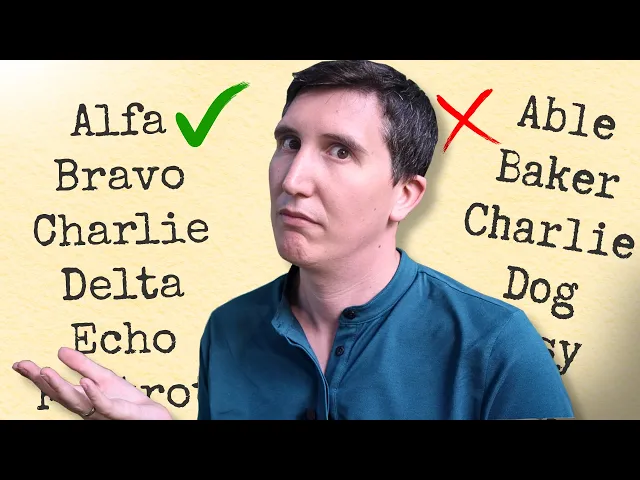
The genius logic of the NATO phonetic alphabet
RobWords
0:00 This is the NATO phonetic alphabet.
0:02 You’ve heard pilots,
0:04 soldiers and police officers use it and it is so much cleverer than you think.
0:10 These 26 words were meticulously chosen as part of a secretive
0:14 process in the wake of the second word war.
0:17 A process that you’ll struggle to find information about.
0:20 However, I’ve dug deep into the archives of NATO and beyond
0:24 to get you the full story and it is fascinating.
0:28 So let’s talk about it in another RobWords.
0:33 I'm in an aircraft hangar in the middle of a storm.
0:36 You can perhaps hear the wind rattling the doors here.
0:38 The relevance of the planes around me will become clear.
0:43 But first up, a note about the name: the NATO Phonetic Alphabet.
0:48 Two points here: one, it is not a phonetic alphabet.
0:52 This is a phonetic alphabet.
0:54 What we actually have here is a “spelling alphabet”.
0:59 It helps you spell things out clearly,
1:01 even over a dodgy phone line or a noisy radio connection.
1:05 And two: it was not invented by NATO.
1:09 I’ll get into all of that, but a lot
1:11 of people call it the NATO Phonetic Alphabet,
1:14 so let’s stick with that name for now.
1:16 Now, allow me to introduce you briefly to its 26 members,
1:20 starting with: ALFA- the first letter of the Greek alphabet,
1:23 but that's not normally how you spell it, is it?
1:26 I'll explain why.
1:27 BRAVO- an Italian word, used in lots of other languages.
1:31 CHARLIE- starts with a CH to help avoid confusion with K or even Q.
1:36 DELTA- another Greek character.
1:39 River deltas are actually so called because
1:41 the Nile delta looked like the Greek letter.
1:43 ECHO- another Greek character.
1:45 A literal one from the myth of Echo and Narcissus.
1:49 FOXTROT- chosen above FOX because it’s
1:52 the same in many languages, whereas FOX isn’t.
1:56 GOLF- the sport is generally known as “golf” everywhere.
2:00 HOTEL- a French word recognised in lots of languages, including English.
2:04 INDIA- placenames are good for these alphabets
2:07 because they don’t change much between languages,
2:09 although they can become awkward if, say, you work for an airline in India.
2:14 JULIETT- another one spelt weirdly, for reasons I'll explain.
2:18 KILO- good K words are surprisingly hard to find.
2:22 LIMA- another placename.
2:24 MIKE- people’s names often appear, for reasons that I will get into.
2:28 NOVEMBER- now, a lot of work went into choosing this one as you will see.
2:33 OSCAR- another person’s name common in lots of European languages.
2:37 PAPA- a surprisingly universal word for dad or Pope.
2:43 QUEBEC- guess where the organisation
2:45 that actually invented this alphabet was based.
2:48 ROMEO- because you can’t have Juliet without her Romeo.
2:51 There’s actually more to it than that.
2:53 SIERRA- initially an unpopular choice.
2:55 See if you can guess why?
2:57 TANGO- another dance with a universal name.
3:01 UNIFORM- replaced UNION at the last minute, donchya know.
3:04 VICTOR- a person’s name, but also a confident word for the battlefield.
3:09 WHISKEY- the drink’s known as whiskey all over the world,
3:12 even if the spelling varies.
3:14 X-RAY- try thinking of another word that begins
3:17 with an X and doesn’t make a Z sound.
3:19 YANKEE- replaced YORK used by the Brits and YOKE used by the Americans.
3:24 And ZULU- which was so very nearly ZEBRA.
3:28 So those are the words and they’ve gone unchanged for seven decades.
3:32 They were fixed in 1956.
3:34 But the story of the alphabet goes back much further.
3:37 It starts with the invention of the telephone in the 1870s,
3:41 [voice on phone] "Loser!" because with telephone
3:43 calls comes a problem that needs solving.
3:46 Early phone lines were far from crystal clear.
3:49 They’re still not, are they?
3:50 But they were even worse back then.
3:54 And this led to miscommunications.
3:56 Early telephonists found that if ever they needed to spell something out,
4:00 like someone’s name, one letter would get misheard as another.
4:04 “It’s Jacobs.
4:06 J A C O B S.” For example, D and T are hard to tell apart at the best of times.
4:12 But on a really bad line, C, D, E, G, P,
4:16 V, and Z- if you're an American- can sound similar too.
4:21 Ditto F, S, and X.
4:23 I and Y.
4:25 Q and U.
4:26 L, M and N sound alike, and A, H, J and K can be easily confused.
4:32 In 1904 the American Telephone and Telegraph Company- or AT&T to you and me,
4:38 ALPHA TANGO and TANGO– sent this advice to its employees,
4:43 pointing out that “The letters B, C, D, F, H, M, N, P ,S, T, V, X,
4:51 Y and Z are the ones which are most likely
4:56 to be misunderstood.” So how to avoid any potential mix-ups?
4:59 Well this is what the company told its staff to do about it.
5:02 For each of these tricky letters,
5:04 they should read out the preceding two letters of the alphabet as well.
5:08 You can see it here.
5:09 In 1910, Western Union Telegraph Company- or Western Union to you
5:14 and me- made the same suggestion to its telephonists, with an example.
5:18 “The name ‘Z.
5:19 Flood” should be spelled Z, X-Y-Z, F, D-E-F, L-double O-D”.
5:27 Now is it just me or is that D-E-Fing confusing?
5:31 Not to worry though.
5:33 Western Union had another suggestion for its staff.
5:35 It said misunderstandings could also be mitigated “by following
5:39 the name of a letter with some frequently used
5:42 proper name beginning with the letter in question.”
5:45 As an example it says “The word ‘Drown’...” Weird example.
5:49 “...should be spelled D for Dora,
5:53 R-O-W-N.” Now that technique is a bit more familiar, isn’t it?
5:58 But it’s not perfect, right?
6:00 Some names sound very similar to one another,
6:02 and what might be a common name to one person might not be to someone else.
6:07 There had to be a better way.
6:09 And within two years, they had one.
6:12 A clever employee, who had also worked for AT&T,
6:16 looked at the words telephonists were typically using
6:19 and compiled a standardised list for everyone to use.
6:22 And here it is.
6:24 You can see a lot of the Western Union employees
6:27 had taken to using placenames as well as people’s names:
6:30 BOSTON, CHICAGO and DENVER.
6:32 And then you’ve got some wildcards like QUEEN, X-RAY and ZERO.
6:37 But there it is.
6:39 One of the very first spelling alphabets.
6:43 I say “one of”, because away from the telecoms industry,
6:46 another sector had been developing its own spelling alphabets.
6:50 Namely, the military.
6:52 I’ll get into that in a second, but first I want to see how many
6:55 phonetic letters I can squeeze into this next bit.
6:58 Because I’ve just got back from a holiday to the states.
7:01 In fact I genuinely did fly DELTA.
7:03 I really did.
7:04 But while I was there I could surf the HOTEL wifi
7:07 like I was back home thanks to this video’s sponsor NordVPN.
7:13 NordVPN allows you to change your online location,
7:16 meaning if you’re in, say, INDIA,
7:18 you can browse like you’re in LIMA or QUEBEC and therefore
7:22 access streaming content that might be blocked where you are.
7:26 But not only that– using a VPN on unsecured public
7:29 wifi hides your IP YANKEEps you safe from online snoopers too.
7:35 NordVPN also provides a complete web protection package,
7:38 ensuring that when up against cyber criminals, you’re always the VICTOR.
7:42 Its Threat Protection Pro feature will scan any files you download for malware,
7:46 direct you away from websites known for scamming people,
7:49 and block irritating or harmful pop-ups.
7:52 BRAVO NordVPN.
7:54 MIKE drop?
7:56 I have NordVPN switched on all the time and because
7:58 I can have it on up to 10 devices, my whole family can stay protected.
8:02 Even PAPA.
8:04 To get all of these advantages too,
8:06 be smarTANGO to nordvpn.com/robwordsvpn that’s nordvpn.com/robwordsvpn.
8:14 Is there an ECHO?
8:15 Or use the link in the description of this video
8:17 to get an exclusive deal with an extra four months on top.
8:22 NOVEMBER is a month.
8:23 There’s a 30-day money back guarantee, so there’s not a KILO of risk.
8:28 Give it a go.....lf.
8:29 GO-.
8:31 GOLF.
8:33 Where were we?
8:34 So the civil telecoms industry is experimenting with spelling alphabets.
8:39 But in the meantime- never to be out-manoeuvred- armed forces
8:43 either side of the Atlantic have also been creating them.
8:47 The US navy had one for identifying flag signals.
8:51 And by the onset of the First World War in 1914, the Brits had theirs too.
8:56 The British Army was communicating using this, sort of adorable,
9:00 alphabet featuring cute couplets like MONKEY and NUTS, and ORANGE and PIP.
9:05 But also nice Britishisms like YORKER, which is a term from cricket.
9:10 By the end of the war,
9:12 the newly minted US Air Service had developed yet another alphabet,
9:15 separate from the US Navy.
9:17 Here it is in a circular from 1920.
9:20 The ABLE BOY alphabet.
9:22 A few things to point out about this one.
9:24 First: I love that they’ve used the British word for Z as their word for Z, ZED.
9:29 Second: QUACK is an excellent choice for Q.
9:32 And third: Don’t these ones look familiar?
9:37 Not a coincidence.
9:38 During the 20s and 30s, things frankly got a bit ridiculous.
9:41 By the time the Second Word War rolled around,
9:44 every armed service in Britain and the U.S.
9:47 had developed its own individual spelling alphabet.
9:50 The pilots were using one, the sailors another and the soldiers yet another.
9:54 With the onset of war, something had to change.
9:58 So in 1942, the US Army Air Forces commissioned Harvard’s Psycho-Acoustic
10:03 laboratory to come up with a single definitive list to be used,
10:07 not just by the American services, but by the Brits too.
10:11 It was to be carefully crafted using the best words
10:14 from the dozen-or-so alphabets already in military and civilian use,
10:18 along with other words they thought suitable.
10:20 They considered 2,400 words all in all.
10:25 It was a lot.
10:27 Perhaps too many.
10:28 War was raging and the need was urgent.
10:31 What’s more, squabbling between the Americans and the Brits
10:33 was getting in the way of finalising the new alphabet.
10:37 A report for the US Air Force later described
10:40 how they therefore had to rush through a compromise.
10:42 “The Generals and the Admirals went down the list taking first a U.S.
10:46 and then a UK preference to complete the list and get
10:50 on with the war.” The alphabet that resulted from the compromise was this one:
10:55 The Combined Services alphabet, also known as the ABLE BAKER alphabet.
11:02 We’re still quite a long way from ALFA, BRAVO,
11:04 CHARLIE, but we’re on our way there, aren’t we?
11:06 CHARLIE is already in place.
11:08 And so are MIKE, VICTOR and X-RAY.
11:11 And so far as the English-speaking world was concerned,
11:14 this was the best spelling alphabet available,
11:17 combining tried and tested terms with words
11:20 chosen by linguists for their clarity and distinctiveness.
11:24 And they won the war with it.
11:26 So, you know, there you go.
11:28 It is actually worth mentioning the approach the Germans took during the war,
11:31 because it was the source of a very recent controversy.
11:34 For many decades, the Germans had been using
11:36 a spelling alphabet devised for the Berlin Telephone Directory,
11:40 made up entirely of men’s and women's first names.
11:45 ANTON, BERTHA etc.
11:46 However, with the rise of the Nazis came calls to change it.
11:52 Specifically these four names here.
11:55 Why?
11:56 Well, because they were considered too Jewish.
12:00 And those calls were heeded in Berlin.
12:03 In 1934 DAVID was replaced with DORA,
12:07 NATHAN became NORDPOL– that’s "North Pole",
12:10 the birthplace of the Aryans according to Nazi pseudoscience.
12:14 SAMUEL became SIEGFRIED, and ZACHARIAS became ZEPELLIN.
12:20 These changes stuck, and they remained in place for almost 90
12:24 years until as recently as 2022, when finally,
12:29 after years of pressure from antisemitism campaigners,
12:32 das Deutsche Institut für Normung,
12:34 the German Institute for Standardisation published
12:37 a completely new official spelling alphabet.
12:41 It uses German placenames instead of people’s names, with the D.I.N.
12:44 saying “city names are very catchy and, unlike first names,
12:48 are not subject to fashion.” All very true.
12:51 However, it also specifically cited the Nazi-era purge of Jewish names
12:56 as the main driver for coming up with a new one.
13:02 Anyway, back to the Allies, And towards the end of World War II,
13:07 governments realised they'd got something else to contend
13:10 with: An imminent boom in, not military aviation, but civil aviation.
13:17 Flights aren’t just for fights.
13:20 In 1944, in Chicago, 52 nations signed a convention that would establish
13:24 an international body to oversee the skies in peacetime:
13:28 the International Civil Aviation Organization,
13:32 or ICAO, which still exists today.
13:36 And it’s this organisation, headquartered in QUEBEC,
13:39 that is the actual founder of the NATO Phonetic Alphabet.
13:44 Indeed, it’s sometimes called the ICAO Phonetic Alphabet.
13:48 But we’re still not there yet.
13:50 The first official ICAO alphabet was this one: ABLE BAKER.
13:55 They just pinched it from the armed forces.
13:57 And why not?
13:58 It had been proven to work.
14:00 Except, there was a key difference between
14:02 the needs of the British and American militaries,
14:04 and the burgeoning global aviation industry.
14:08 Many members of ICAO didn’t speak English.
14:12 Now, while in principle that didn’t necessarily matter– you don’t have to know
14:16 what BAKER or YOKE mean to use them– it did create problems.
14:20 At one point, ICAO commissioned tests to see
14:23 how foreign language speakers handled ABLE BAKER.
14:26 The researchers asked people who had never spoken a single word
14:29 of English in their lives to spell out words using this Anglo-American alphabet.
14:34 And then they noted down what that sounded like.
14:37 In one test, a Spanish participant was asked to spell
14:39 out the letters J H G using the phonetic alphabet.
14:44 And when they did so,
14:45 researchers wrote down what they heard: “HEEG, OH, HAY-OR-HAY”.
14:50 “HEEG, OH, HOY-OR-HAY”.
14:54 This was the Spanish participant’s attempt at pronouncing JIG, HOW, GEORGE.
15:01 Not ideal.
15:02 ICAO knew that an international organisation was
15:05 going to need a more international spelling alphabet.
15:08 And it also knew that to create one, it was going to need help.
15:13 Enter Professor Jean-Paul Vinay,
15:14 a respected linguist at the University of Montreal,
15:18 who was given the task of developing a completely new spelling alphabet.
15:23 And Professor Vinay was told that, to be considered,
15:26 any word had to meet five criteria:
15:29 1, “it had to be a live word in each of the three working languages” of ICAO.
15:35 So English, Spanish and French.
15:37 It had to be easily pronounced and recognized by airmen of all languages.
15:42 “It must have good radio transmission
15:44 and readability characteristics.” Whatever the heck that means.
15:47 “Have a similar spelling in at least English, French and Spanish,
15:52 and the initial letter must be the letter the word
15:55 identifies.” That seems like two points to me, but whatever.
15:58 And 5: It must be free from any association with objectionable meanings.
16:06 So basically, no naughty words.
16:07 Or words that sounded naughty in other languages.
16:11 It was a heck of a task,
16:13 but Professor Vinay did it and this is what he came up with.
16:18 Look how familiar it is.
16:20 Already we have ALFA and JULIETT with their unusual spellings.
16:23 Vinay was worried non-English or non-Ancient
16:26 Greek speakers would mispronounce the PH, not as "fun" but as "puh".
16:32 And that without the added T, the French would say JOO-LEE-AY instead of Juliet.
16:37 A lot of ancient Greek words in there,
16:39 actually, playing on Europe’s shared history.
16:41 The placenames were chosen because they are common
16:44 to many languages and don't change over time.
16:46 And we have three dances there: FOXTROT,
16:51 POLKA and TANGO, which also have universal names.
16:55 I don’t know if the weird spelling of YANKEE is intentional
16:57 or just a typo in the document I sourced it from.
17:00 But either way, this alphabet is impressive,
17:05 because it really does work in English, French and Spanish.
17:09 Well done JP.
17:10 But before putting it to use, the ICAO member states requested a few changes.
17:16 For whatever reasons, POLKA became PAPA and ZEBRA became ZULU.
17:21 And in 1952 this is the alphabet that was put into effect.
17:26 And guess what… Everybody hated it.
17:29 Especially the English-speakers did.
17:31 Those that were used to ABLE BAKER were naturally
17:33 a bit disgruntled about having to learn a new alphabet.
17:36 But they also had complaints like the ICAO
17:39 alphabet having too many syllables, for example.
17:41 Which is not an absurd thing to point out.
17:43 This new alphabet had longer words.
17:45 Only one of them, GOLF, was a single syllable,
17:48 whereas in ABLE BAKER you had DOG, FOX, HOW, JIG, KING etc.
17:55 But proponents of the ICAO alphabet pointed out that this was by design.
18:00 It made it less likely that an entire
18:02 word could be obscured by a moment of static.
18:05 You could lose FOX in a brief crackle but with FOXTROT..
18:09 Well, you’d only lose half of it, wouldn't you?
18:11 But anyway, there was enough objection in the US
18:14 and UK to make ICAO think again.
18:18 Especially as the new North Atlantic Treaty Organisation, NATO,
18:22 had shown an interest in using
18:24 the international civil aviation alphabet as well.
18:27 So they ran some tests to see if the new
18:30 alphabet really was better than the ABLE BAKER combined forces alphabet.
18:34 Because if not, what was the point of getting everyone to learn a new one?
18:38 So ICAO asked Ohio State university to compare
18:41 the two alphabets and to cut a long story short, this is what they found:
18:46 “Both foreign and American listeners
18:48 showed significantly better results in receiving
18:51 the ICAO alphabet under reception conditions
18:54 ranging from fair to very bad.” Basically,
18:57 ALFA BRAVO COCA dramatically outperformed ABLE BAKER CHARLIE.
19:02 Professor Vinay has been vinadicated.
19:05 Vinay-dicated.
19:06 However, the research had turned up some room for improvement in his alphabet.
19:11 So ICAO commissioned yet more research.
19:14 They wanted to test two things this time.
19:16 First: how generally intelligible each word was.
19:19 How easy it was to make it out.
19:21 And second: how often one of the words got confused with one of the others.
19:26 So, they tried the words out on foreign and US air personnel
19:30 and the intriguing results are in this absolute mess of a table.
19:35 On the far right you have an articulation score,
19:38 which tells you what percentage of the time a word was correctly identified.
19:41 The higher percentage, the more intelligible it was.
19:44 Then the circled numbers flag up where
19:47 a word was frequently confused with another.
19:49 So take the word for M, METRO.
19:51 It was often confused with three others: ECHO, NECTAR and EXTRA.
19:57 And you can see how that could happen, right?
19:59 Under bad conditions.
20:00 METRO ECHO NECTAR EXTRA.
20:05 So something had to change.
20:06 And given its extremely low articulation rating,
20:10 just 52.9%, ICAO decided that METRO had to go.
20:15 The study actually resulted in three changes.
20:17 COCA was also ditched,
20:18 which was good because some people thought having a brand name–
20:21 it was a reference to Coca Cola– was bad for some reason.
20:24 PEPSI, ESSO, KODAK and JELLO were all also
20:28 considered and discarded at one point or another.
20:31 And EXTRA was removed, which had the bonus impact of getting rid of the only
20:35 word that didn’t start with the letter that it represented.
20:38 In come the CHARLIE, MIKE and X-RAY that we know and love.
20:42 Further testing also resulted in FOXTROT,
20:45 UNION and ZULU being ditched in favour of FOOTBALL, UNIFORM and ZEBRA.
20:51 But yet more tests found that FOOTBALL and ZEBRA
20:54 were actually worse than the words they replaced.
20:57 So back came FOXTROT and ZULU.
21:00 Et voilà.
21:00 Here it is.
21:01 The finalised ICAO, and therefore NATO, phonetic alphabet.
21:06 Except...
21:07 hold on.
21:09 Something still isn’t right, is it?
21:11 What’s going on here?
21:12 Shouldn’t that be NOVEMBER?
21:13 Well, having apparently finished its work,
21:16 ICAO was made aware by a British research group,
21:18 that the word NECTAR was thought to be too similar to the word for V,
21:23 VICTOR– which it kind of was– and the Brits wanted it changed.
21:27 So they ran some more tests, which resulted in a shortlist of two.
21:32 NOVEMBER and… NUGGET.
21:36 We nearly had nugget.
21:37 But NOVEMBER was chosen and, finally, here we really are.
21:41 Here’s a NATO communication confirming those last changes
21:44 and confirming that as soon as ICAO approved it,
21:47 NATO too would be adopting this new spelling alphabet.
21:52 ALFA BRAVO CHARLIE DELTA ECHO FOXTROT GOLF HOTEL INDIA JULIETT KILO
21:57 LIMA MIKE NOVEMBER OSCAR PAPA QUEBEC- which was the recommended pronunciation,
22:02 by the way, not KWEBEK- ROMEO SIERRA
22:05 TANGO UNIFORM VICTOR WHISKY X-RAY YANKEE ZULU.
22:10 26 words carefully chosen to be as comprehensible as possible,
22:13 as difficult to mix up as possible, and as international as possible.
22:18 And almost 70 years later, we’re still using them.
22:22 Are they perfect?
22:23 I mean, I think they’re pretty close.
22:25 There was a last minute request to change
22:28 SIERRA because it sounded too much like ZERO,
22:30 but here’s a NATO letter telling whoever requested it to pipe down,
22:34 because changing one word would probably mean
22:35 having to change a load of others too.
22:38 The word WHISKEY also proved controversial,
22:40 particularly with some church groups, but it remains.
22:44 The NATO Phonetic Alphabet was not invented
22:47 by NATO and is not a Phonetic Alphabet.
22:50 But what it is, is an achievement.
22:53 The product of years of linguistic experimentation
22:57 and international cooperation and I think it's brilliant.
23:00 Thanks for watching.
23:01 And thanks also to the marvellous people of Derby Aero Club here
23:05 at Derby Airfield for letting me have a poke around in their hangar.
23:09 If you’ve enjoyed this, do let the YouTube bots know by hitting like
23:12 and subscribe and I’ll see you in whatever you choose to watch next.
23:17 Maybe this.
23:18 This is ROMEO WHISKEY, over and out.
23:25 [bang as Rob hits floor]