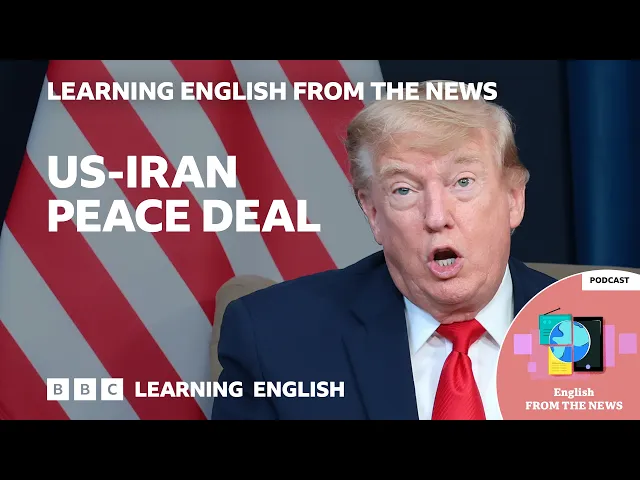
US and Iran to sign peace deal: BBC Learning English from the News
BBC Learning English
0:00 From BBC Learning English, this is Learning English from the News,
0:04 our podcast about the news headlines.
0:07 In this programme, Iran and US peace deal.
0:14 Hello, I'm Pippa.
0:15 And I'm Phil.
0:16 In this programme, we look at one big news story
0:19 and the vocabulary in the headlines that will help you understand it.
0:23 You can find all the vocabulary and headlines from this episode,
0:26 as well as a worksheet, on our website.
0:31 bbclearningenglish.com.
0:32 So, let's hear more about this story.
0:39 The US and Iran have agreed an initial
0:42 deal to end the war between their two countries.
0:45 The agreement is due to be signed by the end of this week.
0:49 It's not expected to contain many details,
0:51 but will be an agreement for 60 days of further negotiations on topics
0:56 such as Iran's nuclear weapons programme
0:59 and opening the Strait of Hormuz to ships.
1:02 During the conflict, over 3,000 people have been killed in Iran alone,
1:06 global oil prices have risen dramatically,
1:09 while the Iranian government has stayed in place.
1:12 Let's have our first headline.
1:14 This is from CNN, an American news channel.
1:17 What was it all for?
1:19 US-iran agreement brings bitter rivals full circle.
1:23 That headline again from CNN.
1:25 What was it all for?
1:28 US-Iran agreement brings bitter rivals full circle.
1:33 This article highlights the similarities between
1:35 the situation now and how things
1:37 were in April 2025 when President Trump proposed nuclear negotiations with Iran.
1:42 We're going to look at the expression full circle.
1:46 This is a metaphorical use of circle.
1:49 Picture a circle.
1:50 If you travel the full distance around the circle,
1:53 you end up back where you started.
1:56 We use this expression to talk about travelling a long way or doing
1:59 many things just to end up in the same situation as before.
2:04 It's often used to express frustration at a lack
2:07 of progress or surprise at what's happened.
2:10 For example, say you had a problem– you spent lots of money fixing your car.
2:15 It was OK for a bit but then it started having the same problem.
2:19 You could say that it's come full circle.
2:23 But full circle is not always negative.
2:25 For example, if you used to study English and now you teach others,
2:30 you could say that you've come full circle.
2:33 The idea in the headline is that after all the military action of recent months,
2:38 the US and Iran have been brought back to a similar situation to before.
2:42 They've come full circle.
2:48 We've had full circle, come back to a similar situation.
2:55 For example, she's come full circle by managing the team she used to play for.
3:05 This is Learning English from the News, our podcast about the news headlines.
3:10 Today we're talking about the proposed peace deal between the US and Iran.
3:15 When talking about what might be in the deal,
3:18 US President Donald Trump has said that Iran will never have a nuclear weapon.
3:22 Vice President JD Vance has said that Iran
3:25 will not get a cent of American money.
3:28 Meanwhile, Iran has said that as a result of the deal,
3:31 Israel will have to remove its troops from Lebanon.
3:34 Israel has insisted that they will not do this.
3:38 This leads us to our next headline and this is from ABC News,
3:42 which is based in Australia.
3:44 The spin wars about who wins and loses in the US-iran ceasefire have begun.
3:50 That headline again from ABC, an Australian broadcaster.
3:52 The spin wars about who wins and loses in the US-Iran 'ceasefire' have begun.
3:59 This headline is about the contrasting statements given by Iran and the US.
4:03 We're interested in the word spin.
4:07 This is another metaphor.
4:08 Spin literally means rotate,
4:10 but we use it metaphorically to talk about how information is presented.
4:15 Think about sports that use a ball– cricket, football, tennis.
4:20 If you throw, kick or hit a ball in a way that makes it spin.
4:24 It doesn't move in a straight line.
4:26 You make it go to one side.
4:29 Politicians, advertisers and news organisations often put
4:32 a spin on the information they give out.
4:35 They say it in a way that can influence you to think in a particular way.
4:40 If something is given a positive spin, it's reported as if it's good news.
4:45 If something is given a negative spin, it's reported as if it's bad news.
4:50 Now, we've been using it as a noun, but it can also be a verb.
4:54 The article says that both the US and Iran are trying to spin
4:58 the news to say that they are the winners from the deal.
5:05 We've had spin, present information in a way to influence how people think.
5:13 For example, the news website gave a positive
5:16 spin to the government's latest press release.
5:23 This is Learning English from the News from BBC Learning English.
5:27 We're talking about the peace deal between the US and Iran.
5:31 The deal aims to reopen the Strait of Hormuz to shipping.
5:35 This is an important route for global trade.
5:38 However, critics of President Trump have suggested
5:40 that this deal represents a failure for his strategy.
5:45 The US have not been able to change the Iranian government,
5:48 destroy the Iranian nuclear programme or prevent
5:51 Iran from launching missile strikes on US allies.
5:55 There has also been criticism in Iran where some have
5:59 suggested the deal is better for the US than for Iran.
6:03 President Trump has said in a Truth Social post
6:05 that the deal "will bring Peace and Security to the whole Region".
6:10 Let's have our next headline.
6:12 This is from Sky News.
6:14 Iran deal is tacit admission of strategic defeat by Trump administration.
6:20 And that headline again from Sky News.
6:22 Iran deal is tacit admission of strategic defeat by Trump administration.
6:28 The writer of this article is saying
6:30 that Trump's strategy in Iran has not been successful.
6:33 Remember, this is the opinion of the writer.
6:36 The word that we're going to learn is tacit.
6:40 Something that is tacit is not said directly,
6:43 but people understand that it's true.
6:46 For example, if someone pays a lot of money for a business
6:49 and then sells it six months later for less money,
6:52 it could be a tacit expression of failure.
6:55 It's tacit because they didn't say that they'd failed,
6:58 but anyone could see that it was a failure because they lost money.
7:02 The headline is saying that by signing this deal with the Iranian government,
7:06 the Trump administration is showing that they
7:08 have failed to achieve their goals in Iran.
7:11 It's a tacit admission because the US
7:13 government probably wouldn't say this explicitly,
7:16 according to the headline writer.
7:18 We can use tacit in more everyday situations.
7:21 You might have tacit agreements or understandings with the people you live with.
7:26 Maybe you take it in turns to buy food without
7:29 ever actually having said that's what you're going to do.
7:34 We've had tacit, understood without being said.
7:40 For example, everyone at the party had
7:42 a tacit understanding of what they should wear.
7:46 That's it for this episode of Learning English from the News.
7:49 We'll be back next week with another news story.
7:52 To keep up to date with our latest programmes, subscribe to our newsletter.
7:57 There's a link in the notes below this programme.
7:59 Bye for now.
8:00 Goodbye.