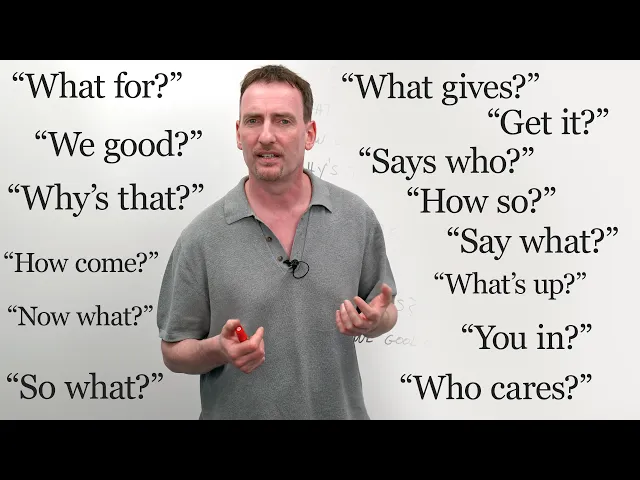
So what? We good? What gives? – Learn to respond to short English questions
Adam’s English Lessons · engVid
0:00 Hi, everybody.
0:00 Welcome to www.engvid.com.
0:01 I'm Adam.
0:03 In today's video, I want to give you some
0:05 practical help when you're dealing with native English speakers, okay?
0:10 And we're going to look at two-word questions because I've found over my...
0:15 over many years that some people, when they're given these questions,
0:19 when they hear them, they don't know how to react.
0:22 They try to build out the question and they get a little
0:27 bit confused because the questions are very short and very contextual.
0:32 Now, what does that mean?
0:34 These questions, you need to understand what is happening in the context,
0:37 what is happening around the conversation, and not worry too much about specific
0:42 words or grammar or anything like that, okay?
0:46 So, I'll give you an example.
0:47 When somebody asks you, "What for?
0:49 What for?" Basically, they're asking you why.
0:53 You asked...
0:54 You want to use something or you ask to be given something, and they'll say,
0:58 "What for?" Or they'll say,
1:01 "How come?" or "Why's that?" These three basically all work similarly.
1:06 If you want to change it into a one-word question,
1:09 it's "Why?" But they're a little bit different.
1:11 "What for?" means for what purpose?
1:12 What are you going to do with it?
1:14 "How come?" is very straightforward, "Why?
1:17 Why do you need it?
1:18 What is the reason for it?" And "Why's that?" For example,
1:22 you said you're very tired.
1:24 "Oh, why's that?" Basically, it means why are you tired, right?
1:28 So, that is just bouncing back whatever you just said.
1:32 You said something, and I'm asking you specifically
1:34 why did you say what you said, right?
1:37 So, all of them mean why,
1:39 but a slightly different use, different context of the reason.
1:45 Say what?
1:47 Say what?
1:47 Say what?
1:48 That's how somebody would answer you if
1:50 you said something that they're not really sure.
1:52 Say what?
1:53 So, either that means either please repeat what you said,
1:56 or they're just not really sure they
1:59 heard you correctly or they don't believe it.
2:01 Say what?
2:02 It all has to do with the tone, how they ask the question.
2:06 So, don't worry too much about the words.
2:08 Pay attention to how the person is asking some of these questions,
2:12 and you'll understand how you should respond to it.
2:15 And the same, like, "What's up?" I think most people know.
2:18 What is up?
2:19 Oh, there's nothing up, right?
2:21 It's just a slang expression,
2:23 means what's going on, what's happening, how are you doing sometimes.
2:26 Hey, what's up?
2:28 Hey, how are you?
2:28 Same idea, right?
2:29 So, but again, I think most people know this one, so we'll move on.
2:33 So what?
2:35 So, you tell somebody, "Oh, I just got a new job." So what?
2:40 I just got a new job last week.
2:43 Or, "Who cares?" These two basically mean the same thing.
2:47 So what or who cares means not a bit,
2:50 like, I'm not interested in what you're saying, right?
2:53 Or it's not important, or I just don't care, right?
2:57 So what?
2:58 Now, so what can also mean what's the consequence, right?
3:04 So, I just got fired.
3:07 Oh, so what?
3:08 So, what are you going to do now?
3:10 A lot of these questions are simply a real question squeezed into two
3:15 words because it's easier to just say two words than build a whole question.
3:19 So it's up to you, based on the context,
3:22 to take those two words and understand the full question.
3:26 But most commonly, so what, who cares, means I don't care.
3:30 Let's go here.
3:31 Says who, right?
3:34 So, under whose authority was this, right?
3:37 So, I say to my colleague at work, "Oh,
3:42 you have to take out the recycling today." Says who?
3:47 Like, who said that that I should listen to it?
3:49 I'm not going to listen to you,
3:51 there's got to be some authority telling you to tell me that, because I don't...
3:55 I'm not going to listen to you.
3:57 This is a little bit of an attack.
4:00 If somebody says "says who", it means they're challenging you.
4:03 They don't want to do what you ask them to do,
4:06 and they're going to say, "Yeah, show me...
4:08 The boss has to tell me to do this.
4:10 I'm not going to listen to you." Right?
4:11 It's a little bit of an attack, a little bit mean to say,
4:14 so be careful, don't say it to somebody else.
4:17 Get it?
4:18 Do you get what I'm saying here?
4:20 Do you understand?
4:21 Right?
4:21 So, if I explain something to you,
4:23 and then I look at you, and I'm like, "Get it?
4:26 Got it?
4:27 Good." Right?
4:28 So, basically, do you understand?
4:30 Okay.
4:31 Now what?
4:32 So, we finished doing something, and now we're standing around?
4:36 Now what?
4:37 So, what do we do from now?
4:40 Like, what do we do going forward?
4:42 Or basically, what is the result of whatever just happened here?
4:47 How so?
4:48 If you explain something to someone,
4:51 or you make some sort of expression of an idea, they're going to say, "How so?
4:57 How is this possible?" or "How is this true?"
5:00 or "How is this going to happen?" Right?
5:02 Basically, what they're saying, explain.
5:05 Explain what you just said, so I understand how it's real,
5:09 or etc., how it's going to happen.
5:12 Now, I'm organizing a little bit of a party,
5:15 or I'm organizing a bit of a project, and I say, "This is what I'm going to do.
5:21 You in?
5:23 You in?" Or if there's a group of people, "Who's in?
5:27 Who wants to join?" or "You in?
5:30 Do you want to join?
5:33 Do you want to become involved in this situation, this project, etc.?
5:39 You in?" But the key is that it's a very quick expression.
5:44 You in?
5:45 Make sure you understand the "you" and the "in", and then the context,
5:48 and say whether you want to join or not.
5:52 Now, this one is a bit slang.
5:54 What gives?
5:57 What gives?
5:59 Basically, "Why did you do that?" It could be one example of what this means.
6:03 What gives?
6:04 Like, "Why did you do that?
6:06 It doesn't make sense to me." It's a little bit of a surprised expression.
6:12 What gives?
6:13 "Why did you say that?
6:14 Why did you do that?
6:15 Why is this happening?" etc.
6:18 It's a little bit of a shock expression.
6:22 You good?
6:22 "You good?" So, if I say "You good?" it means "Are you okay?"
6:27 or "Do you understand what's going on?" It's a little bit like "Get it".
6:31 If I say to somebody, "We good", "We good", basically it means "Are we ready?
6:37 Are we set up?" Or if we had a bit of a misunderstanding or an argument,
6:41 and then we fixed it, everything is explained, and I say to you, "Okay.
6:46 We good?" I mean, do we have a problem between us?
6:50 That's what this question means.
6:51 Do we have a problem?
6:53 If we're good, let's continue on, forget that argument,
6:55 forget that problem, and go on with that.
6:58 Now, these are just some samples.
7:00 There are other two-word questions that you need to just
7:03 pay attention to, and don't get a little bit,
7:06 you know, embarrassed or a little bit panicky if you don't understand.
7:10 Ask for clarification, but if you want to speak to native speakers,
7:15 it doesn't matter where, like North America,
7:18 UK, Australia, anywhere in the world that has native speakers,
7:23 make sure that they're going to use these questions.
7:27 Make sure you know how to answer them and not get a little bit panicky,
7:29 and I've seen that happen a lot, so.
7:32 And another thing, sorry, don't try to expand the question.
7:36 Some of them can't be expanded.
7:38 Some of them are just squeezed, some of them are just expressions.
7:41 Answer the question as it is, and try to answer quickly and short as well.
7:46 That way, it kind of goes well together, okay?
7:50 Now, if you have any questions about this, you
7:52 can ask me in the www.engvid.com comment section.
7:55 There's also a quiz.
7:56 Make sure you take the quiz so you'll see these in a bit
7:59 of a context and get more examples
8:01 and become more comfortable with them, and yeah, practice.
8:05 Use them.
8:06 Don't be shy.
8:07 These are very common expressions.
8:09 People will understand them.
8:10 Use them as much as you can, okay?
8:13 Now, if you like this video, give me a like,
8:15 and don't forget to subscribe to my channel, and come back next time.
8:18 I'll give you some more useful tips to get along with English speakers.
8:22 See you then.
8:23 Bye-bye.