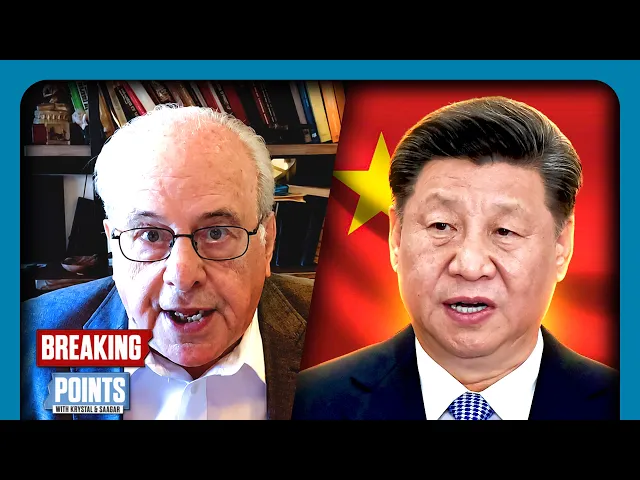
China Says SCREW YOU To US Sanctions
Breaking Points
0:00 Joining us now to talk about the global economic
0:03 impacts from the Iran war is professor Richard Wolf.
0:06 He is a professor of economics
0:07 ameritus at the University of Massachusetts Amherst.
0:10 He's also co-founder of Democracy at Work
0:12 and host of their syndicated show economic update.
0:16 Great to see you Rick.
0:17 Good to see you sir.
0:17 Thank you very much both of you.
0:19 It's a pleasure to be back.
0:20 Yeah of course.
0:21 So I wanted to start with this specific news item and then
0:24 we can sort of broaden out but this seems very noteworthy from China.
0:27 We can put E1 up on the screen.
0:29 This is from our friends over at Dropsite.
0:32 They say China invokes blocking statute for the first time.
0:35 China's Ministry of Commerce has for the first
0:37 time activated its 2021 blocking rules,
0:40 ordering all Chinese firms and individuals not to comply with US
0:43 sanctions targeting five independent Chinese oil
0:46 refineries accused of purchasing Iranian crude.
0:49 Beijing called the US measure imposed under two executive
0:52 orders an unjustified and improper use of extr territorial law.
0:56 The move puts multinational companies operating
0:59 in both markets in direct legal conflict.
1:01 Compliance with US sanctions now risks violating Chinese law and vice versa.
1:07 Global banks and firms with dollar exposure face secondary
1:10 sanctions risk if they continue dealing with the affected refineries.
1:14 So help us understand if you could
1:16 the significance of this action from the Chinese.
1:20 Well, my judgment is it's very significant.
1:23 It marks a change in the way that the Chinese are approaching
1:29 what has been the American foreign policy now for quite some years.
1:34 I would summarize describe that policy as very provocative interferences
1:41 in a way previous American governments uh have not felt entitled to do.
1:46 Uh the Trump administration prides itself
1:50 on doing what previous governments uh didn't do.
1:54 I mean, the war in Iran is a grosser example of all of that.
1:58 Uh and what the Chinese have done until now, excuse me, is tiptoe around it,
2:05 make believe they didn't know about it,
2:08 uh urge their banks and others to find evasive ways of getting around it.
2:14 Now that is most of the time enough.
2:18 Sanctions are a very crude instrument.
2:22 Uh we have been applying sanctions as a nation and the United
2:26 States does that more than any other country on earth.
2:29 Nobody else is even close.
2:31 We have been applying sanctions as as folks know on Cuba,
2:35 on North Korea, on Russia for years and years and years.
2:40 And they have found very quickly ways around it.
2:45 And so they can pretend not to notice
2:48 and get around it and no more feathers get ruffled.
2:53 What the Chinese just did in the clip that you just showed us was to say,
2:59 if you allow me to paraphrase our president, no more Mr.
3:03 Nice Guy.
3:04 We are not going to, you know, tiptoe around you.
3:07 We are simply saying to the world, no more.
3:12 We, the Chinese government,
3:14 will not permit our uh banks to be threatened in this way.
3:19 uh to be inconvenienced to be it costs a little to get around sanctions.
3:25 It's not that it's free.
3:26 It it's a it's a nuisance.
3:29 But we're not going to allow that anymore.
3:31 And we're serving notice on the whole world that this is no longer our problem.
3:38 We are not alone.
3:39 The Chinese going to figure out how to dance around Mr.
3:43 Trump.
3:44 we're, you know, throwing down a kind of gauntlet if if you will saying uh no.
3:50 And so this raises enormous questions because now the next
3:56 issue is how seriously will the Chinese government pursue any
4:05 Chinese or other entity that conforms to what the United
4:10 States wants and thereby violates what the Chinese just did.
4:15 So we'll see.
4:16 And you know, it's another one of these little not so little maneuvers
4:22 around the chessboard and we all wonder who's going to yell uncle first.
4:30 Right now I have to tell you though
4:32 as an American economist born worked here all
4:36 my life and I'm glad about that that this is
4:40 embarrassing that th this is not the way
4:44 international trade ought to be conducted and it
4:50 looks to the whole world my colleagues around
4:53 the world including many that are very friendly
4:56 to the United States it really looks like a country
5:00 that can't compete in the old ways having to do it in these ways and when you
5:08 look at it that way then the sympathy
5:11 begins to move towards China as being the victim
5:15 of this change and they're all worried that they
5:18 will be the next victim of the change
5:21 and it's shifting the whole world balance in ways
5:24 that if I were a policy maker would worry me.
5:28 Professor, let's zoom out more.
5:29 You just spoke there about China, but what does this mean generally?
5:32 You were talking there about
5:33 the international trading system, US dollar hegemony,
5:36 like the basis of the American empire has really rested on its economic might,
5:41 not just to compel countries, but to do business with a lot of these countries.
5:45 When you combine this with the current Iran situation
5:48 and the level of damage US consumers are taking,
5:50 for example, let's put the gas price up here now on the screen.
5:54 Uh we currently have it at $444 about $445 a gallon
5:59 at the national average over $6 a gallon in the state of California.
6:04 So we're punishing our own domestic economy.
6:07 We're also doing kind of like you
6:09 said embarrassing ourselves on the international front.
6:12 Some sort of new order will emerge from this.
6:14 What's that going to look like and how's that going to affect us all?
6:17 Well, things are going very very fast and they're going downhill for the dollar.
6:22 Yeah.
6:22 I don't want to be misunderstood.
6:23 The dollar is still the most important global currency,
6:28 but it is nowhere near as powerful, as dominant as it once was.
6:35 So comforting yourself by saying, well,
6:38 over 50% of the central banks of the world keep
6:42 their reserve to back up their own currency in dollars.
6:47 True enough, but it used to be 80%.
6:50 And that that is a sea change in terms of what is counted as secure.
6:57 You know, we just crossed a milestone a few
7:01 days ago when our national debt exceeds our GDP.
7:05 That's a usual warning sign.
7:08 But to whom is it a warning?
7:10 To the people who lend to the United States.
7:14 Countries, companies, banks, Americans, foreigners.
7:18 They all now have to ask a question.
7:21 Is this declining role of the dollar something that ought to make
7:27 me either stop lending to the United States the way we've been doing
7:32 for the last 30 years or lend but demand much higher interest payments
7:39 to compensate for the rising risk of the number one debtor country in the world.
7:46 And now let me add to that Iran,
7:50 the Gulf countries, the the halfozen countries out there,
7:54 Kuwait, United Arab Emirates,
7:57 all of that, they have taken a shellacking in this war.
8:02 Americans don't perhaps grasp it.
8:05 But the Iranians have been extraordinarily successful,
8:09 far beyond anything that any of us
8:13 foresaw in damaging American bases in those countries,
8:18 damaging gas and oil facilities in those countries.
8:23 Those are all key players in what's called the petro dollar system.
8:28 the the fact that for many years oil was priced in dollars,
8:33 requiring everybody anywhere in the world to have dollars,
8:37 wonderful for our country because everybody has to get their hands on dollars.
8:42 And if they have dollars and hold them,
8:45 the nicest way to hold them is to lend them to the American
8:49 government because you get interest when you hold your dollar that way.
8:53 Well, let me just give you a footnote as a as a strategist.
8:57 If the United States had had to fight the wars in Vietnam, Afghanistan, Iraq,
9:04 or anywhere else with money taxed from the American people to pay for the war,
9:11 the opposition to those wars would have
9:13 been greater than anything we can imagine, for obvious reasons.
9:18 Instead, the whole world lent us the money with which
9:25 we could fight those wars without taxing our people.
9:29 We could use the borrowed money.
9:31 And if you want to really understand
9:34 the craziness of this, the Chinese who are major
9:38 lenders to the United States because they sell
9:41 us so much stuff and get so many dollars
9:44 that they then hold as treasury securities
9:48 that the Chinese government on the other side of every
9:51 one of those wars was helping the US pay
9:55 for the war against which the Chinese were fighting.
9:59 But the craziness of our global uh economic system makes those things happen.
10:04 And right now they are happening to diminish the standing of the dollar.
10:10 And while it hasn't yet hit us, it will.
10:14 And if you want a taste of where it's going,
10:17 then you just have to look at Europe.
10:19 Europe is a kind of basket case now of where we are going.
10:24 We're not yet there.
10:26 We have advantages in this country the Europeans don't have.
10:31 But the Europeans, this morning's headlines all over Great Britain
10:35 are that the cost of living is literally out of control.
10:40 It's as if you showed those statistics you had in front of us a few moments ago,
10:45 but it covered many many more commodities uh than gasoline.
10:50 and it it together was really hurting the standard
10:55 of living of of the mass of the British people.
10:58 So let's talk a little bit about who is going to cry unclele here
11:02 because right now the Iran war is
11:04 predominantly um being engaged as economic warfare.
11:07 There are some indications this morning we may be going back to hot
11:10 kinetic warfare but as of right now um it's predominantly economic warfare.
11:14 Can put this next element up on the screen.
11:16 This is gas prices.
11:17 This is the way most Americans will interact with the war.
11:20 Um, this was from uh a little while ago.
11:22 Now the gas price is up uh a little bit more.
11:25 It's at 446 for the national average.
11:28 And so the bet from Trump is
11:30 that if they can enforce this blockade against Iran,
11:33 that's going to cretail their oil exports
11:37 that their economy is really going to struggle.
11:40 They've been fed this line that their oil wells
11:42 are going to explode and they're going to run out
11:43 of storage capacity very quickly and that it's going to be
11:45 a big problem for the Iranians and that the US,
11:49 although consumers don't want to pay these prices at the pump,
11:52 will be able to withstand the economic pressure longer and that it will
11:56 be less of a problem for the US to deal with than the Iranians.
12:00 You what can you tell us about your assessment of those dynamics?
12:04 Well, you know, it's a little bit like a problem I had teaching mathematics.
12:10 Uh the odds are that there's an immense array of possible outcomes.
12:16 I mean, the more we use our imaginations, we human beings,
12:20 the more we can foresee it could go this way, it could go that way.
12:24 And all of that's true,
12:26 but the job of the brain is to try to focus in on what are
12:30 the most likely because you can't prepare
12:33 for everything and you have to make choices.
12:36 And so you do.
12:37 And we live in a country whose leadership,
12:41 I'm talking now about the Trump people, has been systematically hostile to other
12:48 forms of energy and systematically favoring oil, fossil fuels, gas, all of that.
12:57 The problem is when you do that and you then
13:01 give to places like Iran a weapon they didn't have before,
13:08 you really can't be claiming surprise if they use the weapon.
13:14 They knew like everybody did that a quarter
13:18 of the world's oil goes through the straight of Hormuz.
13:22 They can't possibly fight the United States on a military basis.
13:27 They're an infinitely poorer country, not to mention smaller and all the rest.
13:33 So, they either have to come up with some other kind of weapon,
13:37 or they're not going to be able to to pull off anything in this situation.
13:44 They'll have to do what Mr.
13:45 Trump says.
13:46 They figured it out.
13:48 He emphasizes oil and gas and they can control effectively the price of that.
13:55 And so what we're seeing is the screaming of all
13:58 those in America who thought they had a big friend in Mr.
14:03 Trump because he tilted in their direction their kind of energy their commodity
14:09 the the uh gas burning automobile that uses it and so forth.
14:14 not imagining failure of imagination what kind of vulnerability goes
14:20 with that and they have now learned and then what is Mr.
14:25 Trump going to do?
14:26 He can't deny that he favored the very energy
14:29 source that is now being priced out of everybody's range.
14:34 He's going to tell a story about something that might happen
14:40 in the future to turn a shortage of oil into a glut.
14:46 Is that possible?
14:48 Yes.
14:49 Is that likely?
14:50 No.
14:52 No.
14:52 But if you had an, you know,
14:54 half of a brain really working at this, you wouldn't take that chance.
14:58 You wouldn't lopsidedly go to one in the hopes that it would self-correct.
15:05 And let me warn you,
15:06 if you're going to play that game, here's something to worry about.
15:11 A few days ago, the United Arab Emirates,
15:15 fourth largest source of oil that we have on this planet,
15:19 withdrew from OPEC, stopped working as it has for decades
15:25 with the Saudi Arabianrun cartel of that part of the world's oil.
15:32 Now, long story short, why?
15:35 Because they don't like being held back.
15:37 They have a lot of oil.
15:39 They don't pull it up.
15:41 They don't sell it because Saudi Arabia holds back oil from what
15:47 we could have to drive up the price because they sell that.
15:52 They're just doing what every monopolist ever did in the history of the world.
15:56 Nothing new, nothing strange, nothing exceptional.
16:00 And by the way, with the active support of the United States,
16:04 which of course doesn't say that to its own people,
16:07 because otherwise your upset at high gas prices would go
16:11 to Washington rather than to foreigners upon whom it can be locked.
16:16 What does the United Arab Emirates want?
16:19 It wants to bring up the roughly one and a half
16:22 to two million barrels of oil per day that it could bring
16:27 up but hasn't been because it has to repair the damage Iran
16:32 has done to their uh oil facilities to the American bases there.
16:38 the the damage of the missiles from Iran is very significant as it is in Israel
16:44 and we can keep pretending that it isn't
16:47 the case but the world is too small for that.
16:49 You can find it out if you do a little bit of effort.
16:52 So here's my story.
16:54 United Arabs will su Arab Emirates will succeed and they
16:59 won't be the only one and we might very well
17:03 see the glut that that clip you just showed you
17:07 know implies but that's not altogether good news either because then
17:13 the price of oil will collapse and if it does
17:17 30 $25 you know a barrel instead of what we see
17:23 now then all of the fracking in the Midwest
17:26 of this country will stop and they'll all be out of business.
17:30 And if you think that's not a problem,
17:32 you're making a mistake because all of that depends on bank loans.
17:36 They will not be able to repay them and then our banks will be in a problem.
17:42 I mean, we are we keep using up every angle
17:47 we can in this ad hoc government by by Mr.
17:53 Trump and you know it's going to come sooner or later.
17:57 He won't be able to patch it here, here, and here and then it'll blow.
18:02 But it could blow anywhere.
18:04 But at this point, the mistake was ever,
18:09 in my judgment, to overdo the dependence on on fossil fuel.
18:13 What is that about?
18:15 The whole world is going in the other direction.
18:18 We We're not the do top dog anymore.
18:21 We don't we don't run the world economy.
18:24 That's a fantasy of the second half of the 20th century.
18:28 That's not what we have anymore.
18:31 I regret it.
18:32 You regret it.
18:33 We all as Americans are are having to live with what I just said.
18:37 And that's hard.
18:38 And my heart really, it goes out to people.
18:41 But denying it is not a rational way of coping with this.
18:46 Then what you do is you get the fantasy of the British,
18:50 if they can be so unfriendly.
18:52 You know, they know that their empire is gone.
18:56 They're just playing at it.
18:58 That's why they have a king and why he visits and all the rest of it.
19:03 I I don't want to be mean.
19:05 We don't do that to our credit.
19:07 But there's a denial here that the British can no
19:11 longer or the French or they they know it's over.
19:14 we still think we are and we therefore make decisions on an assumption
19:20 basis that then comes back and whacks us and that's what we're experiencing now.
19:26 Well said, sir.
19:26 Uh we appreciate your time and your analysis.
19:28 You're always dropping knowledge bombs.
19:30 All right.
19:31 I hope so.
19:32 I hope you find it interesting
19:34 and I appreciate and I speak for many of my friends
19:37 all the work that you do on your program.
19:39 Oh, that's extremely kind to us.
19:41 Great to see you.
19:42 Yeah.
19:43 Hey, if you like that video, hit the like button or leave a comment below.
19:46 It really helps get the show to more people.
19:48 And if you'd like to get the full show ad free and in your inbox every morning,
19:52 you can sign up at breakingpoints.com.
19:54 That's right.
19:54 Get the full show.
19:55 Help support the future of independent media at breakingpoints.com.