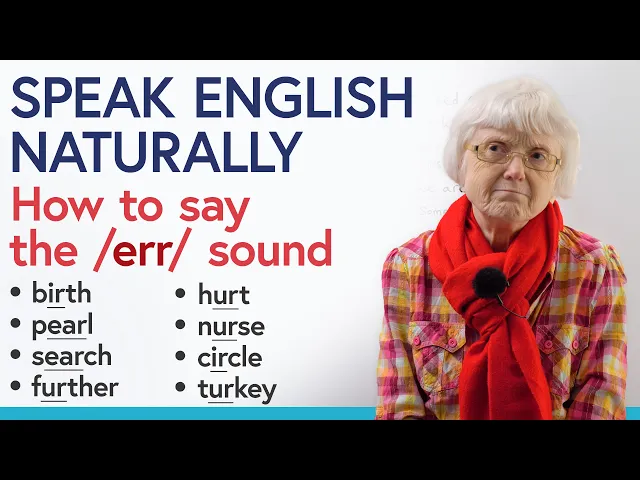
Say it correctly in English! The Confusing “ERR” Pronunciation
Learn English with Gill · engVid
0:00 Hello.
0:00 I'm Gill at engVid, and today we have a lesson on a vowel sound which is "er".
0:10 It's a typically English vowel sound,
0:14 which I think may not be in your own native language.
0:20 Of course, it depends what your native language is,
0:24 but I ask quite a lot of my students, is this sound in your language?
0:30 And they say, "Mm, no.
0:32 No, it's not." So, if that's the case,
0:35 it's a sound that you have to find out how to pronounce,
0:40 how to get your mouth in the right shape to do it.
0:45 And this is the phonetic symbol for "er", so that's the symbol.
0:52 This is my spelling of it, E-double-R, "er", although the "r" is not pronounced.
0:59 So, this is the IPA symbol, phonetic alphabet symbol.
1:04 And to make the sound, you just have to relax your jaw,
1:09 let it drop, "er, er, er".
1:13 It's quite a deep, chesty kind of voice.
1:18 You might feel your chest vibrating a little bit when you do it, "er, er, er".
1:25 If you put your hand on your upper chest,
1:29 here, you might feel some vibration, "er, er, er".
1:33 It's quite a deep sound,
1:35 so it's not a sort of more high-pitched "er, er, er" up there.
1:41 It's best to pitch it lower like that, okay?
1:45 And so, first of all,
1:47 you may not have this vowel sound in your own native language.
1:53 If you do, it's easier because you'll be used to it already.
1:58 If you don't, you have to kind of get used to it and learn
2:04 physically how to pronounce it to get used to what muscles to move,
2:10 muscle memory, okay?
2:12 So, it's "er, er, er", and you just drop your jaw very loosely,
2:19 "er, er, er", "er, er, er", like that, okay?
2:23 And the other tricky thing about this vowel sound is
2:28 that the words in English that contain this vowel sound,
2:34 they have various different spellings.
2:38 So, you could have "ear", you could have "ir",
2:45 "er", "ur", all sorts of different...
2:50 Maybe four or five different spellings.
2:56 And people try to follow the spelling when they say the word,
3:01 but you shouldn't do that.
3:02 Just remember it's "er, er", whatever the spelling, it's "er".
3:07 And the other thing to remember is ignore the "r".
3:12 That is, if you want to speak with a British English accent,
3:18 a UK English accent, the "r" is silent.
3:22 If you're speaking with an American accent,
3:26 then you would have more of an "r" sound,
3:31 so you might have "circle" or "pearl", "pearl",
3:35 and there would be a slight "r" sound in it.
3:40 But for UK English, it's just "cir", "er", "er", "circle",
3:46 and "pearl", and it's just an open vowel sound without any "r".
3:51 The "r" is in the spelling,
3:55 but it's not in the pronunciation if you want to do a UK English accent.
4:01 Okay.
4:02 So, let's just go through these examples of words containing "er",
4:07 and then we also have some sentences.
4:11 So, it's all in alphabetical order, and you can see from the first line,
4:18 we've got three different spellings, but it's all the same vowel sound.
4:23 So, we have "burn", "birth", and the man's name, "Bert".
4:30 So, they're all the same sound.
4:34 Okay?
4:35 "Burn", "birth", "Bert", if you want to repeat it after me as I go through.
4:42 Okay?
4:42 And then the next line, "curl", "curtain".
4:47 So, "curl" is when your hair is in a curl.
4:52 Okay?
4:53 And a "curtain" at the window.
4:57 Okay?
4:58 Next line, "early", "early".
5:01 So, an "early" is an aristocrat in the UK social system,
5:09 like a duke, a noble person, upper-class person, an "early".
5:17 Okay?
5:18 "Earl" and "early".
5:20 And then we have "fur" and "further".
5:24 So, "fur" that you find on a cat or a dog, their hair is called their "fur".
5:33 And "further" is...
5:34 You know the word "far" for the distance.
5:38 "Far", and then the comparative form is "further".
5:43 You will go far, but you could go further, even more far.
5:49 Okay?
5:49 But the word is "further".
5:53 Okay?
5:54 So, "fur", "further".
5:56 And then "girl", "her", "hurt".
6:02 So, "hurt" when you feel pain somewhere.
6:06 Oh, it hurts.
6:08 It hurts.
6:09 Okay?
6:10 "Learn", "merchant", "nurse", "purse", "pearl", "sir", "search", "circle".
6:26 This begins with a "s" line because of the sound.
6:38 It's "s", "circle".
6:39 It's not like "k", "curl", "curtain".
6:43 "Circle".
6:48 "Term", "turkey", "verse", "virtue", "were", "worth", "work", "word".
7:05 Okay?
7:05 So, I hope you're getting used to the sound.
7:09 And if you're saying it after me,
7:12 say it out loud and you'll get used to it that way.
7:15 Don't just think it inside your head.
7:18 You have to say it out loud to get used to how
7:21 it sounds and how it feels when you move your jaw, "er", "er", "er" like that.
7:28 Okay.
7:28 Good.
7:29 So, then we have just three sentences to practice
7:34 on, and I've underlined in red the words, words that contain the "er" sound.
7:43 So, we've got "The girl arrived early at work." So, repeat after me.
7:55 "The girl arrived early at work." Right.
8:02 Next one.
8:04 "We were searching for a nurse." Say it after me.
8:13 "We were searching for a nurse." Right.
8:20 And then, finally, "This term we are certain to learn some new words." After me.
8:35 "This term we are certain to learn some new words." Okay.
8:44 Good.
8:45 So, just to finish with, I'll go through
8:50 the list again fairly quickly so that you
8:53 can hear me say these words in a natural
8:56 way where I'm not emphasizing them too much.
9:00 And listen out, say it with me if you'd like to.
9:05 Okay.
9:06 So, here we go.
9:09 "Burn birth burnt", "curl curtain", "early early",
9:15 "fur further", "girl", "her hurt", "learn", "merchant",
9:25 "nurse", "purse pearl", "sir search circle",
9:33 "term turkey", "verse virtue", "were worth work word".
9:42 Okay?
9:43 So, it should be easy because it's a very relaxed shape.
9:51 Just drop your jaw like that, let your mouth open a little bit.
9:57 "Uh, uh, uh, uh, uh, uh", like that.
10:01 "Uh".
10:01 Okay, so I hope that's a helpful lesson.
10:06 Thank you for watching, and hope to see you again soon.
10:10 Bye for now.