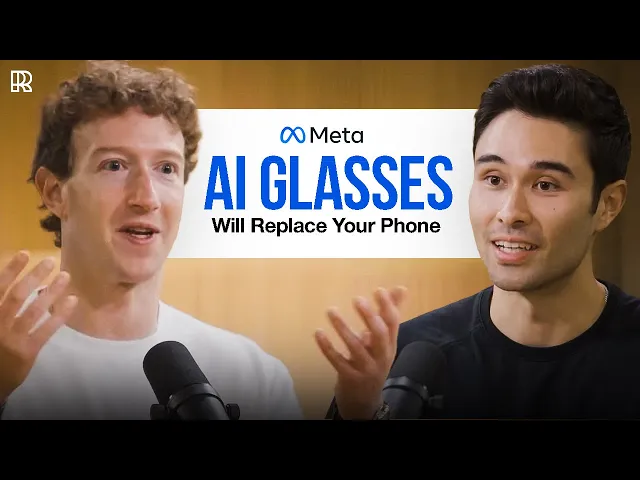
Mark Zuckerberg on AI Glasses, Superintelligence, Neural Control, and More
The Rundown AI
0:00 Somewhere between 1 and 2 billion people
0:01 in the world to have glasses for vision correction today, within 5 to 7 years.
0:05 Is there like any world where those aren't all replaced with eyeglasses?
0:09 The neural pad is going to be personalized to you over time.
0:11 It's not actually picking up motion.
0:12 It's picking up your muscles, firing.
0:14 A lot of people who are designing technology,
0:16 they make something that's kind of bulky,
0:18 and they add a bunch of core functionality to and they're like,
0:21 why don't people want to wear this?
0:22 It's kind of a mantra internally that we have,
0:24 which is this idea that AI is going
0:25 to be the most important technology in our lives.
0:27 We want to make sure that AI is in service of people,
0:29 not just like something that sits in data centers and automates stuff.
0:33 There are rumors that you're,
0:34 like personally going founder mode calling researchers.
0:37 What drove the decision for this llama for was not
0:40 on the trajectory that they thought it needed to be on, like,
0:43 why am I going out and meeting all of the top AI researchers?
0:46 It's like, well, like, I want to know who the top AI researchers are,
0:48 and I want to, like, personally have relationships with them.
0:51 I moved everyone around me who sat with me, and now the lab is there.
0:55 So, I mean, I'm pretty hands on every time
0:57 I think of what a milestone would be in AI.
0:59 They all seem to get achieved sooner than we think.
1:05 Thanks so much for being here.
1:05 Yeah.
1:06 Good to see you.
1:06 Thanks for doing this.
1:07 So today we're talking everything connect 25.
1:12 Can you give us the rundown of everything
1:14 you're announcing and what you're personally most excited for?
1:17 Yeah.
1:17 So the main things that we announced at connect were
1:21 our fall 2025 line of glasses and, you have them here.
1:27 So, so we can just start and go through them.
1:29 I mean, the first one is the next generation of Ray-Ban meta.
1:32 So that's sort of the classic eye glasses that we've shipped so far.
1:37 They're some of the most, you know,
1:40 fastest growing consumer electronics of all time.
1:42 We're very happy with that.
1:44 And a lot of the improvements that we have for these are,
1:49 you know, we doubled the battery life.
1:51 We we have three K video resolution in them now for, for capture.
1:56 And we're introducing new AI features
1:59 like this, this thing conversation focus which,
2:02 allows you if you're in a loud place,
2:05 to basically turn up the volume on friends who you're talking to.
2:08 So if you're in a restaurant or something like
2:10 that, that I think is gonna be really neat.
2:12 Then we've got this guy, which is the Oakley Meta Vanguard.
2:16 So this is our second collab, with Oakley.
2:20 It's, it's more of kind of a performance glasses.
2:24 And, these I think are really cool for a number of things.
2:28 And they're designed for, for a number of things around sports.
2:31 You've got the camera that's centered.
2:33 So that's great for alignment.
2:34 It's wider field of view, louder speakers.
2:37 They're they're water resistant.
2:39 They can, you know, just just a bunch of that, they
2:43 can connect with your Garmin watch so you can,
2:45 you know, you can be running a marathon and, and basically, you know, like,
2:51 you can tell it every mile, capture a video and then at the end,
2:54 it'll produce a video for you where it stitches them all
2:57 together and puts your stats from Garmin on top of it.
2:59 So I think that that's that's a pretty neat thing.
3:01 But I think the most interesting thing by far that we announced is this one,
3:06 which we call ribbon, meta ribbon display.
3:11 And that is because it is the first eyeglasses that we
3:15 have shipped that have a high resolution display in them.
3:19 And the other big breakthrough is that they pair with, with this guy,
3:24 the, the meta neural band, which is the first mainstream neural interface,
3:30 that we're shipping as the way to control them.
3:33 And I think that that's pretty neat.
3:35 I mean, basically every computing platform has its own new input method, right?
3:41 So when you went from computers
3:42 with the keyboard and mouse to phones with touchscreens,
3:45 you kind of got a completely new input method.
3:48 And the same, I think is going to be true
3:50 for glasses and having a neural interface where you can just,
3:53 you know, send signals from your brain with micro muscle movements like this.
3:57 I mean, this is basically about as much movement as you need to make.
4:01 And you can, you know, enter text, neurally.
4:04 just do all the, all the fun stuff that you got a chance to try out.
4:07 But but I think that this is a pretty big breakthrough.
4:09 So I'm very excited about this, but but but overall,
4:11 I mean the whole lineup is good.
4:13 So so it was a it was a fun connect.
4:15 So you had the Ray-Ban metas for kind of every day.
4:19 The Oakleys for athletes.
4:20 And then the displays now for power users.
4:23 How do all these glasses kind
4:25 of tie into that personal superintelligence vision.
4:27 Yeah.
4:27 So I mean, our theory is that glasses
4:31 are the ideal form factor for personal superintelligence,
4:33 because it's the only real device that you can have that can see what you see.
4:39 You can hear what you hear, can talk to you throughout the day and can
4:44 generate a UI in your vision in real time.
4:48 And so there are other devices that people have.
4:51 I mean, obviously you can have some AI on your phone,
4:53 you can do some AI on your watch.
4:55 You could do some of it if you just have like AirPods type type thing.
5:00 But, I think glasses are going to be the only thing that can that can do
5:06 all of the pieces that I just said kind of visual and audio in and out.
5:13 And that that I think is going to be is going to be a really big deal.
5:19 So I got to try it for this interview.
5:21 Yeah.
5:21 And I have to say, there were way more many
5:24 use cases than I initially thought there was going to be.
5:28 Like the AirPods, for example,
5:29 have the live translation, but this is live translation.
5:32 Yeah.
5:32 Yes.
5:33 The captions, there's so much more.
5:34 Yeah, the subtitles are awesome.
5:36 It's awesome.
5:37 So I'm curious, like,
5:38 what are your favorite kind of use cases that you've been using them for?
5:41 I mean, the thing that, that I really had in mind
5:46 when we were designing them for is just sending messages, right?
5:49 I mean, this is the thing that I think we do the most frequently on our phones.
5:53 I mean, I would guess that, you know,
5:54 we all are sending dozens of messages a day.
5:57 I don't really need to guess.
5:58 And we run a lot of the messaging apps that that people use.
6:01 And so I think we know that people spent sent dozens of messages a day
6:06 and, we wanted to make it so that the experience is just really great.
6:12 So now with the glasses, a friend texts you,
6:18 shows up in the corner of your eye for a few seconds.
6:21 It's off center, so it doesn't just block your view, it goes away quickly.
6:24 It's not distracting, but if you want,
6:28 you can just respond as easy as, you know, moving your finger like this.
6:33 And you know I can, right?
6:35 I mean, I'm up to like 30 words a minute typing with the neural text.
6:39 So I think this is I think this is great.
6:44 one of my kind of mental models for this is that, you know,
6:48 in-person conversations are awesome.
6:50 The one thing that I like about zoom is that you can multitask, right?
6:54 It's like if we're having a conversation and you say something,
6:57 I want to get some context,
6:59 on what you're saying or if you remind me that I should go do something or, oh,
7:04 you bring up a person and it's like, oh,
7:05 yeah, I've been meaning to reach out to that person.
7:07 Like if we're having a live conversation,
7:10 I'm not just going to do that right then and then the chances
7:13 that I'm probably actually going to forget by the end of the conversation.
7:15 I follow up on most those things on zoom now.
7:19 I kind of feel like you can just kind
7:22 of text someone off to the side and that's that's fine.
7:26 And this, I think is going to bring that to physical conversations,
7:31 to where it's like, you don't have to break your presence.
7:33 You don't have to like, you know, it's not it's not rude.
7:36 Right?
7:36 You're not like, breaking out a phone.
7:38 You're not really.
7:39 I mean, you can continue to really pay attention to the person
7:41 at just like a very quick gesture with your wrist.
7:44 And, I know I keep on having this, this, this phenomenon where there's,
7:49 like, some information I, I want to have in the middle of a conversation.
7:53 And normally otherwise,
7:53 I would have had to wait till the conversation and text or call the person
7:57 to get the information and go back to the person I was having the conversation.
8:00 Now I just get the information.
8:01 In the middle of the call.
8:02 I just text the person, information comes in and then it's like,
8:04 okay, you can have a much better and more informed conversation.
8:07 So texting I think is really going to be the big thing.
8:09 So how does a texting feature work?
8:11 I know there's like you can talk to me I but you're saying you can actually
8:15 write it down and it automatically goes
8:17 to the phone is that gets the glasses to okay.
8:20 So yeah.
8:21 Yeah.
8:21 With the neural band.
8:22 So like you just really just handwriting.
8:25 Yeah.
8:25 I mean it's you can kind of think about it
8:28 like as if you're holding a small pencil and then what,
8:32 like what motion you would make to write out certain letters.
8:37 But then what's going to happen is that the neural
8:39 band is going to be personalized to you over time.
8:42 So it's going to learn.
8:43 Okay.
8:43 How do you make W or J differently from someone else?
8:47 And it will learn and you will kind of co evolve with it to the K
8:55 to learn with the most minimal version of you making a J is or no or whatever.
9:00 And, and then the feedback loop around that will,
9:03 you'll just be able to make like increasingly subtle
9:05 movements over time where it's not actually picking up motion,
9:09 it's picking up, your muscles firing.
9:13 So over time, I think you're basically going to be
9:15 able to just move your muscles in opposition to each other.
9:19 Not even really move your hand and, and be able to send messages or control
9:24 a UI with your hand at your side in a jacket pocket behind your back.
9:28 It's not.
9:29 I mean, this isn't, it's not hand recognition.
9:33 It's not, it's not the cameras on the glasses
9:36 looking at what your hand is doing.
9:38 It's this band picking up micro signals that your brain
9:41 is sending to your muscles before they even move,
9:45 so you don't actually have to move if you just need
9:46 to, to be able to send the way to send the signals to it.
9:49 And it picks it up.
9:50 And yeah, that's so the wristband reads
9:52 the electrical signals before you even move.
9:55 Yeah.
9:55 Why is that important over.
9:57 Just like adding buttons to the glasses or like improving the voice commands.
10:01 Well, I mean, okay, for voice,
10:04 some of that, a lot of the time you're around other people.
10:08 Right?
10:08 So like, I just think that you want a way
10:11 to control your computing device that is private and discreet and subtle.
10:18 And one of the things that we thought about was,
10:20 okay, can we get whispering to work?
10:23 Because, by the way, voice does work too, right?
10:25 You can control the stuff with voice.
10:26 You can do voice dictation.
10:27 You talked about AI with voice,
10:29 but we just I just thought that there needed to be a way on top of that.
10:33 That was in voice, for for when you want to do
10:36 it more subtly and privately we could be having this conversation.
10:39 I could, you know, have the glasses on and, like, a message, it comes in and.
10:44 Okay, we're talking and I'm like, writing it and I've sent.
10:47 It's done.
10:48 I just I mean, in that time I could have
10:50 sent a ten word message and that would be fine.
10:52 That's so great.
10:53 Okay.
10:53 Then it's like, all right, now I got my response back in and okay,
10:56 here, like maybe I'm writing another response and whatever.
10:59 Yeah.
11:00 Okay.
11:00 Done.
11:01 So, I think that that's going to be I think it's gonna be awesome.
11:06 But in terms of buttons, I mean, yeah, that works too.
11:10 I mean, you can you can take a photo by by tapping the button
11:12 on any of these, you can hold it down to take a video.
11:14 You can, you know, skip to the next track with the swipe or you can,
11:18 you know, start or stop music by tapping on it.
11:21 But, but I think the point is you don't want,
11:25 you don't necessarily want that to be the only way that you could do it.
11:28 Like now with the neural band, I can also just be like,
11:33 I don't know, start and stop music with it in my hand, on my side.
11:35 It's like, all right, like, it's like it's very subtle gesture.
11:38 Like you can't even tell, right?
11:40 Yeah.
11:40 We were joking in the demo room that it's
11:43 almost like right now when you go to classes,
11:45 all the teachers are like, oh, put your phones down, they can see you.
11:48 And like, students are like just checking their phones, distracted.
11:50 But now it's going to be like, hey, like, keep your thumbs out.
11:52 Almost, because it's like, I think it'll be take your glasses off
11:55 or take your glasses off and show your thumbs.
11:57 Maybe both.
11:57 Yeah.
11:58 But, yeah.
11:59 So looking ahead, I guess, what you're saying is,
12:02 like typing and speaking might not be enough to give you enough data to I.
12:06 What you've been typing and speaking might not be enough to give.
12:10 Well now we have electrical signals.
12:12 We can also give to, to the.
12:14 Yeah.
12:14 For the UI.
12:15 Yeah.
12:15 For controlling the UI.
12:16 Do you think like, the neural band is almost like a new interface to it?
12:21 I, yeah, I mean, I think it's it's AI and it's the glasses.
12:26 I mean, there's some parts of the glasses that are like, okay,
12:28 you just have a menu of your apps and you basically can just,
12:33 like, swipe through it very subtly with your hand and it's like, okay,
12:36 now I've selected okay, now I've picked up that, you know, it's I mean,
12:40 this is basically what the interaction looks like is like effectively it's like,
12:43 okay, swipe a couple of times, I brought up the camera.
12:45 Oh, now I have a viewfinder so I can see exactly what the what the image is.
12:49 I want to zoom in.
12:50 I just turn my finger a little bit.
12:51 Actually, that's one of the coolest is when you're playing music.
12:55 The way that you change the volume is you just pretend that there's
13:01 a volume dial and you just turn your wrist and it's like,
13:06 it just feels like magic.
13:07 It's like really fun.
13:09 The way you can bring up meta AI anywhere, you just tap twice.
13:15 It's like.
13:16 But but it's like.
13:17 But I mean tiny, right?
13:19 It's like the kick be your side.
13:21 Like no one would even notice.
13:22 So.
13:22 Yeah.
13:23 No, I think it's, I think this is just
13:25 going to be by far the most intuitive way.
13:28 But if you don't have it, yeah, you can control them with voice.
13:30 You can control them with, with, with, with the buttons.
13:33 I mean, different ways to do it.
13:34 Yeah.
13:35 So it's going to be both the AI
13:36 and the, the UI of glasses and potentially over time,
13:39 other things beyond glasses.
13:40 I think that you'll be able to control with the neural band.
13:43 That's really fascinating.
13:44 Yeah.
13:44 How long did it take you to pick up the controls?
13:47 For the neural band?
13:48 Yeah, for the neural band.
13:51 Not that long.
13:52 I mean, it's pretty intuitive.
13:53 I mean, the way that you kind of think about it is, navigating.
13:57 It's kind of like a D-pad.
13:58 You kind of swipe your thumb right, left, up, down.
14:02 You bring up the, the, the menu by kind of, you know, you can tap twice.
14:07 You bring up that AI by tapping twice, you type as if you have a there.
14:11 Enter text as if you have a pencil.
14:13 The trick is that when you're learning upfront,
14:16 the motions are a little bit bigger.
14:19 And then very quickly, within a few days of using it,
14:22 you get to like very subtle movements.
14:25 and the reality is, is that a lot of the optimization
14:29 isn't going to be on our side or your side,
14:31 it's going to be the machine learning system over time,
14:34 getting personalized to you and getting better.
14:36 And, you know, it's the the times when the the neural text entry is slow.
14:44 It's because I make a mistake and the autocorrect doesn't fix it.
14:47 So now I have to go back manually and re enter the text.
14:51 But yeah, I mean this is just like standard machine learning stuff
14:54 as this just gets better and better and learns your patterns better,
14:57 that just it's gonna be able to autocomplete more of what
14:59 you're doing so you won't even have to make all the motions.
15:01 So you've been calling classes kind of the next platform for years.
15:04 Yeah.
15:05 But the original or even met has really took off with just audio,
15:09 and I, what did you guys stumble on there?
15:13 So we have a few principles and building glasses,
15:16 and the three principles that we talk about
15:20 the most are they have to be great glasses first.
15:24 Right.
15:24 So you have to think about,
15:27 okay for any of the before you even get any of the technology.
15:31 You if you're going to wear these on your face all the time,
15:34 they need to be good looking.
15:35 They need to be light.
15:36 And these are right.
15:37 I think a lot of people that design, who are designing technology,
15:41 they make something that's kind of bulky and they
15:44 add a bunch of cool functionality to and they're like,
15:46 why don't people want to wear this?
15:47 It's like, well, most of the day
15:49 people aren't taking photos or something, right?
15:52 It's I mean, most of the day it's just there.
15:54 And the magic of these is that they're good looking,
15:56 comfortable glasses that you want to wear, and then you have them on your face.
15:59 So when you do want to listen to music or call I or whatever,
16:02 it's it's available to do that.
16:05 So good looking glasses first.
16:08 The other big principle is that the technology
16:11 needs to get out of the way, right.
16:13 So I think a lot of people, when they're designing technology, they, you know,
16:18 they have this impulse to kind of add a lot
16:22 of flourishes and, make it so that the thing that they've built,
16:28 is kind of center stage.
16:30 And, one of the things that I keep pushing back on with our team is no,
16:36 actually, look, especially if you're building glasses,
16:38 it is extremely important that whatever technology you have,
16:42 it is there when you want to use it and then it gets out of the way.
16:44 Right?
16:44 You don't want random stuff in your vision, right?
16:46 It's like, I don't care how cool
16:47 of an animation you made on the design team, right?
16:50 It's like like people, we want this to be super minimal, right?
16:53 If message comes in, you see the message, it goes away when you don't want it.
16:58 that I think the, the classic design just distill those principles.
17:05 So yeah, I think it was kind of a hit for those reasons.
17:08 The third principle, for what it's worth, is take superintelligence seriously.
17:12 So it's a it's kind of a mantra internally that we have, which is,
17:16 this idea that AI is, is going to be the most important technology in our lives.
17:21 And, we want to make sure that AI is in service of people,
17:24 not just like something that sits in data centers and like automate stuff.
17:29 And, so we design these, even the early version,
17:34 the first version of this, to be able to just have easy software
17:40 updates to have improvements like the conversation
17:43 focus thing that we talked about.
17:45 So that way you can get like,
17:46 can I have this great accessibility feature, you're in a loud place.
17:48 You can turn up the volume on a person, right?
17:50 It's like kind of crazy, but it's like, okay,
17:52 so you build in the sensors first that you think
17:55 that the AI is going to need over the next couple of years,
17:58 and then you make it so as you get the software working,
18:00 you can just update it so that we
18:02 can bring the latest AI technology to two people,
18:04 make them smarter with a software update.
18:07 Well, I'm a big fan of personal question.
18:11 Yeah.
18:11 How far away do you think we are from these glasses being so good?
18:14 You just replace your phone?
18:17 So I think about it a little bit differently.
18:19 I think about what is your main computing device right now?
18:23 Phones are your main computing device.
18:25 It's my main computing device for sure.
18:29 But I didn't get rid of my computer, right.
18:32 I just I have my computer, but I just use it less.
18:35 Even a lot of the time.
18:36 I'm even at my desk, and, my computer's right there.
18:41 But if I want to go do something,
18:42 I just take out my phone because that's like my primary thing that I do.
18:44 So what I think is going to happen here.
18:48 Is that I don't think we're going to get rid of our phones anytime soon.
18:51 I just think our phone is going to stay in our pocket more or in our bag.
18:56 And, even very subtle things like, I don't know how many times a day I used
19:02 to look at my phone to see what time it was.
19:05 Now, I don't do that when I have the glasses.
19:07 You just tap quickly.
19:09 The clock comes up done right.
19:12 It's like, okay, I don't need to take out my phone to look at the time, okay?
19:15 Now, like I don't need to take out my phone to look at messages, right?
19:19 It's like, okay, now with these, the camera's great.
19:22 But now with the viewfinder, I know, like, exactly what I'm capturing.
19:26 So, so just, I think you just go kind of use case by use case and all
19:30 these things I would have used to have taken out my phone for, I now don't,
19:34 I think that's sort of the way it's going to go, but I would be surprised if.
19:40 If we kind of get rid of our phones anytime in the next five years,
19:44 I just think it's going to be less and less use slowly using the phone less.
19:49 Yeah.
19:49 I mean, the GPS feature is another one, right?
19:52 Instead of having to look at my phone constantly,
19:53 I'm going to use this like all the time.
19:55 Yeah.
19:55 Just have it in my glasses.
19:57 Yeah.
19:57 Navigating me where I'm wearing to go with the lines.
20:00 Translation even was useful.
20:01 Yeah, there's a lot I'm curious to see
20:04 how other people are going to be using it, but, I think and I think people are
20:08 going to be really curious about is the metaverse.
20:11 How much of the vision is still distilled in these products?
20:14 Well, I think we're getting closer to it.
20:16 Right.
20:16 So the metaverse is obviously it's a very visual experience presence.
20:21 There's some parts of it like stereo audio, which, I mean,
20:24 you can 3D audio which you can, you can get that as great.
20:27 But, you know, starting to get the display, and then, you know,
20:35 the Orion prototype that we showed last year, it's a wider field of view.
20:40 It'll be a more expensive product when it's, when it's ready,
20:43 but I think you're basically going to get to, you know,
20:46 this is one where you can you can have a hologram.
20:49 You can you can kind of have context.
20:51 It's enough to kind of watch a video or have a message thread,
20:54 but this product, especially because it's monocular,
20:59 it's not putting 3D objects in the world.
21:02 Right.
21:02 So there still are things around delivering the sense of presence,
21:06 like you're there with another person that I
21:10 think is going to be really magical.
21:11 And when we get the consumer version of Orion,
21:14 you'll you'll really be able to, to start doing that.
21:17 So I think we're kind of inching our way there.
21:20 But this is a big breakthrough.
21:23 I think the first kind of high resolution display with the neural band,
21:27 and it's going to be a good step for learning how that goes.
21:31 But yeah, no, I think the vision is that all
21:34 of the kind of immersive software around presents that we have for VR,
21:37 we would like a version of that to run on glasses, too.
21:40 I want to switch gears to the the Vanguards.
21:42 Yeah.
21:42 The other fun, really stylish.
21:44 I love to design, a recreation.
21:47 We go on runs and on cycle.
21:49 So I am using those.
21:50 Well, how did you build these with athletes in mind?
21:55 Well, I think a lot of people on the team,
21:58 are pretty intense athletes, and and some of it is, you know,
22:03 we just use the Ray-Bans, and, you know,
22:05 I can't tell you how many pairs of Ray-Bans I fried taking them surfing.
22:09 But it was worth it.
22:10 But they're not water resistant, so.
22:12 I mean, it's pretty obvious, like, you were like,
22:15 okay, we want something that's water resistant.
22:17 The extra, sound, the kind of power in the speakers.
22:21 These are six decibels louder is really
22:25 valuable and helpful when you're doing loud things.
22:28 So, if you're cycling at 30 miles an hour and it's windy.
22:32 The other day, a few weeks back, I was taking a call on a jet ski,
22:36 and I could hear the person completely fine over the engine of the jet ski.
22:40 And, and we have this advanced, like, noise reduction in the background.
22:46 So we've designed these.
22:49 It's got the microphone in the nose pad,
22:51 which basically means that you could be in a wind
22:55 tunnel and the other person on the other
22:57 end of a phone call would not be able to hear any of the background noise.
22:59 You just come in crystal clear.
23:01 So, I think stuff like that is awesome.
23:04 Then, you know, pairing it with, and then there's all
23:07 this other stuff that I think you want for sports.
23:10 The video stabilization is good.
23:11 The pairing with Garmin and Strava, I think is good.
23:13 We put an LED in the corner, so that you can have it light up when you're,
23:18 to give you a reminder if you're to, to make sure you
23:21 stay on pace that you want or in your target heart rate zone.
23:26 So yeah, I mean, there's a lot of there's a lot of things like
23:29 that that I think are going to be are going to be pretty neat for athletes.
23:32 Yeah.
23:33 It's fascinating.
23:34 Why do you think it was important
23:36 to design so many different glasses for different lifestyles?
23:40 And how much broader do you really expect to go from here?
23:43 Well, I mean, I think people have different styles, right?
23:45 So, this isn't like a phone where everyone's going
23:49 to be okay having the same thing and just like,
23:51 can maybe have a slightly different color case or like
23:54 put a different sticker on my case and then I'm good.
23:56 Like, I think people have different face shapes.
23:59 They have different esthetics.
24:00 Like it's I mean, people wear different kinds of clothes.
24:02 I think this is like an important part of our identity and sense of style.
24:07 And some of it is functional too.
24:09 I mean, some of it is a little more lifestyle, some of it is more active.
24:12 And, you know, part of this is,
24:18 some people prefer thinner frames, some people prefer thicker frames.
24:22 You will always be able to fit more technology and thicker frames.
24:26 So as we get to more display, like more advanced holograms,
24:31 it will always be a little bit thicker of a frame
24:35 than what you can do for the thinner ones.
24:37 So I think that there's a choice that people will make around okay.
24:41 Like, do I prefer the esthetics and the kind
24:43 of the simplicity of the thinner ones,
24:45 or do I like the esthetics of the of the thick ones?
24:49 It's unfortunately, fortunately,
24:53 kind of big glasses are in style so that that kind of work.
24:55 So there's that, there's the whole, spectrum.
24:59 And then there's also the price point in affordability.
25:01 Right.
25:01 And less technology.
25:02 You're always gonna be able to offer for, for, for a more affordable price.
25:08 And that's going to be great too, because we want to make it so that, you know,
25:10 there's like more than a billion people.
25:12 It's somewhere between 1 and 2 billion people
25:13 in the world to have glasses for vision correction today.
25:17 And I don't know, I think within, you know, whatever it is, 5 to 7 years.
25:22 Is there like any world where those aren't all replaced with eyeglasses.
25:25 And it feels to me like it's kind of like
25:27 the iPhone came out and everyone had flip phones,
25:29 and it's like just a matter of time before they're all smartphones, right?
25:32 So I think that that's going to be the case with glasses too.
25:34 But people have different glasses and they want different glasses
25:37 and they want different glasses at different price points and style.
25:40 So our goal is to just,
25:42 work with a lot of iconic brands to do some, some great work.
25:45 So on the Vanguards, you mentioned the Garmin integration.
25:48 I thought this was fascinating.
25:49 Yeah.
25:50 Because this basically allows AI to kind of see your heart rate pace,
25:55 location, everything kind of all hands free while you're running or cycling.
25:59 How long do you think it will be
26:01 before we have like a personalized coach that's there,
26:03 like proactively in your ear?
26:04 Yeah.
26:05 I mean, it can do that a bit.
26:07 So I think, for running, for example, if you want to ask it what your heart rate
26:14 is or what your pace is, it can answer now.
26:17 I mean, I don't know how hard you run, but when I'm running,
26:20 like for performance, I don't really want to talk to something.
26:24 Right.
26:24 It's like there's you're probably above that heart rate zone.
26:29 But there are times when I'm like skiing really fast and I
26:32 want to know how fast I'm going because that's kind of fun.
26:34 And, you know, you're not necessarily out of breath doing that.
26:37 So, yeah, I mean, part of it is being able to talk
26:39 to it and it can give you the stats in real time.
26:42 That's one of the reasons why we built the LED in is,
26:46 we want to make it so that, you
26:49 just have a very simple visual indicator of, okay,
26:52 am I on my my kind of pace target?
26:55 Am I on my heart rate target?
26:56 But I know you can kind of get a sense of, like, over time,
27:00 it's going to be pretty good to have a display in those, too.
27:03 Yeah.
27:03 I mean, the real time coaching is.
27:05 Yeah.
27:05 So, like, I guess for an example,
27:07 if I'm running and I want to say in zone two, which is,
27:10 yeah, below a certain heart rate,
27:12 I don't wanna go to too hard because I want to stay in the zone.
27:15 I guess my question is, will I be able to have a coach that's telling me,
27:19 oh, hey, slow down a little bit.
27:21 You're all too fast.
27:22 Yeah, that's the goal of the LED to start.
27:25 And if you're trying to stay in the zone two, you probably can't talk to it.
27:27 Right.
27:28 Because I mean that's kind of the definition of zone two, right.
27:30 It's like you should you should be able to.
27:31 Right.
27:32 So it's I don't know if it's the definition, but it's a proper answer.
27:36 Yeah.
27:36 Yeah.
27:37 So, so you can, you can, you can basically you can ask at different stats
27:42 and, and it knows if you're connected to Garmin.
27:46 Yeah.
27:46 So I know you've been training a lot.
27:48 Have you like found any good use of it too
27:51 in your training as, like almost like a coach or.
27:53 Well, I take them surfing and they don't break, which is nice.
27:56 There we go.
27:56 Yeah.
27:57 So, there's the ravens are good.
27:59 But like I said before, I've, fried a few pairs of those, okay?
28:02 And they captured moments, like, in real time too, right?
28:06 Yeah.
28:06 I mean, one of the nice things about this is because the camera is centered.
28:11 It's like, really perfectly aligned.
28:13 I mean, the image really in the video
28:15 feels like it's coming exactly from, from your perspective.
28:19 It's nice even when the camera's off to the side.
28:22 But it's like these things about delivering a sense of presence.
28:28 They kind of have this feeling where it's like when you get it to be perfect,
28:31 it really feels like it clicks.
28:32 And if you're like two degrees away, it's still pretty valuable.
28:35 But it's not.
28:36 But there's something about having it in the middle
28:38 that I think is really quite compelling.
28:40 Okay.
28:40 And wide field of view.
28:42 I'm excited to try them out.
28:43 Yeah.
28:43 So you're raising three kids while building superintelligence.
28:49 I'm curious what conversations you're having right now about what?
28:53 What was the about to grow up in, Well, I mean,
28:59 it it comes up in a bunch of different things.
29:01 But, in our family, we build a lot of robots.
29:07 I, I'm really into 3D printing.
29:10 I think that's like a really fun DIY hobby.
29:14 My daughters are really into it.
29:16 They're like making stuff.
29:18 Kind of got to the point where I'm like,
29:20 all right, you need to design your own stuff.
29:22 I'm not just going to print stuff that we find on the internet.
29:24 So now they're using all the different tools
29:26 to to do that, and I work with them on that.
29:28 It's like a fun hobby, but in a bunch of ways.
29:31 I kind of think of robotics as like the thing after you get I mean,
29:39 obviously they'll they'll kind of develop contemporaneously to some degree.
29:43 But, but I think we're gonna have a really smart,
29:48 kind of just kind of intellectual eye.
29:51 And then you get the robotics,
29:52 which is going to be the kind of fully embodied version of it.
29:55 So, so, yeah, I mean, there's there's not that much that, you know,
30:00 the kids could do with, you know,
30:03 developing AI at their age, but you can actually,
30:07 they can and they just enjoy making stuff.
30:10 So, I mean, it's like kids love 3D printing and it's like, not very complicated.
30:16 And it's just a fun hobby.
30:18 And so yeah, so we have this project going on right now.
30:21 First I just ordered a bunch of robots
30:23 from the internet that you could assemble.
30:25 That because there's like a bunch of starter
30:27 packs and things like that and all of that.
30:29 And then, the next one is basically designing
30:33 our own and basically just like, you know,
30:35 okay, 3D print the shell is you have the, the, you know, whatever the, you know,
30:40 you do a version with the Raspberry Pi or the, the, the Jetson,
30:44 you know, and just like, get that to, to to work pretty well
30:47 for, for running language models and doing interesting stuff with it.
30:50 Yeah.
30:51 That's, that's a step up over Legos.
30:53 That's fun.
30:53 Yeah.
30:54 Yeah, yeah.
30:55 No.
30:56 That's true.
30:58 It's nice because Legos are, You run out of blocks.
31:05 Yeah, right.
31:06 But true.
31:07 But with, like, the internet, you don't you don't run out.
31:10 Are there any, like, specific, I guess,
31:13 traits or skills you're trying to teach your kids?
31:16 So, for example, Dennis Hassabis, he said learning how to learn is a really
31:21 important trait is I think you're thinking of teaching,
31:24 I mean, I mostly try to teach our kids to be good people.
31:32 I mean, I guess there's like the there's
31:34 all the intellectual stuff they're talking about,
31:35 like, what's interesting, robots or whatever.
31:37 But, I don't know.
31:40 I mean, I think, like being caring and kind
31:45 and things like that, I think are really important.
31:47 So just a, a bunch of values type things like that.
31:53 But yeah, I mean, I, I agree with Dennis's answer too.
31:57 It's less about like learning a specific thing and more
32:03 about kind of learning how to go deep on a thing.
32:07 So I'm I'm a big believer that.
32:13 So a lot of people say some variant of like, oh yeah,
32:16 you want to learn how to learn but okay, but how do you do that?
32:18 Right.
32:19 And I guess my theory on how you
32:21 do that is basically a very depth first approach.
32:24 So rather than just like trying to have some conceptual framework,
32:31 you complete a project, right?
32:32 So like you will learn a lot by building a robot, like,
32:37 whether you, actually care about robotics
32:41 after that is completely incidental to, like,
32:45 you took a problem with decomposed into all
32:48 these things we needed to figure out, like the design for the 3D printing.
32:51 And she needed to get the printers to work and then like,
32:54 and then we needed to, like, get the Raspberry Pi to work, and it's like, okay,
32:58 we're like learning a lot about wheels right now, right?
33:00 It's like, okay, we're going to do treads.
33:01 Are we going to do wheels?
33:02 Like, how many wheels?
33:02 Like, how do you want to, you know.
33:03 So and that stuff, I think you basically
33:07 it's like you're learning how to decompose problems, how to debug things.
33:13 And that's like you just learn by doing.
33:16 So that's, that's kind of my, my philosophy on it.
33:18 Yeah, I like that.
33:20 And I think just doing stuff we have common interests.
33:22 So yeah, you know, it's like sometimes we, build a robot,
33:25 sometimes we watch K-pop doing hunters, you know, it's like you got to have fun.
33:28 Okay.
33:29 Okay, so when we do achieve superintelligence,
33:35 these glasses are going to see everything we see here.
33:38 Everything we.
33:38 And now even some of our muscle impulses.
33:42 What human traits should we fight to preserve?
33:44 And what should we just let go?
33:47 Well.
33:50 I'm not sure I agree that they're going to see everything.
33:52 Or maybe there will be like some sensor that does,
33:55 but they're not necessarily going to retain it.
33:56 I'm not sure that you I mean, do you want them to, but so that's a whole
34:02 separate direction that we can that we could go into.
34:05 But I think just kind of like being
34:07 able to pick out the salient bits are important,
34:09 and giving people control over that is important.
34:11 But, but that's not really the core of what you're asking.
34:14 So the, I think like to me creativity is very important.
34:21 And, like having a sense of here's like what you want to make in the world,
34:30 And like, having an idea of how you,
34:32 I mean, it's, it's some of the themes that we just talked about,
34:35 like, how do you decompose that?
34:36 What are the steps to do that?
34:38 What are the tools that are going to be most helpful in doing that?
34:40 I think is part of the job of a creator or a builder is to, like,
34:45 be a kind of master of the tools that are available to them, right?
34:49 If you're not, then you're not going to kind of be at the edge of, of your work.
34:53 You know, it's a that's a competitive world.
34:57 So, yeah, I kind of think.
35:06 I don't know, I think the, the, all of the AI progress,
35:09 I think has been very fascinating because people have sort of conflated
35:14 intelligence with, like an intent or like a desire to do something.
35:20 And I think part of what we've seen so far from the AI
35:23 systems is that, you can actually separate those two things, right?
35:27 Like the AI system has no impulse or desire to create something.
35:31 It just it's kind of it sits there and waits for you to give it directions,
35:36 and then it can go off and do a bunch of work.
35:38 And so I think the human piece at the end is going to be,
35:44 well, what do we want to do to make the world better?
35:47 And I think some of that will be around like
35:50 a personal kind of creative manifestation of what you want to build.
35:56 But I do think some of it then,
35:57 and I think in our industry we probably underplay this a bit,
36:00 is just like caring about other people and, you know,
36:04 taking care of people and spreading kindness and like
36:07 so I think that that stuff is really important too.
36:08 And I think I will help with that as well.
36:10 So this conversation wouldn't be without obviously,
36:14 the superintelligence labs that you've you've been on a spree
36:17 over the last couple past months and all over the news.
36:19 Yeah, it's been busy.
36:21 Yeah, yeah.
36:21 When did you decide to kind of make that change from the outside?
36:26 There are rumors that you were, like,
36:28 personally going founder mode, calling researchers, emailing all that stuff.
36:32 What drove the decision for this?
36:36 Yeah.
36:36 I think I mean, it was largely lama for was not
36:42 on the trajectory that I thought it needed to be on what I mean,
36:46 Lama for was in many ways a big improvement over Lama three.
36:49 But like, we weren't trying to be a bit better than Lama three, right?
36:54 We were basically trying we want to build like we're a frontier lab, right?
36:59 That's who wants to be doing leading work, right?
37:02 That, so I kind of felt like.
37:08 I learned enough about how to set up a lab
37:12 that, that I wanted to kind of reformulate the work that we're doing,
37:19 with a few basic principles.
37:20 So one is huge focus on talent density, right?
37:24 So you don't need many, many hundreds of people.
37:27 You need, you know, 50 to 100 people.
37:31 It's a group science project who can basically
37:33 keep the whole thing in their head at once.
37:36 Like, seats on the boat are precious, right?
37:39 It's like, if someone is not, is not,
37:42 isn't pulling their weight on that, then that's like it has this huge,
37:49 negative effect in the way that it doesn't
37:51 for a lot of other parts of the company.
37:53 So I think like just this absolute focus
37:56 on, like having the highest talent density in the industry,
38:00 drove a lot of what you heard about.
38:03 Okay.
38:04 Well, like, why am I going out and meeting all of the top AI researchers?
38:07 It's like, well, like, I want to know who the top AI researchers are.
38:10 And I want to, like, personally have relationships with them.
38:12 And, and I want to build the strongest team that we can.
38:17 So that was that was a big part of the focus.
38:22 There are other parts to like, I think when you're doing long term research,
38:25 one of the principles that we have for the lab
38:28 is we actually don't have deadlines that are top down, right?
38:31 It's like it's research, right?
38:32 You don't know how long the thing is going to take.
38:33 All the researchers, you know, everyone's competitive.
38:36 They all want to kind of be at the frontier and doing leading work.
38:38 So, you know, me setting a deadline for them isn't going to help.
38:43 It's not it doesn't help them at all.
38:45 Right?
38:45 It's like they're moving as fast as they can to try to understand,
38:50 the, the kind of what we need to solve the problem.
38:53 So, but that's, that's kind of.
38:56 Yeah.
38:57 So we organize the lab to be very flat.
39:00 We don't want layers of management that are not technical.
39:04 Right.
39:04 It's a the issue is people start off technical and then they go into management
39:07 and then six months or a year later you like still think you're technical,
39:11 but you're actually like haven't been doing the stuff for a while.
39:14 So you're the, the knowledge just kind of slowly decays or quickly
39:18 decays in a, in an environment that's moving as quickly as that.
39:21 So anyway, those are the basic principles.
39:25 But I think that overall, taking a step back, I think that AI is going to be
39:29 the most important technology in our lives in our lifetimes.
39:32 Building the capacity to build absolutely leading models, I think,
39:38 is going to be a really critical
39:40 and very valuable thing for, for unlocking creativity,
39:42 building a lot of awesome things.
39:47 So, yeah, I'm absolutely just going to focus and do the things that we need
39:50 to do in order to, to to make sure that we can continue to do that.
39:53 How hands on are you still with the lab?
39:57 Well, I'm in the lab.
39:59 I moved everyone around me who sat with me, and now the lab is there, so.
40:03 I mean, I'm pretty hands on.
40:05 That's like.
40:05 I mean, I mean, you the chief scientist, you know, sits right next to me.
40:10 So.
40:10 And, you know, a lot of the, the other teams sit within 15ft of me.
40:14 So, so, I mean, what would I say?
40:17 I, I mean, look, I'm not an AI researcher, right?
40:20 So it's not like I'm, like, in there, like,
40:23 telling them what research ideas to to do the things
40:27 that I can do is as CEO of the company,
40:31 I can make sure that we have the very best people and talent density.
40:35 I can make sure that we have by far the highest compute per researcher,
40:39 and that we do whatever it takes to go build out all that capacity.
40:43 I mean, you probably saw the announcement
40:45 that we had we're building this, Prometheus cluster,
40:47 which is I think it's going to be the the first kind of gigawatt
40:53 plus single cluster that's like a contiguous
40:55 cluster for training coming online next year.
40:58 And, we're building a, cluster in Louisiana that is,
41:05 it's going to be five gigawatts,
41:08 and we're building several more clusters like that that are
41:11 that are just going to be multiple gigawatts.
41:13 So, yeah.
41:14 So I mean, that's that obviously takes some conviction.
41:16 I mean, we're talking about many hundreds of billions of dollars of capital.
41:20 So you both need to have like a good business model
41:22 that can support it and you need to believe in it.
41:24 So I, that's that's one thing.
41:27 And then like, there's all these other parts of running a company where,
41:30 I don't know, I mean, like big companies have positives and negatives,
41:33 and it's sort of my job to make sure that we
41:36 channel all the positives that, that we can towards this effort.
41:40 And then I can clear as many of the kind of things
41:42 that would otherwise be annoying about running a company out of the way.
41:44 So, you know, when we build something awesome,
41:47 we'll get in our apps and get it to billions of people quickly.
41:49 That's a good thing that you can do inside a big company.
41:52 And then like whatever the other kind of things, that would be more annoying.
41:55 It's sort of my job to clear them out of the way.
41:56 So how do I do that?
41:58 Well, I want to make sure that I know the researcher as well.
42:01 Right.
42:01 And that they, you know, that, like when they have an issue that they feel
42:06 comfortable texting me or just like walking over in my desk.
42:09 And, so I think that that's actually part
42:11 of running the whole thing well is like,
42:14 is that the kind of like I have that rapport with them?
42:17 And, in that way I can be in the information flow to understand what
42:21 the issues are that they're having so I can go sell them for them.
42:25 So it's like building the culture of everything.
42:27 I was open, everything moves fast.
42:29 Yeah.
42:29 And you're personally talking with all these researchers.
42:32 Yeah.
42:33 I mean, I'm doing other stuff for the company too, obviously.
42:35 But yeah.
42:36 And but yes, I'm just trying to make sure
42:39 that we move as quickly as, as, as, as we
42:42 can to get the researchers what they need
42:44 to do the best research in the industry.
42:46 Last question.
42:47 If we do achieve superintelligence, then whenever that is,
42:51 what are the plans to integrate it into existing products?
42:54 Yeah.
42:54 I mean, I think when you have superintelligence,
42:57 the nature of what a product is will change pretty fundamentally.
43:00 I mean, you think about our products today, a lot of the big ones,
43:06 or if you look at Instagram or Facebook or our business model around ads,
43:11 they're basically already these very large
43:16 transformer systems or the recommendation systems,
43:19 not language models today, but they're basically already these big,
43:25 massive scale machine learning systems.
43:30 So, I mean, in the future.
43:34 Do you think we'll, we'll get to a point where, you know,
43:37 instead of having it be a recommendation system that, you know,
43:40 has some kind of basic understanding of what you might care about
43:43 and therefore can kind of spit out an idea for a story.
43:47 And then you have the app that renders it.
43:49 I just think you'll have models that you'll
43:52 interact with directly that, that, that it'll, it'll recommend content.
43:58 It'll generate content.
43:59 You'll be able to talk to it.
44:00 Right.
44:00 It's like just so I think it's this stuff will be much more integrated.
44:04 And then, I think that that sort of culminates in the glasses version where I
44:12 think what you're going to get is
44:15 eventually this always on experience that, I mean,
44:17 you can control when it's on and off,
44:19 but it can be always on if you want where it can,
44:22 you can just let it see what you see here,
44:24 where you hear it can go off and think about the context of your conversations
44:28 and come back with, with more context
44:30 or knowledge that it thinks you should have.
44:33 When you need an app, it can just generate the UI from scratch for you.
44:38 In your vision.
44:41 I, I'm not sure how long it's going to take to get to that.
44:44 I don't think this is like five years.
44:47 I think it's going to be quicker.
44:50 So, two, three.
44:52 It's hard to exactly know, but, but I don't know, I would guess it's,
45:00 every time I think of what a milestone would be in AI,
45:05 they all seem to get achieved sooner than we think.
45:09 So I think like my optimism about AI
45:15 has generally only increased as time has gone on.
45:18 In terms of both the timeline for achieving it and how awesome it's going to be.