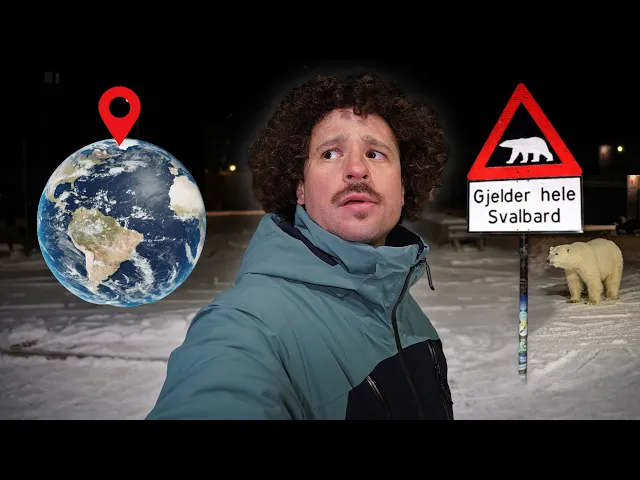
Fui a la isla “más oscura” del mundo | ¿CÓMO VIVEN? | Svalbard 🇳🇴
Luisito Comunica
0:00 This village, located closest to the North Pole,
0:03 is currently the northernmost inhabited settlement in the world.
0:07 People live practically half the year in complete darkness,
0:11 and the government requires you by law,
0:14 to possess a firearm to lessen the chance of being consumed by a polar bear.
0:20 Alcohol use is monitored,
0:21 and it is said that there are more polar bears than people on the island.
0:27 Undoubtedly, one of the strangest places we
0:30 have explored in the history of the channel.
0:33 This is a glimpse of Svalbard island.
0:45 We find ourselves in Svalbard, the most northern inhabited island on Earth.
0:50 Life in this place is quite extreme in many ways, starting with the climate.
0:55 The temperature here generally stays between zero and negative
0:59 ten degrees Celsius for most of the year,
1:02 and in winter, the populated areas can go down to minus thirty.
1:06 Oh, I don't know if you notice, I don't know if you can hear me, I'm congested.
1:11 I don’t know if I sound more nasal than usual,
1:14 I’m naturally a bit nasal, but right now, I’m the very Kiko.
1:18 I got a cold since we arrived, yes, it is really cold.
1:22 So this will be an adventure of Luisillo, the little sick guy.
1:26 The residents here spend four months of the year in total darkness,
1:31 Another four months of the year with twenty-four
1:34 hours of light and the remaining four months,
1:37 so to speak, more like what we are used to elsewhere on the planet.
1:41 On the island, there are different communities,
1:44 with Longyearbyen being the most populated, with a population ranging from two
1:50 thousand five hundred to three thousand people,
1:52 and this is where we will focus to make this video.
1:56 In other small towns, there might be around one hundred residents,
2:00 fifty in some, and in others, perhaps fewer than twenty.
2:04 but it is somewhat complicated to reach them,
2:07 as there are no roads connecting them.
2:10 If you want to go to the neighboring village,
2:13 you have to go by boat in summer, or by snow vehicle in winter.
2:18 Imagine falling in love, right?, with someone from another little town.
2:23 Anywhere else in the world, it would be like, well, I just take a little bus,
2:28 no worries, I ride my bike, get some exercise, no way, my dude, here,
2:32 you have no choice but to ride your snowmobile,
2:35 spending long hours in these harsh conditions and praying
2:38 that a polar bear doesn't come your way,
2:41 because indeed, that's another fascinating fact about this island.
2:45 Here it is speculated that there may be more polar bears than humans.
2:49 This is one of the locations on Earth where
2:52 there is a significant concentration of this endangered species,
2:55 and it's crazy to see how suddenly there are signs warning about polar bears.
3:01 People here must carry a firearm,
3:04 because if you need to leave the so-called safe areas,
3:08 the risk of encountering a wild animal increases,
3:11 and that's why it's quite common for people
3:14 to carry a rifle in the trunk of their vehicles.
3:18 Here, good Nils is teaching me something really interesting, and that is,
3:22 well, here in Svalbard it's super normal for everyone to have guns.
3:26 By the way, Nils wanted me to mention that everything is very secure,
3:31 the guns are not loaded.
3:32 So Nils, how many do you have?
3:34 Well, we each have one for my wife and me.
3:38 Yes, we use it for hunting and to protect against dust.
3:43 Which one would be good for protecting yourself against a polar bear?
3:47 They all work well to protect against dust.
3:50 What kind of gun does this use?
3:52 We have a few for comparison.
3:54 I have one for my wife.
3:55 Now it looks like she’s more masculine than I am since this is my gun.
4:00 It isn’t very large, but it works well.
4:03 Always, outside the city, we carry a weapon with us.
4:07 We need to bring them to frighten them, to protect ourselves.
4:12 I typically use the gun I carry when snowmobiling.
4:15 Whenever we go out of town, we must carry a weapon for our safety.
4:20 If there’s a dust storm, our last option is to fire it.
4:24 Before that, we try to scare it away with our voices or use a flare gun.
4:28 I’ve seen roughly thirty of them, like that.
4:31 In the city, they aren’t seen frequently, but when we go further out,
4:34 along the coast, that’s where the dust storms are found.
4:37 Most of them are frightened.
4:39 They notice you and don’t want you near.
4:41 They wish to stay far away.
4:43 The boundaries of the population are indicated
4:46 by these signs that read Yelder Helles Svalbard.
4:49 And this means that by crossing this boundary,
4:52 if I don't have protection against bears,
4:55 in theory, I am breaking the law and could be fined.
4:59 For this to occur, it would be quite complicated;
5:02 I would need to meet a genuinely irritable police officer,
5:06 someone who is really struggling.
5:08 In theory, you could be fined up to ten thousand crowns,
5:12 or about one thousand dollars.
5:14 I’ve been told this law was implemented around nineteen
5:18 ninety-six when a tourist was eaten by a polar bear.
5:21 And yes, it’s right here, okay?
5:23 This line marked by the signs means I should
5:27 have a rifle for protection from here on out, theoretically.
5:31 Wow, once you leave the town, you really see how dark it gets.
5:35 Let’s try this out; we have light now, I’m lit up,
5:39 and let’s turn off the light to see how it looks.
5:42 Check this out, hello Borgo.
5:44 And now that the sky is reflecting, we have the moonlight,
5:48 which is a huge spotlight, it makes a big difference.
5:51 This is how these people live for practically half the year.
5:56 Another fact that has really impacted me about nature
5:59 is that there are no trees on the entire island.
6:03 Actually, if you view Svalbard Island on Google Maps,
6:06 you'll see that the whole ground looks white.
6:09 The plant life resembles moss more;
6:12 we are located above the coordinates referred to as the tree limit.
6:17 Everything is quite different; as I mentioned earlier,
6:19 it's a very extreme place in many ways.
6:22 Certain scientists claim that the polar bear is among
6:25 the few bears that view humans as a food source.
6:29 However, this does not imply that killing
6:31 bears left and right is advisable, certainly not.
6:35 Actually, the polar bear is a very well-protected species,
6:38 and it's said you can only kill one if your life is in serious danger.
6:44 It is recommended to carry a flare gun to first scare the animal,
6:49 then it is advised to shoot into the sky,
6:52 shoot into the ground, Make a lot of noise,
6:55 and if you find it less than two meters away from you, then you can shoot it.
7:00 If you do end up killing it,
7:03 a complete investigation begins to establish who attacked whom first,
7:06 and the procedures are followed,
7:08 the path of the bear's movement, where the bullet entered,
7:11 what kind of bullet it was, and what type of rifle was used.
7:15 If they find that you murdered him deliberately and your life was safe, yikes,
7:20 you could go to jail for as long as fifteen years and face very large fines.
7:26 Due to some bears that have died at the hands
7:28 of a human who was in danger and this has been verified,
7:32 you can find stuffed polar bears in various parts of the city,
7:36 and they are really impressive,
7:38 and also bear skins displayed on the walls of businesses.
7:43 So now you know, when you find yourself in Svalbard,
7:46 be well armed and well prepared, because indeed, our sweet,
7:50 cuddly bears can be all around, and when they get close to you,
7:54 you might notice they aren’t so cuddly after all.
7:58 Let’s talk about something that really
8:01 catches my attention and surely yours too,
8:04 how is it that on this island one cannot die?
8:07 It’s not that you can’t die, right?
8:09 I mean, dying isn’t something you plan, right?
8:12 Like, I’ll die on Thursday at six PM, right?
8:14 The truth is that here, they can’t bury you,
8:19 and this occurs because of something known as permafrost
8:22 that is found in the soil of this island.
8:25 It brings with it two very significant causes,
8:28 both of which are the most intriguing and disturbing.
8:32 First, because of the permafrost, the soil is always moving,
8:36 So this means that even if you bury a human body meters and meters underground,
8:42 it will eventually rise to the surface.
8:45 Secondly, due to the bacteria and viruses that are kept alive by the permafrost.
8:51 It is said that around the nineteen eighties,
8:55 scientists in the area found flu viruses
8:58 in human bodies from around the Nineteen ten.
9:02 Thus, the flu virus was alive in that corpse for about seventy years.
9:07 You can imagine that this could bring a significant,
9:11 indeed tremendous biological risk to this island, can't you?
9:15 Burying thousands of bodies, all with live bacteria preserved by the permafrost.
9:20 No man, buddy, here would arise the next macropandemic, the zombie attack.
9:25 However, as you can see, behind me there is a cemetery.
9:29 Well, this is a very old cemetery that was
9:33 established before this rather disturbing fact was discovered.
9:37 And since then, you can no longer bury a body here,
9:39 not even your pet's body, for example, they won't let you bury it.
9:43 You have to either incinerate it or send it to the mainland of Norway.
9:48 And they also say that if you’re looking a bit unwell, they’ll say, 'Hey, buddy,
9:53 I think you’re really sick, you’re quite ill,
9:55 forgive me,' But you have to go to the burger place.
9:58 In other words, to live in Svalbard,
10:00 you must be in good health; you can’t be seriously ill.
10:03 How about that?
10:05 Crazy, right?
10:05 What a disturbing thing!
10:07 An island where they send you far away so you
10:10 can die and your remains can rest without surfacing later,
10:15 scaring the entire town and possibly creating very, very dangerous diseases.
10:20 What a fact, yes, very unsettling.
10:28 This is, so to speak, the city center.
10:31 I’m surprised by how people ride bikes.
10:34 What cold?
10:35 My friends say.
10:36 Here in this part of the center, we find many shops, we find a lot of commerce.
10:41 Truly, you can find practically everything.
10:44 This is the biggest supermarket, in fact,
10:47 the only truly large supermarket on the entire island of Svalbard.
10:51 And just look, this is really interesting.
10:54 You can see signs in most shops that say no entry with weapons.
10:58 Because, as we talked about, it is extremely, extremely common here.
11:03 We went into the supermarket to look around and wow!,
11:07 they truly have everything, products from everywhere.
11:10 I was surprised to find a whole section, okay, let’s listen carefully.
11:15 On the northernmost island in the world, super isolated,
11:18 in the only supermarket there is an entire section dedicated to tacos.
11:23 In these countries, there is a lot of culture around eating tacos,
11:27 very adapted to their culture, to their recipes.
11:30 In Norway, the day for eating tacos is Friday, known as taco Friday.
11:34 And one interesting thing we noticed
11:36 in the supermarket is that they offer free water.
11:40 Let’s see, in many of these countries on this side of the world,
11:43 it’s like why would you buy water when people drink from the tap?
11:47 It turns out that here in Svalbard,
11:49 the magnesium content in the water is very high,
11:53 so it can be dangerous if consumed regularly.
11:56 So, if you take water straight from the faucet, it will hurt you over time.
12:01 That's the reason supermarkets have
12:03 these enormous water tanks available for free.
12:06 And well, while walking through the streets,
12:08 we have also seen many people walking their little dogs.
12:12 One breed that is very common to see here
12:16 is these huge huskies that are often used for work.
12:20 We talked to a really nice girl who kindly told us about her little dog.
12:25 This is Fjord.
12:25 He’s four years old and prefers not to be a dog.
12:28 Where does he sleep?
12:29 Outside or in your home?
12:31 No, he sleeps in my bed.
12:32 I think he loves this weather.
12:34 Yes, it's true.
12:35 Huskies are happiest in winter.
12:37 In summer, they get stressed due to the heat, which you can see in the gardens.
12:42 They are more stressed when it is above ten degrees.
12:45 Yes, that’s the most common breed here, and they handle the cold well.
12:49 Those dogs resist the harsh cold.
12:51 Actually, they are accustomed to it;
12:54 nature designed them to withstand these extreme temperatures.
12:57 Wow!
12:58 Look how funny, we found Adriana from Peru here.
13:01 How are you, Adriana?
13:02 Very well, and you?
13:04 Adriana was talking to me here about a Latino community,
13:06 meaning there is a Hispanic community and everything here.
13:09 I never thought that would be the case.
13:12 Uruguayans, Argentinians, Peruvians, who are just a few,
13:15 there are three of us, Mexicans too, and yes,
13:18 It's really cool to find your fellow countryman here, for example,
13:22 he was the only one here, but now we have each other.
13:26 Hey, have you come across a polar bear or something similar?
13:29 Not yet, I haven't seen one,
13:31 but if you leave the island, you could run into one.
13:34 It's also crazy to be here because it's going to get even colder,
13:37 then you experience minus twenty-five, minus thirty,
13:40 you just have to be strong and mentally prepare yourself too.
13:44 I plan to stay here for as long as needed to save
13:47 up and move elsewhere because this situation is quite intense too.
13:51 It's said that people here don't lock their homes
13:54 or cars because of the bears and wildlife.
13:56 If there's a risk, it's like, oh no!
13:59 A bear is after me.
14:00 You can find refuge anywhere, or so they say.
14:03 But I'm not sure, have you checked?
14:05 Do people leave their houses open?
14:07 Thanks!
14:07 Yes, in fact, I leave it open, I mean,
14:09 it’s not like I lock it or put the key in, we
14:12 are in Europe and we are on an island that is quite small.
14:16 You can go out here at five in the morning,
14:18 nothing will happen to you, two, three, I don’t know.
14:20 It’s a pleasure to chat with you, and we wish you all the success.
14:23 They are tastes.
14:24 As in most places with these weather conditions, of course,
14:28 there is a significant alcohol consumption problem in Svalbard.
14:32 Wow, you practically live half the year completely in darkness.
14:36 It’s very common to have a day off plan, let’s drink from very early.
14:41 So, an interesting measure that the authorities have taken
14:44 to prevent vice from getting out of control and having
14:48 much more serious consequences is that they have set
14:51 limits on the quantity of alcohol that residents can buy.
14:55 Essentially, you receive a small card where they add points,
14:58 similar to when you go to a café for sandwiches or burgers,
15:02 and with each purchase, they punch a hole.
15:05 And with this, you can basically buy
15:07 a maximum of two liters of liquor per month.
15:11 This month, you can also purchase twenty-four
15:13 beers and one liter of strong wine.
15:16 But yes, it is a very curious measure, honestly, that I personally had not seen,
15:21 and you can only buy alcohol in authorized stores.
15:24 This happens in all the countries around here.
15:27 Whether it’s Finland, Sweden, Denmark,
15:29 or Norway, they have their government stores,
15:32 and this store here is the only liquor store in this town.
15:36 To get a better grasp of this alcohol matter, Renato welcomed me into his home.
15:41 How are you, Ren?
15:42 I’m great, all good here.
15:43 Now, go ahead and pull it out.
15:45 I mean, show the card.
15:46 Take out the card, my friend Ren.
15:49 Check this out, what we are seeing is
15:53 the card to control alcohol consumption in the population.
15:57 Sometimes, some people don’t drink alcohol at all,
16:00 but they still have the card, while others drink more.
16:03 They trade, buy for each other, and just pass it around.
16:06 Sure.
16:07 They make it seem like someone else is buying.
16:09 That’s pretty cool.
16:10 If you’re here and not an addict, you can benefit from the addicts, right?
16:16 Pass me a landa and I’ll let you buy with my little card.
16:20 And well, here good Renato basically works in the kitchen.
16:24 You’re a chef, right?
16:26 He just welcomed us into his house.
16:28 Thanks, Renato.
16:28 Seriously, what great hospitality, what wonderful people we've met here.
16:31 Renato gave us a taste of his talent.
16:33 Wow, I mean, he made us some really professional little toasts.
16:38 He decorated them with red fish roe.
16:40 He prepared cauliflower with bacon and crab legs with butter for us.
16:46 A dish for which people pay three
16:48 hundred dollars at the place where Renato works.
16:51 We enjoyed that here, right?
16:52 Thank you so much, really, thank you.
16:54 Hey Renato, do you prefer the dark era or the bright era?
16:58 Even though the first time was a bit complicated for me,
17:01 I did suffer a little during that time...
17:04 I had a bout of depression for about a month and a half, but I overcame it.
17:07 By taking my vitamins,
17:08 the same doctors prescribe things to help you feel better,
17:12 go out with friends, chat, and always be...
17:14 in a better social environment, so to speak.
17:17 Hey, it’s really good that you reached out for help.
17:19 Wow, it’s great that you recognized it because many people take much longer.
17:23 It’s well known that in these areas with such climates, terrible things occur.
17:27 People harm themselves and so on.
17:29 I'm really happy to hear that you're doing well and so successful, so great.
17:34 Ren is showing me around his house.
17:36 It's really amazing, isn't it?
17:38 They live really beautifully, congratulations.
17:40 But what caught my attention the most, I want to show you.
17:44 It's that the house they rent includes this attic.
17:46 Calen, in this attic,
17:49 the house they rent actually includes a safe for keeping weapons.
17:55 Check this out, with the space here.
17:57 This is just like the one we saw at the church,
18:00 the one at Nils' house that welcomed us.
18:03 You haven't gotten your gun permit or anything.
18:06 No.
18:06 I want to do it, that's for sure,
18:08 but I have to take a course first and then go buy it.
18:11 So the fact that you don't have your gun
18:14 license means that basically you can't leave the city.
18:17 I just can't go out, but I can go out with a guide or someone
18:20 who has a license and a weapon, for sure.
18:23 Well, my good Ren, when you have your weapons here,
18:25 with a lot of responsibility, right?
18:27 Obviously.
18:35 I love that a big part of the marketing on this island
18:38 is that they label everything as the northernmost place in the world.
18:42 For instance, this is the bar that is the furthest north in the whole world.
18:47 The northernmost Toyota car agency on the planet.
18:50 Plus, there’s the gas station that’s the most north.
18:55 See this?
18:56 It’s really good marketing and absolutely true.
19:00 Yes, that’s really nuts.
19:01 I mean, after us, if we keep going up, what’s left?
19:04 Polar bears, a lot of ice, and way too much, but way too much frozen water.
19:10 It makes me laugh that there’s only one gas pump.
19:13 So, this is all there is.
19:15 Or does it have two sides?
19:17 Oh, wait, there are two.
19:18 Look, here’s one side, okay?
19:20 One and two.
19:21 Yes, you can have two cars at the same time.
19:23 And of course, there are no firefighters or gas station attendants,
19:27 just refueling and paying inside.
19:29 Quite nice.
19:30 Great marketing strategy.
19:31 And it’s really cool, honestly, for the locals.
19:34 To say, like, dude, I live at the planet’s first point,
19:38 in the northernmost part of the world.
19:40 That’s cool.
19:41 I feel a bit envious.
19:42 Then I remember how stuffy I feel in this climate and it fades.
19:47 I’d better return to my warmth.
19:49 The island of Svalbard is governed by Norwegian law.
19:53 but it is said that the inhabitants
19:56 here are from approximately fifty different nationalities.
20:00 This is a migrant island.
20:02 Naturally, the majority are Norwegians,
20:04 but you encounter people from everywhere.
20:07 Anyone who wants to save a decent amount of money,
20:11 as it is said that salaries are very good here,
20:15 and if you don’t mind freezing your butt off for half the year, you’re welcome.
20:19 Come on over!
20:20 By the way, if you see some movement behind me,
20:23 a lot of people walking and such, it's because it is currently noon.
20:28 Right now it is twelve o'clock in the afternoon.
20:31 The light lasts like this for twenty-four hours.
20:34 It’s no secret that winter clothes are very expensive here.
20:38 That is why locals here in Svalbard started this initiative called Bruktiken,
20:45 which basically means the second-hand store,
20:48 where you can come for winter clothes completely free.
20:54 Basically, since a lot of people come and go here, they gather things, right?
20:59 You buy a lot of jackets and then it’s like,
21:01 well, I’m leaving, I can’t take four bags of winter jackets.
21:05 Then people come here, donate what they no longer use,
21:09 and afterwards those who arrive and perhaps
21:11 need winter clothes to avoid freezing to death.
21:15 can come here, take what they need, and it’s free.
21:18 Unfortunately, it’s closed right now.
21:21 I would have loved to go inside and see exactly what they sell,
21:25 but we can get an idea through the windows, and it looks amazing.
21:29 I was fascinated by this initiative.
21:32 More Bruktiken in cold areas around the world.
21:35 Before coming here, I honestly thought I would find a very rustic,
21:40 very disconnected community.
21:42 I thought communicating and sending files would be very complicated, but no,
21:47 the truth is we found everything to be very well developed.
21:52 In fact, I want to show you this.
21:54 Look at the quality of the internet I have on my phone.
21:57 This is not a wifi network; it's the phone's internet.
22:00 We are going to do it in real time so you don't think it's a screenshot.
22:04 Look at this.
22:05 Almost two hundred megabits download, and twenty upload.
22:08 No, it’s really impressive and fascinating.
22:11 This has pleasantly surprised me.
22:14 Staying in touch with my work team on the other side of the world,
22:17 sending them high-quality files and all, has been no issue whatsoever.
22:21 And like in all my journeys, I now stay connected with...
22:25 Please, let’s read here.
22:26 Hello Fly, of course!
22:28 A quick pause for our favorite sponsors, Hello Fly.
22:32 Thanks once more for supporting our work.
22:35 In fact, Hello Fly is a fantastic service,
22:38 which I have mentioned numerous times, to help you stay connected globally.
22:43 They have regional plans, which greatly simplifies things,
22:46 so if you’re traveling to different countries,
22:49 you won’t need to change your SIM in each place.
22:52 It operates with a super easy eSIM.
22:54 For instance, here in Svalbard, I have coverage with my same European plan.
22:59 I didn’t need to purchase another.
23:01 The rates are very affordable.
23:03 You decide how many days you’ll be traveling.
23:06 And it shows you the price for unlimited packages, absolutely!
23:10 In many territories, it even allows you to share the internet.
23:13 I don’t know, for your computer, for another device.
23:17 We also have a discount code for channel users.
23:20 It's showing up here.
23:21 You get five percent off on every purchase and recharge.
23:25 If you encounter a polar bear, take a photo right then and there.
23:29 And before the bear eats you,
23:30 you have time to send it to your mom so she at least remembers you fondly.
23:35 Thank you, HolaFly, for sponsoring our content.
23:37 Honestly, it is a service I often use during my travels.
23:41 Now, let's continue freezing our butts off.
23:49 Guys, having twenty-four hours of night really messes with your head.
23:53 You can't figure out if it's day or night.
23:57 It's oddly hard to sleep.
23:58 Anyway, I want to show you this really funny hotel we're staying at.
24:02 Honestly, it's pretty cool, very cool.
24:05 This one is called the Base Camp Hotel,
24:08 themed as if it were a camp, a base, a campaign.
24:11 The hotel is truly awesome, and the staff is incredibly great.
24:14 Just so you know, this isn't a paid ad, okay?
24:17 We paid for our stay, but I want to show you this cool accommodation.
24:20 Look at our room.
24:21 This is like the suite, I don't know.
24:23 We have our little room, it's really nice.
24:26 Look at this, these are the little beds,
24:28 cozy, it's really not bad, not bad at all.
24:31 But don't let diarrhea get you from up here, because...
24:33 No, no, no, by the time you come down, you've lost the battle, my friend.
24:37 It's really cool, if you ever go to Svalbard, I highly suggest it.
24:41 Just to clarify, this is not a paid promotion,
24:43 but the experience is really unique.
24:44 Thea welcomed me into her home.
24:46 Meet Thea, a fantastic person, completely Norwegian,
24:49 she's been residing here in Svalbard for a while.
24:52 And we are learning a lot, she has a beautiful house,
24:55 honestly, with a balcony, but it's absolutely beautiful, truly beautiful.
24:59 They have their living room, some seal pelts,
25:03 we're learning a lot about daily life.
25:05 It's a joy.
25:06 What I wanted...
25:08 My life.
25:12 All of it.
25:15 Oh, yes!
25:20 These are for snowmobile journeys.
25:22 And yes, trips on the road with us or in the garden.
25:27 It's the thermos soil of Svalbard.
25:29 It's amazing.
25:30 And often covered by regular pants.
25:34 Inside.
25:35 It's not only this, I mean, the coats and such,
25:38 but they have an incredible number of shoes, check this out.
25:42 These, these are like, what?
25:43 Snowmobile.
25:44 Snowmobile, these.
25:47 What is this?
25:45 Oh, yes!
25:48 Yes.
25:51 Yes!
25:51 Yes!
25:52 How many kids?
26:00 Four hundred and nearly thirty.
26:02 Or thirty-three, I believe.
26:04 Four hundred and thirty.
26:05 There are a lot of kids here.
26:08 There are many families.
26:09 And it's a wonderful place to spend time with family.
26:15 Yes.
26:15 One in the yard and another in school.
26:21 Public.
26:21 All schools, like the public schools in Norway, are free.
26:25 They have the first and tenth grades, and then school and universities.
26:34 I love it.
26:35 I won't come back.
26:36 We know we can't stay here forever.
26:38 But we want to stay here for ten years or more, maybe.
26:41 Can you see that little house right above the mountain, that is lit?
26:48 Well, it has a legend, actually.
26:51 Super pretty, super cute.
26:53 It turns out that what that is,
26:56 is an old entrance to a coal mine that used to be there.
27:00 Eventually, the coal mine was closed, so that construction stayed.
27:06 And from there, the locals of the town started
27:09 a legend that this is where Santa Claus lives,
27:13 since this is the nearest settlement to the North Pole anywhere on Earth.
27:17 They say that Santa Claus hangs out there, right?
27:19 And he is relaxed and having a good time,
27:22 enjoying his beers all year until he has to work in December.
27:25 And that is why they created this small mailbox right here, so in this mailbox,
27:31 children come during the Christmas season
27:34 to leave their wish letters for Christmas gifts.
27:38 They put everything in there,
27:39 and the belief is that Santa Claus will come for it.
27:42 And if you behaved well, he will leave you your gifts, and if you behaved badly,
27:46 he will leave you a lot of coal from that very mine.
27:48 We can see that the construction has some little lights
27:52 on, which serve no purpose other than to continue the legend.
27:56 They turn them on on the first of December
27:57 and turn them off on the thirty-first of December,
27:59 once the festivities are over.
28:01 And it's nice, right?
28:02 It's sweet.
28:02 On December first, kids come here and line up; it's really nice.
28:06 People serve hot punch, and everyone enjoys themselves.
28:09 Such a beautiful belief!
28:10 I was thrilled to see a little note here.
28:12 Look, I’m not sure if we can catch it on camera.
28:15 It drew a small house, like Santa Claus's house, with its treats and everything.
28:18 I love that little towns do this to make children happy;
28:21 there’s nothing more beautiful than that.
28:23 Another unsettling piece of information about the island
28:27 is that the houses are gradually sinking.
28:30 And this also happens because of the famous permafrost we mentioned earlier.
28:35 Because the earth is moving, the foundations of the homes,
28:39 no matter how deep they might be,
28:42 are slanting, which is causing many houses to be evacuated these days.
28:48 We just encountered one that is wow!
28:51 It’s as clear as can be.
28:53 This structure is really very askew, and they had to evacuate it;
28:56 they had to notify the people living here.
28:59 You know what, dude?
29:00 Your house is going to fall; it’s going to go away, so we’ll get you a new one.
29:05 This has caused that today one of the major industries providing jobs
29:09 on the island is people who bring in engineers from the mainland.
29:14 carpenters, builders in general, to be able to put new pillars, new foundations.
29:19 Since we’re on this topic, let’s briefly touch on the housing situation here.
29:25 And it is very interesting that it is estimated that nearly
29:28 eighty percent of the homes here are owned by companies, you know.
29:33 They are owned by large companies.
29:35 This occurs because, as we've talked about,
29:37 this society has a population that rotates a lot.
29:41 It's unusual for someone to stay longer than, let’s say, five years?
29:45 Five years here?
29:46 Thus, most homes are owned by large companies that regularly hire people,
29:50 and it works like this: I hire you, work for me for a few years,
29:55 I provide you with this house to live
29:56 in, or I rent it to you at a reasonable price,
29:59 and then you leave, and I give it to someone else.
30:01 And yes, only around twenty percent of the homes are owned by individuals,
30:06 those who say, I want to invest in a house here and create a future, etc.
30:11 Yes, only about twenty percent.
30:13 How about that?
30:14 A fascinating detail, and yes, this sinking problem, wow,
30:17 it’s really scary, and we see it very well demonstrated here.
30:21 Listen, this permafrost brings a lot of consequences, check it out.
30:25 This thing behind me is the drainage system,
30:29 and also the wiring system, I'm learning.
30:33 You can't have the wiring or drainage underground because
30:38 that would eventually cause it to leak and break, creating chaos.
30:43 So it’s on the surface, they use these wooden boxes,
30:46 and yes, just like we see, through this wooden box.
30:49 Right now, a little piece is probably being transported at full speed.
30:55 And also all the electrical cables and so on.
30:58 Wow!
30:58 No, no, no, this permafrost has the island's people very resourceful,
31:03 coming up with solutions for everything.
31:10 We were walking down the street and saw a very handsome guy riding his scooter,
31:15 and we said, Wow, he looks cool, he looks awesome!
31:18 Out of nowhere, he let out a powerful Luisillo,
31:20 and it turns out he’s from Argentina.
31:22 How are you, Luchi?
31:24 Everything's fine, I’m from Argentina, Patagonia,
31:25 and I’ve lived here for a year and two months.
31:28 Look, the good Luchi is letting me try out his scooter.
31:31 You basically need to give it a strong push,
31:33 and once you speed up, you won't stop, just look.
31:36 Push hard, push hard, push hard, and off we go!
31:39 It does pick up speed quickly, but I want you to see this, when you brake, Oh!
31:45 It slips terribly, so here it's not a good idea to slam on the brakes,
31:49 because, well, everything is frozen.
31:51 Hey, but what a great mode of transport, my Luchi.
31:54 Luchi, have you ever met a bear?
31:57 A polar bear while riding your scooter?
31:58 No, I haven't had that luck, because honestly,
32:00 I'd only want to see one on a boat trip.
32:02 That's the only way to see them.
32:03 But why do you say you'd like to?
32:03 Polar.
32:05 Because I really want to, I love them dearly,
32:07 and I would love to see one and have the opportunity to run.
32:12 Let's see if your scooter can keep up.
32:13 Well, few people get to die doing what they love,
32:17 and it seems Luchi would like to die while seeing a polar bear.
32:22 And what now?
32:23 Were you heading home or what?
32:25 Now I'm going home right over there, in front, yes.
32:28 Hey, can we join you?
32:29 Yes, of course, Of course.
32:33 Making friends here in Svalbard is so easy.
32:35 I’ve seen that in all the buildings, you need to take off your shoes.
32:40 Leave your shoes outside.
32:41 This is something extremely traditional in Norwegian culture.
32:45 It originates mostly from the era of coal miners.
32:48 So they adopted the custom of taking off
32:50 their shoes before entering to avoid making a mess.
32:53 Hey, what a beautiful house you have here, wow!
32:56 It's very common here in Svalbard to have candles and lights,
33:00 because we have four or five months of darkness.
33:03 We must ensure our homes are welcoming
33:05 and as bright as possible during those months.
33:08 Hey, I see you have plants; how do you keep them from dying?
33:11 We actually have these lights that are specifically for plants,
33:15 so they survive the entire dark season.
33:18 I’m learning curious things here with Luchi, especially regarding pets.
33:23 Tell me about this; he says you can have dogs, but no cats.
33:28 What’s the reason for that?
33:29 No, they are prohibited because they are basically predators,
33:32 which could disrupt the local fauna and flora since it’s a very exotic place.
33:38 Unfortunately, cats are strictly forbidden here.
33:40 A reindeer could be disturbed; you cannot touch reindeer,
33:44 and you can only take pictures of them.
33:47 So neither cats nor dogs can try
33:50 to attack them because they are protected animals.
33:53 It's true that not having a weapon can lead to a fine.
33:56 So, how does this work?
33:57 You get fined.
33:58 For crossing the signals at each cardinal point in the town,
34:02 if you cross that line,
34:04 it's like you're breaking the rules, so that's why the fine would be charged.
34:08 You risk danger if you don't tell a friend you're going hiking;
34:11 if a bear eats you or you get lost, no one knows, no one will find you because
34:16 the wind can blow and the snow can cover you.
34:18 You might be under snow for years.
34:19 You might be under snow; let's continue.
34:20 We are going to visit the Svalbard Global Seed Vault,
34:25 that is, the seed storage for the entire world.
34:28 Which is exactly as its name suggests.
34:31 A repository that holds seed samples from all countries
34:34 in the world in case a catastrophe were to occur.
34:39 I have no idea, maybe a natural disaster or a dreadful war.
34:44 The politicians lose their minds and start nuclear wars,
34:49 destroying whole populations.
34:51 And then it's like, bro, I had the corn I had been cultivating
34:54 for more than two hundred years right there, buddy.
34:57 I can no longer make my tasty blue corn tortillas that I enjoy.
35:01 Don't worry, because here in Svalbard they have a copy
35:05 of the seeds so you can plant them again,
35:08 So you can regain all the advancements humanity achieved over centuries.
35:13 Right in this construction,
35:14 which I attempted to access but was unable to, as they are quite demanding.
35:19 I have watched videos on the internet of people who have successfully entered,
35:23 and it looks incredible inside.
35:25 Here are a few samples with the respective credits to the creators and such,
35:29 because it's really awesome, great job.
35:31 But good old Luisillo here from the outside, freezing a lot, will tell you.
35:36 It is estimated that there are close to one billion samples
35:40 here and collectively about five hundred billion seeds from the entire planet.
35:46 The most recent case of a country that needed
35:48 it was around the year two thousand fifteen,
35:51 which happened in Morocco due to something very ugly.
35:54 They really lost seed samples.
35:57 And Svalbard came to the rescue of the situation.
36:00 One wonders, why here?
36:02 Why under Norway's regime?
36:03 Why do they trust them so much?
36:06 Firstly, because Norway is peaceful.
36:08 Secondly, because a treaty says there can be no military activity in Svalbard.
36:14 Therefore, unless someone intends to invade, there should be no disaster here.
36:19 And thirdly, why do they think so?
36:21 Because of the permafrost.
36:23 Indeed, this topic resurfaces.
36:25 As we've mentioned, permafrost does an excellent job of preserving everything.
36:29 And since this deposit extends down below the mountain,
36:32 it can be at temperatures of around minus six degrees,
36:36 from minus six to minus ten.
36:38 Which will preserve it extremely well.
36:41 Next time, let me in, okay?
36:42 Authorities of Svalbard would be cool.
36:44 I'll return in summer to see what it's like during the day.
36:55 I was received at a husky breeding center.
36:58 This is truly fascinating.
37:00 Here they have about eighty puppies,
37:02 although I've been told that if we count the mothers that are already pregnant,
37:07 there might be around ninety.
37:09 These are all Alaskan Huskies, though there are quite a few mixed breeds.
37:14 Let's keep it simple regarding the situation.
37:17 These dogs are used for work, specifically for sledding trips.
37:21 Basically, they train them to endure extremely
37:25 long days in the wilderness, as we've discussed.
37:29 In fact, there are no real roads on the island that connect the villages.
37:34 Historically, people have used sleds pulled by dogs for transportation,
37:39 and today many adventurers look for this experience.
37:43 It's really cool how they all have
37:46 their little houses with a layer of reindeer fur.
37:49 They also put sawdust in there for some extra warmth,
37:53 but these dogs handle these temperature levels very well.
37:58 I'm a city person, and honestly, I'm used to seeing puppies in sweaters;
38:02 it's the most normal thing, and the puppy sleeps on the couch.
38:07 That's great, that's excellent.
38:08 These are simply dogs from the North Pole.
38:11 However, most of these dogs will eventually go through a phase
38:15 of wearing sweaters and having toys at some point in their lives.
38:19 because here they are made to work until they are perhaps about seven years old,
38:23 after which they are given up for adoption.
38:26 We have talked to some owners who have told us,
38:28 oh sure, my dog was from one of these training centers,
38:30 once he turned seven or eight years old, they gave him to me.
38:34 and they are often extremely obedient dogs.
38:36 Honestly, they are quite amazing.
38:38 I’ve loved watching the process and seeing how they
38:41 have them all in their little houses with their names,
38:43 and some even get up on the roofs.
38:45 It’s very nice, and as I tell you, it’s something cultural here that has been
38:49 going on for literally hundreds of years.
38:52 I’ve been working with the dogs for eight years
38:54 at the company’s base camp since I arrived in Svalbard.
38:58 The highlight is going on trips with them,
39:02 the expeditions, bringing guests along, and guiding in general.
39:06 Here is where we link the dogs, the cable.
39:11 This is rigged for eight dogs, a bit different from other companies,
39:16 You have two dogs in the front and at the stop,
39:19 there are two, two, two, four times, so you have eight dogs in the system.
39:24 You have Needles, this is the cable, You have two skis and a piece of steel.
39:31 Go through this and the clothes come off in the snow.
39:33 Since it is such a small population, there really isn't a jail here,
39:37 there is no prison system, But what there are,
39:41 are small holding cells here at the police station.
39:45 Well, it's not like you see patrols everywhere and such,
39:49 It's a very tiny town and there is a very,
39:53 very small chance that someone commits a crime here.
39:56 But what they tell me is that there are many reports of drunken
40:00 fights and that's why there are some holding cells here to catch them,
40:05 To calm down the tempers of the guys and then they let them go.
40:08 But if someone were to commit a crime beyond that, a serious crime,
40:12 I don't know, killing someone or whatever, some kind of more serious aggression,
40:17 what would happen is that they would detain him
40:20 here until the authorities could come from the mainland,
40:23 They would then take him to mainland Norway
40:25 and there he would be sentenced and all that.
40:28 Right here, good Renato had a close encounter with the police.
40:32 He has a buddy who was in jail.
40:35 Let him tell us the experience.
40:37 No, well, some guys who were Norwegian started looking for trouble,
40:41 and in the end, he answered them and ended up winning.
40:44 I mean, you have a fight.
40:45 So, they went to file a complaint with the police.
40:48 They said he had to serve a specific sentence for around a month.
40:52 They mentioned he could go anytime during the year,
40:54 whenever he wanted to present himself.
40:52 F***.
40:56 So, they told him, you from Svalbard have to go all the way to Oslo, let's say,
41:01 to the capital, in the month you choose, show up,
41:03 and we’ll put you in jail for a month.
41:05 Hey, that's quite comfortable, isn't it?
41:08 Sounds good.
41:08 What was good there was that it was like a small apartment,
41:12 it had a TV, a DVD player, they did the shopping, and had all the amenities.
41:17 You recount that story with so much detail.
41:20 I think it was you.
41:21 It was an Argentine friend, we can't say his name,
41:23 but he knows who he is, and he allowed us to go.
41:26 Yes, I actually talked to him just now, and yes, he gave us permission.
41:31 It's wild, but it happens,
41:32 and you really have to go to the mainland to face your consequences.
41:43 Let's briefly look at the church,
41:46 which is actually the only religious temple on the island.
41:50 This is, honestly, very interesting.
41:53 As Svalbard is a multicultural population,
41:57 this church also welcomes Muslims to meet here, Hindus,
42:03 Buddhists, and so on, Because, indeed,
42:06 there are people from numerous places around the world here.
42:09 So, if you ever want to have a special
42:12 ceremony and bring together all the island's Muslims,
42:14 you can invite them here to the church, and they are very welcoming about it.
42:19 It's like, yes, freedom of worship, do your own thing.
42:22 What did I think?
42:23 It's super beautiful, right?
42:24 Very respectful and open, and look at this, it's also quite odd.
42:28 I think not many churches worldwide have a vault, a security box with weapons.
42:34 Very unusual, a church where all religions from around
42:37 the world can come together and is well-armed.
42:40 Another very particular fact about this island.
42:44 There is only one hospital on the island,
42:46 which is this one right here; it is actually quite big,
42:49 where urgent cases can be treated,
42:51 fundamental health issues and maintain hospitalized patients
42:55 for subsequent transport to the main land.
42:58 For example, if you need a complicated operation, they can't handle it here.
43:03 If you were suddenly attacked by an animal and need a leg amputation,
43:06 they will take urgent measures here,
43:08 but then they will transfer you to the mainland for specialized treatment.
43:11 Likewise, if a pregnant woman goes into labor early, if the baby is in trouble,
43:16 there’s no choice, she cannot be moved to the mainland, she will deliver here.
43:20 The concept is that sensitive situations should take place in mainland Norway,
43:26 while urgent matters are dealt with here.
43:30 urgent cases or simpler matters.
43:32 Until a few decades ago, the island of Svalbard was very different,
43:37 basically a place for miners and scientific researchers.
43:41 But as time has passed, it has taken on a much more familiar vibe.
43:45 A clear example is this Christmas market we came to visit,
43:49 very beautiful, very friendly.
43:51 All these types of activities have made tourism
43:54 one of the major activities in Svalbard today.
43:58 Interestingly, this fact that people come here, fall in love, build families,
44:04 and remain for a long time,
44:06 is part of Norway's strategy regarding this territory.
44:10 Let's be realistic, there will always be conflicts over land around the world.
44:16 Svalbard was involved in a major dispute nearly
44:19 one hundred years ago over who would govern it.
44:22 So today, to avoid conflict, to prevent a war from breaking out,
44:29 or military intervention, Norway has encouraged people to have families here,
44:34 to create life, to have shops,
44:37 and to promote commerce in general, so that people can live well.
44:42 This way, military conflict is avoided.
44:45 Honestly, it's a brilliant strategy that creates jobs,
44:49 enhances quality of life, urbanizes areas, and fosters peace.
44:54 I believe we all prefer to live in a world with lovely
44:58 Christmas markets and families walking their dogs and babies in the streets,
45:03 than in a world where leaders are fighting over pieces of land.
45:17 Well, there you have it, a little bit of life in Svalbard,
45:21 the most northern island on Earth.
45:24 Honestly, I loved it, what a beautiful adventure this was,
45:28 we even leave here with new friendships,
45:31 what interesting and friendly people we met.
45:34 Such a unique lifestyle, so peculiar.
45:37 One truly does not exaggerate when saying this is a very, very unique place.
45:42 How did you find it?
45:43 What did you think?
45:45 Drop your thoughts in the comments below,
45:47 would you want to live somewhere like this?
45:49 Thank you so much to everyone who welcomed me
45:52 into their homes and shared their lives with me,
45:56 telling me such personal stories.
45:58 I truly appreciate it from the bottom of my heart,
46:01 and of course, thank you all for joining me on another adventure.
46:06 You know the drill, see you in a few days with a new video.
46:09 Bye!