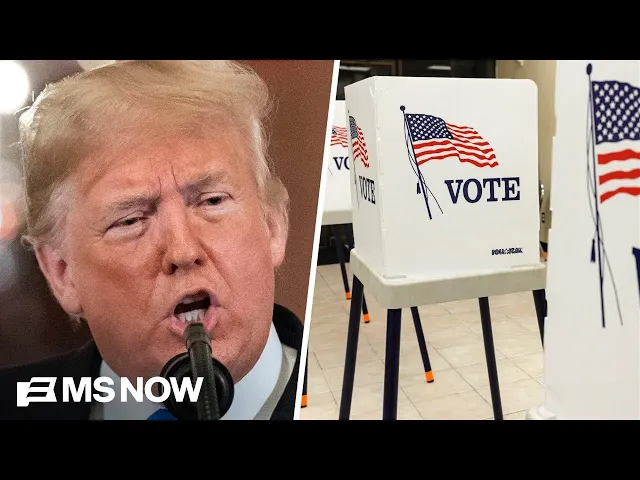
Poll: 35% believe midterms will likely be stolen
MS NOW
0:01 JOINING US, MSNOW POLITICAL ANALYST AND DEMOCRATIC STRATEGIST BASIL SMEICHEL,
0:03 RICK SINGLE, SAM STEIN And so with us, recipe for success, right?
0:07 Worried about fraud, worried about elections being stolen,
0:11 worried about voter suppression.
0:14 It seems like there's very little trust left in the system, Basil?
0:18 Well, it's a confluence of events, right?
0:20 It's the SCOTUS decisions and the redistricting,
0:22 the loss of the teeth and the strength of the Voting Rights Act,
0:26 and just overall distrust for institutions, right?
0:29 That's just gone down significantly on both but particularly with young voters.
0:34 What's interesting about the poll, if you look at the cross tabs,
0:36 a lot of older voters are really
0:38 focused on the votes not being counted properly.
0:41 And that kind of took me back to 2000 and the Supreme Court and Gore Bush.
0:46 Right?
0:47 So to be honest, when I read that, I was like, yeah,
0:50 there's been a lot of distrust over a long period
0:53 of time going back to at least that moment in 2000.
0:58 So all of the things that we would normally do,
1:01 persuasion, all the voter protection, that has to be built in well ahead
1:07 of the actual election as opposed to closer to it,
1:10 which folks would normally do.
1:12 We talk about this a lot about people not trusting the system,
1:14 but correct me if I'm wrong, Sam, I don't have the numbers right in front of me,
1:16 but the turnout for presidential elections
1:19 the past few cycles has been breaking records.
1:21 So even though people aren't trusting the system.
1:24 They are still showing up.
1:27 Right, and that might be related, right?
1:30 I mean, so one of the rallying cries for Trump during the 2024 was to make
1:35 the election too big to rig if you remember and so he sold his people
1:39 on the idea that if you just came out and voted in such vast numbers
1:44 they can't cheat you out of a win
1:46 now everything about it was sort of preposterous.
1:49 They've investigated voter fraud allegations by nauseam in multiple
1:53 states and found vanishingly few instances of it,
1:56 but it was a motivating factor for his folks.
1:59 And similarly, obviously when Trump's on the ballot and, you know,
2:04 even during the COVID pandemic,
2:05 that is an incredible motivator for Democrats who feel very
2:09 petrified by the presence of him in the Oval Office.
2:12 And so they go out and they vote two.
2:15 We'll see if these trends continue.
2:17 Obviously, having this amount of distrust
2:20 in the security of our elections and the results
2:24 and the accuracy of the results is a huge problem A massive problem,
2:28 and I don't think our institutions are doing a very good
2:30 job to convince voters or people that our elections are secure.
2:34 I don't want to discount that, but I also do want to hold on to the numbers
2:39 here and be impressed at Americans showing
2:41 up to participate and vote in the system.
2:45 And when we're talking about November,
2:48 there is a whole lot of Democratic enthusiasm,
2:51 independent enthusiasm out there people are not happy with the way
2:54 things are going and the feeling out there is that people
2:58 want to participate to change the way things are going
3:01 the next opportunity to do so is THAT'S A GOOD THING,
3:06 I MEAN, IN LOOKING AT THE STATISTICS,
3:08 I ACTUALLY WAS SURPRISED BY HOW LOW THE AMOUNT OF DISTRUST IN ELECTIONS IS.
3:13 I MEAN, WITH ELECTIONS, there's perception and reality, right?
3:16 So the reality is, you know, voter fraud is 0 .0001% of all voters.
3:23 That's the reality.
3:24 Everybody agrees with that.
3:25 Perception is that there's something wrong with the elections.
3:27 And part of the thing that I think is a problem in our democracy,
3:31 and Basil, you're talking about going back generations.
3:33 We don't explain how elections work.
3:35 We don't do civics.
3:36 We don't do civics.
3:37 I've been a poll worker in two of the last four elections,
3:41 because I just wanted to see how it works.
3:44 Like, man, it's secure, right?
3:46 The amount of precautions and belts over and over,
3:50 it's just crazy how secure it actually is.
3:53 But people are not THEY ARE NOT AWARE OF THAT.
3:55 FOR EXAMPLE, WHEN PEOPLE VOTE, THERE SHOULD BE JUST AN EXPLANATION OF WHAT
3:59 HAPPENS TO YOUR ACTUAL PHYSICAL VOTE WHEN YOU VOTE.
4:03 PEOPLE DON'T KNOW SO IT'S STILL A MYSTERY AND WE'VE TRUSTED IN THAT PROCESS.
4:07 WHY DON'T WE TELL THEM?
4:08 IS IT BECAUSE THERE ARE POLITICIANS WHO DON'T WANT
4:11 US TO KNOW SO THAT THEY CAN SOW DISTRUST?
4:13 WHY, I MEAN, WE ARE A DEMOCRACY THAT ONLY FUNCTIONS
4:17 IF If we all participate and we trust the system,
4:20 it's it behooves us all to better understand it.
4:23 Why have we not even before now gone in and done what Rick is suggesting?
4:27 Explain how these works, how this works.
4:29 Why have we not invested in civics programs
4:32 in our schools so that people understand this democracy.
4:37 Well, I have an answer for that.
4:39 We actually did.
4:41 I think the parties used to really do that.
4:43 And there are a lot of organizations, the NAACP,
4:46 among others, that actually go into communities and do that.
4:49 Here is the problem that we face today,
4:52 and it's actually not exactly a new problem.
4:54 When you look at K-12 education and when districts
4:57 don't have money some of the first things to go
4:59 are some of those kinds of classes it's
5:01 the art and music yes but it's also things like
5:04 civics so then the burden becomes uh it falls
5:07 on all these other organizations to do that work they
5:09 can't do all of it number one and number
5:11 two when you look at the fact that there are
5:14 over 14 ,000 school districts in this country 14
5:16 ,000 different ways to teach kids when you look
5:20 by it from state to state and district to district
5:23 they're are some areas that are going to teach civics
5:25 they're going to be schools that are going to teach
5:28 debate so that you know when young people actually
5:30 become of come of age they are really conversant
5:32 on the issues and how to think critically but you
5:35 have some districts that don't teach that at all
5:38 and you look at someplace like florida which is
5:40 taking so much out of the curriculum some places
5:42 that didn't even teach phonics again until recently so so
5:46 you wonder why there is this patchwork of civic
5:50 engagement because it's almost by design that they're trying
5:53 to keep people from not being engaged let's talk about
5:57 redistricting net good net bad for democrats is it going
6:01 to matter in this moment when people are as angry
6:04 and frustrated about the economy it does matter because
6:06 it's an arms race and that's just not good
6:09 for democracy at all but what what recourse do democrats
6:12 have at this point if the republicans are going
6:14 to do this you know in the middle of a census
6:17 period then what what else should democrats do because
6:21 the reality is if they don't do anything um
6:24 then you'll have what what i think is upon
6:26 us really right now it's like an american version
6:29 of apartheid because when you redistrict these congressional seats
6:32 you redistrict everything below that yeah and concentrate inequality does
6:35 it does it is there a backlash among the voters
6:38 who are being disenfranchised or the voters who are
6:41 being told that their districts are being broken up
6:44 it did jay mart um jonathan martin of politico was
6:46 was writing about how the republican party might be
6:49 doing incredible damage to their trust with black voters
6:53 specifically what little what little trust was there i
6:56 mean donald trump did make gains he did make gains
6:59 but this maximalist approach to redistricting definitely has
7:02 a has a has a downside because it's not just
7:05 the redistricting is the fact that there is intentionality around
7:09 taking away the representation of black voters how many members
7:13 of the black caucus might be gone after this year
7:16 a lot and that's and people are now becoming
7:18 so much more aware of that this if nothing
7:21 else the trump years have taught us civics but it
7:23 would be also harder for a lot of Republicans
7:26 to get elected now because they have their districts are
7:29 more diverse they have fewer of their own voters
7:31 it goes as to his point earlier if there is
7:34 sufficient anger and people to your point are informed
7:37 about the path forward and what they need to do
7:40 to change the circumstances then I think you have
7:42 that counterbalance but there are 23 states that have a trifecta
7:47 of Republican governors and legislatures it's just geographically difficult
7:53 we've learned this there is a point where you go
7:57 too far and when you go too far you
7:59 end up suffering the consequences of ESPECIALLY BECAUSE OF THAT.
8:02 AND SAM, WHEN WE LOOK AT THE WAY THIS REDISTRICTING
8:04 HAS HAPPENED IN THE MIDDLE AS BASIL CENCUS CYCLE,
8:09 THERE ARE A LOT OF PEOPLE THAT HAVE
8:12 MOVED AROUND THIS COUNTRY OVER THE PAST FEW YEARS, ESPECIALLY BECAUSE OF COVID.
8:16 AND ARE THESE PARTIES totally sure,
8:19 is the Republican Party totally sure that the districts
8:23 they're drawing today in 2026 look the same way they
8:27 did six years ago when the census or whatever it
8:32 was seven years ago and the census was being done.
8:34 Is it the same place or have the demographics changed?
8:39 Has the political makeup changed?
8:40 And are they running a risk of having maybe MAYBE A LOT, YOU KNOW,
8:46 MAYBE A PURPLE DISTRICT INSTEAD OF A DEEP
8:48 RED DISTRICT AFTER THEY'VE RENDRAWN THESE MAPS.
8:51 I GUESS BOTH CAN BE TRUE.
8:53 THEY'RE PRETTY SURE.
8:53 THEY HAVE VERY GRANULAR DATA ON VOTING HISTORIES.
8:56 THEY KNOW EXACTLY WHERE TO DRAW THESE LINES TO maximize their opportunities.
8:59 They're not doing this just, you know, with crayon.
9:02 They're doing it with precision.
9:03 And frankly, they're doing it in a way that even in a huge wave election year,
9:08 they're going to win seats because of this.
9:10 Now, I will say Democrats are still accurately favored to win the House because
9:16 the backlash against Trump is going to be
9:18 so profound that it will carry them over.
9:20 And also, the Republican majority is so
9:22 thin already that it doesn't take too much.
9:24 But here's a scary proposition.
9:26 What's to stop Republicans from just simply doing
9:28 this all over again in these same states?
9:31 Should they see the results and say, ah,
9:32 we got to tinker with these lines a little bit.
9:33 And then on top of that, obviously Democrats in some of the trifecta
9:37 Democratic states are going to do exactly this before the 2028 cycle.
9:42 This is the beginning of the bifurcation of the House.
9:45 It's not the endpoint.
9:46 This is going to be something that happens every couple years,
9:49 modified with the most up-to-date data and statistics that they can compile,
9:54 with districts kind of revised down to the street to make
9:58 sure that each party optimizes as much as they can.
10:01 And we're going to have a future in which there's probably like
10:03 a It sounds like you are on board with my retirement plan