What's Hidden Under Antarctica?
Cleo Abram
0:00 Ready?
0:05 When you fly over Antarctica all you see is white.
0:12 You don't hear any birds.
0:14 You don't see any plants.
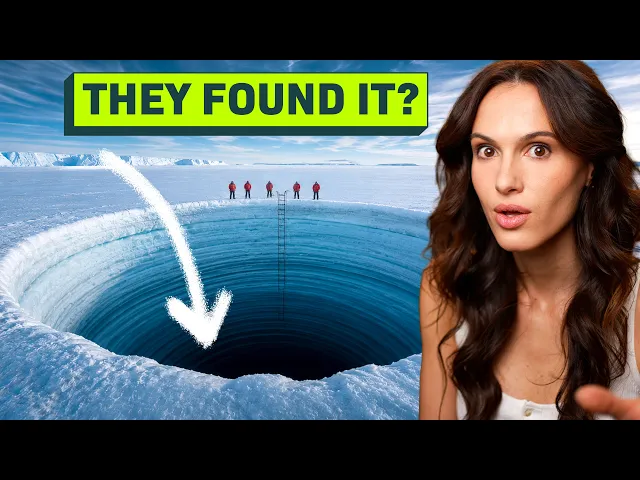
0:16 It looks empty, but there's something hiding down below this ice.
0:23 In 1970, a group of Soviet scientists started drilling right here.
0:28 For 28 years they kept going and going until after nearly 4000m.
0:36 They suddenly stopped because they had found something unimaginable.
0:41 Liquid water.
0:43 A secret lake, down below all this ice that had been completely
0:49 sealed off from the rest of the world for 15 million years.
0:54 How?!
0:55 And...
0:55 is there something alive in there?
0:59 Creatures that have been evolving separately from the rest
1:03 of the planet for 15 million years?
1:06 So scientists started searching for more of these secret lakes.
1:09 And as they did, they realized there is way
1:13 more going on under Antarctica than we ever thought.
1:19 I needed to know the truth about Earth's most remote continent.
1:24 So I've come all the way to Antarctica
1:27 to show you what's really happening down below this ice,
1:32 and exactly what they discovered when they finally broke inside.
1:38 Bring out the drill!
1:47 Ready?
1:48 If you wanted to drill to the bottom of Antarctica.
1:51 The first thing you need to realize is this ice is way thicker than you think.
1:56 If we were to take a chunk out of this ice and place it on the surface,
2:00 at its thickest, it would be this tall.
2:05 Wow.
2:07 That's nearly the height of Mount Kilimanjaro.
2:10 You would have to stack the tallest building
2:12 in the world six times to reach the top of that!
2:16 And this isn't just one uniform block.
2:18 It's full of all different kinds of ice.
2:21 And if you looked into the hole left behind by our chunk, you'd see land!
2:28 So as we start drilling, at first we're passing through snow,
2:32 which is surprisingly scarce here because Antarctica is the driest,
2:36 coldest, windiest continent on Earth.
2:39 It's technically a desert.
2:41 I can confirm it is very cold and very windy.
2:46 On average, it only snows a couple centimeters a year here,
2:49 meaning the snow just a few feet under your boots could be from a decade ago,
2:52 but as our drill makes its way through this snow, the texture starts to change.
2:57 "The snow then, of course, keeps accumulating and the deeper layers
3:01 become consolidated into firn." That's Dr.
3:04 Steven Chown, a biologist who specializes in life on Antarctica.
3:08 He's leading the trip I'm on with the White
3:10 Desert Foundation's “Science Week.” It
3:12 supports scientific research in Antarctica.
3:14 The “firn” that he's talking about is the stage between snow and ice.
3:18 It looks like a frozen sponge.
3:20 So we're drilling through this frozen sponge.
3:22 And before we reach the point where it actually turns into ice,
3:25 we hit something alarming.
3:33 I don't know why driving over it feels so much scarier than walking over.
3:37 It really does.
3:38 The reason to be scared is that as we're drilling through the firn,
3:42 it's not staying still.
3:43 As the snow and ice builds up its own weight,
3:46 slowly pushes it over the land toward the coasts.
3:49 And then, as it reaches the end of the continent,
3:52 it leaves the land and extends out over the ocean.
3:55 That's called the ice shelf.
3:56 The problem is, as this giant ice sheet slowly flows across the rocky ground,
4:02 it stretches and contracts.
4:04 And if it stretches too fast, the firn snaps, creating...
4:11 I'm about to go down into that crevasse.
4:13 You would never know it was here.
4:15 Oh my God.
4:17 This is a little bit of a test of my claustrophobia.
4:21 Bye!
4:24 Into the darkness we go.
4:26 Whoa.
4:27 It's huge.
4:31 This is incredible.
4:36 You would never think this is down here.
4:38 Look how deep this is.
4:39 You would not want to fall down into one of these.
4:42 I'm gonna...
4:43 I'm gonna get out now.
4:45 This is the amount of time that I want to spend underground.
4:49 So to not fall into a crevasse and to know what's coming down below us,
4:53 we need to do a lot of prep.
4:55 So back in the 1950s, scientists would explode TNT on the surface to measure
5:01 the seismic waves that would bounce back through the ice.
5:04 Today, they shoot lasers from satellites that bounce off the surface,
5:09 and any wrinkles or sagging give us hints at what's below.
5:14 TNT, space lasers.
5:15 Scientists are awesome.
5:19 But to really get underneath in detail,
5:21 they mostly shoot ice penetrating radar down from planes like this plane!
5:27 They crisscross the continent,
5:28 filling in a picture of what's really underneath Antarctica.
5:33 And what they can now see is the outline of an ancient world.
5:43 It's not flat.
5:44 There's a trench deeper than the Grand Canyon,
5:47 a completely hidden mountain range that rivals the European Alps.
5:52 Evidence of a massive impact crater and the largest volcanic region on Earth.
5:58 But in the late 60s, as they were flying these ice penetrating radar planes,
6:03 they suddenly spotted something especially strange.
6:06 "They also saw these weird depressions, a really big one,: like flat spots?
6:10 "Yeah, sort of a tiny depression" That earlier research
6:13 with the TNT had hinted that there was something odd here too.
6:17 And that Soviet drilling team?
6:18 They're drilling right on top of it.
6:21 So let's go deeper.
6:23 The deeper we go.
6:24 It's like we're going back in time,
6:26 layers upon layers stacked on top of each other.
6:30 The pores in the spongy firn get squished and the air
6:34 inside gets locked in, creating little bubbles from that time in history.
6:38 So now we're passing the Renaissance, the Roman Empire, ancient Egypt,
6:45 when humans started farming,
6:48 there's the extinction of Neanderthals and the first modern humans.
6:54 "And you can analyze that record by drilling
6:57 a core all the way down through the ice." Wow.
7:00 This is not easy.
7:04 Is it going down?!
7:06 I can't tell!
7:12 Oh, awesome.
7:18 "So here you can tell the story of the ice.
7:20 So if you hold it up against the light,
7:21 you can see some of the layers." I see it!
7:24 Wow.
7:27 Look at all these bubbles.
7:28 Those are pieces of atmosphere from decades or centuries ago.
7:32 But it's not just bubbles.
7:34 It's also sort of these tree rings of different.
7:37 I don't know what to call it.
7:38 Shades of ice?
7:40 "Exactly." But if you hold it up,
7:42 you can see that there are actually lines in it.
7:44 Ice that forms in winter has
7:46 a different texture and composition than summer ice, creating these lines.
7:50 And you can count them like tree rings,
7:52 but you can also see huge sudden changes:
7:55 "Where you can see certain events like a volcano eruption,
7:58 for instance." Like this!
8:00 That dark line is ash from a volcano eruption over 20,000 years ago.
8:06 And as I was looking at these layers of exposed ice,
8:10 I realized why scientists said were not allowed
8:13 to do something while we're hiking on Antarctica.
8:16 This is why you can't pee on the ice.
8:19 Because if you did, one day some descendant
8:23 of yours would be taking an ice core in Antarctica,
8:27 and they'd dig and dig and dig and they'd pull it out and they'd say,
8:30 “What's that yellow line?” It's a funny way
8:33 to understand what's really so important about this ice.
8:36 It's this incredible record of Earth and life on Earth that we can learn from.
8:42 "For me, one of the most amazing,
8:45 cool science things is that a team from Europe has found a core.
8:51 It's 1.3 million years and pulled they it out,
8:55 and they haven't yet analyzed it, but it's in the lab." Oh, that’s so exciting.
8:59 When can we expect it?
9:00 "I reckon in the next couple of years." Awesome.
9:03 "And that'll be the longest history of the planet's climate in ice." Oh my God.
9:17 As I was hiking, I said how lifeless everything looked.
9:20 And then Dr.
9:21 Chown told me to go find a white rock and look underneath it.
9:26 It became kind of a mission as we were hiking around,
9:29 and at first I really didn't understand why.
9:32 Mico, I went for a hike.
9:33 I'm in Antarctica right now and I was picking up white rocks.
9:38 Why would under a white rock be a good place to find life,
9:42 as opposed to just under any rock?
9:44 "Those white rocks can let a little bit of light filter through,
9:48 almost like a natural greenhouse effect for those tiny organisms underneath.
9:52 It's a really neat adaptation." So this is Mico.
9:55 It's like Clippy, but way smarter, actually.
9:58 Wait, hold on one second.
9:59 There's a secret way to turn it into.
10:01 Yeah!
10:01 I find that talking out loud to it sometimes helps
10:04 me figure out what I'm most interested in, and then
10:06 I can go deeper into the research and figure
10:08 out which way I want to go with the story.
10:10 I'm still on the hunt for a white rock with life underneath.
10:13 Now, we're almost at the lakes at around 3500m or over two miles deep.
10:19 The ice has completely changed.
10:22 There are no bubbles.
10:23 There's no dust.
10:25 It's so clear you could read a book through it.
10:27 This ice isn't coming from compressed fallen snow.
10:31 It's coming ...from below.
10:34 After decades of drilling and radar and seismic
10:36 and satellite data there was only one explanation.
10:40 A lake.
10:41 And not just any lake.
10:43 It's huge.
10:45 It's similar in size to Lake Ontario.
10:49 By volume, this is the sixth largest lake in the world.
10:53 It's called Lake Vostok.
10:56 But wait, how could there be liquid water under all this ice?
11:01 Well, for one, the ice is acting like a giant thermal blanket.
11:04 Heat from Earth's core is held in place down here.
11:07 But more importantly, sitting under all this ice is ~350 times
11:11 more pressure than what you feel at sea level.
11:15 And as pressure rises, water stays liquid at lower temperatures,
11:21 which means ...a massive under ice lake is possible.
11:26 So now the question is, if there's water down there, could there be life?
11:30 And if it was isolated from the rest of the world for 15 million years,
11:35 what would it look like?
11:37 With a drill poised right above it They now have to decide.
11:42 Should they poke it?
11:43 "They realized they could potentially go all the way
11:47 through into the lake water." Was that risky?
11:50 "Yeah.
11:50 Oh, totally.
11:51 Nobody knew what would happen.
11:52 Like, would it pressurize and blow everything out?
11:55 Would it, you know, would it be really super dangerous?" "We actually looked
12:00 at this very closely because we don't want to kill anybody." Oh, good.
12:04 That's John Priscu, one of the first scientists to study Lake Vostok.
12:07 "If you take a Pepsi bottle and you put in a Mentos,
12:10 these little minty things, and blow it in, it just blows up.
12:14 So that's what we're looking at.
12:15 So Lake Vostok had a lot of water and be a blowout like a volcano.
12:19 This took about ten years to sort out.
12:21 It took a good portion of my life." But during this time,
12:25 studies kept finding more and more lakes.
12:27 Hundreds of them.
12:28 And satellites revealed something very weird.
12:32 The ice sheet was lifting and dropping almost ten meters in some places, and Dr.
12:39 Helen Fricker was the first to notice.
12:41 "Yeah, it was pretty incredible.
12:42 It was one of those, like, jaw-dropping moments." While Vostok and other lakes
12:46 like it sat sealed off around the continent,
12:48 there were hundreds of other active lakes that can literally lift and drop
12:53 parts of the ice sheet as they filled and drained into one another.
12:58 And the first one that she saw was here.
13:01 "The whole lake shape looks like a footprint."
13:03 So there aren't just lakes down there.
13:05 It's an entire plumbing system under the ice connected by rivers.
13:11 So at this point, over a decade had passed since
13:13 drilling had paused at Vostok and we'd learned so much.
13:16 So now the plan wasn't for one country to drill into one lake.
13:20 It was for three countries to drill into three lakes:
13:24 the Russians into Lake Vostok,
13:26 the British into Lake Ellsworth, and the Americans into Lake Whillans.
13:31 Time to poke an ancient lake!
13:33 First up, the Russians.
13:34 They had a massive head start with their effort to drill into Lake Vostok.
13:37 But they had a problem.
13:39 There hole was already filled with drill fluid to prevent it from freezing,
13:43 specifically kerosene.
13:44 So to solve this problem, they added freon, which is heavier,
13:47 and the idea was that it would act like a plug.
13:49 And then they used the special drill with a heated
13:52 tip to slowly melt into the surface of the lake.
13:55 And as soon as they broke through, the pressurized water from the lake,
13:58 shot up over 30m into the hole, pushing the kerosene and the freon away.
14:03 "I saw the videos and there was kerosene blowing at the top of that hole.
14:07 It was a little scary.
14:08 I'd be running as fast as I could." They left
14:10 that new lake water in the hole to freeze for a season,
14:13 and then they pulled it up to study it,
14:15 and the headlines said that they found a totally new type of bacteria!
14:20 But those bacteria were suspiciously similar to the bacteria found in kerosene.
14:25 "Problem was that it mixed with the drilling fluid,
14:28 which is highly contaminated.
14:29 It's full of bacteria.
14:30 so they didn't publish anything." "That was
14:33 controversial because many people said they had
14:37 contaminated with drill fluid." So the international
14:39 science community was skeptical of the Russian find,
14:42 but the British and the American teams were still trying to poke their lakes,
14:46 and they were using a different drilling tech that didn't use drill fluid,
14:50 but super clean hot water that was filtered and decontaminated with UV light.
14:55 This boiling, pressurized water just blasts and melts away the ice,
14:59 but it still needed fuel to power the thing.
15:02 And the British team, they ran out.
15:05 The other teams tried to help them get more fuel, but they couldn't.
15:09 So now, with only one team left,
15:12 they slowly went deeper and deeper and deeper until finally...
15:20 "And I remember breaking into the lake and you could hear the cheers.
15:23 The whole roar went up.
15:24 It was pretty...
15:25 I had goosebumps and we broke through." So they
15:28 bring up a sample of liquid water from this lake, and inside they find life.
15:35 Tons of life!
15:37 A full ecosystem with colonies of bacteria
15:40 and tiny organisms that were all thriving without sunlight.
15:45 And in 2018, they did it again here, this time sampling sediment too.
15:50 Dr.
15:50 Priscu gave us a sneak peek of the research
15:52 that he's about to publish from that lake.
15:54 And it seems to show that some of the life under
15:59 Antarctica is genuinely new and different than anywhere else on Earth.
16:04 "We found some new kinds of viruses that are bacteria viruses." Don't worry.
16:09 These are viruses that are specific to bacteria.
16:11 They're not going to infect you.
16:13 I was worried about that too.
16:14 I want to study them.
16:15 I just want to never get them.
16:17 "No, I don't think you’re gonna get ‘em.
16:19 I mean, I'm still alive." Do you think.
16:22 Do you think that there are larger animals down there that we haven't seen yet?
16:28 "Yeah.
16:28 That's another.
16:29 That's a good question.
16:30 We looked around, we took an ROV and we had cameras going,
16:33 so unless they were avoiding us, there’s not." But that new microbial life is
16:39 really special because while it's new to us...
16:42 "So Antarctica hasn't always been fully covered with ice
16:45 So maybe the new life we find is old life.
16:48 Old new life." Using this new research,
16:50 we can learn about the origins of life on our planet and even beyond it.
16:57 One of the coolest things about this story is that all of this science,
17:01 all of this drilling through incredibly thick
17:03 ice and not contaminating it or us,
17:05 and all of this technology is exactly what we would
17:09 use to explore the icy moons and planets for alien life.
17:15 Finding life here makes many scientists think that we'll find it out there.
17:21 Do you think that there is life on the icy moons like Europa?
17:27 "Yes.
17:28 Yes, definitely." We found life in one of the coldest,
17:32 darkest, most alien places on Earth.
17:35 There are hundreds of other lakes still untouched.
17:39 And while scientists think it's very unlikely
17:41 that any of them contain larger life forms, what's inside is still a mystery.
17:46 "It's just cool.
17:47 Science is amazing and humans are amazing for doing this." "We
17:51 have a lot more to explore." Exploring has never been easy.
17:55 "The teamwork involves so many people involved.
17:58 You know, it's just an incredible thing." but it's worth it.
18:02 There are still untouched places left
18:06 to be discovered and new mysteries to solve.
18:10 HUGE*, if true.
18:11 We're making another episode all about what really happened with the ozone
18:15 layer on Antarctica and the current science happening right now.
18:19 So if you want to know more, subscribe.
18:27 "We haven’t even shown you the ancient aliens
18:28 and the ice wall and the government conspiracies.
18:31 The pyramids underneath.
18:33 So much here though." "Like and subscribe,
18:35 because the conspiracies are out there and they don't want
18:38 you to know about them." We want come to us
18:41 and we will tell you." "I think there's one
18:43 of the aliens right now." That's that's what you're hearing.
18:45 Yeah.
18:46 Oh, no.