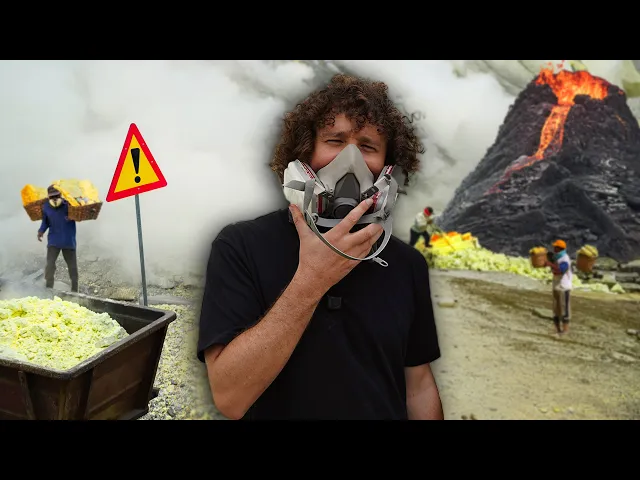
Así es el trabajo “más peligroso” del mundo (adentro de un volcán) ⚠️🇮🇩
Luisito Comunica
0:00 These incredibly brave miners work deep inside
0:02 an active volcano that could erupt at any moment.
0:06 Every single day, they are exposed to water
0:08 so acidic it could easily blind them,
0:11 and gases so toxic they could suffocate in seconds,
0:14 only to then walk miles with dozens of heavy kilos balanced on their shoulders.
0:18 Without a doubt, one of the most dangerous jobs that exists on the planet.
0:23 That is a truly and deeply disturbing fact.
0:35 We're on the island of Java, in Indonesia,
0:37 and today we've climbed up to the crater of the Ijen volcano
0:41 to witness firsthand one of the most dangerous jobs in the entire world.
0:45 This incredibly grueling and arduous labor
0:47 consists of extracting sulfur from the volcano
0:49 to sell it by the kilo and subsequently send it to various industrial factories.
0:55 The miners are exposed to highly hazardous and toxic gases and bodies
0:58 of water so acidic that it could even be potentially fatal to any human.
1:02 Being such an extreme and dangerous activity,
1:05 their working life is usually extremely limited and short,
1:08 barely ten to fifteen years at most.
1:10 Most workers suffer from chronic and debilitating respiratory conditions,
1:14 as well as severe wear and tear on their knees and even broken shoulders,
1:18 as they must manually extract dozens of kilos of solid sulfur every single day.
1:23 They do this work completely by hand,
1:25 and then they must walk down a steep path for over three kilometers
1:28 from the very top of the volcano all the way to the base,
1:31 while carefully carrying fifty to seventy kilograms
1:34 of weight in their traditional bamboo baskets.
1:36 In this video, we're going to talk with dedicated
1:39 people who have been doing this job for years, and we'll try to figure out why
1:42 in our modern world today with so much technology, this job still exists.
1:46 Come on, the arduous labor at the Ijen volcano, Indonesia awaits us.
1:50 Let's get started on this now.
1:59 This volcano is often called the yellow hell,
2:02 because of the obvious conditions here and how lethal everything can be.
2:06 It is yellow because that's the color sulfur turns once it solidifies.
2:11 This is what the miners are going to collect so they can sell it later.
2:15 The hardest part is that these people aim
2:18 to earn barely five to fifteen dollars a day.
2:21 since each kilo usually sells for one thousand to one
2:25 thousand five hundred rupiahs depending on the set price,
2:27 so do the math, even if you collect ninety, one hundred kilos in a day,
2:33 the maximum pay you can hope for is maybe about seven dollars,
2:37 And it's not like the individual miners can simply set whatever price they want,
2:41 because a mining company holds a monopoly
2:43 on extracting resources from this crater.
2:45 Consequently, they are the only ones who can buy the material to resell it,
2:49 and therefore, they are the ones who set the price.
2:52 It's not like there's a negotiation, it's not like, oh no,
2:55 there's not much today so I'll sell it to you for more,
2:57 no, no, no, whatever they tell you is what they're going to pay you.
3:00 Aman.
3:01 Friend.
3:01 Safe.
3:02 Friend.
3:02 My friend.
3:03 Taman Kawan means friend.
3:04 So look right here, our buddy has fifty kilos
3:06 here and he makes two or three trips every day,
3:08 and just look at him, he's acting like it's nothing at all,
3:11 man, I mean, it's truly impressive.
3:17 We're already here chatting with the people.
3:19 Obviously, we have a translator guide because I only learned about four words,
3:22 very useful by the way.
3:24 How are you, friend?
3:25 Good, good.
3:25 Good, good.
3:26 Good, good.
3:26 We've already established communication here with some
3:29 miners and they're going to take
3:30 us down to the very heart of the matter to understand it better.
3:32 And look, we're learning something really tough,
3:34 and that is that they don't receive their...
3:37 ...pay day by day, but they don't get their cash until the weekend.
3:40 So they track it like: today you got these kilos,
3:43 tomorrow those, and they keep adding it up;
3:45 until the weekend they see their money.
3:47 And that's if the accounting is honest...
3:49 ...and at the price the company dictates, because I'm telling you,
3:53 it's a monopoly, they have the sole permit to exploit the sulfur.
3:56 Likewise, they're telling us that well,
3:58 all of them are freelancers, they're independent workers.
4:01 So all their uniforms, all their masks and such,
4:04 they have to buy them themselves.
4:06 So many workers can't afford to buy, well, a mask like this, you know,
4:09 to be able to breathe the gases like this one.
4:12 So they just use small wet scarves, small rags,
4:15 and that's how their lungs deteriorate more and more.
4:18 We're going down to explain better how this works.
4:29 Whew, it's really tough in there.
4:31 Wow!
4:32 Whew.
4:32 It's super, super necessary, as well as the goggles.
4:35 Can you hear my breathing?
4:37 Wow!
4:37 I feel my breath is a bit short because
4:39 we were just taking pictures in there and all.
4:41 No, no, and these guys do this for years, years.
4:43 It's very hard, very hard.
4:45 I understand why it's one of the most
4:47 dangerous jobs in the world, if not the most.
4:49 Look, what we're seeing is basically how the volcano releases a lot of gases.
4:53 Obviously, the volcano is extremely hot.
4:55 There's boiling magma and in this magma there are many components.
5:00 Among these components is sulfur,
5:01 which is the bright yellow gold we're collecting.
5:04 The gold of Java, as they call it.
5:08 How does it work?
5:09 It's that the extremely boiling, boiling, boiling gases are violently expelled.
5:12 So the miners properly install...
5:15 ...pipes.
5:16 This is like a metal pipe that deteriorates, in fact, quite quickly.
5:20 We saw there how the piping is already completely worn out.
5:23 So it's very hot, and what the pipe does is that this smoke,
5:28 this vapor, can condense.
5:30 In this way, it remains as an extremely hot liquid,
5:34 which eventually falls to the ground,
5:36 concentrates with the pipes they make, and in this way, it solidifies.
5:40 Once it's all solid, the miners arrive with their picks
5:43 and shovels and extract it completely manually.
5:46 That's how they collect it, and once they have the large pieces,
5:50 they proceed to cut them into smaller pieces to be able to transport them.
5:55 This raw sulfur, they later carry it up in heavy baskets,
5:58 all this long way we just came down, which is honestly very heavy.
6:01 Forty, fifty, sixty, or some maybe even eighty kilos;
6:05 they carry them on their tired backs to later
6:08 weigh it all and get paid for their hard work.
6:10 And this sulfur, why is it so valuable?
6:12 Well, that is because it is used for many, many things.
6:15 The most important thing to note here is sulfuric acid.
6:19 It is used for various medicines, for skin creams,
6:22 for medical ointments, for gunpowder, matches, and even for food products.
6:26 For sugar, for example, it is used in the process to make white sugar.
6:31 To remove the color, that's what it's used for.
6:33 Sulfuric acid is used for many, many things.
6:36 So it's very hard, it's really tough to think that, so
6:40 that we consumers have white sugar and preserved wines at a good price,
6:44 this crew is here risking it all in the mine,
6:47 risking their health, shortening their lives,
6:49 without exaggeration, just as it is.
6:52 Hey, and in case it hasn't been clear,
6:54 we are right now literally standing inside a volcano.
6:57 That's right, we are in the very crater of an active volcano.
7:01 This thing at any moment could erupt, and at any moment it could explode.
7:05 If these miners risk their lives, well, that's it,
7:08 there is just no way to sugarcoat it.
7:11 Each and every day they don't know if they're going
7:13 to make it out alive from here, from this job.
7:16 Now, since the workers are independent, as I was telling you, well,
7:19 the mining companies save a lot of money
7:22 because they don't have to give them health insurance,
7:24 or a pension, or even a salary,
7:26 because they only get paid for what they collect.
7:28 It's not like, oh, they're going to give me
7:30 this much biweekly and I have economic security, so to speak.
7:34 No, no, no, none of that.
7:35 And the most heartbreaking thing, honestly, the saddest and hardest part,
7:39 is that this is no longer a completely necessary industry, okay?
7:43 This way of extracting sulfur has already
7:46 been replaced by a much more massive industrialization.
7:49 To put it in perspective, in this mine they can extract every single day, maybe,
7:54 if many people come to work and are hitting it hard,
7:58 from ten tons to thirty tons in the whole day of this raw sulfur.
8:02 But if we transition to a much more industrialized process,
8:05 with specialized machinery that extract using gases and oil these companies can
8:10 manufacture and produce up to one thousand tons in a single day.
8:14 So it's absolutely incredible that the most modern industries,
8:17 companies, and factories that have machinery, oil, and gases,
8:20 in a matter of minutes—and I'm not exaggerating when I say minutes—produce
8:24 the same sulfur that is produced here all day long with this human labor.
8:29 So that's the hardest part of all,
8:31 that the sulfur industry is of course very important and very necessary,
8:35 but this way of extraction, sadly and as cold and harsh as it sounds,
8:40 is no longer necessary for humanity.
8:43 So, if this work, this labor, is no longer necessary, why?
8:46 Why is it still being done?
8:48 Well, basically due to a lack of opportunities, because there is no other job.
8:52 Nearby, the only additional work that can be found is,
8:56 for example, in crop fields.
8:58 Rice farming and fruit farming are options,
9:00 but they provide much lower wages than this labor.
9:03 So the men, wanting to give their families a much better life,
9:06 come here to willingly risk their very lives, to shorten their working time,
9:10 and to put their physical bodies at risk to be able to earn more money.
9:14 The cruel irony is that by trying to give their families a better life,
9:19 they're actually significantly shortening their own lives.
9:21 And why hasn't a substantial financial investment been
9:25 made to create a more industrialized process here?
9:28 Well, basically because nobody has cared enough.
9:30 Okay, it sounds awful, but it is what it is.
9:33 The thing is, to install machinery, elevators,
9:36 and so on, it would require millions of dollars in investment.
9:39 Something the company doesn't want to pay
9:41 for because ultimately this isn't that profitable.
9:45 It is much more cost-effective to keep paying the workers on a weekly basis,
9:49 around five to seven dollars a day, and in this way they can keep on mining
9:53 the sulfur while the company's monopoly license remains in full effect.
9:57 This sounds terrible, but it's the reality.
10:00 It is significantly more cost-effective for industries to have laborers here
10:04 risking their lives than to install
10:06 machinery or fully industrialize this process.
10:18 We met good old Saman here and good old Olazim,
10:20 who are both telling us all about the job.
10:22 We're learning right away, and oh my god,
10:24 we're starting off really strong, check it out.
10:26 They're letting me try to carry this on my shoulder,
10:29 which is exactly what they do, well, on a daily basis, so let's see.
10:32 This thing here, how much does it actually weigh?
10:34 Oh man, no way.
10:35 Wow!
10:36 This is incredibly heavy, no kidding, this weighs about seventy kilos.
10:40 Oh!
10:41 Holy cow, man!
10:42 Holy cow!
10:43 Wow!
10:43 This is absolutely unbelievable!
10:45 Holy cow!
10:46 Holy cow!
10:46 Holy cow!
10:47 No, no way, this is really tough.
10:49 Wow!
10:50 Honestly, it's extremely heavy.
10:52 Truly admirable, and I'm telling you all this, look,
10:56 just climbing the volcano to get here was hard enough for us, okay?
10:59 It really took a lot out of us, and these guys do it while carrying this, that's
11:04 why I say they often have broken shoulders.
11:06 Look at how his shoulder is so, so worn down.
11:09 No, seriously, wow!
11:11 This is just really, really hard.
11:13 They're telling us they usually work ten to twelve hours a day.
11:16 They start very early in the morning and leave around one
11:20 in the afternoon so they don't get hit by the sun when it's strongest.
11:23 And while many dedicated workers come here every single day,
11:26 they tell me that since they've been doing this for several years now,
11:29 they only come about three times a week.
11:32 But back when they were much younger,
11:33 they would consistently do it like six full days every week.
11:36 Man, that's really tough.
11:37 Terima kasih, huh.
11:38 Terima kasih, terima kasih.
11:40 Terima kasih.
11:41 Of course, to all these people who are letting us film and everything,
11:44 we're giving them good tips.
11:46 And yeah, look, this, what we're seeing here is what they risk their lives for.
11:50 This is what's called the devil's yellow gold.
11:53 What our friend here is doing is really catching my attention.
11:56 Look, he's picking up small pieces.
11:58 Of sulfur that he finds, look, because it's everywhere, okay?
12:02 So since this one here just came out, it's boiling hot,
12:06 he puts those there so they all melt together,
12:08 and then later he'll have a larger piece and be able to take out heavier chunks.
12:13 Man, I'm glad we brought these big goggles and the mask because, holy cow!
12:18 If you take it off, your eyes start stinging right away,
12:21 and your throat starts stinging too, you cough a lot.
12:24 A shout-out to my buddy I met in Texas who gave me these goggles.
12:28 A guy I met at a bar, and the brother was just getting off work and he told me,
12:32 Luisito, I want to give you my goggles, they'll come in handy one day.
12:35 And today they're helping me out a lot,
12:37 so if you're watching this video, brother, thank you, my friend.
12:39 Good old Eddie here has been our contact,
12:42 the big boss, he's the supervisor of this entire area.
12:45 You, how many years work here?
12:47 Thirteen long years.
12:48 Thirteen years?
12:49 Oh wow, that is a very long time, wouldn't you say?
12:52 Yeah, it has been quite a long time.
12:53 And um, for most people, how many years maximum work?
12:56 The number is forty-five.
12:58 Forty-five?
12:58 Oh wow.
12:59 Look, there are people who work here for up to forty-five years.
13:01 I thought they were much, well not shifts,
13:03 much shorter working lives because of how risky it is, but holy cow.
13:07 I have worked here for the past eleven years
13:09 and the actual physical risks of working here range
13:12 from breathing the air to the strain on our muscles
13:15 we have to have a lot of endurance and strength.
13:17 One must exercise extreme caution to avoid
13:19 the inherent dangers of the environment.
13:21 Until just a few years ago,
13:24 somewhere between three hundred and four hundred different
13:27 miners used to work here on a daily basis,
13:29 but it has been widely reported that in recent times,
13:32 maybe only forty or fifty actually come to work each day.
13:35 The primary reason behind this shift is that the miners have realized
13:39 that they can earn much more money in the local tourism industry.
13:42 And this brings with it a very tough, very complicated,
13:46 and very interesting conflict of interest
13:48 that is currently unfolding right here.
13:50 You see, this volcano is quite touristy because it's one of the few places
13:55 in the entire world where you can see the fascinating phenomenon of blue fire.
13:59 Tourists come in the very early hours of the morning
14:02 to be able to see the crater illuminated with surreal blue colors.
14:06 There are few volcanoes in the world where this can be appreciated so vividly,
14:10 and it is quite possible that this is the only one of its kind.
14:14 This phenomenon is basically caused when the sulfur coming
14:18 out of the volcano hits the oxygen that's outside.
14:21 It creates a kind of combustion.
14:23 So the sulfur is vital for us to be able to have this spectacle.
14:28 When the mining company realized that many
14:29 of its miners were now dedicating themselves to tourism,
14:33 whether it was guiding groups of tourists,
14:35 whether transporting visitors in traditional carts,
14:38 or even selling handcrafted souvenirs,
14:40 they decided to play their cards against this trend
14:44 and flat out shut down the entire show.
14:46 because while the blue fire is a natural phenomenon,
14:50 for it to be seen with this intensity,
14:52 the pipes that the mining company has installed are needed,
14:55 And since they have paid for very expensive concessions so that for more than
15:00 thirty years they are the only ones who can exploit the sulfur in the crater,
15:05 they basically control the whole area; so if they wish,
15:08 they can make the sulfur go somewhere else,
15:11 and they can make it disperse however they see fit.
15:14 they can make the concentration drop, they can send it back there,
15:17 and because of that, the people we've met here tell me,
15:20 to date they've had three months of protest, that there's no blue fire,
15:24 unless you contact a special tourism agency that pays them
15:27 and they flat out set up the show for you,
15:30 they release the sulfur where it should be
15:32 and that way you can see the blue fire.
15:33 They tell me that some guides also, looking for a strategy,
15:36 what they do is they take gasoline and spread it.
15:39 and they trick tourists like, oh look, the blue fire,
15:42 but it's actually gasoline that they've put there themselves.
15:45 Why?
15:45 Because the mining company basically has this sulfur held hostage.
15:49 They have the monopoly; only they are allowed to exploit it.
15:53 So if they don't want there to be a show, there won't be one.
15:55 So it's definitely a very complicated situation.
15:59 The mining company paid a lot of money
16:01 to the government to have access to the sulfur,
16:04 but this industry has become somewhat obsolete.
16:07 It's attracting tourism, and they're not seeing royalties from this tourism,
16:12 so they want their piece of the pie.
16:14 Honestly, man, this world is driven by money, it's pure economic interest,
16:18 and right in the middle are the workers
16:20 with the constant uncertainty of, should I get
16:23 another job or should I deteriorate my own body just to earn a bit more money?
16:28 Eddy is telling me that inside this tube here,
16:31 it's approximately two hundred and fifty degrees Celsius.
16:33 It's boiling; it's extremely hot.
16:37 Oh man, yeah, yeah, yeah, it's really, really incredibly hot, wow.
16:40 And yes, look right over there,
16:41 we can clearly see how the liquid is boiling and bubbling away.
16:45 Touching that would be super toxic.
16:46 Honestly, oh, how do I describe it to you?
16:48 When the large fumaroles come like that, it burns you,
16:51 like you breathe and you have to cough right away.
16:54 Just look at the amount of smoke you can see there.
16:57 Wow, and look at that, right where the pipe is, you can see the blue fire.
17:01 Oh, I don't know if the camera can catch it, but look, that's the blue fire.
17:04 Wow, how crazy.
17:16 And as if it weren't already enough that these workers
17:18 have to deal with these extremely toxic fumes,
17:21 the water also has acid levels that are considered to be extremely dangerous.
17:26 This lagoon we're seeing here in the crater,
17:28 with its very paradisiacal blue color,
17:31 is practically like a giant vat of diluted liquid battery acid.
17:36 To put it into a better perspective,
17:38 the fresh water that we humans usually drink
17:41 has a neutral pH level of approximately seven.
17:44 Lemon juice, which is very acidic, usually has a pH of two.
17:48 The water we're seeing here currently has a pH level that is close to zero.
17:53 It's very, very acidic, very dangerous.
17:56 If this water gets into your mouth, for example,
17:59 a tooth could actually fall out, no exaggeration.
18:01 This water can dissolve heavy metals; it can even dissolve plastics.
18:06 Here Eddy is giving us a demonstration of how this pipe that's right here,
18:10 just look at this, Just check out
18:12 how incredibly easily that fragile pipe breaks.
18:15 So if someone were to accidentally fall into these waters and, for example,
18:18 you opened your eyes, you'd most likely go blind, you'd start to get burned,
18:22 your skin would start to get very irritated.
18:24 That's why they need to be very, very careful.
18:26 But look at how Eddy grabs it like that with his hand,
18:29 look at that, look at that, it breaks.
18:31 Oh, this is, well, it's metal.
18:33 Just like delicious cookies.
18:34 Just like delicious cookies.
18:36 Like cookies, yeah.
18:37 Exactly, like a little cookie here, exactly.
18:39 Yeah.
18:39 To give us an idea, if this is what the water does to metal,
18:42 what can it do to your body, your eyes, your lungs, your stomach, your teeth?
18:48 It's clear why this is indeed one of the most truly dangerous jobs in the world.
18:52 There's risk, there's danger at every turn.
18:55 This one here, this is not toxic?
18:57 Not toxic.
18:58 It's not acid.
18:59 It's not acidic at all.
19:00 So this water here isn't acidic, it's not toxic; it is just a bit of warm water.
19:04 But that one over there is actually very acidic.
19:07 Oh, when everything gets all white like
19:09 this, that is exactly when it hurts the most.
19:11 Honestly, your eyes really hurt like crazy.
19:14 And all because of this thing here,
19:15 they call it the yellow gold of Java, the gold from hell.
19:19 It's really tough that this is one of the only job options.
19:22 It's good they've realized they can earn more from tourism.
19:25 And hopefully they can quickly balance the situation
19:28 between mining and tourism so this can end, really.
19:31 Because yeah, it's just...
19:33 Terrible, just terrible.
19:34 The workers are showing me around here.
19:36 They say this is their five-star hotel.
19:38 That's what they call it as a joke, yeah.
19:40 This is where they rest, check it out.
19:42 We've already made some friends here.
19:45 Hello!
19:45 Hello there.
19:45 Hello.
19:47 So, look, my brothers here are basically just really tired.
19:50 So they come here to rest, look.
19:52 They come to have a cigarette, right?
19:53 They're here smoking for a bit and then they take a little nap.
19:56 So they rest for a while and then they get back to work.
20:00 Look, they told me to get a shot of them smoking here.
20:03 And my brothers here are always smoking; you even see them working hard,
20:07 carrying those incredibly heavy baskets, and they're just smoking away.
20:10 It's just great.
20:12 Smoking's good.
20:13 Great.
20:13 Good, smoking's good.
20:15 Smoking's good, smoking's good.
20:17 Once the sulfur has been collected, it's packed into large sacks,
20:20 and then these men take on the job
20:22 of transporting them down to the foothills in carts,
20:25 where the sulfur will be weighed and recorded,
20:27 and they'll count exactly how much each person has collected,
20:31 and that's how their earnings are calculated so they
20:33 can get paid at the end of the week.
20:36 And look, going down is clearly a bit less complicated than going up,
20:39 but still, they're carrying over one hundred kilos here,
20:42 so it's tough, it's really tough.
20:44 A great many of the local people who used to work
20:46 in the mines now transport visiting tourists to the top,
20:50 as it provides a much higher income for them;
20:53 for those with mobility issues or the elderly,
20:56 this service is exceptionally useful.
20:59 So we are going to do a little demonstration for this video,
21:02 please don't attack me in the comments,
21:04 we're obviously paying these workers and everything,
21:07 so take a look at how it all works;
21:09 you sit like this, and then basically three people pull you.
21:12 One.
21:13 Two.
21:13 Three.
21:15 And that's how they get you up.
21:17 For the trip up they charge about one million,
21:19 which is approximately fifty US dollars.
21:23 And for the round trip it's one and a half million,
21:26 about seventy-five dollars approximately.
21:28 And in this way, they make much more money;
21:30 they earn a much larger profit than they could by working in the mine.
21:34 Now, many people criticize this service, and with very good reason,
21:39 because they often say it's like a...
21:42 Modern slavery, let's call it that, right?
21:45 Like you're paying someone to carry you
21:46 and all that, I honestly completely understand that narrative,
21:49 but if we put the situation into perspective...
21:51 well, this is a job that's actually much less tiring,
21:57 much less risky than working in the mines, and they can be earning more money.
22:00 And lacking other sources of work, besides the farming fields and mining, well,
22:05 this turns out to be a more convenient option for them, given the reality.
22:10 These two super friendly men worked for over twenty
22:12 years in the mine and then they realized like,
22:14 no, well, here I can earn up to five, ten times more than there.
22:18 What he does tell me is...
22:20 that his knees, right?
22:22 And yeah, look here, see.
22:23 Check out how our friend has his shoulder, well, broken.
22:25 Because for many years he carried extremely heavy loads.
22:29 So, well, it breaks.
22:30 In the same way, he tells us he has knee problems because of that.
22:35 That he has lung problems, breathing problems.
22:37 Honestly, it's really tough.
22:38 I mean, we're seeing it.
22:39 These are the results of working for so long.
22:43 So, I think if you put the work into perspective, well, wow.
22:47 given the circumstances and the possibilities, well,
22:49 this is a more dignified job and without a doubt much, much less risky.
22:53 Oof, and super admirable, it really gets very steep in certain sections.
22:57 Honestly, it is incredibly tough,
22:59 both obviously for the people who work transporting visitors,
23:03 and especially for those who go down with all that heavy sulfur on their backs.
23:07 Man, this whole path, imagine carrying sixty kilos on your back like that.
23:11 That's why they end up like this with broken shoulders.
23:14 No, no, it's really tough, really tough.
23:16 Wow!
23:17 And his fitness is impressive.
23:18 Check out my bro here with his cigarette going up, like it's nothing.
23:21 No, I'm already, like seriously, struggling here, you know?
23:23 I mean, I'm totally wiped out.
23:25 And this bro with his cigarette and everything, a champion.
23:28 He's in really heavy-duty shape.
23:30 Having to start work so early,
23:32 most of the miners will start at four in the morning.
23:35 Many choose to, simply, stay and sleep here.
23:38 Check it out, this is a lodging that's owned by the mining company.
23:41 And this one's free, okay?
23:43 This one, yeah, if you're working with the mine and all,
23:46 they don't charge you anything.
23:47 So many, instead of having to go all the way home
23:50 and then come back the next day and sleep very little,
23:53 it's very tiring, they'd rather choose to stay and sleep
23:55 here all week and only go home for one day.
23:57 Then they come back and this way they make better use of their time and energy.
24:01 We have a little campfire here, right?
24:04 Where they can boil water, have a little coffee, whatever.
24:07 And right over here is where the sleeping beds are.
24:10 Take a good look at what we have right here.
24:11 They are built like small and functional individual
24:14 cubicles with pretty simple mats that slowly rotate.
24:17 And also, over here,
24:18 they have a convenient spot where they can clean themselves up,
24:21 go to the bathroom whenever they need to, and so on.
24:24 During the nighttime hours it gets somewhat cold,
24:27 that's why they keep these warm campfires burning and well yeah,
24:30 basically they make their entire lives here.
24:32 So while some people can return to their own homes and well
24:35 be with their families and all and sit down to eat with them,
24:38 Others, because of the distance or high cost, choose to stay here.
24:41 Life becomes a cycle: going to the mine, then drinking, smoking, and chatting.
24:46 That's how they get by and survive.
24:48 I was told there used to be more of these places,
24:51 but now with fewer workers, only this one remains.
24:54 Maybe fifteen live here permanently, and they rotate,
24:57 sometimes twenty during peak season, and that's how they keep rotating.
25:10 We're learning about another way these miners earn some additional income.
25:14 And look, they make souvenirs out of sulfur, they put them in molds,
25:18 and they come out with these really interesting figures.
25:21 Look, here we have a Buddha,
25:23 they also make a little turtle, and they make a cat.
25:25 And they sell each of these to tourists for fifty thousand.
25:29 Three dollars, two and a half dollars.
25:31 So in this way, it's like, okay, I sell the sulfur to the mines and all that.
25:34 But since there's a lot of tourism, I make some money off it.
25:38 Man, they are...
25:38 Really smart people, huh.
25:40 Very smart, very smart, smart.
25:41 Of course we're going to buy some of these souvenirs,
25:43 I mean, it's great and how resourceful, what resourceful people, right?
25:47 Well, they say, a lot of tourists come here, so let's sell them these things.
25:50 I love people like that, always pushing forward, good, good, good.
25:53 They're teaching me a word here, Javanese,
25:54 from the island of Java, which is mongo, mongo.
25:57 Mongo.
25:57 Mongo.
25:58 Mongo.
25:58 Mongo.
25:59 Mongo.
26:00 Mongo.
26:01 Bye, mongo.
26:02 Bye, mongo.
26:02 I appreciate it, mongo.
26:04 Hey, yeah.
26:04 Good luck, friend, good luck.
26:05 Bye.
26:06 No, and did you see, I mean, I think that's the most, uh...
26:09 Well, special, I mean, and that...
26:11 Man, you feel really bad that...
26:12 These are people who work really hard, they face very harsh realities...
26:16 And yet here they are joking and smiling and making jokes and laughing and...
26:20 And that attitude makes their jobs feel much less heavy.
26:24 No, honestly, wow, what truly resilient people, they are just so admirable.
26:37 Well, there you have it, a glimpse into the harsh and demanding reality
26:40 of the miners at the Ijen volcano in Indonesia.
26:43 Without a doubt, this was a very difficult and complex
26:47 report for us to produce, so I want to thank,
26:50 first of all, the brave miners who welcomed us so warmly,
26:53 always so smiling and positive,
26:55 despite their truly difficult and grueling circumstances.
26:58 Thanks to the good...
26:59 Tegu, our fixer, and to the good Eddy,
27:02 who helped us get close to all the workers.
27:05 To Ari, to Kamari, who works incredibly hard behind the camera.
27:09 And of course, also to all of you for joining us on another adventure.
27:13 We'll see you as always, you know it, in a few days with a new video.
27:16 Goodbye.
27:17 Bye.