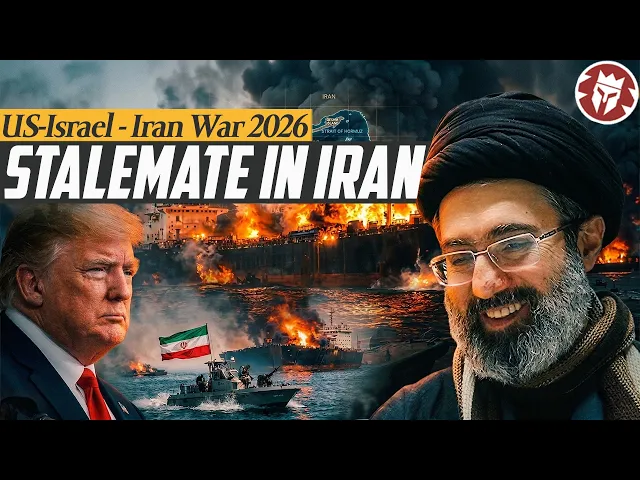
Will Iran Become Another Forever War?
Kings and Generals
0:11 Many long wars were initially expected to be short affairs.
0:15 “Home by Christmas” was what many on both
0:17 sides believed when World War 1 started.
0:20 Neither the Soviet Union nor the United States probably predicted
0:23 that they would have to fight very long insurgencies in Afghanistan.
0:27 Most recently, Vladimir Putin intended a short
0:30 and victorious war in Ukraine and certainly
0:33 did not want to get bogged down there for more than 4 years now.
0:37 At the start of conflicts,
0:38 political leaders and ordinary folk alike express conviction
0:41 or hope that a war will end soon,
0:44 either through poor calculation or simply out of basic human nature,
0:48 hoping that a bad thing will not last long.
0:51 Today, we once again talk about the war
0:53 in Iran- this time trying to answer the question:
0:57 Is it going to turn into another long war?
1:16 ESCALATION We have already made a video describing how
1:43 the war in Iran has been going on so far, so,
1:45 we are not going to talk in depth about who did what
1:48 and the impact of things that the sides have done to each other.
1:51 You can go ahead and watch our previous video for that.
1:54 Instead, we are going to start by analyzing how
1:56 different escalatory steps of the sides impact the length
1:59 of this war and then try to understand the main
2:02 arguments for a short war and a long war.
2:05 First of all, on a strategic level, there is not much the sides can really do
2:09 anymore at the current step of the escalatory ladder.
2:12 The US and Israel have so far
2:14 mostly targeted Iran’s political and military leadership,
2:18 military industrial complex, military bases,
2:20 missile and drone infrastructure, naval and air defense assets,
2:24 nuclear infrastructure, airports, and oil and gas extraction infrastructure.
2:28 Iran has meanwhile responded by targeting the American
2:31 bases in Iraq and the Gulf countries,
2:33 Israeli and Gulf cities and infrastructure, the Gulf oil and gas facilities,
2:37 and the most consequential response of all is
2:40 the closure of transportation through the Strait of Hormuz.
2:43 The sides can continue doing more of the same.
2:46 Of course, the advantage for intensity,
2:47 precision and damage is on the side of the US and Israel,
2:51 but striking a few more military bases
2:53 and oil depots will not force Iran to surrender,
2:56 or alter the strategic situation.
2:58 At this level of escalation,
3:00 only the complete elimination of Iran’s missile and drone production
3:04 facilities and missile launchers can potentially alter the current status quo,
3:08 since it will deprive Iran of its main deterrent and retaliation weapon.
3:12 According to the Reuters sources,
3:14 the US has destroyed one-third of Iran’s missile arsenal,
3:18 while another one-third may have been damaged or inaccessible,
3:21 being buried in bunkers.
3:23 Another source claimed that a third of Iran’s
3:26 drone capability has been destroyed as well.
3:29 Meanwhile, a senior Israeli military official has told
3:31 the Institute for the Study of the War that Israel
3:34 has managed to destroy 290 out of the estimated
3:38 410-440 missile launchers that Iran had prior to the war.
3:42 Both of these factors, along with the total air domination by the US and Israel,
3:47 have decreased both missile and drone attacks by Iran significantly.
3:50 First of all, because Iran has already used some of its reserves.
3:55 Second, because many missile depots have been destroyed,
3:57 including some underground missile depots,
3:59 which may be inaccessible to the Iranians now.
4:02 Third, due to the air domination of the US and Israel,
4:05 Iran has to be careful while using mobile missile launchers,
4:08 since any missile launch creates a heat signature,
4:11 which gets noticed by its enemies.
4:13 This detects Iran’s missile launchers.
4:16 While this does not mean their immediate and imminent destruction,
4:19 it is certainly a risk.
4:21 Thus, Iran has to be careful to preserve their launchers after losing so many.
4:25 This has further decreased the number of missile launches.
4:29 Along with that, according to the military
4:31 experts interviewed by the Washington Post,
4:33 significant damage has been inflicted on Iran’s Khojir,
4:36 Parchin, Hakimiyeh and Shahroud missile
4:38 propellant producers and missile assembly facilities,
4:41 key elements of Iran’s missile production infrastructure.
4:44 Moreover, at least 29 missile launch sites
4:46 have been struck by the US and Israel,
4:50 which further complicates the situation for Iran.
4:52 But Iran’s missile and drone production has always been decentralized,
4:56 some elements of which are deep underground.
4:59 This means that at least some of the military production may have survived.
5:03 And since the 10th day of the war,
5:05 the number of missiles and drones launched by Iran has been quite stable,
5:09 with an average of around 30-35 missiles and 70 drones.
5:12 So, unless the US and Israel
5:15 locate and destroy ALL critical production facilities,
5:18 Iran will continue launching missiles and drones.
5:20 Even if in smaller numbers.
5:22 As a professor at the Doha Institute, Muhanad Seloom puts it,
5:26 “It takes one successful drone to shatter a sense of security.”
5:29 As long as Iran is capable of making long-range strikes,
5:33 the status quo at this stage of escalation will not be altered dramatically.
5:38 So, unless one of the sides decides to escalate the war,
5:41 it is difficult to see how either side can gain a further advantage.
5:44 What kind of escalation are we talking about?
5:47 Well, first of all, the sides can expand the type
5:50 of objects they strike and the intensity of strikes on them.
5:53 Of course, the US and Israel have already
5:55 hit many oil and gas facilities in Iran,
5:58 while Tehran has responded by doing the same to the Gulf countries.
6:01 However, we are not yet at the escalatory stage,
6:04 wherein the sides would target the adversary's
6:07 oil and gas industry for full destruction.
6:09 The South Pars gas field is arguably
6:11 the single most crucial gas facility of Iran.
6:14 It accounts for roughly 70-75% of Iran’s gas production
6:18 and holds about 40% of Iran’s total gas reserves.
6:22 Around 85% of electricity produced in Iran depends on gas,
6:26 so the destruction of the infrastructure on this gas field would
6:30 be a massive blow to both Iran’s electricity supply and its exports.
6:34 On March 18, Israel conducted a strike on the South Pars,
6:37 which was a clear escalation to the degree
6:40 of forcing Donald Trump to tweet basically denouncing this attack.
6:43 But not just conducting a limited strike and actually destroying the Iranian
6:48 side of the gas field would be an even bigger escalation.
6:52 The same is true for Kharg Island,
6:54 the energy hub responsible for almost 90% of Iran’s oil exports.
6:58 The US strikes have reportedly destroyed military targets on the island,
7:02 but so far have spared the oil infrastructure.
7:05 They can as easily obliterate the oil infrastructure on the Island,
7:09 which would be a massive blow to Iran and constitute a major escalation.
7:13 One of the things stopping this from happening is Iran’s
7:16 potential retaliation- they can target the destruction of the Qatar
7:19 side of the South Pars gas field and other
7:22 crucial oil and gas facilities of the Gulf countries,
7:24 such as the Ras Laffan energy hub,
7:27 the North Field offshore gas reservoir of Qatar, the Ras Tanura refinery,
7:31 Yanbu oil port, the East-West pipeline of Saudi Arabia,
7:34 the Shah gas field and the Fujairah port of the UAE.
7:38 Some of these facilities have already been hit hard,
7:40 but Iran can elect to send larger salvos of missiles,
7:44 trying to destroy them for good.
7:46 Any side attempting not just to harm,
7:48 but to destroy the other’s oil and gas infrastructure would mean a total
7:52 energy war and a global energy crisis that the world has never seen before,
7:57 with undoubtedly disastrous consequences for basically everyone.
8:00 Iran can also retaliate by destroying desalination plants in the Gulf countries,
8:05 which are strategic facilities for them,
8:07 as they supply the vast majority of drinking and industrial water.
8:11 Their destruction has the potential to cause a regional
8:14 humanitarian and refugee crisis within weeks in the Gulf countries.
8:18 This is exactly what has been deterring
8:20 the sides from moving up in the escalation ladder.
8:22 This does not mean it won’t happen, but it is still quite unlikely.
8:27 Another obvious escalatory step, which the US-Israel coalition can take,
8:31 is sending ground troops to Iran.
8:33 Although the United States publicly remains committed
8:36 to winning this war without deploying ground forces,
8:39 the fact that it has sent an additional 3,500 troops to the Middle East,
8:43 and rumblings from the corridors of Washington reflected in the American media,
8:47 indicate that at least a limited ground operation is being considered.
8:51 The most discussed scenarios are
8:53 the deployment and longer-term presence of American
8:55 troops on the Kharg Island to take control of Iran's main export hub,
8:59 or on the Qashm Islands to disrupt Iran’s blockade of the Strait of Hormuz.
9:04 Limited operations, such as missions to capture Iran’s
9:07 enriched uranium is also discussed as an option.
9:10 But particularly the first two options may
9:12 be very costly for the American servicemen,
9:14 since they will instantly become targets of Iranian missiles and drones.
9:19 Operating and remaining in a closed space
9:21 under such circumstances would be extremely problematic.
9:24 There is very little appetite in America for a ground assault,
9:28 and losing American servicemen on the ground in Iran
9:31 would make the public support for this war,
9:33 which is already quite shaky, even lower.
9:35 So, it is not exactly a foregone conclusion
9:38 that the American military will conduct a ground operation in Iran.
9:42 ARGUMENTS FOR A SHORT WAR Bottom line- there is
9:44 little to suggest that at the current level of escalation,
9:46 the strategic outlook of this war will change in either side’s favor.
9:50 And it is not a given that the sides
9:52 will be ready to escalate further due to the deterrence
9:55 both sides still possess and due to unclear prospects
9:58 of further escalation by the United States and Israel,
10:02 which will almost certainly backfire into a global energy crisis.
10:06 That is the biggest argument in favor of a short war.
10:09 Continuing and escalating the war is very risky,
10:12 particularly without actually guaranteeing success for the United States.
10:16 Signals from Donald Trump and his cabinet members indicate
10:19 that the United States may just declare victory and exit the war.
10:23 In late March and early April,
10:25 Trump said that they will be “out of Iran pretty quickly”, “within two weeks,
10:29 maybe two weeks, maybe three”, as the United States is apparently on track
10:34 to fulfil all its objectives “shortly, very shortly”.
10:37 U.S.
10:37 Secretary of State Marco Rubio echoed these sentiments,
10:41 saying that the United States expected
10:43 to finish its operation in “weeks, not months”.
10:46 He also proclaimed the destruction of missile and drone production facilities,
10:50 missile launchers and the elimination of Iran’s air force
10:53 as the main objectives of the United States in this war.
10:56 So, on the one hand, the president is conveying the message
11:00 that they have basically obliterated Iran,
11:01 and they would be leaving in a matter of weeks.
11:04 On the other hand, the secretary of state
11:07 is purposefully tempering the expectations of the war
11:09 and omitting harder objectives like regime change
11:12 or the complete destruction of Iran’s nuclear program.
11:15 A long war brings the flashbacks of Iraq and Afghanistan,
11:19 which the American government wants to desperately avoid.
11:22 The war in Iran has already caused a major hike in oil prices,
11:26 and the longer this war goes
11:27 on and the longer the Strait of Hormuz remains closed,
11:30 the worse the global economy is going to get.
11:33 Fuel and food prices will rise significantly, supply chains will be disrupted,
11:37 industries will slow down, shortages will become more apparent, and so on.
11:42 The potential impact of the war in Iran on the global economy is a major topic,
11:46 and deserves a video of its own to describe what might happen.
11:49 We are not going to dive any deeper here,
11:52 but beyond any doubt, it will have very many negative consequences.
11:55 This will be felt in the United States, too,
11:58 and the last thing that Trump and the Republicans need with the looming
12:02 midterm elections in November is another long war in the Middle East,
12:05 with inflation at home.
12:07 It is not impossible to imagine Trump declaring victory, pulling back,
12:10 blaming others for the mess of this war’s making
12:13 and advising them to clean up this mess instead of him.
12:17 What about Israel?
12:18 Messages from the Israeli leadership do not indicate
12:20 that they will exit the war in the short term.
12:23 However, for what it is worth, Israel’s prime minister, Netanyahu,
12:26 stated on March 31 that the war was “beyond the halfway point”,
12:31 while IDF’s spokesperson Lieutenant Colonel Nadav Shoshani said Israel
12:35 was prepared to keep operating for “weeks to come..
12:38 To assess whether Israel may indeed prefer to stop the war soon,
12:42 we need to understand what the key goal of Israel in this war is.
12:46 At his March 19 press conference,
12:48 Netanyahu explicitly spelled out three goals: removing the nuclear threat,
12:52 removing the ballistic missile threat and creating conditions
12:55 for the Iranian people to topple the regime.
12:58 If we boil these down to a single strategic goal,
13:01 it is to turn Iran into a non-threat.
13:04 Make sure it would not be able to strike Israel from a long distance,
13:07 make sure it is not in a position to support its allies
13:10 and proxies in the Middle East and completely eliminate the nuclear threat.
13:14 And one can argue that Israel has made some progress in achieving these goals.
13:19 We have already discussed Iran’s missile capabilities- it has survived so far,
13:23 but it has been badly degraded.
13:25 The fate of Iran’s enriched uranium is unclear,
13:28 but its key nuclear facilities have been severely damaged, too.
13:32 Iran is in flames, its military and civilian infrastructure is in shambles,
13:37 and many of its leaders have been killed.
13:39 It will take years, if not longer, for Iran to restore its pre-war
13:43 capacity of military production and threat generation.
13:46 Part of its axis has been defeated,
13:49 while the others have been significantly weakened.
13:52 Another favorable outcome of the war for Israel is that the relations
13:56 between Tehran and the Gulf countries are at an all time low,
13:59 and any rapprochement between them in the near future is extremely unlikely.
14:03 So, why not just declare victory and exit the war?
14:07 After all, if Iran starts to rebuild its nuclear and missile program,
14:10 it can bomb them once again.
14:12 A short war may be a better option for Iran for a range of reasons.
14:17 First, the war ending will stop the destruction of the country,
14:21 assassination of its leaders and killing of the civilians,
14:23 the death toll of which has already exceeded 1900 people.
14:27 The regime has survived and shown its resilience.
14:31 Continuing the war is risky.
14:33 What would happen if the US and Israel escalate
14:36 and completely destroy Iran’s energy grid and oil and gas infrastructure?
14:40 There is a chance it could cause societal collapse,
14:43 unrest, and defections from the regime.
14:45 The war, by its nature, is unpredictable,
14:48 and further pressure from the enemy may just finally put
14:51 too much strain on the regime and lead to its collapse.
14:54 So, why not just take the W,
14:56 after you have demonstrated that you are capable of resisting,
14:59 after you have preserved the regime,
15:01 while at least some of the industry and infrastructure are still surviving?
15:05 LONG WAR But, unfortunately, it is never so simple.
15:07 For all the destruction inflicted by the United States and Israel on Iran,
15:11 they have not been able to achieve their main strategic goals.
15:15 If they exit the war right now,
15:17 the regime, although weakened, will still be there.
15:20 And many expect it to be even more
15:22 radical against America and Israel for obvious reasons.
15:25 Iran may have fewer missiles and drones to launch,
15:28 but if it is still capable of producing them,
15:31 it can ramp up production to restore its deterrence.
15:34 Moreover, now they should have a better idea
15:36 of how to hide their facilities from America and Israel.
15:39 The same is largely true for Iran’s remaining nuclear infrastructure.
15:42 Since the US and Israel have not claimed control over Iran’s enriched uranium,
15:47 Iran probably still has it.
15:49 Some of the infrastructure has also presumably survived.
15:52 If the United States and Israel stop the war right now,
15:56 they may never get a chance to face Iran in such a weakened state.
16:00 The war stopping right now would give Iran breathing space.
16:02 The likeliest scenario if the regime survives is for Iran to turn
16:06 into a proper military dictatorship
16:08 with the IRGC as the most powerful structure.
16:11 And the main focus of such leadership is
16:14 going to be on restoring Iran’s military capacity,
16:17 including its missile and drone production infrastructure.
16:20 Stopping the war will also allow American
16:23 adversaries like China and Russia to help
16:25 Iran more actively and openly with rebuilding
16:28 the country and its military capacity.
16:30 Along with that, the United States and Israel have
16:33 already poured a lot of resources into this war.
16:36 Stopping it short of achieving a clear victory would cause
16:39 questions at home to the Trump administration and the Netanyahu government.
16:42 What was the point of all this, if
16:44 the regime and its nuclear capability are still there?
16:47 This is where the sunk-cost fallacy may come into play.
16:51 We have already done so much, let’s push a little bit more,
16:55 let’s bomb more and see where it leads us.
16:58 This will be especially true if the United States decides to send in ground
17:01 troops to occupy some land or conduct a limited operation and suffer casualties.
17:06 It may cause a temptation to send more troops to avenge death,
17:10 which would mean a vicious circle that prolongs the war and is tough to exit.
17:15 But what if Trump follows through on his statements
17:17 and actually leaves the war due to the myriad of factors,
17:20 which we discussed a few minutes earlier, without a ceasefire or a peace deal?
17:23 There is no guarantee that Israel and Iran will stop,
17:26 even if America exits the war.
17:29 Israel may continue striking Iran, occupying Lebanon,
17:32 while Iran may continue attacking Iran and the Gulf countries.
17:36 Surely, over time, the intensity may drop,
17:38 but a low-intensity war is still a war with escalatory potential.
17:42 On top of that, Netanyahu may have
17:45 a personal political interest in a longer war,
17:47 since a national election is expected in Israel this year,
17:51 and a clear and tangible success is crucial
17:54 to his electoral success after 3 years of war,
17:57 which has worn down Israeli society.
17:59 Of course, Netanyahu is still facing criminal
18:02 proceedings for corruption and the wars in Gaza
18:04 and now in Iran have clearly slowed
18:06 and disrupted the trial proceedings against him.
18:09 But again, even if Israel exits the war tomorrow,
18:12 where is the guarantee that Iran will not keep striking it?
18:16 And the probability of Israel not responding
18:18 to strikes from Iran is extremely low,
18:21 which pushes things back into the vicious circle.
18:24 But let’s presume for a second that the United States and Israel
18:27 do indeed exit the war without reaching some sort of deal with Iran.
18:31 It still won’t solve all the problems created specifically by this war.
18:35 Particularly, the closure of the Strait of Hormuz.
18:38 It remains the biggest leverage at Tehran’s disposal,
18:40 and they are extremely unlikely to end
18:43 the blockade without getting anything in exchange,
18:45 for instance, guarantees that the United States
18:48 and Israel do not attack them anymore.
18:50 A senior Iranian official has told Reuters that they
18:53 will not reopen Hormuz in exchange for a temporary ceasefire,
18:56 also warning that the Strait "will never return to its former status,
19:00 especially for the US and Israel".
19:02 Exiting the war without opening the Strait of Hormuz by force or through a deal
19:06 would have been a major reputational blow
19:08 to the reputation of the United States.
19:10 There is just too much at stake: it is a critical lifeline for the Gulf
19:14 allies and a crucial global trade chokepoint.
19:17 For all the posturing of Donald Trump,
19:19 the conventional logic says that the United States will not simply abandon its
19:23 Gulf allies and leave the strategic Strait of Hormuz in the hands of Iran,
19:27 which most likely means a longer war.
19:29 CONCLUSION The war in Iran has opened Pandora’s box of bad or worse solutions.
19:33 Whether the war ends in the near future or goes on for longer.
19:38 Too much is at stake, and it feels like, as currently presented,
19:42 all possible scenarios cause a lot of unpredictability and potential for chaos.
19:47 Everything spells trouble.
19:48 The good news is that, as of April 6,
19:51 Pakistan has been trying to broker a deal between the sides,
19:54 but it is difficult to see how they will bridge such
19:57 a massive gulf that caused the war in the first place.
20:00 On April 7, Donald Trump threatened Iran with a social
20:04 media message claiming that a whole civilization will die tonight,
20:07 never to be brought back,k and on April 8th,
20:10 the sides announced that they have agreed on a ceasefire,
20:12 but both Iran and the US have
20:15 presented radically different frameworks for the ceasefire agreement.
20:18 A few hours later, Israel carried out a strike against Lebanon,
20:21 the biggest of this war so far,
20:24 which prompted Iran to close the Strait of Hormuz once again.
20:28 On April 12, US Vice President Vance left Pakistan,
20:31 stating that the negotiations did not lead to an agreement,
20:34 which Trump followed by threatening Iran with a full naval blockade.
20:38 All this shows that, although the ceasefire continues,
20:41 there is significant potential for escalation and a prolonged war.
20:45 We will talk about this war more in the coming weeks,
20:48 so make sure you are subscribed and have pressed the bell button to see it.
20:52 Please consider liking, subscribing, commenting,
20:54 and sharing- it helps immensely.
20:55 Our patrons and youtube members can watch more than
20:58 200+ exclusive videos- join their ranks via the link
21:01 in the description or by pressing the join
21:03 button under the video to watch these weekly videos,
21:06 learn about our schedule, get early access to our videos,
21:09 access our private discord, and much more.
21:11 This is the Kings and Generals channel, and we will catch you on the next one.