Progressives have a new playbook. We tested it in Queens | America, Actually
Vox
0:00 Buzzwords like progressive and affordability are
0:03 thrown around all the time in politics, maybe now more than ever.
0:07 But what do they actually mean?
0:09 And is there a difference between what it means
0:11 to the elected officials and what it means to the people?
0:14 Today, I'm going to talk to the head
0:16 of the Congressional Progressive Caucus to give his answer.
0:20 And then we're going to go to one of the most
0:22 progressive districts in the country to see what people actually think.
0:32 Last week, the Congressional Progressive Caucus,
0:35 one of the largest blocks of Democrats on the Hill,
0:37 released their new affordability agenda.
0:40 That's 10 planks meant to make Americans
0:42 lives cheaper in areas like utility bills, child care, or prescription drugs.
0:47 And I'll highlight some of the biggest policies
0:49 included in the list because I think it's important,
0:52 like requiring companies to pay double wages for overtime,
0:55 not just time and a half.
0:56 banning surveillance pricing,
0:58 where companies use personal data to raise prices through AI,
1:02 and offering every firsttime homeowner $20,000
1:06 in down payment assistance and expanding rental assistance.
1:10 But if you ask me, I think the most interesting
1:12 thing about this proposal is the timing of it all.
1:16 Democrats aren't in control of Congress.
1:18 Donald Trump will still be the president for the next couple years.
1:21 And it doesn't feel as if these policies
1:23 have any kind of short-term viability on the Hill.
1:27 Why is this happening now?
1:28 I think we should see it as an effort in flag planting and litmus test creation.
1:33 And progressives in Congress are trying
1:35 to define what affordability means to them ahead
1:38 of the 2026 midterms and ahead of a 2028
1:41 presidential election that will define the party's future.
1:44 And so as we think about a postTrump America,
1:47 this feels to me like a good place to start.
1:51 Joining me now is Congressman Greg Kesar.
1:53 He's the head of the Congressional Progressive Caucus and a member from Texas.
1:57 Thank you for joining us.
1:58 I mean, as we talked about, we wanted to talk about the new
2:01 affordability agenda that the progressive caucus released.
2:04 And my first question was kind of why release this agenda now?
2:07 Democrats are obviously not in the congressional majority.
2:10 Why at this moment?
2:11 Look, the new affordability agenda is the progressive caucus's
2:15 10-point plan to bring down costs for everyday people,
2:20 especially by taking on the big corporations and the ultra rich
2:23 that are screwing you over and making their money jacking up your prices.
2:27 And the reason that we put this agenda out now is
2:30 because we want candidates campaigning on this agenda in their primaries.
2:34 We want people to win their elections by going
2:38 and connecting with their voters about driving down costs.
2:40 And then here's the radical part.
2:42 If we take the majority,
2:44 I want us to pass these kinds of policies to bring
2:47 down your utility bill $500 next year to pass policies to cap
2:52 your child care cost or reduce the cost that prescription drugs
2:56 cost and then dare Donald Trump to try to block it.
2:59 If they pass it, great.
3:01 If they block it, then voters will know who to blame.
3:04 But right now, the idea I hear from a lot of voters is,
3:07 okay, they know who Trump is.
3:08 They might be really pissed off at his lies and how he is,
3:11 but they want to know what Democrats stand
3:13 for, especially when it comes to these day-to-day economic issues.
3:17 It sounds like you find these planks achievable in, you know,
3:20 the ability to kind of keep Democrats together
3:22 and kind of unify the caucus around them.
3:24 Can you explain that to me?
3:26 Because, you know, uh, Congress hasn't necessarily gotten itself a reputation
3:29 for passing big bills over the last couple years.
3:32 How achievable is this stuff?
3:33 Voters are so upset and rightfully pissed off right now
3:38 at the way their costs keep going up and up and up.
3:42 And so I hear from elected officials all over,
3:45 but especially my Democratic colleagues that we've
3:48 got to do something about this.
3:49 And so I think this is a key opportunity to finally
3:54 beat big pharma and start producing tons of our own
3:57 generic drugs as a country and collapse the prices of so
4:00 many of the drugs people rely on for their healthcare.
4:04 Right now is a moment to finally take on these super
4:07 PACs that are trying to buy politicians and elections and policies.
4:11 And so I smell blood in the water in this moment while
4:14 voters are upset to forge a new consensus in the Democratic party.
4:18 If I hear you right, it sounds like you're saying some of this agenda should
4:21 be seen as a signal to fellow Democrats in 2026,
4:24 2028, saying this is what affordability means to us.
4:27 Yeah.
4:27 Look, as a progressive and a progressive district,
4:31 I could put forward an economic agenda that polls really well in Austin,
4:36 Texas, but maybe has more trouble, say, in some rural parts of the country.
4:40 We chose strategically not to do that and instead put out
4:44 an agenda that polls very well with two out of three Trump voters,
4:49 seven out of 10 independents.
4:52 And I didn't just do that for political reasons.
4:55 We did that because we want to get this agenda passed.
4:57 This is a kind of no excuses agenda.
5:00 It plays well in every district and helps voters
5:03 with the thing we hear number one from every day,
5:06 especially disengaged voters about,
5:08 which is how damn expensive life is getting in this country.
5:11 Uh to that point, is that the reason that I don't see
5:14 things like climate change or even Medicare for all listed amongst these planks?
5:18 You're mentioning that you wanted to focus on things that have consensus
5:21 across the party and across kind of an achievable group of people.
5:25 Is that the reason I feel like some progressive priorities
5:28 that of the past that I remember hearing things like the Green New Deal,
5:32 for example, aren't on this list?
5:34 So, as a progressive caucus,
5:36 we have things called our flagship agenda that includes
5:39 Medicare for all and the Green New Deal.
5:41 We keep on fighting for those flagship bills and to bring
5:45 more parts of the party together around on those ideas.
5:48 But you're right, it is not the overwhelming
5:50 number of Democ Democratic members of Congress.
5:53 That's part of my job is to keep convincing folks on those issues.
5:56 But these are not our flagships.
5:57 This new slate are our battleships that go in addition to our flagships.
6:01 These are the kinds of issues and battleships.
6:05 Yeah, these battleships, man.
6:06 We've got in some cases 80% support of voters,
6:10 not just right now, but consistently.
6:12 And so, let's move that stuff since we can have
6:15 consensus on it while still pushing for the big ideas.
6:17 It does feel a little bit though that Democrats are talking about climate less.
6:21 Is that true?
6:23 I think that what we need to make sure we
6:25 do in the climate movement is connected to everyday people's lives.
6:28 The moment that Republicans tried to make it
6:31 seem that tackling the climate crisis was about
6:33 buying more expensive products or was kind
6:36 of an elite luxury, we took a big hit.
6:40 And so I think that it's very important
6:42 if we care about having a livable climate agenda,
6:45 we need to talk about how electrification is going to make things cheaper.
6:48 Let's get this restarted by taking on the insane price of your electric bill,
6:53 earn people's trust, and then show folks how a agenda on climate can
6:58 actually make your life more affordable instead of more expensive.
7:02 I I hear the connection between climate and affordability that maybe
7:04 wasn't front and center uh five or 6 years ago.
7:07 I wanted to also ask about the ban on surveillance pricing in particular.
7:11 I know you introduced a bill on that policy and your bill
7:14 would prohibit the use of surveillance-based pricing and wage setting.
7:17 It would also prevent the use of AI to set wages
7:19 and personal data like an individual's
7:21 finance history rather than their performance.
7:23 This all makes sense to me, but I wanted to ask that it feels kind
7:27 of downstream from a bigger question of tech and AI
7:30 regulation that we've heard from uh members of the house
7:33 who have called for a moratorium on data centers overall.
7:36 I was wondering why isn't something like that on this list
7:39 and it's instead a focus on surveillance pricing and that more narrow issue.
7:45 We need AI regulations big time.
7:48 But let's get started with, in my view, taking on the AI lobby on something
7:54 that makes sense to basically everybody watching at home.
7:58 So, this is still a priority of that achievability, it sounds like.
8:02 Yeah.
8:02 Yeah.
8:02 But let's just talk about the surveillance pricing just
8:04 for a second because it rightly pisses people off.
8:07 We had the other day uh somebody on Twitter tweet at JetBlue,
8:12 I'm trying to get to a funeral.
8:13 Somebody just died.
8:15 And in the last day, the price on this flight has gone up like $250.
8:20 And the customer service rep responded from JetBlue saying, "Clear your cash.
8:24 Clear your cookies." And this is the thing that people know is going on.
8:28 You're getting your private data scooped up.
8:31 They run it through AI and they figure out how to set a price for you.
8:34 That is the kind of thing that should unite Democrats,
8:37 but also tons of independent and Republican voters to say,
8:42 "Yeah, these folks are using AI to screw us."
8:45 Part of the premise of this episode is we
8:47 want to break down buzzwords like affordability and even progressive.
8:51 You know, we talked about the former,
8:52 but I think the latter matters as well as it's one that can be misdefined.
8:56 What does being a progressive mean to you in 2026,
9:00 and how would you distinguish it from just being a Democrat?
9:02 For me, being a progressive means at least two things.
9:06 One, being willing to unite lots and lots of people,
9:11 all of the folks that are getting screwed over against
9:14 the powers that be that are making your life worse.
9:18 Whether that is oppressing you on a civil rights issue
9:20 or jacking up your costs like we just talked about,
9:23 it's about bringing the everyday person that may not have money
9:27 power but should have political power together to take them on.
9:31 And then second, I think it it being progressive is
9:34 is essentially a hopeful enterprise that you think I think
9:39 that the world can be much better that we don't
9:41 have to settle for crumbs or settle for the status quo.
9:45 How does that differentiate you from what
9:47 we're seeing in establishment democratic politics today?
9:50 Yeah.
9:51 Democrat.
9:52 Yeah.
9:52 If we want to talk about AI,
9:54 which we you just asked me a question on a about AI.
9:56 I think a lot of the establishment traditional Democratic politics,
9:59 this is happening in Washington DC right now, are telling candidates,
10:03 don't even say the words AI, you know, and if you if you do say there needs
10:07 to be safety but innovation and then shut up, right?
10:09 the the traditional Democratic politics is don't step out there,
10:13 don't take a risk because maybe AI lobbyists are going to spend tons
10:17 of money against you in a campaign or there's a lot of sort
10:21 of democratic politics that says we've got to be in this race against
10:26 uh China on AI and so we can't have guard rails against surveillance.
10:31 We can't have guard rails against it taking your job.
10:34 Uh because we've got to beat China.
10:36 And in my view, being progressive means let's
10:38 unite all the people that are getting their costs
10:41 jacked up and have them vote for a politician
10:44 even if the AI industry spends against them.
10:46 That's the uniting working people part of being progressive.
10:49 And then the hopeful part of being progressive is saying, well, look,
10:54 I don't want to become a surveillance state in this race against China.
10:58 I don't want us to have to lose our jobs.
11:00 we can ask for more than the status quo.
11:03 And I think the hopeful part of being progressive is no,
11:06 we can all come together and figure out how it doesn't make us poorer and how it
11:09 doesn't actually make us an authoritarian state that starts
11:13 seeming similar to the countries we're racing against.
11:17 I want to ask you maybe that same question though and flip it.
11:20 If we asked most Americans what they think being a progressive mean,
11:23 what issues do you think they would come back with?
11:26 Like if we asked them to define a progressive member of Congress,
11:29 do you think that they would say the same thing?
11:31 I think you get all different kinds of answers.
11:34 But if I am willing to be critical of our own movement or critical of, you know,
11:38 we always got to be self-critical because I want to win
11:41 and uh in many ways we had some very significant losses,
11:45 especially against Donald Trump just last presidential election.
11:48 What h I think is really important is for people to know that we care about
11:54 your everyday ability to pay for your child
11:57 care and your housing and save some for retirement.
12:00 But there are lots of folks who think that uh general
12:03 civil rights might be our very first uh idea or ideal.
12:08 And I of course believe in that deeply.
12:10 But I think we will continue to lose immigrant rights,
12:14 continue to lose LGBT rights.
12:16 We'll continue to lose on those if we
12:18 do not regain people's trust on your day-to-day economics.
12:23 And I think once we reclaim that, I think we will be
12:26 able to restore a lot of those civil rights that we've lost.
12:29 You know, to the point about Republican branding,
12:31 obviously Donald Trump did a lot of that in the last
12:34 election and to your point did it somewhat successfully.
12:36 You know, his most effective ad of the 2024 cycle,
12:39 at least if you believe the numbers,
12:40 was the spot that declared Kla Harris was for they them not you.
12:44 Amala supports taxpayer funded sex changes for prisoners.
12:48 Surgery um for prisoners for prisoners.
12:51 Every transgender inmate in the prison system would have access
12:56 and I've been across the country as people have used
12:58 that ad or or even just the progressive focus on uh
13:02 cultural issues to your point to kind of say
13:05 that the party have been pulled away from its core concerns.
13:09 Is those things no longer a priority for progressives?
13:13 We should of course defend groups that are being attacked by Donald Trump.
13:18 Trans folks, immigrants, whoever it might be.
13:22 What we also need to do is point out who the real villains are.
13:27 Because Donald Trump told this complete story.
13:29 He said, "Your rent is going up.
13:31 Let's blame it on some Venezuelan immigrants.
13:33 Your healthcare is getting worse.
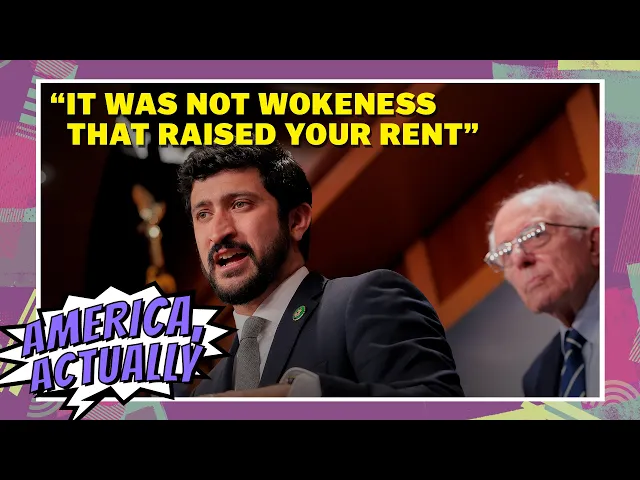
13:35 Let's blame it on wokeness." But it was not wokeness that raised your rent.
13:39 It was a Wall Street hedge fund, right?
13:41 It was not trans folks that made your healthcare worse.
13:45 It's a healthcare CEO.
13:46 But I don't think we told that story.
13:48 I think what we need to do is make
13:50 sure we're targeting the real villains in the story.
13:52 Cuz there's a lot of people here in Texas who go, "Greg,
13:55 you might be more progressive or more liberal
13:57 than me on this or that social issue."
13:59 But you care about making sure I can afford my house without having to work 10,
14:04 20 hours of overtime every single week.
14:07 You know what?
14:07 I'll be for you.
14:08 Even if we may have our differences on that, this issue, or that.
14:11 And that's the kind of coalition I think we need to be able to build.
14:13 I want to ask about what more.
14:15 Let's talk about defund the police because I read in 2020
14:17 that you were one of the elected officials that uh kind of stood
14:20 with Austin's movement and they were one of the few cities
14:23 that successfully reallocated funds from the police
14:26 budget to other issues like housing.
14:28 These days, even folks like Zoramani here in New
14:31 York have reversed their support for that idea largely.
14:34 I wondered what you thought about that.
14:36 What do progressives think about crime and public safety now as opposed to then?
14:41 I was always wary of the slogan um even in those times
14:45 because that meant that people didn't hear what I had to say
14:48 next which is you know what what if we move our DNA
14:52 labs out from under police departments and have them run scientifically.
14:55 What if some of the money that we are spending
14:58 just throwing money at the police association and police unions,
15:01 let's take some of that, set up domestic
15:02 violence shelters so that people aren't having to call
15:05 911 over and over and over again because
15:06 they can't get out of an abusive situation.
15:09 So, I think we need to claim public safety and civil rights.
15:13 Uh, and I think we can't uh just abandon uh the movement for police reform.
15:19 But I do think that we've got to get people to understand
15:22 beyond the slogans that we care about not just civil rights,
15:25 so we care about civil rights, but also their safety.
15:27 I guess I would have though asked that question more specifically.
15:30 Were Democrats or specifically progressives over
15:33 the last election cycle too differential to sloganering?
15:36 Too differential to certain uh interest or public
15:39 groups that didn't want them to be as explicit
15:42 on uh uh maybe saying where there was
15:44 a disconnect between progressive class and the working class.
15:47 Like why wasn't that said at the time?
15:50 Like couldn't you have said I don't like the slogan?
15:53 Here's what I think is so important is that I think people need
15:59 to know that we're going to put your interest as a working person first.
16:04 I know and I'll tell you a story from the Harris campaign specifically.
16:07 You know, I went out uh to Nevada to campaign for the vice
16:11 president who I was a strong supporter of in that election.
16:14 And it's when I knew we were very likely going to lose.
16:17 I went and sat in rooms with all these Latino voters.
16:22 So many people who said, "Look, I voted for Obama.
16:25 I voted for Clinton." Lots of folks who said, "I voted for Joe,
16:28 but this time I'm going to vote for Trump." And when I asked them why,
16:32 I got answers like, "I feel like y'all are focused on other stuff."
16:35 And when I pushed them on what other stuff meant,
16:38 they brought up the cultural issues.
16:40 And I think that that is the mistake that we've made.
16:43 That isn't just the vi on the vice president in her short campaign.
16:46 It is, I think, a Democratic party brand issue.
16:50 And we've got to change the brand now in the election
16:53 season because if all people learn about our brand is that we're
16:57 the anti-Trump party and they never learn what we're for, then
17:01 that will have been a big mistake and a huge failure.
17:04 Congressman Kesar, thank you so much for joining us.
17:06 I really appreciate your time.
17:08 Thanks a bunch.
17:09 Next up, we're headed to Queens,
17:11 home of one of the most progressive districts in the country,
17:14 and we're going to go to the streets to ask people directly,
17:16 what do you actually want from progressives?
17:22 So, after talking to Congressman Khazar, I decided to come to Atoria,
17:26 one of the biggest neighborhoods in Queens
17:27 and part of New York's seventh congressional district,
17:30 which is statistically one of the most progressive areas in the country.
17:34 It's actually so progressive, in fact, it got nicknamed the Kami Corridor.
17:38 So, we're going to talk to some voters
17:39 here and see what progressive means to them.
17:41 Let's go.
17:43 When you think of the word progressive, what does that mean to you?
17:46 Um, more modern.
17:50 More modern.
17:51 Less tradition, more I don't know.
17:53 There's just new things around here.
17:55 New ideas.
17:56 New ideas.
17:57 Yeah.
17:57 Uh-huh.
17:57 Do you have any issue that comes up like as the top of the list?
18:00 If someone said, "I'm a progressive." Is there something you expect of them?
18:05 I guess equality and affordability.
18:07 Equality and affordability would be top of the list.
18:11 Yeah.
18:11 We talked to the Congressional Progressive Caucus,
18:13 the the progressive group in Congress,
18:15 and they have a new 10-point plan about affordability,
18:17 about how to make people's lives more affordable.
18:20 I want to show you it and get your reaction.
18:22 So, these are the different planks that they are trying to focus on.
18:26 And I guess for you,
18:27 I would love to know what you find the most important out of that list.
18:31 And is there something on that list you wish was there?
18:33 Oh, wow.
18:34 Vacation time, people, and money in people's pockets,
18:37 getting big money out of politics.
18:38 Wow.
18:39 Is that even a possibility?
18:41 I mean, that's why I think a lot of people's question is like,
18:43 is that even viable?
18:45 I know.
18:45 I was like saying I I didn't even
18:47 think that was I thought that was non-existent.
18:49 I I guess, you know, I think like, you know, you want people to live well.
18:52 You don't want them to just survive.
18:55 So, you live in the seventh district.
18:57 I don't This makes me feel this makes me feel sporty.
19:00 Um, so you live in the seventh congressional district.
19:02 I do.
19:02 I live up on Dipmore.
19:03 If someone calls themselves a progressive Democrat,
19:05 what do you think that means?
19:06 Well, I got a I got a state.
19:09 I'm from Kansas originally.
19:10 I moved here about 10 years ago.
19:11 So, I'm from a very red state.
19:13 My parents are hog farmers.
19:15 So, uh that's how I was born and raised.
19:17 Um so, moving out here was a bit of a culture shock.
19:20 Um progressive has a negative connotation in Kansas.
19:23 You know, they actually laid out a 10-point plan of what
19:26 they said was their I got it actually written down for you.
19:28 All right.
19:30 I can't wait to poke holes in it or agree with You are in luck
19:34 because right there is a Congressional Progressive
19:36 Caucus' 10-point plan of how to make cost.
19:39 I am not.
19:40 I'm actually here because I want folks's real response to it.
19:43 You can love it, you can hate it.
19:44 It's up to you.
19:45 Prescription drugs.
19:46 I do not know enough about that.
19:48 So, they're actually So, so some of these are like a matter of cost cutting.
19:52 So, they're saying that imposing a corporate tax
19:55 and refunding that money to uh consumers or um
19:59 so we don't tax corporations enough.
20:01 Their argument was that they should tax some more.
20:03 They're just trying to drive them out.
20:06 So when we think about all the priority when we
20:08 think about the priorities that Democrats or progressives have talked about,
20:11 it doesn't always sound like cost of living.
20:13 Sometimes it's been LGBT rights, abortion rights, immigrant rights,
20:17 like you know, they've been thinking more about social cultural issues.
20:20 I mean, how much should they focus on that versus things like cost of living?
20:25 None.
20:26 Oh, you think that you're saying focus on the money, focus on affordability.
20:30 Yeah, because that is what all humans can relate to.
20:33 We all work.
20:34 If you work, that means you want a better life.
20:37 Not even you want a roof over your head.
20:38 You want to eat.
20:39 If you work, it's because you want to not want walk around naked.
20:42 You need clothes.
20:43 You need to eat.
20:44 You need to be healthy.
20:45 You need health.
20:46 That means groceries.
20:47 That means money.
20:48 So money is essentially the root of everything.
20:50 I don't care if you're gay.
20:51 I don't care if you have all that.
20:53 That that's like secondary.
20:54 third like that doesn't that's not a priority.
20:56 So yes, that should have been the main focus.
20:58 So here's a little secret.
20:59 I actually live in New York's seventh congressional district.
21:02 So it doesn't surprise me at all that when you ask people about
21:05 the progressive nature of this community
21:07 or about the diverse nature of this community, they have a lot to say.
21:10 And when we talked to people, they really helped us understand buzzwords
21:14 like affordability and progressive a lot clearer.
21:17 I feel like I heard people say that they wanted
21:20 their members of Congress to prioritize cost of living above everything else,
21:25 even if that means deprioritizing some of the cultural issues
21:28 that progressives have focused on in the last four or five years.
21:32 In fact, it sounded pretty close to what
21:34 Congressman Khazar told me in our interview
21:37 that these are connected issues and that a politician
21:40 gains credibility on one by leading on the other.
21:43 America Actually will be in your feeds every
21:45 Saturday with an interesting interview in politics and culture.
21:49 And you can of course listen to America Actually
21:51 in the Today Explain feed or wherever you get your podcast.
21:55 Support the show by going to vox.com/members.
21:58 That's vox.com/members.
22:01 See you next week and cue the music.