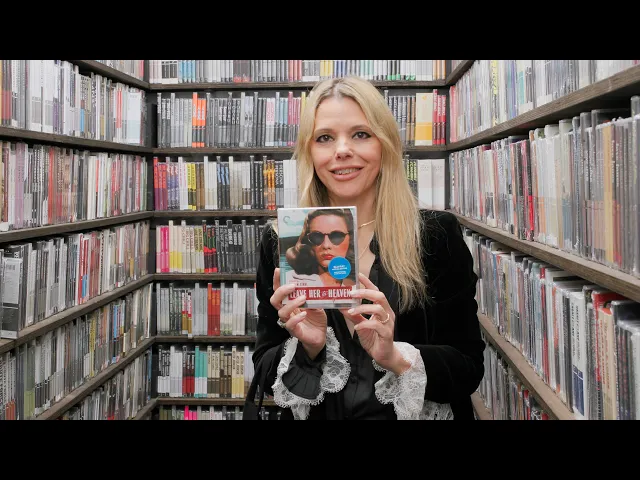
Kim Morgan’s Closet Picks
CRITERION
0:00 Hello, I’m Kim Morgan.
0:01 I’m in the Criterion Closet.
0:02 I feel very honored to be here.
0:04 I co-wrote Nightmare Alley with Guillermo del Toro.
0:08 That just recently came out.
0:10 And I have contributed to some of these wonderful editions.
0:17 I’m choosing Merrily We Go to Hell,
0:20 an incredibly daring film about marriage and the breakdown of a marriage.
0:25 There’s so much more to say.
0:27 This is such a complicated movie.
0:28 And Fredric March and Sylvia Sidney are so incredible in it.
0:32 Watch all of Dorothy Arzner’s films that you can,
0:35 because she was such a fascinating woman and filmmaker
0:38 and very important in the history of cinema.
0:41 Something Wild by Jack Garfein.
0:43 This film really means a lot to me because I became good friends
0:46 with him and I know this was a very personal film to him,
0:51 starred his then-wife, Carol Baker,
0:53 and it’s a very… realistic depiction of the aftermath of rape and the surreal,
1:01 anxious feelings that follow.
1:04 Cinematography by Eugen Schüfftan, who did Eyes Without a Face,
1:08 so there’s all these experimental elements to the film as well.
1:11 Sheila O’Malley wrote a beautiful essay for this, too.
1:14 I recommend that you read her essay on this.
1:17 Ellen.
1:18 Ellen from Leave Her to Heaven.
1:20 Farran Smith Nehme and I have talked a lot about the movie.
1:23 She writes a lot for Criterion.
1:25 We’re always discussing this film together because we feel,
1:28 although she does many misdeeds, obviously, in an understatement,
1:32 we have this feeling that she maybe, perhaps,
1:35 is an artist herself and she’s not really happy with her husband’s book.
1:39 However, do not dedicate a book to your wife’s sister.
1:45 You will have Vincent Price defending you in court after you pass away.
1:49 I’m summarizing it in the briefest way possible, so, please,
1:52 you’ll get much more out of it when you watch it.
1:54 Thirty Two Short Films About Glenn Gould.
1:57 I love movies that aren’t traditional biopics.
2:01 I love that through the music– There’s a scene in here that I
2:04 love where he’s at a diner and he’s listening to all the sounds,
2:08 he’s listening to the people talking,
2:10 and you can feel the musicality of that, and what Glenn Gould would incorporate,
2:14 just in regular life, how musical he was, what a genius he was.
2:19 More people should check out this film,
2:21 and it’s just a beautiful… meditation on Glenn Gould.
2:27 It’s not just directly telling you about him.
2:30 It feels the way music makes you feel.
2:32 There’s mystery still there.
2:34 He allows the mystery, it’s so… such a beautiful film.
2:38 I love this movie, Punch-Drunk Love.
2:40 I remember seeing this at a screening and just
2:43 walking out… just kind of walking on air.
2:45 I love that what Paul Thomas Anderson did with Adam Sandler, who, of course,
2:52 in other work, I believe,
2:54 showed that he had dramatic chops, and even in his comedy,
2:58 the anger that he would show, you see it in here and he pulls it out of him,
3:03 somewhat in a way that Hitchcock pulled out of Jimmy Stewart.
3:07 It’s universal, but there’s something so
3:09 American about Jimmy Stewart and Adam Sandler,
3:11 just the way that he shows his… his sadness,
3:15 his… his anger, and the edginess, right down to the score,
3:20 the way that you feel constantly on edge, either with his happiness,
3:25 as he’s walking through the grocery store and doing the little tap dance,
3:30 or just the constant worry.
3:32 It’s such a romantic, beautiful movie, all about the messiness, also,
3:37 of love and all of the anxiety that it can produce.
3:43 Unforgettable.
3:44 Unforgettable.
3:45 So Kiss Me Deadly by Robert Aldrich.
3:48 This was made in 1955.
3:50 It’s a little bit late in the noir cycle.
3:53 This film was so influential to the French New Wave,
3:57 and then all the way to Quentin Tarantino with Pulp Fiction,
4:00 with the suitcase, and Alex Cox’s Repo Man before that.
4:03 But the movie is just, still to this day, I don’t want to use the word modern.
4:09 I want to say timeless.
4:10 If you have not seen the opening sequence of this movie,
4:13 you have not watched cinema.
4:15 You need to see the opening of this movie.
4:18 And I love that Aldrich, he ranged from doing Ulzana’s Raid to The Longest Yard.
4:26 A vicious, somewhat nihilistic filmmaker, in terms of this film,
4:31 but also had a lot of heart and sensitivity towards men,
4:36 women, and really saw the whole human condition.
4:40 There’s a reason this film has endured and has
4:42 inspired so many people and I love it so much.
4:45 And I love all the Los Angeles locations.
4:48 In fact, when I’m driving down Wilshire,
4:49 I always point out Mike Hammer’s apartment building.
4:52 It’s right on Wilshire.
4:53 Every time I pass by.
4:54 My friends make fun of me because I have to, like, take a picture and text them.
4:58 So I’m choosing The Killing.
4:59 This is a seminal Kubrick film,
5:03 and what I love about it is it moves like clockwork in terms of the heist,
5:09 but then it ends with that suitcase.
5:11 And I don’t want to just focus on the suitcase here,
5:14 but he buys the worst suitcase, I must say.
5:16 The absurdity of it is almost beautiful.
5:20 In fact, it is in the way that Sterling Hayden,
5:22 who’s so perfect in this film, says those great final lines,
5:27 “What’s the difference?” Which you could read as very sad,
5:33 and his life is over, or very Zen-like.
5:36 I recommend this, but also get Barry Lyndon and Eyes Wide Shut, get all three.
5:41 But I don’t want to be greedy, so… this in the bag.
5:45 So, Criterion kindly pulled these out for me.
5:49 I wanted to show these in honor of the great Udo Kier:
5:55 Flesh for Frankenstein, Blood for Dracula.
5:59 Two of his greatest performances.
6:01 I’m very partial to Udo.
6:03 I adored him.
6:04 Watch these movies and watch all of Udo Kier’s movies.
6:09 He made many, and he always left such an impression.
6:12 There was no one like him.
6:14 No one like him.