Vastly Bigger Space Things, BONG Grounded On 4/20 - Deep Space Updates - April 22nd 2026
Scott Manley
0:04 Hello, it's Scott Manley here.
0:05 It's April 22nd.
0:07 Two weeks ago, we had astronauts around the moon.
0:10 Last week, we had Space Symposium.
0:11 And right now, we have another batch of deep space updates.
0:14 Of course, starting again with the rocket launches.
0:17 So, we had a Starlink, three launches, one from Slick Fory on April 14th,
0:22 and uh two from the West Coast, from Vandenberg on April 15th and April 19th.
0:27 Over in China on April 14th, we had a Kinetic 1 solid rocket launching
0:32 three Gillan Gaen 7 Earth observation satellites from Jichuan.
0:38 All these going into sun-synchronous orbit,
0:40 providing high resolution imaging for their customers.
0:43 April 16th, we saw a Russian soy use
0:45 2.1b and this was sort of a surprise launch.
0:48 I think they're kind of keeping a low profile
0:50 or keeping them secret because of potential drone attacks.
0:53 Uh so this was to launch eight cosmos military satellites and the designations
0:57 for these are cosmos 2609 through 2616
1:01 all launched from placets into a sun-synchronous orbit.
1:05 What's interesting I think about this is it marks the debut
1:08 of the soy use 2.1b with the vulga upper stage.
1:12 Now sorry this is more like a tug space tug stage.
1:15 This is able to move the payloads into their final orbits.
1:18 Now, normally we would see something like the FAT,
1:20 but the Vulga is a whole lot smaller, cheaper.
1:24 It doesn't have quite the performance,
1:25 but it's a lot easier to put this on and and have a you know,
1:28 the payloads go into the correct orbit.
1:30 And we've seen that the payloads are indeed in different orbits
1:33 having been distributed by this new uh you know, cargo stage.
1:38 On April 17th, again in China, we saw a long march 4C launching
1:42 the duche payload into sun-synchronous orbit from Jichuan.
1:47 Uh so this is like a high precision earth observation atmospheric
1:50 monitoring satellite that's supposed to look at things like greenhouse gases,
1:53 pollution, you know, climate data and it's operated by China's
1:57 Ministry of Ecology and the Environment.
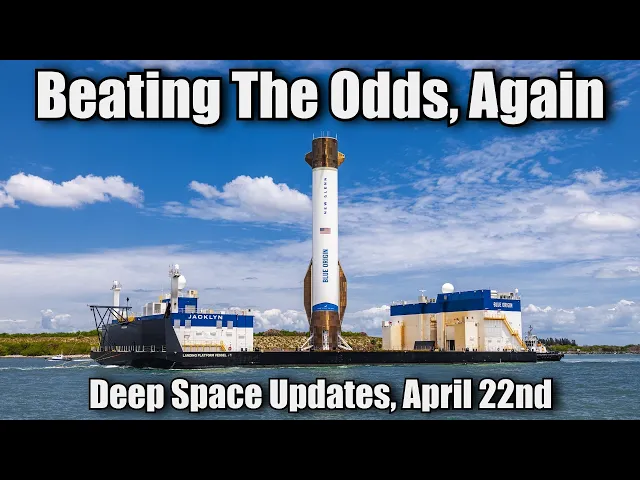
1:59 On April 19th, Blue Origin, they make the third flight of New Glenn
2:04 and everyone was excited to see how this would work.
2:07 They were reusing the booster.
2:08 Never tell me the odds.
2:10 Although it was missing the engines that had originally flown,
2:14 those have been replaced.
2:15 They've made some changes to heat shielding
2:17 but you know this is still a development
2:19 program and unfortunately the development turned
2:22 into a a problem with the second stage.
2:25 So this was supposed to launch Bluebird 7 for a space mobile.
2:29 This is very large phase array antenna that's supposed to provide
2:32 uh you know cell communications and the launch was successful.
2:36 Again it looked slow going off the pad.
2:38 I have no doubt that if I do the math
2:40 it will actually turn out that this is perfectly fine.
2:43 The booster separated.
2:45 It landed on the barge.
2:46 Jacqueline out at sea.
2:48 Excellent.
2:49 Everyone was super excited to see that the payload reached orbit.
2:52 Again, this looked like a hugely successful mission.
2:55 And then um yeah, then we found out
2:57 that the payload had been deployed into the wrong orbit.
3:00 And we don't really know much else until
3:03 24 hours later when Dave Limp said, "Yeah,
3:06 they observed an engine problem in the upper stage." And at that point,
3:12 they weren't very clear about what happened next.
3:14 Now, since then, we've seen that the Bluebird payload has de-orbited,
3:18 which is unsurprising given that it was in kind of a low orbit.
3:20 We've seen that there was a maneuver performed by the upper stage.
3:24 And we've also been unable to find the upper stage,
3:27 which would suggest that Blue or Origin were in fact able to de-orbit the stage.
3:32 So best bets we have on what happened is yes they had performance
3:36 with the engine problems with the engines and out of an abundance for caution
3:41 they cut short the burn deployed the satellite and then used the engines
3:45 to de-orbit the stage where it was
3:47 supposed to thereby being good orbital citizens.
3:50 However we have not heard any of this information from Blue Origin.
3:54 So this is entirely speculation based upon the facts that we have.
3:58 The FAA have declared a mishap and so there's going to be
4:01 an investigation that will ground New Glenn for a good few months.
4:04 The booster is coming back into port as I record this.
4:07 It is smack bang on the center of Jacqueline.
4:10 Good job on that.
4:11 You know, again, teams at Blue Origin, I'm sorry this happened.
4:14 It's unfortunate.
4:15 I'm sure you'll fix the problem.
4:16 You should definitely feel some pride in recovering the booster, but you know,
4:20 we'll uh hopefully see you flying again
4:22 and doing fully successful flights going forwards.
4:26 And then uh just yesterday uh April 21st,
4:28 we had a SpaceX Falcon 9 launching GPS 3 number
4:33 10 out of Cape Canaveral Space Force Station, Slick 40.
4:37 And that was going into a medium Earth orbit.
4:39 It's a GPS satellite.
4:40 This is actually the last of the GPS 3 satellites.
4:43 This one is named Hedi Lamar after the Hollywood
4:46 actress who also accidentally sort of figured out frequency hopping,
4:49 which is kind of important for modern communications.
4:53 So anyway, that was the the last flight of uh well that was
4:56 the last flight which will be recovered by the barge just read the instructions.
5:01 That was a surprise.
5:03 So uh we found out that you just read the instructions as one of two barges
5:07 on the east coast and soon after the landing
5:10 they said congratulations you've just supported 156 uh landings.
5:14 Now you are going to be handling Starship super heavy work.
5:18 So I'm presuming they will be moving materials, stages,
5:20 tanks or whatever between Bokhica and Florida for developing this.
5:25 Now this has some interesting implications
5:28 going forwards because with only one barge,
5:31 they're not going to be able to launch quite as fast.
5:33 But then again, they've really only been launching
5:35 from one launch site out on the east coast.
5:39 So, this feels to me as if they're sort of, you know,
5:43 cutting down on the number of Falcon 9 launches,
5:45 hoping that Starship will finally start delivering u,
5:48 you know, Starlink satellites.
5:50 So, I think we may indeed have reached peak Falcon 9 launch cadence.
5:55 It also has an interesting implication for uh
5:59 Falcon 9 heavy because with only one barge,
6:04 how do you recover two boosters downrange?
6:06 Next week we are expecting a Falcon Heavy flight carrying Viasat spacecraft
6:13 and that will be having both boosters return to the launch site.
6:16 So that's not a problem.
6:18 We know that we're expecting Nancy Grace Roman to also use uh
6:22 Falcon Heavy and the Europe's um Martian rover the the Rosalyn Franklin.
6:29 Those are both supposed to use Falcon Heavy.
6:32 We don't know if they're going to be doing an RTLS
6:34 or if they're going to just expend the boosters, you know,
6:38 sacrifice the entire stack to the dark lord of Delta V as I like to see say,
6:43 or are they going to have both boosters fighting it out
6:46 to see if they can both land on the same barge?
6:48 That is something I would love to see and see if it's possible.
6:52 I'm sure it's possible.
6:53 I'm sure it'll be very exciting if it doesn't quite work.
6:57 Anyway, uh one other launch that's probably worth mentioning
7:00 is uh they had a haste launch last night.
7:03 That is a rocket labs electron carrying a payload for hypersonic testing.
7:07 All we knew that this was flight was called bubbles.
7:10 There were a bunch of you launch photographers turned up and we
7:14 saw some nice long time you know long exposures of this.
7:17 We don't know anything else about this flight but nevertheless it did happen.
7:22 So moving onwards, SpaceX have been moving forwards
7:26 with their uh you superheavy flight number 11 or 12.
7:30 Number 12.
7:31 Yes.
7:32 Got to remember these things, right?
7:34 We saw the first full 33 engine
7:37 static fire with Raptor 3 engines, V3 Superheavy.
7:42 So there was a whole test program leading up to this with tanking
7:45 tests and then uh they did like spin prime test,
7:49 igniter test, and then finally we got a full
7:51 33 engine test fire with the new flame diverter.
7:54 And it looks good.
7:55 The booster has been taken off the orbital launch mount.
7:58 And I'm presuming they're going to be making final changes
8:01 neat to towards as they move towards getting ready to launch.
8:05 Definitely looking like May is is going
8:08 to happen rather than April at this point.
8:10 So yeah.
8:11 Um anyway, another SpaceX thing is
8:15 that of course the IPO documentation is moving forwards.
8:19 We've seen sources now saying $1.75 billion and we've
8:24 also seen that there's apparently language in this um
8:28 document which advises investors that things like space data
8:32 centers may not be commercially viable or even possible.
8:36 And of course all the space data center skeptics have been saying,
8:38 "Aha, I told you so." And you know what?
8:40 like they may not be possible.
8:42 We've always said that.
8:44 Uh but this is basically language which is added to these documentations
8:48 this documentation by lawyers rather than engineers
8:52 who actually try to solve the problem.
8:54 So you know take take that for what whatever you want.
8:58 Anyway, also with, you know, counting down towards an IPO,
9:03 we were surprised to hear that SpaceX has basically put
9:07 $10 billion on the table with the AI company Cursor,
9:12 buying services, but also buying an exclusive right, I guess,
9:17 to buy them at a later date for $60 billion.
9:22 This is unusual to be seeing such
9:24 a big acquisition this close to a potential IPO.
9:27 Typically what happens is you have the IPO, you're flushed with cash,
9:30 you go out and buy some other stuff to make your brand stronger.
9:33 In this case, they said they put 10 billion down for services and said,
9:36 "Hey, maybe we'll buy the whole thing." Cursor,
9:39 the only thing I know that they really do is their coding system,
9:42 and it seems like they're not the only coding system in town,
9:45 but you know, they're making billions of dollars.
9:48 It seems like a, you know, an AI company that actually has revenue.
9:52 A couple of weeks ago, the world watched as Artemis 2 flew around the moon.
9:56 I mean, some people literally tracked the crew
9:58 with backyard telescopes and amateur radio equipment.
10:01 And yes, people were absolutely fascinated by the toilet situation,
10:04 which feels perhaps a bit more personal than the crew might have liked.
10:08 Now, if you would find this level of scrutiny uncomfortable,
10:11 then I have some unfortunate news for you
10:13 because there are all sorts of organizations
10:15 that make it their business to collect as much
10:17 information about you and everyone else as possible.
10:20 Yes, these are the data brokers who build tools
10:23 that collect fragments of information about everyone they can.
10:26 And while we hear about the big data breaches on the news,
10:29 the data brokers will happily take everything they can find,
10:32 including public records, your social media habits,
10:35 all of this helps them build a profile about you, who you are, where you live,
10:39 your habits, your family, your friends,
10:41 and their business model is to sell this for profit.
10:44 There's all sorts of customers for this kind
10:46 of information where knowing about you helps for things like
10:49 knowing what kind of products you could be sold
10:51 or what kind of premiums insurance companies could charge you.
10:54 There's examples of people facing higher costs for insurance because data
10:58 brokers shared something about them which made them look riskier than others.
11:02 There can be a direct cost to you that you don't even know about.
11:05 And so our sponsor incogn offers a way for you to get ahead
11:09 of this kind of data collection and protect yourself from the data brokers.
11:13 There are laws that require data brokers
11:15 to take down your information if requested.
11:17 In theory, you can do this yourself, but Incogn has the ability to track
11:21 and identify your data over hundreds of data brokers.
11:24 Their service knows more and can get
11:26 your data taken down faster and more completely.
11:29 This simplifies the whole process, leaving you lots of time and ultimately
11:32 keeping your personal data under control.
11:35 Setting up Incogn is easy.
11:37 After creating an account, it uses your information to check with all known
11:40 data brokers and identify matching records across the internet.
11:43 In fact, there'll probably be so many that you'll see the value in having
11:47 incogn on your side so they can
11:49 get to work sending those legal takedown records,
11:51 deleting your personal data from the internet.
11:53 And now, occasionally,
11:54 you might discover other places where your data is shared,
11:57 news sites, health apps,
11:58 places outside of incogn's extensive list of data to brokers.
12:02 But even if incogn doesn't know about it,
12:04 they can still help drive the takedown request using their custom removal tool.
12:09 Take back your personal data with Incogn.
12:12 Use code Manley at the link in the description to get 60% off an annual plan.
12:17 And now back to the video.
12:19 Okay, moving elsewhere in the world for big ambitions.
12:23 China rolled out their first Long March
12:25 10B reusable rocket at commercial launchpad 2
12:29 at Wang Chang commercial space launch site
12:32 in Hainan for their final pre-launch testing.
12:35 Now this is a 5 m diameter rocket.
12:37 It is comparable to Falcon Heavy and it's
12:41 what China will be using for their lunar program.
12:44 So understandably um you know rocket watchers
12:47 are very interesting to see what happens.
12:49 We've seen like a wet dress rehearsal happen with this.
12:52 We've seen the you know rocket loaded up with propellant and uh
12:56 they invented and they've done
12:58 various integration tests and countdown procedures.
13:00 Now this booster recovery is interesting because they use this weird
13:05 like a frame where it comes down and there's a bunch
13:08 of wires which are designed to snag the stage and we've
13:10 actually seen some demonstrations of this actually
13:14 happening at with subscale stuff.
13:16 And we've also seen a barge off the coast actually
13:19 you know next to another sub another full full scale test.
13:23 So anyway things are moving forward and we are expecting a launch
13:28 of uh long march 10b with I believe it might have
13:32 the mangju a satellite spacecraft like a replacement for Shenho on board
13:37 but I'm don't count you know don't quote me on that.
13:40 Let's see I should actually do some more research before I make these things.
13:44 China also announced a great success in the rendevu and proximity
13:48 operation tests for their Chingho or lightboat prototype cargo spacecraft.
13:54 So this is launched on March 30th on the Connecticut
13:57 2 spacecraft which was a successful launch and this is
14:00 supposed to be a lowerc cost resupply vessel for the Tiangong
14:04 space station and potentially other stations that come along.
14:07 So it was able to perform long-d distanceance approach rendevous
14:11 tests uh with with second secondary satellites that it deployed.
14:16 So, uh yeah, this is another step forward on China.
14:20 Now, as I said last week, we had the space symposium which is like a big event
14:23 in Colorado and uh lots of announcements come out of that.
14:28 Rocket Lab, they announced the Gaus Hall effect thrusters.
14:32 So, these are basically Hall effect thrusters.
14:34 They're able to work with Xenon, although they can work with Krypton as well.
14:38 Looks like they're about 700 to 800 watt power providing 40 milltons of thrust.
14:43 Although apparently they can run at lower power
14:45 levels if you are willing to accept lower thrust.
14:48 They claim that they're able to build up
14:50 to 200 of these per year per for potential customers.
14:53 And that sounds like a lot until you realize that every
14:56 single Starlink spacecraft also has Hall effect thrusters on board.
14:59 So they're producing at a completely different scale.
15:01 Also interesting to note is that Rocket Lab
15:04 said that there's no ITAR stuff in this.
15:06 so they can be sold to companies outside of the US.
15:11 Um, as part of Space Symposium,
15:14 Amazon announced uh that they are acquiring Global Star for 11.57 billion.
15:20 And this is a pretty big deal.
15:22 This is supposed to bolster their Amazon Leo constellation.
15:25 And what's really interesting is that this means that Amazon now control
15:30 the constellation that Apple uses for its satellite service on its phones.
15:35 Now this is Apple has had satellite service on its phones for a few years.
15:39 It's a very limited text messaging scenar you know situation capability
15:43 that's supposed to provide you know very limited connection in an emergency.
15:48 It's not supposed to be making phone
15:50 calls or sending text messages all the time.
15:52 So uh Amazon Leo is also
15:55 of course expected to potentially provide other services.
15:59 Could Apple be the first company to be
16:01 able to use both uh uh both Amazon services?
16:05 That'll be certainly both services from Amazon and Starlink.
16:08 Yeah.
16:09 Uh Amazon also unveiled their like phased array antenna for airliners and they
16:15 do have JetBlue apparently on board
16:17 although JetBlue are in dire financial straits.
16:20 Delta potentially coming on board.
16:22 So, um, yeah, there's now some fragmentation in the aviation
16:27 market based on the time scales that aircraft move at.
16:30 Having Starlink up there isn't as big of an advantage as you might imagine.
16:34 Okay.
16:35 Um, so yeah, the also during space symposium there was the White House
16:41 Office of Science and Technology launched
16:43 the National Initiative for American Space Nuclear Power.
16:47 So essentially saying, hey,
16:48 here's NASA and the Department of Defense and the Department of Energy
16:52 to to work together providing like parallel mutually re reinforcing designs
16:59 for space nuclear power like nuclear
17:02 fishision propulsion all those capabilities that are
17:05 going to be needed for on orbit and on the moon capabilities.
17:10 Um the Department of Defense or Space Force also announced that Blue Origin are
17:16 basically expected to be the ones bidding
17:18 on the Space Launch Complex 14 at Vandenberg.
17:21 So that would be the first West Coast site for New Glenn.
17:26 This is considered to be like the most viable heavy
17:28 lift launch site because you have to be able to move
17:31 the stages in on a barge and this is the one
17:33 the best location to set up a dock and everything for that.
17:36 One other blue origin story is that the Endurance uh Blue Moon Mark1 lander
17:41 which had been tested at Johnson is now out of the thermal vacuum chamber.
17:46 Uh testing was successful.
17:48 They actually showed like a cool uh bit of video showing them deploying
17:52 their antenna in the vacuum and the temperatures
17:54 that would be expected during space flight.
17:57 So that is now out of the chamber.
17:59 It got put back into its transport casing and is now at the Cape
18:02 where they will start doing like a you know dress rehearsals on the lander.
18:06 They're going to fuel it up with cryogenic propellants,
18:08 perform separations test,
18:10 validate the communications as they prepare for launch.
18:13 Of course, that is now going to be gated
18:15 on New Glenn coming back into flight capability and Amazon,
18:19 sorry, and Blue Origin being comfortable
18:22 launching the spacecraft on this booster.
18:24 And it could well make sense for them to do a third test
18:27 flight or for a fourth test flight of New Glenn with their own payload.
18:32 Um, Vast at Space Symposium, they came with the big ass docking ring.
18:38 Uh, I don't actually know if there's
18:39 official name for this, but they said, "Hey,
18:41 you guys have been working with the international docking adapter,
18:44 which is basically derived from a design from the 1970s.
18:47 Here's a huge one." So, the international docking adapter,
18:51 the internal passageway is about 80 cm wide.
18:54 This new station space station size docking adapter they have unveiled is 2.9 m
19:00 on the inside which you could fit an entire
19:04 so use capsule through the middle of that.
19:06 This is designed to be the kind of thing to join large
19:10 space stations and it's not just like the commoning common birthing mechanism
19:14 which is used on the space station which is larger provides much
19:17 larger room but it needs to be like manipulated with a robot arm.
19:21 This adapter is supposed to include soft capture capability
19:26 so that it can capture and lock on its own.
19:28 Not only is it bigger,
19:29 it uses like a powered bolts to connect the two ST sections together.
19:34 So those drive through and they provide a strong join, you know.
19:38 So this is basically if you're building big space stations as Vast wants to do,
19:42 this makes complete sense.
19:45 Uh, another space station builder, Voyager Technologies,
19:48 they have signed up with NASA for a private
19:51 astronaut mission expected to fly in 2028.
19:54 So, this will be the third provider offering
19:57 private astronaut missions to the International Space Station.
20:00 Previously, we've seen uh Axiom fly four flights.
20:04 They've got another flight in the future.
20:05 Vast is going to fly another one.
20:08 And now, Voyager Space is going to get one in 2028.
20:11 So that's uh you know more flights to the International Space Station.
20:15 All of course using Dragon because Starlininer isn't ready by any means.
20:20 Uh NASA by the way they have uh they've
20:23 got some stuff going on in their aerospace stuff.
20:25 The X59 we've been seeing it doing test
20:28 flights and they've now got to the point where
20:30 they're confident raising the landing gear and verifying
20:33 that that works and then dropping the landing gear.
20:35 Of course, this is pretty essential if
20:37 you're going to be flying this thing supersonic,
20:39 and that is the ultimate goal of the X59 to be able
20:42 to fly supersonic and not make nearly as much of a boom.
20:46 So, that's a very important step on that.
20:48 Also, you know, again, aviation sort of we have Hermes, if you know,
20:52 they want to build like a Mach 5 private jet or whatever.
20:56 They've been flying their uh quarter horse mark 2.1.
20:59 That's also got to the point where it's taking
21:01 off and landing and like retracting the landing gear.
21:04 Uh and that will mean that they are will be
21:07 able to go supersonic and the FAA has indeed given
21:10 them permission to go supersonic presumably involving some sort
21:14 of plan flying in the supersonic test corridor down near Mojave.
21:18 Um another story from Axiom by the way at Space Symposium was the space suits.
21:24 So, Axiom announced at Space Symposium that they are
21:29 basically they've they're almost they've almost completed the critical design
21:33 review on their AX EMU lunar space suits and they
21:37 are hoping to perform the first test flights in 2027.
21:41 And one of the things we I thought is well this would
21:45 neatly dovetail with Arteimus 3 if they could get it on there,
21:49 but they might also equally just fly
21:51 this as a test on the International Space Station.
21:54 So, they're getting to the point
21:56 essentially where they'll be building the qualification
21:58 units and sending those over to NASA for testing later this year,
22:03 hoping to get into a position where they
22:05 can actually fly these in space next year.
22:07 Which is interesting because this statement,
22:10 this public statement on the progress came out days before NASA's
22:14 Office of Inspector General released
22:17 a critical audit report titled NASA's acquisition
22:20 of Next Generation Space Suit Services and warned that the AY's
22:24 Next Generation Space Suits may not be ready in time for 2028.
22:29 So yeah, we have Axiom saying one thing
22:32 and the NASA Office of Inspector General saying,
22:34 "Wh we don't think this program is going quite
22:36 as well as we expect." And and to be clear,
22:38 we knew this program was in trouble when
22:41 Collins and David Clark pulled out basically saying, "Yeah,
22:45 we don't think we can make money on it." And as you know, David Clark,
22:49 they, you know, they're already making stuff that that flies as it is,
22:53 and they're deciding,
22:54 "Nah, they can't be bothered to fly anymore because it's too risky." Uh,
22:58 so Axiom is the only the only company that is
23:02 in the lunar and next generation space suit game.
23:05 We don't have replacements for space suits on the ISS.
23:08 We've only got like a handful of units
23:10 that are in flight condition at this point.
23:13 Uh the space suit situation is kind of disastrous if you ask me.
23:17 And the sooner we actually get replacements, the better.
23:20 And if Axiom is able to do that, then I am all for it.
23:25 Uh yesterday NASA had a massive press conference
23:29 where they unveiled the fully armed in operation.
23:32 Sorry.
23:32 Fully assembled Nass Nancy Grace Roman Space
23:36 Telescope at the Goddard Space Flight Center.
23:38 Yes, this was it's a wide field infrared observatory designed to look at like,
23:43 you know, dark energy studies, exoplanets, all that good stuff.
23:47 And you know, this has been marvelous to watch because I
23:49 think it was originally scheduled for like late 2027 and NASA
23:54 has just executed on this program and brought it around
23:57 and it's ready to launch later this year on a Falcon Heavy.
24:00 And I also thought, okay, so they had they had a whole press conference
24:04 talking about it and you know, you can watch that.
24:06 You can learn lots of things about the capabilities.
24:08 I'm excited to see this fly.
24:09 But this was also, as a music nerd, I noticed that they had bathed this thing
24:15 in uh an aesthetically pleasing purple light,
24:19 you know, so it made it look high-tech and cool.
24:21 But this was on the 10th anniversary of the death of Prince,
24:25 you know, the purple icon himself.
24:27 Um, I'm going to imagine that NASA is paying tribute to this great lost artist.
24:33 Um, now if we go out to real deep deep deep space,
24:38 Voyager 1 is continuing to go outwards.
24:40 It's expected to reach one light day from the Earth, you know, later this year.
24:45 But, um, they have just shut down another one of their scientific instruments.
24:50 They shut down the low energy ion detector or charged particle measuring thing.
24:54 They're now left with like a magnetic field system and a plasma wave detector.
24:58 They are basically trying to keep the thing working so that it
25:02 doesn't run out of electrical power and go into safe mode
25:05 because if it goes into safe mode then it can be very
25:08 hard to recover it especially with very limited amounts of power available.
25:12 So they are are trying to stay well within their budget
25:15 so that they don't have any problem that will exceed it.
25:17 Now they have left a critical part
25:20 of the ion or the charge particle counter still running.
25:23 There's a motor that rotates the instrument
25:26 and that only takes about half a watt of power.
25:29 They've kept that running because if they shut it down,
25:31 it might freeze in place and it means they
25:33 can never turn it back on again in the future.
25:36 Another spacecraft off in deep space is New Horizons and it
25:41 passed a an interesting um you know landmark on its flight.
25:45 It's not really a landmark because it's in deep space, a space mark.
25:48 Uh it is now further from Pluto than it was when it launched.
25:52 Of course, it visited Pluto and then headed off
25:54 out into the deep solar system beyond into deep space.
25:58 Uh yeah.
25:58 So now now it is uh now it's further from that.
26:02 It's a long way from Earth, too.
26:04 So anyway, the other thing that we've had over the last week or so,
26:07 we've had a sort of continual set of updates on Artemis.
26:12 Obviously, we've been getting the pictures back and the best stuff
26:15 has been getting released and some of it's like really simple.
26:17 One of my favorites was this photo that came from the US Navy recovery team.
26:21 essentially a diver underneath the capsule taking a picture off
26:25 the heat shield while it was still in the water.
26:27 If you remember when it was coming down,
26:29 we saw this like white mark on it and some people were like,
26:31 "Oh no, that's a big chunk that's being knocked off." And I was like, "Actually,
26:35 the color of the heat shield underneath isn't white." Um,
26:39 but photos from underneath can show these like cool markings and it's
26:43 actually really amazing because you can see where the the heat flow is,
26:47 the the the way the air has been moving over this.
26:51 It's a very it's an awesome image to see.
26:54 But beyond that, we've had the crew.
26:58 They did like this great interview and I I heard about
27:00 this from all sorts of people who aren't traditionally into space.
27:03 They talked about the crew's discussion of going
27:06 behind the moon and feeling, you know, that they are that this is a unique
27:11 event that they are not equipped to understand.
27:14 And listen, astronauts are better equipped to understand this than anyone else.
27:17 And if they say they have trouble understanding it, then I believe it.
27:21 Um, you know, it was affecting them in profound ways which
27:24 seem to have communicated with uh people beyond the traditional space fandom.
27:30 But we've also seen the astronauts starting to come back to their daily lives.
27:35 We've seen them like as soon as they landed,
27:37 apparently they obviously had to do a bunch of like testing
27:40 to make sure that they were able to handle walking around in zerog.
27:43 Apparently, one of the things that they did was they got them in lunar
27:47 space suits to practice moving around in the moon so that they can say,
27:50 "Well, okay, you took 10 days to get to the moon.
27:53 Can you actually do a mission on the surface of the moon?
27:55 Is there anything we can learn from this?" That's cool as well.
27:58 But we also got some of the wonderful like candid
28:02 videos from the iPhones that were recorded during the flight.
28:05 And you obviously one of the the wonderful ones is uh Reed Wiseman.
28:11 You know, while we've got the other
28:12 two crew members shooting photos with the camera,
28:15 you can hear the shutters going.
28:16 He's just trying to get a photo
28:17 of our video of the Earth setting behind the moon.
28:22 And you know, the iPhone doesn't quite focus right away, but then it goes in.
28:26 And it's wonderful because not only can you see
28:28 this through a device that we understand as humans, right?
28:31 We everyday people, we can have iPhones,
28:34 so we can understand what an iPhone camera is like.
28:36 So it gives us it makes us connect better
28:38 to this than say these high-end Nikon cameras with big fat lenses.
28:43 But you can also hear the crew in the background talking about like no way.
28:47 Like oh it it it's it's wonderful to hear that.
28:51 Also less wonderful was to hear Christina Cook showing
28:55 her reaction to the wakeup tune of a Pink Pony Club,
28:59 you know, Chapel Ran, big fan.
29:01 Uh, singing along and then they cut it off before the chorus and she's like,
29:05 "No, bring it back." Yes.
29:13 Wait, where's the chorus?
29:15 No.
29:15 Call them.
29:17 Call them.
29:18 That is cruel.
29:19 And it is cruel, you know.
29:21 Capcoms are frequently astronauts.
29:23 They're not DJs.
29:24 I'm happy to train you if you ever need some help.
29:29 Yeah.
29:29 One other wonderful piece of video that was shared was uh
29:32 the first recovery crew members opening
29:35 the hatch and getting into the spacecraft.
29:37 That that is again makes you feel really connected to this mission
29:41 in a way that we never saw with the Apollo missions, right?
29:45 After all, no recovery diver wanted to get
29:48 into the Apollo capsule as I understand it.
29:52 Um so anyway like with astronauts connecting with everyday people there's
29:56 one other thing I want to mention is uh yesterday a group
30:01 of like a hundred astronauts announced a project called astronauts for America
30:05 and it's it's uh supposed to be like a nonpartisan organization essentially
30:10 dedicated to upholding the constitution restoring public trust in America you
30:14 democracy basically the whole point of this is to celebrate the things
30:20 that we space nerds have in common rather than looking at the media
30:26 which is constantly trying to find the things that differentiate us.
30:30 Right?
30:31 Um so this is like you know 100 plus astronauts from all sides,
30:35 all political sides all agreeing that uh America
30:39 would be better if we had more astronauts.
30:42 And I'm sort of down with that.
30:44 And so there's one other like wonderful connection
30:48 between regular people and spaceflight that really speaks
30:51 to me because uh I I've seen David
30:54 Burn on his current tour and he it's fantastic.
30:56 I love it.
30:57 Uh but while he was performing at Santa Barbara,
31:00 he uh looks up in the sky and he sees a Falcon 9 leaving this beautiful
31:04 trail in the sky and he's pointing
31:05 at it and referring to it while they're singing, you know, once in a lifetime,
31:08 which is of course one of the most iconic talking head songs.
31:11 And yes, it is once in a lifetime to be
31:14 performing that and seeing the rocket launch in the background,
31:17 but maybe more people will start seeing rocket launches happening elsewhere.
31:21 So anyway, that is my bit.
31:24 Moving onwards in the next week again, we're going to see a Falcon Heavy launch.
31:27 Always excited to see that.
31:28 We're going to have a dual return, double sonic boom.
31:32 So if you're on the East Coast, pay attention for that.
31:34 I'm Scott Manley.
31:36 Fly safe.