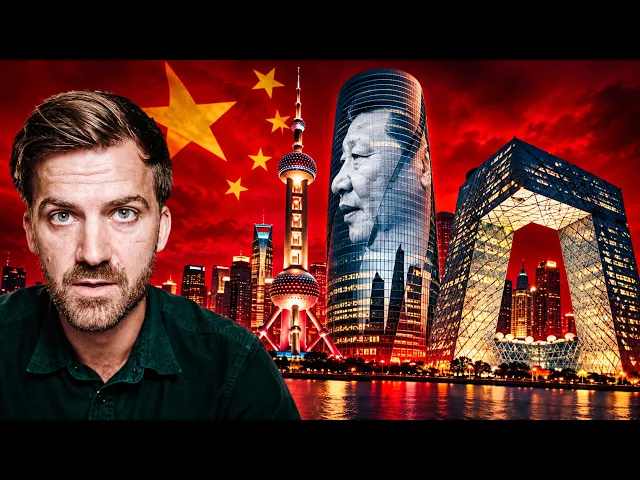
The REAL reason China built so much
Johnny Harris
0:02 (envelope rips) (letters clattering)- Okay.
0:11 Hey.
0:12 Hey.
0:13 I got your package, and I'm not sure what I'm doing
0:16 here or looking at, or what I'm supposed to do next.
0:19 So your task is to use some of these shapes,
0:22 not all of them, to, from memory, assemble the Chinese flag.
0:27 Okay.
0:33 Okay, wait, why am I doing this?
0:35 This all began with some videos.
0:37 China is next level.
0:39 This might be the biggest building I've ever seen.
0:41 If they tried to build something like this in America,
0:43 it would take at least two decades.
0:45 Okay, this is insane.
0:47 This city does not look real, bro!
0:49 It looks 4K.
0:50 Videos that started appearing on my feed a couple years ago.
0:53 Every time I come to China, I just realize how far behind my country is.
0:57 China doing some things.
0:59 I don't understand how the architects were able to build a city like this.
1:02 [Vlogger] Train stations in China are absolutely insane.
1:07 [Johnny] Videos of people, most of them from the United States,
1:10 experiencing something that felt genuinely brand new and exciting.
1:14 ...next to one of the most impressive modern marvels of engineering.
1:18 Modern China.
1:19 [Vlogger] Look at the twinkles.
1:20 Look at the twinkles.
1:21 Oh, they've gone off!
1:22 Agh!
1:22 (bystander laughing)- [Bystander] It's all coordinated!
1:25 [Vlogger] China is decades ahead.
1:26 (laughs)- [Johnny] I read an article about these videos,
1:29 spoke to the guy who wrote it.
1:31 They're just surprised by, like, technical innovation essentially.
1:35 A train going into a building!
1:37 What the—- These videos are fun, and they're awe-inspiring,
1:42 but they also made me start to wonder: what am I actually looking at here?
1:46 What is this?
1:47 How did China build all of this stuff, and what does it say-- Johnny.
1:51 No, you cannot make this video.
1:53 [Johnny] No, but I just need to look into this thing that-- You are
1:56 in the middle of producing a documentary series that releases in a few weeks.
2:02 It's true.
2:03 In a few weeks' time, you will see "The Human Element," my new
2:07 adventure show where I travel all around the world
2:10 to find human stories that teach us about
2:13 the most important issues happening around the world.
2:16 (light thoughtful music) I can't wait to share it with you.
2:19 It's coming soon.
2:22 Anyway, the fact that this new series has been all of my focus pretty much
2:26 all year is actually part of why you've seen so much of this guy lately.
2:30 This is Adam.
2:31 Adam is my producer, and he has been diving deep into many of the things
2:36 that I have been deeply curious about and would make a video about,
2:39 but I haven't had the time or focus to actually dive deep.
2:42 So Adam has dived deep, and he's very good at it.
2:45 [Adam] I would actually argue that you should
2:46 spend more time talking about how awesome I am.
2:48 I think I would say....
2:50 (laughs) So when I started fixating on China and its infrastructure
2:53 and why it looks like this, I turned to Adam for help.
2:56 I can imagine an explainer section that's like,
2:59 "Let's get to the bottom of how China's government and society actually works.
3:04 How decisions are made, who controls power,
3:06 how the economy works."- That could be interesting.
3:09 Adam and I made videos this year about fascism, oligarchy, democracy.
3:14 So I knew that if we worked on this together,
3:16 we'd have to get into it from a specific angle
3:19 to look at what the system is behind all of this stuff.
3:23 What are the systems that made China look like this?
3:27 And a central question for me is, is this communism?
3:32 Like, China's communist, right?
3:34 And to be totally clear, I know that what we're looking at in these videos
3:37 is a snapshot of a very specific slice of China.
3:39 That's what a lot of you are thinking right now.
3:40 This isn't all of China.
3:41 This is rich coastal cities that don't
3:44 represent most of China and Chinese people's experiences.
3:47 China is obviously not a perfect society,
3:49 and yet they're able to build a lot of things very quickly.
3:51 And my main hypothesis that I think a lot of us share is,
3:54 well, they're able to do it because they're a dictatorship.
3:58 They've got one leader who calls all the shots.
4:01 When you're a dictatorship,
4:02 you can just wave your magic wand, and stuff gets built.
4:05 If a leader wants a bridge, they build a bridge.
4:07 But that turns out to not quite be it.
4:11 The truth, as we learned more,
4:13 turned out to be much more interesting and surprising
4:16 and informative about what modern China actually is.
4:20 And so that's what we are going to talk about today.
4:24 What is the system that produced the China we see today?
4:28 What do we call it?
4:29 Where did it come from?
4:30 And how has it been able to so quickly make all of this?
4:35 (light gentle synth music) (light poignant music)- Okay,
4:47 so why did you make me make a flag?
4:49 So we're gonna get to that in a second,
4:50 but first I know that one of your biggest questions was,
4:54 like, "Is China actually communist?"- Yes.
4:58 Modern China to me feels very clearly capitalist and not communist.
5:04 Right.
5:04 So one of the first things we're gonna
5:05 talk about is why that distinction gets complicated, right?
5:08 Because we have been taught our whole lives
5:10 to think of economies in terms of either state-run,
5:15 like the Soviet Union, or market-driven, like the United States.
5:19 So in the Soviet Union, where the state ran the economy,
5:23 businesses were owned by the state, land was owned by the state,
5:29 and the decisions behind what the economy was actually producing,
5:32 also decided by the state.
5:33 Whereas in a market-driven economy like ours,
5:36 businesses are typically privately owned, most property,
5:39 typically privately owned, and what gets produced,
5:41 it is determined by the market.
5:43 To me, that was the model that I always understood,
5:45 you know, capitalism versus communism.
5:46 And China completely upends that, right?
5:49 So in China, you have multiple entire industries that are state-owned,
5:54 like oil, like airlines, like telecommunications.
5:57 They also, though, have an enormous private sector.
5:58 Think about Huawei, think about Alibaba.
6:00 Land in China is always publicly or collectively owned.
6:04 So it's either owned by the state or owned by collectives of citizens,
6:07 but individuals and developers can lease land,
6:10 and factories and houses and apartments can be owned.
6:13 So you can own your house in China, but you don't own the land that it's on.
6:16 China's government has poured tons of money
6:19 into sectors of the economy like electric vehicles,
6:22 batteries, solar, semiconductors, AI,
6:24 but also there are huge parts of their economy that are market-dictated.
6:28 Like, they didn't make WeChat.
6:30 There are tons of industries and very successful companies in China that did
6:35 not get help from the government in the same way at all.
6:38 They do not have a communist,
6:41 Soviet-style, centrally planned, state-run economy.
6:45 Wait, Max is in this video?
6:46 [Adam] Oh, you mean our colleague, Max Fisher, host of the Newpress channel,
6:49 "The Bigger Picture," former New York Times correspondent who
6:51 has spent a lot of time reporting on China?
6:52 A zillion conversations with people who are from China,
6:55 China experts, China economists, China political scientists.
6:59 Okay, so China is communist and capitalist then, right?
7:03 It has features of both, but for an ordinary Chinese citizen,
7:05 a lot of their life would basically look completely familiar to you.
7:09 You earn a salary, you have money in a bank account,
7:10 you shop at privately owned businesses,
7:12 you order food from restaurants that are competing with each other.
7:15 You can buy a car, you can buy an apartment, you can invest your money.
7:19 If we're asking if China is communist, if we look at only their economy,
7:24 that's gonna give us a really strange answer.
7:26 That's what this graphic,
7:27 that system of thinking about communist versus capitalist that I've always had,
7:31 this is looking at the economy.
7:33 But then where is communism in everyday life then?
7:36 Is it even there at all?
7:39 Okay, so now you can show me your flag.
7:42 [Johnny] This is what I did.
7:44 [Adam] Yeah.
7:44 Not quite.
7:45 You came very close.
7:47 "China flag." Oh, (beeps) so it's not this.
7:50 It is a big old star.
7:53 Yes.
7:53 So it's one big star and four small stars, basically.
7:56 You came close.
7:57 My question for you is, do you know what anything on this flag represents?
8:01 No clue.
8:02 Okay.
8:02 So the four small stars on the flag represent what,
8:06 back in the 1940s, they considered to be the four social classes.
8:10 And if you're looking at the actual flag,
8:11 you'll notice that they are not all upright.
8:14 Those four small stars are kind of like pointed.
8:16 They're turned around a little bit.
8:17 The tops of them are all pointed towards the big star.
8:20 And the big star is the Chinese Communist Party.
8:24 And the reason we are looking at this is
8:27 that the party is not just in charge of China.
8:30 China is actually built around the party.
8:35 But I have a kind of a dumb question here.
8:37 What is, quote, "the party?" Like, we talk about China's Communist Party,
8:42 and I know what political parties here are.
8:44 Like, here in the West, we have the Democrats,
8:46 the Republicans, whatever, but this feels different.
8:49 I don't think this is the same.
8:51 The Chinese Communist Party seems like a different thing,
8:54 and I do not understand it.
8:56 Yeah.
8:56 So I have been thinking about it like...
8:58 (light inquisitive music) The population of China is,
9:02 like, you know, 1 1/2 billion, right?
9:03 Only about 7% of these people are members of the party,
9:07 so a small slice, but in China that is, like, 100 million people.
9:13 Now, these party members are members of a club, basically.
9:17 It's not a job.
9:19 They are members, and they join for different reasons.
9:22 You can join because ideologically you feel
9:24 very aligned with the Chinese Communist Party.
9:26 Maybe you just want to serve your country.
9:28 Joining the party can help you get a leg up in your careers because
9:31 the party is so woven into the different
9:33 institutions of the country, private and public.
9:35 And that gigantic membership of people who are just Communist Party members,
9:39 that is the pool from which the party
9:41 recruits this even smaller group of professional party officials.
9:46 Got it.
9:47 It's a small fraction of total party membership,
9:49 which is to say it is still millions of people.
9:52 These are the party officials, and they are part of a hierarchical
9:57 organization that functions kind of like a corporation.
10:00 Even more than, you know, state-owned industry or public land ownership,
10:05 what we're looking at right now, the party:
10:08 this is the most communist thing about China.
10:11 (sparse percussive music)- (claps) So let's talk about China's government.
10:18 Like most governments, it exists at a lot of different levels.
10:22 At the top, you've got, like, president, prime minister, and as you go down,
10:26 you have things like State Council, provincial government,
10:28 municipal or city governments, county governments, township governments.
10:32 Fine, that's easy to understand.
10:34 That's basically every government.
10:35 But at the same time,
10:36 what makes it unique is that right alongside that government,
10:39 there is this thing called the Communist Party.
10:42 It's like a parallel structure.
10:44 For every town government, there is a corresponding town party committee,
10:49 and this continues all the way up the ladder.
10:51 Party offices that mirror the government office.
10:56 And the most important thing to understand about this mirror
11:00 structure is that all of the power is here.
11:04 With the party.
11:05 At any level, the party leader, the party organization is in charge.
11:10 [Johnny] So if you have a city mayor and a city party leader, on this diagram,
11:14 it looks like they're kind of on equal footing,
11:16 like they hold positions at roughly the same level,
11:18 but that's actually not true.
11:19 The party leader is actually the one in charge.
11:22 They're the ones who decide what happens.
11:24 They make the big decisions, and the mayor mostly just makes them happen.
11:29 They're the administrator.
11:30 What's really important to understand is that there is the party,
11:33 which is the backbone of the entire government,
11:36 and then there's the government, which does a lot of the policy implementation.
11:40 Okay, but people in the government,
11:41 like that mayor we were talking about, he's actually a party official too.
11:45 Basically anyone with any power in the government
11:48 is a part of the Chinese Communist Party.
11:51 The party is both in charge of and woven into the government itself.
11:57 Which means if we follow the party structure all the way to the top,
12:00 this is where real power lies in the country.
12:03 It's like here, this pyramid.
12:04 (light thoughtful music) This is a diagram that you'll
12:07 see if you search "Chinese Communist Party hierarchy" or whatever,
12:10 but we're gonna make our own.
12:12 You've got this group of around 200 decision-makers.
12:16 This is the Central Committee.
12:17 And within that, 24 of these people are members
12:22 of even the more elite decision-making group called the Politburo.
12:26 Within that, currently,
12:27 there are seven people that belong to the Politburo's Standing Committee.
12:33 These are effectively the people running China.
12:35 There are seven of them.
12:36 And there is one guy who holds the title
12:39 of general secretary of the Chinese Communist Party.
12:42 Today, that is this guy, Xi Jinping.
12:44 He is also the president, but remember what we said: the governmental role,
12:48 president, is actually less powerful than the same role in the party.
12:53 The general secretary of the Chinese Communist
12:55 Party is the way more important role.
12:56 That's where Xi Jinping gets his power.
12:58 If you're struggling with this, I don't blame you.
13:01 Just think of these two systems,
13:03 the party and the government, as two parallel entities,
13:07 but they're wrapped around each other,
13:09 but with one indisputably in charge and more powerful.
13:13 There's a name for this system.
13:14 It's called a party-state system.
13:17 And this is the reason why China is communist.
13:21 It's not just because they call themselves a communist party,
13:24 but this party-state system is a Leninist concept, like Vladimir Lenin.
13:30 Lenin's contribution to communism was the role of having a vanguard party,
13:35 both in the revolution to lead the revolution,
13:37 but once that party is now in power, it actually runs the state in ways
13:43 that are different from other types of states.
13:46 All these positions of leadership are controlled
13:49 by the party to make sure that its priorities, its policies are being followed.
13:55 A state controlled by a communist party, a vanguard party is what he called it,
14:00 which is what Lenin says is the vehicle necessary to reach communism,
14:05 where a society has no classes,
14:08 where the things that produce wealth are collectively owned by everyone.
14:12 This is something that the Chinese Communist Party states as its goal still.
14:16 So they aren't just communists because they call themselves the Communist Party.
14:19 They actually have real governmental machinery
14:22 that comes from the communist tradition.
14:23 This.
14:25 (light pensive music) It is a Marxist-Leninist idea.
14:30 And what turns out to be really interesting is this question.
14:33 If this thing is the system that created the China that we see today,
14:37 how did they do that?
14:39 How did it happen?
14:40 How did it make that happen?
14:41 Because there is a reason that we are making this video about China and not,
14:44 like, North Korea or another communist country.
14:46 Why are we so interested in how China works specifically?
14:49 And the answer is kind of in this chart.
14:51 Over the last 40 years, extreme poverty around the world has fallen by a ton.
14:54 And that drop has been driven by several countries
14:57 that have had a very dramatic drop in extreme poverty.
15:00 So there's India, this is Vietnam, this is Bangladesh, and then you have China.
15:07 Wow.
15:08 Geez.
15:10 And that's a big part of the question that we're asking here.
15:12 The real question is what was it about
15:15 this structure that made this miracle look specifically like...
15:23 this?
15:25 (soft pulsing music) And I think an easy answer would be,
15:28 China is a dictatorship, there's one man at the top,
15:30 he can do whatever he wants,
15:31 and that includes lifting hundreds of millions of people
15:34 out of poverty if that's what he wants.
15:35 But it's not quite that easy.
15:37 (lively string music)- For this part of the story,
15:48 we're going to actually start at the end of an era:
15:52 the end of Mao Zedong, the founder of communist China.
15:55 He was the leader of China for about 30 years.
15:58 Now, we're not going to get too deeply into Mao in this video.
16:01 We're not going to litigate his legacy,
16:04 partly because, by the time he died in 1976,
16:09 China almost could not have possibly looked more different than it did today.
16:13 Like, I can't emphasize this enough.
16:15 China was poor.
16:20 Economically, it's in chaos.
16:22 Politically, it's in chaos.
16:24 The country is not remotely in a state of order.
16:27 And that's here on this chart.
16:30 Mao dies in the '70s,
16:31 and there's a power struggle on who's going to be the next leader.
16:34 And the one who emerges is this guy, Deng Xiaoping.
16:40 He's going to have an enormous impact on China's future,
16:42 but in a very different way than Mao did.
16:45 Mao was kind of this crazy romantic; he was a warlord; he was a poet.
16:50 What exactly is the opposite of a poet?
16:53 Deng coming into power is, he's a pragmatist.
16:56 He's not a hardliner.
16:58 I mean, there's really no way to tell the story of how
17:00 China got the way it did without talking about Deng Xiaoping.
17:03 He was a party guy, but he was also a pragmatist.
17:07 He saw that China had a big problem,
17:10 that China's poverty was actually a threat to the Communist Party.
17:14 It is not clear that the Chinese experiment is
17:18 going to work at this point, when Mao dies.
17:20 Deng looks around at China at the end of Mao's reign,
17:23 and he knows that the future of the Communist
17:25 Party is tied to the future of China's economy.
17:28 The people need to eat if they're going
17:30 to continue to let the Chinese Communist Party rule them.
17:33 So he begins to make changes that are going to completely transform China,
17:37 and one of the most important changes he
17:39 makes is probably one of the most boring.
17:40 But we gotta talk about it.
17:42 (light thoughtful music) Let's go back to this diagram of government and party.
17:46 There's actually something kinda misleading about this.
17:48 It shows the hierarchy, but it doesn't show the organization.
17:52 What do I mean by that?
17:53 What I mean is, like,
17:54 it makes it look like there's just kind of like one ladder and there's,
17:57 like, the same amount of people in each of these rungs.
17:59 But remember, as you go down, you're getting to, like,
18:02 the state level, then the city and the town level.
18:05 Each of these have large groups of people who
18:08 are leaders of each of these gajillion cities around China.
18:12 So you have tens of thousands, if not hundreds of thousands,
18:16 of local governments, like millions and millions of local officials.
18:20 And like any big hierarchical organization,
18:24 among all of these millions of officials,
18:27 there are lots of ambitious people who are motivated
18:29 by the very rational thing of wanting to be promoted.
18:33 They want to move up in their job.
18:34 They want more money, more power.
18:36 Totally normal, reasonable impulse.
18:38 But multiply that by several million, huge population,
18:41 and suddenly you have this big beehive.
18:45 (pensive string music) Okay, so how do you get a promotion?
18:52 Well, under Mao, the main thing that these worker
18:55 bees were rewarded for was revolutionary credentials:
18:59 how deeply committed they were to, like, the ideology of communism,
19:03 loyalty to the party, your fervor, your might for the communist revolution.
19:07 And Mao kind of wanted it all centralized around him.
19:10 There was a cult of personality around him.
19:12 But Deng, the pragmatist, starts to tweak this.
19:16 He decentralizes power away from him and his central
19:19 government and makes loyalty to a single leader less important.
19:23 He wants younger, better educated,
19:25 more technically competent officials to come up through the ranks.
19:29 To try to emphasize a little bit more practical knowledge rather than,
19:32 you know, straightforward adherence to Mao Zedong Thought,
19:36 Marxist-Leninist thought.
19:38 When you think of China technocratic governance, that is a Deng Xiaoping thing.
19:43 "Technocratic governance," what does that mean?
19:45 Let me just put it this way.
19:47 What Deng does is he changes the way these officials are graded,
19:52 what they're judged by, how they're able to move up in the party.
19:56 He lays out new priorities.
19:59 [Bruce] At the bottom of the system, for, like,
20:01 county-level people or city-level leaders,
20:04 their key task is to make the economy grow.
20:07 To make the economy grow.
20:09 Economic development.
20:11 [Bruce] It's a little bit like a computer game that to get out of one round,
20:15 you need certain skills.
20:16 It's very mind-boggling when we think about it from the Western,
20:20 especially American, context.
20:21 Every government official in China is graded,
20:24 like, literally graded with a grade sheet.
20:27 And I've seen these grade sheets, and it has, like, you know, 100 items on it.
20:30 But right at the top, in big letters, is economic development.
20:34 This is now dictating the decisions of millions
20:37 of powerful officials all across the country
20:40 who know that if they want to move up in the Chinese Communist Party,
20:42 make the economy grow.
20:43 It's really predictable who gets promoted based on increases of GDP,
20:49 increases of tax revenue, increases of investment into the economy.
20:56 And suddenly, local officials in a number of places
20:59 have a huge new way to please their boss:
21:02 by finding creative ways to stimulate economic growth.
21:06 That's very strong motivation because, you know, you want to move up.
21:10 The people who led those places saying,
21:12 "My route to personal success within the Communist Party
21:15 is to really knock it out of the park economically,
21:20 and I'm gonna color outside the lines to do that," and that being rewarded.
21:24 So Deng, the pragmatist,
21:25 has just changed the incentive structure of all of China,
21:30 and this is going to determine basically the next
21:32 30 to 40 years of what happens next.
21:35 It'll be a major engine to China's economic miracle.
21:38 He also creates Special Economic Zones,
21:41 basically a sandbox where people who have been indoctrinated
21:45 in communist economics can start to play around with capitalism.
21:48 Essentially that's where this side of the ledger begins.
21:52 Private companies that are taking investment and trying
21:55 to make money in a free market.
21:56 But only in a few parts of China.
21:58 Not everywhere at first.
21:59 Deng is not done yet.
22:00 There's one other thing he does that's kinda wonky,
22:02 but it's also super important.
22:04 He changes how the country's finances work.
22:07 For a lot of the Mao era, all the provinces and local governments basically sent
22:13 their revenue right back to the central government.
22:16 And in return, the central government would give them each a fixed flat budget.
22:20 This was known as “eating out of one big pot.”
22:23 And while it offers a kind of fairness across all the regions,
22:26 Deng realized that it doesn't really incentivize
22:28 local governments to try to earn more revenue.
22:31 You get the same budget no matter how much
22:33 tax revenue you bring in, so he changes it.
22:36 So now, the local governments only have to send to the central
22:40 government an agreed-upon amount of their tax revenue every year,
22:43 and anything above that, they get to keep for themselves, for their government.
22:48 Deng called this “eating in separate kitchens.” (syncopated melodic music)- So,
22:56 “eating in separate kitchens,” gigantic deal for the Chinese economy, right?
22:59 It means that not only do all these local officials in all these places have
23:02 this personal incentive for generating economic activity,
23:05 the governments themselves can now benefit from it.
23:07 In other words, it's not just individuals wanting promotions;
23:11 it's now governments that get money to play with.
23:13 What it kicks off is, local officials in rural areas,
23:16 they start to go into business.
23:17 They start factories that are owned by these towns.
23:20 Towns and villages start to open factories.
23:22 They're called Township and Village Enterprises, TVEs.
23:25 It's a factory that might be owned by the local government,
23:27 the government might choose the managers of the factory,
23:29 they might get a bank loan, the government can get the land,
23:32 and the government collects the revenue when the factory succeeds.
23:34 And TVEs are hugely profitable.
23:37 They make tons of money.
23:39 China's very rural; it's agricultural, and it finally starts to industrialize.
23:50 Farmers across the country are now becoming trained factory workers.
23:53 They're basically in the country; out in the country is becoming industrial,
23:58 and they have a phrase for it that is called leaving the land,
24:01 but not the countryside.
24:02 So you have, like, Western media noticing these small villages
24:05 that are getting rich through a strange blend of communism and capitalism.
24:10 (gentle thoughtful music) Then it's the '90s, and instead of Deng,
24:14 we have this new guy in charge,
24:16 and Beijing realizes that they have kind of a problem.
24:18 Since the switch to eating in separate kitchens, they're like,
24:23 "We kinda miss the old days of having all this money that we
24:26 used to get from the local governments." And so they switch it up again.
24:30 It's complicated, but the very,
24:32 very summarized version is that the local governments now
24:34 owe a ton more money to the central government.
24:38 They get to keep a lot less of their tax revenue.
24:40 And what that means is that these TVEs, these factories,
24:44 that have been one of the best ways for local
24:46 officials to get promoted for spurring economic development, rural factories.
24:49 They generate tons of tax revenue.
24:51 They become less financially rewarding for local governments because Beijing
24:55 is taking a bigger share of those taxes that they generate.
24:58 So the officials in those places start
25:01 looking for another way to get their promotions
25:05 via economic activity and another way
25:07 that the local governments actually can benefit from directly.
25:10 (light lively music) So remember how we
25:15 said that land in China is publicly owned?
25:18 [Johnny] Mm-hmm.
25:19 It's a little bit more complicated.
25:20 Urban land is state-owned.
25:23 Rural land is owned by a village collective,
25:25 which is not the same thing as the government.
25:26 It's collective of the people who live there.
25:27 So this is a town center.
25:29 This is on state-owned urban land.
25:31 And then this is the outskirts of the town.
25:33 It's rural land owned by a village collective.
25:35 The state does not own it, but also that land is not very valuable yet.
25:39 What the government will do is they requisition some of that land;
25:43 they compensate the people who live there, but it's not buying it.
25:46 They forcibly take the land.
25:49 Basically.
25:49 So now it's state-owned land.
25:50 They develop it, they build infrastructure on it,
25:52 and now the value of the land goes up because it has roads, it has whatever.
25:56 And now that they've made that land so valuable,
25:58 they can lease the rights to use the land, not sell the land itself,
26:02 but they can lease the rights to the land to a developer.
26:04 And now that they've made that land so valuable,
26:06 they can lease those rights for a much higher
26:08 price than it costs them to acquire and develop it.
26:09 And the money they make this way,
26:12 they don't have to send to Beijing; they keep it.
26:14 So the developer builds,
26:15 and that increases the value of the land even more, and the surrounding parcels.
26:18 So now the government, which still owns this land,
26:20 now owns land that is way more valuable than it was,
26:22 and now they can even borrow money from banks using that land as collateral,
26:26 and that gives them even more money to build.
26:29 This, after this change in the way that China's finances work in 1994,
26:34 becomes a huge new engine of China's economy called land financing.
26:38 So now it's the new best way for local governments to make
26:42 money and for local officials to generate that economic activity that they need.
26:46 And this is unusual.
26:47 In a normal market economy, development,
26:49 like what gets built, is determined mostly by demand.
26:54 A private developer will see that people want
26:56 houses or offices or factories and they say,
26:59 "We can make money if we build these things." That's true in China too, right?
27:02 That's not not there, but there's this other huge incentive in the mix,
27:06 which is that the act of building itself is good for the local government
27:10 and it's good for the people who work
27:12 for the local government and for the party.
27:14 (sparse groovy music) It brings in revenue,
27:24 it juices economic activity, and by this time, the 1990s,
27:27 that goal of economic activity has taken a very
27:29 particular shape at the top of the scorecard:
27:31 an increase in the gross domestic product, GDP.
27:35 This is how it gets formalized,
27:37 and it becomes what's known in the evaluation system as a hard target.
27:42 Things like providing healthcare, providing education,
27:44 and cleaning up the environment.
27:46 Those are nice things to do, but not sufficient to get promoted.
27:51 What you really need to do is make the economy grow.
27:54 How high can you push economic growth?
27:56 And there were periods of time when
27:57 economic growth in China was very high indeed,
27:59 in which particular poor provinces might be growing at 15%,
28:03 20% in the earlier years of economic reform.
28:07 And now, because basically those TVEs, those factories,
28:09 they're not giving the local governments the revenue stream they once did.
28:12 Real estate and land development are
28:15 doing that, and so something shifts dramatically.
28:20 They pour money into infrastructure,
28:22 so new roads, new port facilities, new telecommunications,
28:26 a new airport, short-term gains because you're creating jobs,
28:31 you're creating value that way.
28:32 (light groovy music)- There's genuinely so much more
28:45 I wish I could have included in this video,
28:48 this one, the oligarchy one, the fascism one,
28:50 all these videos that we've done on these big topics.
28:53 Luckily, that's why newpress.com exists,
28:55 where we can go beyond the video and talk deeper about these topics.
28:59 If you are watching this before October 20th, our producer, Adam,
29:02 is going to be doing a live Q&A for Newpress members.
29:06 You can go sign up at newpress.com.
29:08 Being a member supports this work,
29:10 but it also gets you in on these types of Q&As,
29:13 as well as letting you watch the videos early and ad-free.
29:16 My documentary series, "The Human Element," is coming out soon.
29:19 The members made that happen.
29:20 And so because of that, I am putting
29:22 the episodes up early and ad-free on Newpress.
29:25 Thank you, everyone who supports.
29:26 I really appreciate it.
29:28 Back to the video.
29:29 (light groovy music) By now,
29:31 we've established that all over the giant country of China,
29:34 local officials are competing with each other.
29:36 They're juicing the economy however they can,
29:39 and now one of the most important tools in their toolkit is building stuff.
29:46 When your boss arrives from Beijing
29:48 or from the provincial capitals in your local city,
29:51 you can bring them around and say that "This is what I've achieved.
29:54 Look at the high-rise buildings,
29:56 look at the five-star hotels that we have built." So those are
29:59 the kind of ostentatious political achievements
30:00 that they can sell to their superiors,
30:02 which will look good on their CV, then they get promoted very quickly.
30:07 Okay, but hang on a sec.
30:08 This competition among officials around the country to move up
30:12 in the party can't possibly explain all of China's infrastructure development.
30:17 (light thoughtful music) Like, there are huge projects, like this massive dam.
30:23 It's like the largest dam in the world;
30:24 it's called the Three Gorges Dam, or China's trains.
30:27 They've got these rail networks that looked like this in 2008,
30:31 and then by 2020, they looked like this, high-speed rail all over the country.
30:35 This wasn't just some province leader trying, like, to get a win.
30:38 These are nationally coordinated projects.
30:40 No single local or provincial official could have made all of these happen.
30:44 But here's the thing, because if you look at something like
30:46 where the high-speed rail network got built,
30:48 local officials in each of these cities and all of the stops along the way,
30:53 each of them benefit from having a station built in their city.
30:56 They wanted that for the reasons we've already talked about.
30:59 The land value would increase, economic development and activity would increase,
31:03 and that's what they're scored on, remember?
31:05 Which brings us back to some of those images
31:07 that we saw at the beginning of the story.
31:09 A train going through a building, an incredible skyline built over the course
31:13 of just a few decades, high-speed trains.
31:16 China's infrastructure today is the envy of the world.
31:20 And when we wonder how China got these things,
31:23 what we just explained is a huge part of the answer.
31:27 (sparse gentle music) This enormous nationwide competition
31:32 among officials all over the country to develop,
31:35 to grow, and especially to build.
31:39 But let's talk about some of the flip side here,
31:41 because this system also produced its own kind of weird outcomes.
31:46 Guizhou province in China's southwest is a poor,
31:51 inaccessible, heavily mountainous province.
31:54 It's about the fourth poorest province in China.
31:57 When I was traveling around in Guizhou,
31:59 I spent about five days cycling through the province,
32:02 what I noticed was that it has much better
32:04 infrastructure than essentially anywhere in New York or California.
32:12 [Johnny] Guizhou, which is only slightly larger than the state of New York,
32:16 but for some reason has twice as many highways.
32:20 Look at some of these bridges.
32:22 These bridges go over massive gorges.
32:25 They're some of the tallest in the world.
32:27 This is the Huajiang Canyon Bridge in Guizhou, China,
32:30 and it's just another reason why-- [All] I love China!
32:34 [Johnny] But weirdly, if you look around,
32:36 you see that these are kind of bridges to nowhere.
32:41 You might remember that 15 years ago,
32:43 news started going around of these Chinese ghost cities.
32:47 Ghost cities.
32:48 Ghost cities.
32:49 Ghost cities.
32:49 Ghost cities.
32:50 Ghost cities.
32:51 Like this one, Kangbashi in Inner Mongolia.
32:54 Look at Zhengdong here in Henan province.
32:56 Entire cities built not necessarily for people, but to juice GDP, totally empty.
33:04 Okay, but it's not that simple because look at Kangbashi today.
33:08 Look at Zhengdong.
33:09 People eventually did move into a lot of these places.
33:13 And they did start using those bridges to nowhere.
33:16 So these ghost cities or these bridges to nowhere don't necessarily
33:19 show us that China built too much or in a stupid way.
33:24 Sometimes when you're looking at a ghost city,
33:25 what you're looking at is that they were
33:28 just building so fast that they outpaced demand.
33:31 But this does show us that this whole operation,
33:34 this whole system depends on a kind of unlimited demand,
33:38 that there will always be more people to come
33:41 move into your city or use your trains.
33:44 And that has been a decent bet in a country that has 1 1/2 billion people,
33:48 but unlimited demand is not real.
33:52 China becomes, and they see this coming;
33:54 they know this is coming for many years,
33:55 very literally a victim of their own success.
33:58 (soft pensive music)- So if we go
34:03 back to the chart of China eliminating poverty,
34:06 the percent of China's population in poverty, if you look at it,
34:09 you do see a kind of inflection point, right,
34:11 in the early 2010s where it almost gets to zero
34:15 and then kind of slows down a little bit, right?
34:16 Again, incredible accomplishment, but it does slow down a little bit.
34:19 Close to zero, not quite there.
34:21 And if you look at a chart of their GDP growth,
34:24 in other words, like how much higher was their GDP than last year,
34:27 for decades, this version of the chart shows, like, 1985 to 2010,
34:31 China's GDP growth was, like, around 10% every year, which is crazy.
34:37 Like, places like the US have been lucky to hit 4% or 5%.
34:40 But if you expand the chart past, like, 2010,
34:43 you see that at that same moment in the early 2010s,
34:46 China's GDP growth slows down.
34:48 At that same inflection point.
34:50 And those two things are related to each other because what they
34:53 represent is basically like a magic trick that you can only do once.
34:57 The children of factory workers go to college, they get better jobs,
35:00 standard of living goes way up,
35:02 people buy nice apartments, people start owning smartphones.
35:06 You cannot lift your whole country out of poverty two times.
35:10 You can build your way from poverty to a kind of prosperity,
35:14 but once you are there, you hit diminishing returns.
35:18 And China's economy slows down.
35:20 But they still have all this stuff.
35:22 Like, all the stuff that came out
35:25 of this period of rapid GDP growth and insane building, it's all still there.
35:30 They have this incredible-looking country,
35:32 but a lot of it comes out of this, what
35:34 we now understand as a specific period in history,
35:36 this 40-year boom that they had,
35:39 but that most people agree we have kind of moved on from at this point.
35:44 I talked to one of our Newpress members; her name is Vivian,
35:47 and she has spent a ton of time in China,
35:49 mostly in Shanghai, and she has tons of close friends who are Chinese citizens.
35:53 I talked to her because she was posting
35:56 on the Newpress site under your post about this video.
36:00 (bright thoughtful music) And she had a lot that was really,
36:03 really interesting, I really wanted to talk to her.
36:05 And we had this long conversation.
36:06 One of the things she told me was
36:07 that the friends of hers who are Chinese citizens,
36:09 they find it legitimately funny that, like,
36:12 Americans have these reactions to the way China looks.
36:15 When we, like, gawk at it, we're like,
36:16 "This is amazing!"- They're curious why we
36:18 have this opinion from an outside view.
36:20 Like, "Foreigners always think China's great.
36:22 Why do you think that?"- I think she was born in the UK,
36:25 so she's not from mainland China.
36:26 And her parents, who lived in the UK for many years,
36:30 they actually have retired to a city in mainland China.
36:33 They're probably more British than Chinese in some ways.
36:37 They're also doing the influency thing of being like,
36:40 "China's great."- And the point of that stuff is that it is very,
36:44 very common for outsiders to see the best in China,
36:47 for us to notice specific things about it.
36:48 But among citizens, and especially among young
36:51 people there right now, we have seen,
36:53 like, actually kind of a malaise take over in the last few years.
36:57 I love this phrase from a few years ago,
36:58 this idea of “lying flat” that Chinese young people sometimes talk about,
37:02 like as in lying down,
37:03 like disengaging from the rat race that is supposed to make them wealthy,
37:06 but maybe no longer necessarily is.
37:08 You know, you can't not mention that the way that the country
37:11 handled COVID was really unpopular and alienated a lot of people.
37:15 But the point is that there's, like,
37:16 a powerful sense right now in China that the era
37:18 that we've been talking about in this video of dramatic,
37:22 generationally almost instantaneous increases in living standards,
37:26 it's gone; it's over.
37:27 Wait, but this is a big deal because Deng Xiaoping,
37:29 when he changed the whole system to make it more economically minded,
37:32 he did that because he was afraid that they actually
37:36 had to deliver economic prosperity in order to remain in power.
37:40 Is that still in play?
37:41 Is that still a worry among the party?
37:43 100%.
37:44 You know, Deng's perspective on this, remember, was not like,
37:47 "We're going to lead our country to prosperity, and then our job will be done,
37:50 and you won't need us anymore,
37:51 and we'll have done exactly what you want us to do." No,
37:53 like, that was a warning of, like, disaster.
37:55 If the prosperity machine slows down, that's bad news for the party.
38:00 But if you remember what Max said before...
38:02 They see this coming.
38:02 They know this is coming for many years.
38:05 [Adam] And that is why the scorecard,
38:07 the grade sheet that we've been talking about with economic development or GDP,
38:10 like, as the top thing, there actually is one other thing
38:13 at the top of that list alongside economic development
38:16 that is just as important to understand if
38:19 you wanna know basically how China's system works.
38:22 (tense thoughtful music) (crowd yelling)- [News Reporter] The Iron Curtain
38:28 between East Germany and West Berlin has come tumbling down.
38:31 Okay, so we've kind of told you this story up to present day.
38:35 We've obviously left out a lot about China for simplicity,
38:39 but there's one more thing we cannot leave out.
38:43 [News Reporter] Mikhail Gorbachev,
38:44 the eighth and last ruler of the communist empire founded by Lenin,
38:47 announced he was quitting.
38:50 It's the late 1980s, early '90s.
38:52 Deng Xiaoping and the Chinese Communist
38:55 Party are facing some truly existential threats.
38:59 First, they're looking over here at Russia,
39:02 the original model of their entire political system,
39:05 the Soviet Union, and it's declining.
39:08 And this was a warning sign that a communist
39:10 regime could rule for 70 years and then poof.
39:13 And in China itself, this really starts to feel like a threat.
39:17 There was a growing middle class
39:19 that had aspirations that went beyond economic growth.
39:22 All of this led to student-led and worker-led protests,
39:25 especially in Tiananmen Square in Beijing.
39:27 Deng is really the force behind the decision to send
39:30 in the military and massacre what we think is probably a few thousand
39:35 of his own citizens in order to violently suppress this because he
39:40 was looking at communist countries falling in Europe and elsewhere in the world,
39:44 and he said, "That's not gonna be us." His preoccupation
39:47 with stability also had a real dark side to it.
39:52 Remember, this is Deng Xiaoping.
39:54 This is the guy who, like, decentralized power away from himself to rescue
39:59 China's economy from Mao's ideological excesses.
40:03 But here we see that Deng wasn't doing this just to be like a nice guy.
40:08 He saw this as a survival tactic.
40:10 If you're satisfied with the way things are
40:13 going for you and you're optimistic about the future,
40:15 you're less likely to be frustrated and be supportive of change.
40:21 Look at this article from 1997.
40:23 It's about America's China policy, and it says that, quote,
40:26 "It is almost a religious belief that democracy will come to the world's
40:33 most populous country after it gets richer." This was the '90s.
40:37 We had just, quote, "won the Cold War;” democracy
40:39 and capitalism were gonna take over the whole world.
40:42 China was the last communist bastion that was going to fall,
40:46 and all it needed to do was get connected to the world,
40:49 make a lot of money, and democracy would come to China.
40:52 But that's not what happened.
40:53 (bright thoughtful music) And part of the reason why was because by the '90s,
40:59 a new priority item had been moved to the top of the local official's scorecard.
41:04 Remember the scorecard?
41:05 The second big metric was, how much can you tamp down on what
41:09 they call “mass incidents,” which essentially means protests.
41:13 Maintaining social stability.
41:14 Maintaining social stability.
41:16 Now, remember, economic development was like a “hard
41:20 target,” something you can easily measure with a number.
41:22 You can see if it goes up; you can see if it goes down, by how much.
41:26 But social stability is what we call a “veto target.” It's a yes-or-no question.
41:32 Do you have social stability in your province or your town?
41:36 What even is that?
41:37 For China, social stability is like, protests,
41:40 making sure that people aren't angry or frustrated,
41:42 making sure there's not, like, crime or terrorism.
41:45 It's a bunch of different things,
41:46 but it is now an important marker on your resume
41:49 if you want to move up in the party.
41:51 The city that you preside over needs to have zero protests.
41:54 Like people are extremely happy.
41:56 They've got nothing to protest about.
41:58 [Johnny] So as of the '90s,
42:00 these were the two most powerful pressures on local officials across China,
42:04 and it turned out, doing both of these at the same time isn't exactly easy.
42:10 There are some very beautiful Chinese cities,
42:12 but there's a couple of things that you need
42:14 to know about how they were built in the first place.
42:17 (bright chiming music) There were people living
42:27 in these places previously before these beautiful buildings were built.
42:31 Some of them were adequately compensated,
42:33 but a lot of people were compensated below what the worth of the land was.
42:38 And when you don't want to leave because you know the land is worth more,
42:41 you were forcefully removed.
42:42 So that happened a lot in China,
42:44 and that's the source of a lot of societal tension.
42:47 The source of a lot of societal tension.
42:49 And so this is the issue faced by local officials,
42:51 or a big issue faced by local officials all across China, right?
42:56 The development imperative, GDP, requires local officials to build,
43:01 but building can make people mad.
43:03 That is kind of the reason that it is so hard to build in the US,
43:06 because building makes people mad!
43:08 But you don't want people to be mad.
43:10 You need economic development, and you need social stability.
43:14 So you have to build,
43:15 but not in a way that makes people mad at the government or the party.
43:20 It'll look very bad.
43:21 Local leaders get fired and lose their positions.
43:24 So those two items can easily be in conflict with each other,
43:27 and the challenge becomes, for the party: how do you coerce people without
43:31 it bouncing back on the government or the party?
43:35 Repression in the West is commonly understood as, let's say, police arrests,
43:40 you know, ICE agents arresting immigrants,
43:44 but Chinese-style repression is really under your skin.
43:49 [Adam] Lynette Ong, who studies this stuff, talked to me about two of the most
43:52 common ways that that kind of repression happens.
43:55 All sorts of demolition and land-grab projects typically involve gangsters.
44:00 Mobilize a bunch of youth, punks,
44:03 unemployed people from the street, go do intimidation, which,
44:08 they can turn around and say, you know,
44:10 "These people, we've got nothing to do with them.
44:12 We don't know who they are.
44:13 It's random people from the street making
44:17 trouble." The second strategy doesn't involve violence.
44:20 These are people in their 50s and 60s
44:23 who have served in various roles in the community.
44:27 These are retirees; people know and respect them.
44:30 And some of them will even volunteer to do
44:33 these jobs for the government because they think,
44:35 you know, development is actually good for the community.
44:38 And so why are you resisting, right?
44:40 And they are retirees; they kinda still believe in the CCP values.
44:44 So they go out there and convince their neighbors.
44:48 "You are being very stubborn.
44:51 You refuse to sign the papers.
44:53 All the people in this community have signed.
44:56 Your selfishness, self-centeredness has held up other
45:01 people's future." You become a social outcast.
45:04 (tractor engine whirring)- [Adam] It's the kind
45:08 of thing that, as a visitor or even, like,
45:10 a foreigner living in an expensive city,
45:12 there's absolutely no reason that you would ever encounter this.
45:15 For the people that go there for the first time expecting, you know,
45:19 a very heavy presence of repression on every street corner,
45:23 that's not what you see.
45:24 Especially when you visit,
45:25 it's easy to come away with a very positive impression.
45:28 But Chinese citizens all know that this happens.
45:30 They are fully aware.
45:32 It is a facet of Chinese life that affects not everybody,
45:36 but affects enough people that everyone is aware
45:38 of it and everyone knows someone who has encountered it.
45:41 You know how in the United States, most people don't suffer from, like,
45:45 crushing medical debt that has ruined their lives, right?
45:48 Like, most people have not had to set up a GoFundMe to pay for something,
45:50 but we all know someone who has.
45:53 Yeah.
45:53 Repression in China is kind of a version of that.
45:54 And so at this point, Xi Jinping has been in power almost 15 years.
45:58 And under him, the security state
46:00 that oversees all this stuff has expanded tremendously.
46:03 (bright thoughtful string music) There was
46:12 this estimate when he took power around 2013 that China had around 30
46:18 million surveillance cameras installed around the country.
46:21 And just a few years later, 2019, a study found that it was over 200 million.
46:28 Xi Jinping is obsessed with social stability.
46:42 For a long time, China has had what scholars
46:45 sometimes describe as a kind of bargain with its people.
46:49 Everyone sort of knows the terms.
46:50 The party delivers growth, prosperity, stability, security,
46:55 and the people do not get to choose who governs them.
46:57 But the big question, the big debate that no one really knows the answer
47:01 to, is what happens when delivering that growth gets much harder?
47:07 When they're not able to do it like they used to?
47:09 What we know for sure is that the years after Mao Zedong and before Xi Jinping,
47:17 that gave us the China that we see today, at least most of it.
47:22 And Xi is dismantling a lot of what defined that era.
47:27 GDP growth is no longer as important in party evaluations as it once was.
47:32 Today under Xi, things like loyalty and ideology, those things matter much more.
47:38 A lot of people think that Xi has decent reasons for moving away from that era.
47:42 That obsession with GDP and growth
47:45 did lead to China overbuilding, over-speculating.
47:50 But China is now an uncharted territory.
47:52 (light pulsing music) So much of the China that you and I see today,
47:59 the ones I see in those TikTok feeds,
48:02 was created by those 40 years that Deng engineered.
48:07 His beehive of incentives.
48:10 In other words, these images are kind of an echo,
48:13 and no one really knows what's going to happen next.
48:21 So these videos don't really show us everything.
48:24 They don't show us how this stuff got built or why.
48:27 They don't show us who got displaced.
48:29 They don't show us what happens next.
48:32 What I've concluded is that they mostly show us ourselves
48:37 reacting to a country that has truly surprised all of us.
48:45 And we wonder, why can't we have that too?
48:49 And the answer to that turns out to be,
48:53 not dictatorship, authoritarianism; that doesn't explain the whole thing.
48:57 Because there are plenty of democracies that aren't
49:00 the US that actually do have great trains.
49:03 And plenty of autocracies that don't.
49:07 Which means that the answer to the question of what can we
49:11 learn from China isn't necessarily that people need to not have rights.
49:16 It's something else.
49:18 Remember, at the end of the day,
49:21 this whole thing has been a story of incentives,
49:25 what the people in charge get rewarded
49:27 for and what they're encouraged to do with their power.
49:32 In a place like China, those incentives come from the top, from a party system.
49:38 But in a democracy, like the one I live in, they come from the bottom.
49:43 They come from us.
49:46 We keep our leaders accountable.
49:49 So the question is: what do we choose to reward?