The Mighty Mississippi (Full Episode) | America the Beautiful | Nat Geo Animals
Nat Geo Animals
0:02 NARRATOR: It is the greatest mash-up of rivers in North America.
0:08 The Mississippi meets the Missouri, and then...
0:13 hello, Ohio.
0:15 Together, a torrential team.
0:19 They converge on one wild stretch of waterway
0:23 to make a magnet for nature's miracles: the sweet...
0:30 the savage...
0:33 and the strange...
0:36 all hidden within the mighty Mississippi.
0:40 (music) (music) (music) Place three large, frigid rivers in a bowl.
1:05 Take all the ice and snow they've collected over winter and apply heat.
1:12 (music) Then sprinkle in some spring rains.
1:26 It's a recipe for disaster.
1:31 There's a part of the Mississippi River
1:34 where such a flood can run virtually unchecked.
1:38 (music) A force of nature with no dams or locks.
1:49 A 200-mile stretch that's both powerful and untamed.
1:54 (music) It starts where the Missouri River meets the Mississippi,
2:05 and it goes down to where the Ohio joins the fun.
2:13 Out here, nature gets to run its course.
2:17 (music) But all this water threatens dens among the banks.
2:29 These young red foxes may soon have to find a new home.
2:34 (music) (music) (mewing and chattering)
2:48 (mewing and chattering) They're only pups, but they are ready to explore.
3:00 (music) (music) It seems the kits don't
3:11 waste a thought on floods or future hardships.
3:17 But Mom knows it can get tough.
3:22 Her coat is patchy, possibly from mange— a skin disease caused by mites.
3:29 Her partner?
3:30 He's around less, now that the pups are getting older.
3:34 But she still has to care for them.
3:37 She's now a single parent giving her young all she can, while she can...
3:46 seeing them through their own troubles.
3:51 This little tyke got a stick in the eye, but he'll recover...
4:01 ...thanks in part to the scraps his mom brings to the table.
4:10 In another six months, they'll be off on their own.
4:16 Red foxes roam more of the planet than any other canine species.
4:23 But their footprint is firm in the Middle Mississippi.
4:30 It is an area unique in all America.
4:37 It's the home of the biggest river rendezvous in the lower 48.
4:43 First, the mighty Mississippi, then, north of St.
4:49 Louis, bring on the Missouri, and just 200 miles or so farther on, in Cairo,
4:57 Illinois, they meet the Ohio to make a triple header.
5:05 Geologists call this stretch the Middle Mississippi,
5:10 and it holds the most powerful convergence of water in the nation.
5:15 (thunder) Water is life.
5:22 So it makes sense that the three rivers
5:25 area draws a huge cast of animal characters.
5:28 (music) The soil is soft and easy to dig.
5:37 (music) The grasses provide food.
5:43 (music) And the trees give shelter from the elements.
5:55 Thousands of birds use nest boxes that conservationists have
5:59 been building for them for nearly a hundred years.
6:03 (flapping) (chirping) Inside,
6:09 a mother wood duck has made a feather-down bed for a fragile family of eggs.
6:17 It's spring, so this new generation of wood ducks is ready to enter the world.
6:24 (music) (music) (music) (music) (chirping) (music) At birth,
6:50 they are about as helpless as it gets,
6:54 but the learning curve is steep for these guys.
7:00 There's no food up here,
7:02 so they have just 36 hours to leave the nest, or starve.
7:08 And it's a long way down.
7:11 (music) Mom checks in.
7:19 (music) Once most of her babies have hatched, she signals them to come on down
7:28 with a special call she uses this time each year.
7:38 (twittering) (twittering) She needs to get them to the river,
7:48 where she can protect them.
7:49 (twittering) First step, get out of the nest.
7:57 (music) It's a leap of faith.
8:04 (music) (chirping) (music) (music) Their tiny wings can't carry them.
8:23 But, hey, ya gotta try.
8:25 (music) (music) (music) The duck dive.
8:49 The back flip.
8:51 (music) Each has its own heroic style.
9:04 The leaves cushion the landing.
9:07 (chirping) But that's just the beginning.
9:13 The water is a hundred feet away.
9:19 That's a short walk for us,
9:21 but a life-and-death marathon for a duckling that weighs less than an ounce.
9:27 (music) (music) Mom leads the way.
9:41 But there are some stragglers.
9:46 It often happens.
9:50 A couple of ducks miss the mom train.
9:53 (music) (music) (music) These two siblings may pay dearly for their tardiness.
10:18 (chirping) Now they must tackle the path ahead all by themselves.
10:25 And danger is everywhere.
10:29 Foxes, bobcats, raptors...
10:36 and one hungry black rat snake, right at their level.
10:44 Less than two days old, and the journey of a lifetime.
10:58 (music) NARRATOR: Even without Mom,
11:05 these baby wood ducks instinctively know they must move
11:10 fast through the undergrowth and towards the Mississippi River.
11:19 They run a gauntlet where they may be the main course.
11:24 All they have on their side is each other.
11:29 How long their little lives will last
11:32 may depend entirely on how this journey ends.
11:36 (music) (music) (music) (music) (music) Finally,
12:07 they make it to the water and can join the family.
12:13 (chirping) (music) (chirping) (quacking) (music) Here
12:37 in the heart of the three rivers,
12:39 Mom can keep watch while they eat their greens and bugs and grow strong.
12:47 But there are still threats.
12:51 Some of the biggest are just around the bend.
12:59 (music) (music) (music) (music) (music) They are
13:26 as still as statues, a strange sight.
13:31 They appear as rocks.
13:35 But this is flesh and blood.
13:39 They're at the surface to breathe, but frozen.
13:43 Their metabolism is slow, and they have a lifetime of practicing stealth.
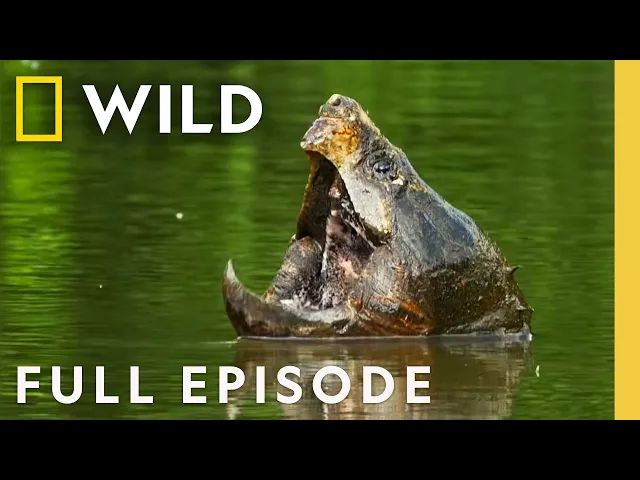
13:50 These are alligator snapping turtles, famous for their powerful jaws.
13:58 (music) (music) Down below,
14:11 they patrol the depths and shallows of the waterways.
14:18 They are the heavyweight predators down here.
14:24 They grow to more than 200 pounds and live for up to 70 years.
14:34 The males never leave the water.
14:41 And the females...
14:44 just once a year.
14:46 (bird squawking) A perilous annual sojourn.
14:52 This is a mission of maternal duty.
14:57 Female alligator snapping turtles must find a spot
15:01 about 50 yards from the river's edge.
15:04 (music) Somewhere with soft soil.
15:11 (music) And she begins an excavation.
15:20 (music) (music) (music) Her sharp claws break the dirt.
15:43 And her hind legs work like shovels.
15:50 It can take hours.
15:55 Well into the night.
16:02 Every minute she's here, she's vulnerable, exposed to predators.
16:14 Even the bugs seem to know she won't move until she's done.
16:24 This is a job that can't be rushed.
16:29 She appears to enter a trance.
16:34 Then, at last.
16:37 (music) (music) She mated two months ago, and now she lays her eggs.
16:59 Throughout the long night, she lays from ten to as many as fifty.
17:04 (music) (music) This may be the only contact she ever has with her offspring.
17:23 But she carefully tends to their most immediate need.
17:30 To remain hidden from predators.
17:33 (music) (music) It's been a hard night's work.
17:50 But will her eggs even make it to morning?
17:55 She returns, knowing nothing but exhaustion.
18:02 (splash) (music) NARRATOR: Turtles are just one of hundreds of species
18:21 drawn to the three rivers of Middle Mississippi.
18:25 (music) The rivers also attract people, especially those who like to fish.
18:38 (motor humming) The lower levels of the tributaries are easy to navigate.
18:54 In some sections, the channels are only six feet deep.
18:58 (music) (music) It's in these low-lying waterways that anglers need to beware.
19:14 It's calm on top.
19:19 But there is great danger below.
19:28 They search for just the right fishing hole...
19:31 (music) (music) (music) Hoping to catch a white bass.
19:58 Unaware that any second they may trigger an ambush attack.
20:05 All it takes is a passing boat.
20:10 (motor buzzing) (splashing) Asian carp jump en masse.
20:27 (music) (music) A reflex triggered by anything
20:37 that sounds and feels to them like danger.
20:44 Carp in these parts can weigh up to a hundred pounds,
20:48 but it's these five or ten pounders that are the big jumpers.
20:52 (music) No surprise for seasoned anglers out here...
21:04 but the carp have broken noses and knocked people unconscious.
21:11 In America, they aren't popular for eating.
21:18 The Asian carp was introduced to the United States
21:22 in the 1970s to control weeds on fish farms.
21:27 Some escaped.
21:29 They multiplied.
21:34 And now, they can be hard to escape.
21:40 The sound of their own boat engine keeps the fish coming.
21:45 They are the unwitting conductors of an aerial ballet.
21:50 (waltz music playing) (waltz music playing) (waltz music
22:06 playing) (waltz music playing) (waltz music playing) (waltz
22:22 music playing) (waltz music playing) Asian carp continue
22:39 to spread throughout the convergence and farther north.
22:44 Some fishery experts expect carp to soon reach 31 states...
22:51 taking over the three rivers area and 40%
22:54 of the waterways in the continental United States.
23:03 There's another invasion about to take place here.
23:09 One of biblical proportions.
23:24 NARRATOR: Every year in the Middle Mississippi area,
23:28 one of summer's cooler days triggers a landmark event.
23:33 (music) (music) Some mayflies live in the river as nymphs for more than a year.
23:47 (music) Now they hatch with wings...
23:56 and surface all at once.
24:00 (fluttering) (music) They weigh down the branches of young
24:13 trees like a bumper crop of graying leaves.
24:17 They're not just hanging out; they have important business here.
24:26 They slow down...
24:33 and one by one...
24:37 become frozen in time.
24:45 At least on the outside.
24:54 On the inside, a new creature is ready to break out of the old skin.
25:00 (music) (music) This molting is their final transition into adulthood.
25:17 (music) (music) (music) (music) At this point, they are vulnerable.
25:44 And the blackbirds and grackles know it.
25:47 (music) (music) They don't get meals this easy every day.
26:03 (music) (music) This is a special feast
26:15 that happens on just a few days each year.
26:22 Those mayflies who do make it emerge with a brand-new body...
26:29 and ready to find a mate.
26:32 There's only one catch.
26:36 But it's a doozy.
26:39 This is the last day of their lives.
26:43 Most will only live for the next 24 hours.
26:49 No time to waste.
26:52 They must find a mate in the frenzy, and the clock is ticking.
26:57 (music) (music) (music) (music) There are obstacles to dodge.
27:25 But most won't be stopped.
27:27 Not today.
27:33 Up and down the Mississippi, they create their own rush hour.
27:38 (music) (music) Their numbers grow so dense,
27:51 they can appear as clouds on Doppler radar.
27:56 So little time for romance, they mate on the fly.
28:04 The females then lay their eggs in the river, as many as 10,000 of them each.
28:12 They danced in the dark— a party fit for their final day on Earth.
28:20 Now they return from whence they came, as corpses,
28:25 to the swelling waters of the three wild rivers.
28:30 (music) The Ohio adds its own super power to this alliance of rivers.
28:42 By volume, it is the biggest contributor to the Mississippi River,
28:48 and she doubles the discharge rate to nearly
28:50 a half million cubic feet of water per second.
28:58 When the river is high,
29:00 it could fill more than 400 Olympic swimming pools every minute.
29:05 (music) The only thing that helps temper the flow is the season.
29:14 (music) It's getting close to fall.
29:21 (music) Temperatures begin to cool off.
29:31 And time to see if the turtle eggs,
29:34 laid in the spring, will finally produce young.
29:45 NARRATOR: The alligator snapping turtle eggs have
29:49 been incubating in the ground for three months.
29:53 Now this.
29:59 They don't crack like a bird egg.
30:02 (music) They are softer, more rubbery.
30:12 It takes a good bit of pecking and clawing
30:15 to get out and into their nest cavity.
30:21 As with many epic journeys, the first steps can be the most challenging...
30:28 and the stickiest.
30:33 They still get nutrients from the egg sac attached to their bellies.
30:40 When it's gone, instinct drives them to dig their way out.
30:45 (music) (music) (music) (music) They know which way to go.
31:15 But, like the wood ducks,
31:18 getting there alive may be the biggest challenge they ever face.
31:29 Their shells are already hard, but that isn't enough to protect them
31:35 against the many predators that lurk nearby.
31:41 Especially this menacing blue heron.
31:49 This time, a sunfish.
31:54 But it will eat a baby turtle.
31:59 The turtles may grow to be giants.
32:04 But right now it seems like everything
32:07 is bigger than this tiny one-ounce creature.
32:12 The terrain becomes an obstacle course.
32:24 (chirping) (music) (music) Finally, entrance into their new home.
32:48 Water never tasted so good.
32:50 (music) (music) Their chances of long-term survival just dramatically increased.
33:07 (music) (music) (music) On their side they have camouflage...
33:27 and the ability to use their snouts like snorkels...
33:34 and make like a living rock.
33:42 The return of winter is now just a matter of time.
33:46 (screeching) Creatures on all three rivers must prepare.
33:54 This muskrat works on a hut that would make
33:58 a beaver jealous— a giant mass of grasses, mud, and cattails.
34:08 It's a sturdy home...
34:11 with just one flaw.
34:13 (honking) It's not soundproof.
34:17 (honking) (honking) That becomes a problem every year...
34:31 (honking) when something extraordinary happens.
34:39 (honking) NARRATOR: There's a chill in the air near Mound City, Missouri.
35:01 Snow geese stop here on the Missouri River each winter to freshen up.
35:07 (honking) They're migrating down from the Arctic, headed to the Gulf of Mexico.
35:15 (honking) What starts as hundreds...
35:21 (honking) soon grows to thousands.
35:26 (honking) Then tens of thousands fill the sky.
35:32 (honking) More noisy neighbors than a muskrat can handle.
35:40 (honking) By the week's end, hundreds of thousands of geese have flown in.
35:48 (honking) (honking) (honking) But not all will leave alive.
36:05 (music) Bald eagles sometimes eat snow geese.
36:19 Those eagles, just a few years old or younger,
36:23 don't have their white heads yet, but they still have an appetite.
36:30 The geese know the threat.
36:33 They panic.
36:35 (flapping and honking) (honking) (honking) (music)
36:55 (honk) They leave a sick bird behind...
37:00 and with little hope.
37:02 (chirping) (honk) (music) (honk) The goose is cooked.
37:22 (music) (music) The eagles fight for pieces and argue over the spoils.
37:40 (chirping) (music) (chirping and screeching) (honking) After a week-long stay...
38:02 the massive flock of geese, and some ducks, move on south.
38:08 (honking) (honking) (honking) (honking) (honking)
38:38 (honking) (honking) (honking) Aerial calligraphy.
38:58 (honking) (honking) Translated, it says, 'Ta ta,
39:14 Missouri.' 'We're off to find warmer waters.' Meanwhile,
39:24 the Missouri River heads east for a journey of its own.
39:32 It must rendezvous with the Middle Mississippi
39:35 and add its weight to the three rivers area.
39:40 It carries with it the kind of cold that's hard to shake.
39:45 (music) (music) Yet, even in the darkest depths of winter, there is life.
40:02 (music) (music) And some of it is having a lot of fun.
40:16 River otters live on all three rivers.
40:22 This family can't get enough of that slippery, slide-y, snow-white surface.
40:29 (music) (music) (music) (music) (music) No need to hibernate like other mammals.
41:00 River otters have oily waterproof fur to protect them from the cold.
41:06 (music) And frigid water?
41:15 Not a problem.
41:24 They can stay under the ice, hunting for three to four minutes.
41:30 And sometimes they need to.
41:35 They'll eat as much as 20% of their body weight every day.
41:48 'Wanna share?' 'Well,
41:54 okay.' (music) And an otter family that hangs together plays together.
42:11 You don't usually think of carefree days in winter.
42:16 But that's what these are, in the three rivers area.
42:25 In this water, there flows the essence of America.
42:31 (music) Ultimately, it's all called the Mississippi.
42:44 But that's water from 31 of the lower 48 states— two-thirds of the country.
42:55 And it's the Middle Mississippi where most of that comes together.
43:01 This special section represents the country in another way, too.
43:09 The 200 miles from Saint Louis...
43:14 down past Cape Girardeau...
43:18 and to Cairo, Illinois is a powerful and wild stretch of the Mississippi.
43:25 (music) (music) And the animals seem to know it.
43:35 (honking) They converge here, too...
43:43 for a taste of what all these rivers can offer...
43:48 to live in this part of America, where they,
43:54 like the rivers, can flow free, roam wide, and remain wild.