Our Minds Are Weirder than You Think
Kurzgesagt – In a Nutshell
0:00 You exist in a truly secret place nobody but you can enter: Your mind.
0:06 When we say mind we mean the place where you, whatever you are, exist.
0:11 It's the totality of your inner world,
0:13 the location of your consciousness and memories,
0:16 the toolset of your intelligence.
0:18 It’s the place where all of your wants, thoughts and emotions happen,
0:22 where you think, learn, dream and imagine things– consciously and unconsciously.
0:29 Your mind is truly your own,
0:32 a universe only directly accessible and inhabited by you–
0:36 and inaccessible to anyone else in the universe.
0:40 And your mind is probably unique to you.
0:43 Probably, because how would we know if two minds are the same?
0:48 What do you see when you imagine an apple?
0:50 A detailed scenery, a crisp image with clear details and colour?
0:54 Is the apple hanging in a void?
0:56 Can you rotate it?
0:57 Is it a 2D shape?
0:59 Is it colorless or transparent or very vague?
1:03 Or don’t you see anything at all but feel what an apple feels like to you?
1:08 Maybe a weird mix?
1:10 Do you have an internal voice that narrates your life?
1:13 Do you have an inner monologue?
1:15 Is there silence inside your mind?
1:18 Do you only hear voices when you read?
1:21 Or do you process thoughts nonverbally or even just feel the world around you?
1:26 It is a bit stunning how many variations of inner
1:29 universes humans have and how different our minds must be.
1:34 Humans have arguably the most complex minds on earth but today
1:38 it is widely accepted that minds are not exclusive to us.
1:42 There are trillions of animal minds out in the world,
1:45 uncountable little secret universes, forever locked to us.
1:49 And by looking at them and their evolution we may be able
1:52 to learn why our minds are as stunning as they are today.
1:56 A pretty wild idea is that minds
1:59 might have originally evolved to control your movements.
2:02 To create a gap between all of your sensory input,
2:04 and your motor output, how you react to information by moving your body.
2:10 A Tool To Deal with the World When life
2:13 emerged it was without any minds but just cells,
2:17 able to eat, poop and reproduce.
2:19 They already had to navigate a complex and dangerous world
2:22 and to process sensory input– but they were extremely inflexible.
2:27 If a cell had the inner state “hungry” and sensed “food” it automatically moved
2:32 in that direction– or it flapped around randomly
2:35 until it ran into a meal by accident.
2:38 This worked well enough for billions of years and still does.
2:41 But as life exploded in complexity and became multicellular,
2:44 cells began to dedicate themselves to processing information.
2:48 The first very simple “minds” emerged: little more than tiny gaps.
2:54 Virtual spaces in which sensory information could be processed
2:57 for a short moment before these early animals had to react.
3:02 Roundworms only have 302 neurons in total,
3:04 yet they are already able to learn things like “this thing is bad”
3:09 and retain a memory that changes behavior
3:12 for a few hours before they forget again.
3:14 Minds on this level most likely don’t reason or think,
3:18 but use simple rules that work well in their environments.
3:22 Scientists still debate whether this counts as mind
3:25 or are still just preprogrammed automated reflexes.
3:29 With more neurons, animals can “freeze” before they act.
3:33 Process and interpret information and make decisions
3:35 for what is the best option at that moment.
3:38 This is arguably where a true inner space, a mind begins to emerge.
3:43 And some insects may have something like it, like our buddy the bee.
3:48 With a brain smaller than a sesame seed and about one million neurons,
3:53 a bee has a much larger mind gap.
3:56 And it is filled with information about the world.
3:59 It builds and remembers a huge mental
4:01 map of flowers over square kilometers of terrain,
4:04 cross referencing it with the position of the sun to find its way.
4:07 Bees can take shortcuts, so they can’t be simply following reflexes
4:11 but are actually navigating their internal maps.
4:14 In extreme cases when resources are scarce,
4:16 bees can move up to 10km from their hives to collect
4:20 food– the equivalent of going from Paris to Rome for groceries.
4:24 And they teach the location of the food by dancing.
4:28 Minds have emerged a few times
4:30 in evolutionary history and evolved in different directions,
4:33 so while we are telling this story by increasing complexity,
4:37 in reality minds are more like a weird mix of different experiments,
4:41 depending on what niches the animals fill.
4:44 If your mind wants to experiment with a business idea,
4:48 our partner Odoo has got you covered.
4:50 Odoo is an all-in-one management software
4:52 that helps you run your business every day.
4:55 Every business idea starts simple, but things can get complex fast.
5:00 That’s where Odoo comes in: with more than 45 user-friendly apps,
5:04 you can handle everything from accounting and inventory to CRM
5:08 and much more– all centralized on a single platform.
5:12 For example, you can create and send invoices in seconds:
5:15 just select your customer, add your products and quantities,
5:19 define the billing terms, and send everything via email.
5:22 Plus, the built-in chatter gives you an overview of your emails,
5:26 notes and activities– all in one place.
5:29 Tracking your payments, with clear statuses and deadlines, is just as simple.
5:34 You can try all these features for free–
5:37 because your first Odoo app is free forever,
5:39 with unlimited support and hosting included.
5:42 When you’re ready to scale up,
5:43 Odoo adapts to your needs– you can simply add more apps.
5:47 And you get access to all applications starting at just $24.90 a month.
5:53 With Odoo, your business mind knows no limits.
5:56 And now back to the video!
6:00 Mind complexity probably increases dramatically as we add more neurons,
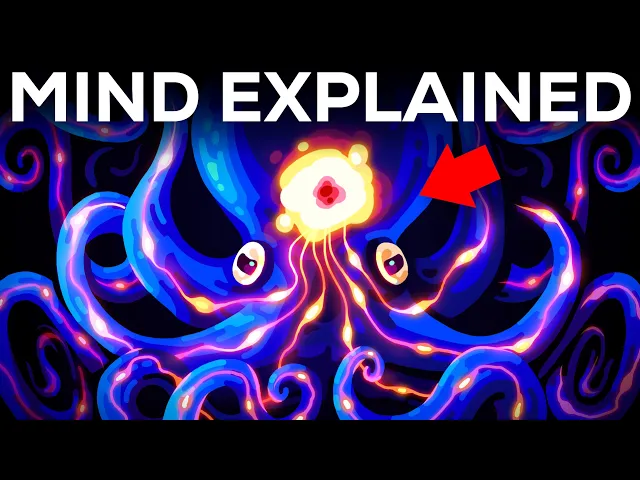
6:05 like the octopus that has about 500 million of them.
6:08 Only 40% of their neurons are in their central brain,
6:11 while each of their arms has their own mini nerve centers that taste,
6:15 process information locally at the same time and act on their own.
6:19 The central brain does still coordinate
6:21 them for complex behavior, like catching prey,
6:24 because imagine 8 arms doing their own thing all the time.
6:27 But different arms are specialized and used primarily for different tasks,
6:32 like exploring or movement.
6:34 And we know their arms can make decisions
6:36 independently to some degree and have some autonomy.
6:39 Octopuses are very intelligent animals, able to do loads of complex things,
6:45 so their minds should be somewhat complex.
6:47 But how does their mind experience things?
6:50 Is it distributed over their whole body?
6:53 Does an Octopus feel like multiple smaller minds interacting as one thing?
6:58 If octopuses show how strange minds can be,
7:02 birds show how sophisticated they can become
7:04 if it develops in a different direction.
7:07 Some bird species with billions
7:09 of neurons probably have surprisingly sophisticated minds,
7:12 where they can go one step further:
7:15 While minds may have started as a gap to delay action,
7:18 bird minds are able to simulate a map of reality, including other players.
7:23 Scrub Jays are hoarders that catch and hide all
7:25 sorts of food in different places, from worms to nuts.
7:29 Inside their mind they keep track of time
7:31 and are aware that fresh food goes bad.
7:34 So after a few days have passed they will ignore the hiding places
7:37 of dead worms and instead go for the nuts that are still good.
7:42 Probably more impressive,
7:42 they might be able to simulate the minds of other birds–
7:46 If a scrub jay is hiding food and notices another jay watching,
7:50 they will return later and re-hide their stash so it doesn’t get stolen.
7:55 Which is a perfect transition to what makes the minds of humans so special:
8:00 While we are probably not the only animals that can simulate other minds inside
8:03 our mind– humans with our 86 billion
8:07 neurons have taken it to extraordinary depths.
8:10 The Internal Universe When humans are born
8:14 they are cute but selfish blobs of meat, solely focused on their own needs.
8:19 But around 18–24 months a baby becomes able to recognise itself in a mirror.
8:25 It realizes that something that seems to be “other” is actually
8:29 itself– which is usually a delightful experience for the human larvae.
8:33 But it is also the first step of a powerful realization:
8:37 You are not just an observer in the world–
8:40 there are also others that can observe you.
8:42 You see and you are seen.
8:44 And if you are seen… well then you can’t just behave egoistically
8:48 all the time– because you need the goodwill of others to stay alive.
8:52 We humans are not just simulating other minds in our minds.
8:55 We simulate minds, simulating minds.
8:58 We think about what others think.
9:00 We think about what they think about us thinking about what they think.
9:04 And so on.
9:05 There are a lot of layers.
9:07 This awareness of the minds of others may be one of the origins of our moral
9:11 conscience and a huge reason why we are able to live in large societies,
9:16 with other humans we are not related to.
9:18 And may have spawned one of our most charming obsessions: storytelling.
9:23 We don’t just remember that an event happened,
9:25 we imagine what the people that were part of it were thinking,
9:28 what we think they should have been thinking,
9:30 what might have happened if they acted and thought differently.
9:34 Combined with our ability to create fictional universes
9:36 to plan ahead we have created countless fictional worlds,
9:39 with people that don’t exist but that we deeply relate to.
9:43 That are real to us.
9:45 Every movie, novel or comic is humans
9:48 sharing their internal simulations with each other.
9:51 Whether you see a photorealistic apple in your mind
9:54 or feel the concept of an apple, in the storytelling space we are all
9:59 able to come together and understand each other.
10:01 This is how we transport information about morality and our values,
10:05 about what we think is good or bad.
10:07 So maybe the most amazing thing about human
10:10 minds is that they're fundamentally social- filled with voices,
10:14 ideas, and perspectives from countless others.
10:17 Your thoughts and feelings have been shaped
10:20 by stories that never happened but that you've
10:22 absorbed and simulated in your mind in a way that is unique to you.
10:27 In a very real sense, your secret mind isn't just yours,
10:30 but a collaborative creation between you
10:33 and all the human minds that came before.
10:36 And if you want you can add your stories as well.
10:39 For the ones that come after.
10:45 Our latest Limited Edition Pin is here–
10:48 kicking off the new Cosmic Time Collection.
10:50 It’s an homage to Halley’s Comet,
10:52 the cosmic traveler that has been visiting Earth for millennia.
10:56 It only returns around every 75 years but we
10:59 captured it in a super sparkly, rotating pin.
11:02 Only 10,000 exist, and each one is individually numbered.
11:07 Wear it to complete your outfit, add it to your collection,
11:09 or make it the first piece of a brand new one.
11:12 Over the years we’ve created quite a tradition
11:14 of these tiny sculptures– and you’ve loved collecting them.
11:18 So we decided to take it one step further.
11:21 Meet the first ever kurzgesagt figurines–
11:24 small collectible scenes from the kurzgesagt universe.
11:28 If you’ve been around the channel for a while,
11:30 these might look a little familiar.
11:32 Mission Control, meet Duck– always ready for another trip through space.
11:37 Never stare directly into a deadly ray
11:39 from space– this birb learned the hard way.
11:42 And whatever you do… never press the big red button.
11:46 Get one– or all of them– for your desk,
11:50 bookshelf, or honestly… your life in general.
11:52 We had a blast designing them, packing each one with love and tiny details.
11:58 Head over to our shop, we’ve put together a few deals for you.
12:01 Get your special piece of kurzgesagt now.