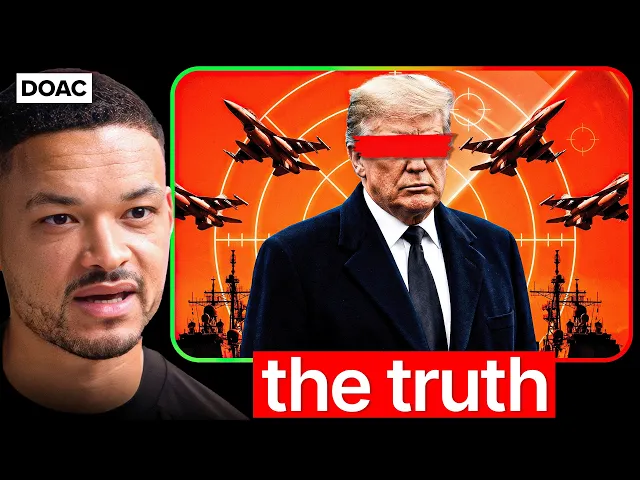
The REAL Reason Trump Started The Iran War
The Diary Of A CEO Clips
0:00 What is going on?
0:01 Like, really take me back to the beginning.
0:03 What did Trump think was going to happen?
0:05 How is this linked to Venezuela?
0:07 Why would he do this after saying that he was
0:09 the president that was going to stop all the wars?
0:11 What is the big picture here?
0:12 And literally one of the eight wars that he
0:14 said that he had stopped was with Iran.
0:17 This was not what he was voted in on.
0:21 He was voted in he ended the war in Afghanistan.
0:24 I mean, he cut the deal with the Taliban.
0:26 Was it a great deal?
0:27 Yeah, for the Taliban it was pretty good, but it got the Americans out.
0:31 20 years.
0:33 A trillion dollars.
0:35 Fought on the backs of the Afghan people and of Americans,
0:40 not wealthy Americans,
0:41 not people like Trump that could find a way out of service.
0:45 But poor Americans.
0:46 And Europeans.
0:47 Yeah.
0:47 And Europeans who fought side by side
0:50 with the Americans when the Americans asked them to almost
0:53 all of them sending troops and many
0:54 of them wounded and dying in the same numbers,
0:57 the same percentages, just as courageous as the Americans were.
1:01 Right?
1:01 So, Americans wanted an end to that.
1:04 Vietnam, Iraq, Afghanistan, what the hell are you guys doing?
1:08 We're not benefiting that.
1:09 Stop it.
1:10 Trump stopped it.
1:11 So, why did he do this?
1:12 Why did he do Why did he do this?
1:14 I think there are three reasons why he did it.
1:16 I'll take you through.
1:18 First reason, you said Venezuela.
1:20 Not on this map.
1:21 Shouldn't be relevant to this map.
1:23 Turns out it's relevant to this map.
1:25 Trump had plans to take out Maduro.
1:29 He's got a lot of people inside his administration
1:32 that see this guy as a real problem.
1:34 And by the way, a problem for the region.
1:36 8 million Venezuelan refugees destabilizing the region.
1:40 Lots of drug export destabilizing the region.
1:43 So, he had been planning to do something.
1:46 Was it also linked to the oil?
1:47 It was relevant.
1:48 They have the world's largest oil reserves.
1:51 It is going to take far more years than
1:53 Trump will be in office to make that meaningful.
1:56 So, it sounds good from a branding perspective and you're
2:00 going to see a few hundred thousand more barrels a day,
2:02 but it's it's going to be years.
2:04 If you saw that um testimony by the CEO of Exxon Mobil who said,
2:09 you know, Venezuela is not investable today.
2:12 And Trump was angry at him.
2:13 And all the other energy CEOs like, thank you for saying that.
2:16 We're not saying anything.
2:16 Like, him.
2:17 Look at him.
2:18 Look at him.
2:19 Not much courage among those CEOs publicly.
2:21 So, the oil is a great headline for Trump.
2:23 It doesn't matter much for Trump's presidency.
2:26 And we know Yeah, just check it some color on that.
2:28 Is that because they just can't They have to build
2:30 up lots of infrastructure to be able to extract it?
2:32 Oh, yeah.
2:32 And And because all their engineers are gone.
2:34 Most of them in the oil patch up in Canada which has similar geology to it.
2:39 Because they've destroyed so much of their infrastructure.
2:42 It's broken down.
2:43 Because the governance structure isn't there yet.
2:46 They don't have people that are capable of actually ensuring that there
2:49 will be contracts that you would follow through on and engage in.
2:52 People that still have huge lawsuits that need to be resolved, right?
2:55 So, all of this stuff.
2:56 But, to get to your I don't want to lose
2:58 sight of your why did Trump do this in Iran?
3:01 So, the first point is beginning of the year.
3:04 Trump goes in to Venezuela, right?
3:09 It is the most successful military operation you can possibly imagine.
3:14 Not a single American serviceman or woman is killed.
3:18 They go in.
3:19 They take Maduro out.
3:21 They don't kill him.
3:22 They don't injure him.
3:24 They bring him to a jail in Brooklyn.
3:26 Right here in New York.
3:27 Out of borough, but still counts.
3:29 New York City, right?
3:30 Extraordinary.
3:32 And he's facing justice.
3:34 And meanwhile, Delcy Rodríguez, right?
3:38 Suddenly, vice president becomes acting president.
3:41 It's like, sir, we want to work with you guys.
3:44 We don't want any of that, right?
3:46 And so, you've got a new government that is has a different trajectory,
3:50 but it's basically the same regime.
3:51 And they say, whatever you want, we will work on.
3:54 You want We'll open our oil sector.
3:56 We'll open our mining sector.
3:57 We'll have better regs.
3:58 We'll We'll We'll try to improve
4:00 the economy for the average Venezuelan." I mean,
4:02 they're starting to become popular.
4:03 In another year, if they had elections in Venezuela,
4:06 it is not inconceivable that she would win.
4:10 At a democratic election, which is like blows your mind, right?
4:13 Whole but hundreds of political prisoners, they have released.
4:17 I talked to leaders all over South America.
4:20 They all think this was a success.
4:23 This is enormously popular among the populations
4:26 in those countries because they care about security.
4:29 That's what they've been voting on.
4:30 Their elections have been about the economy and local security.
4:34 And Venezuela has been a problem for them, right?
4:36 I mean, they're exporting people, causing crime.
4:39 Colombia, Peru, Brazil, this Chile, right?
4:43 This has been a serious issue.
4:44 So, Trump Trump is hugely feeling great, successful.
4:48 Now, he's like, "I can do that in Iran.
4:50 I can do it even bigger." So, that's the first reason.
4:52 That's the first I said three reasons.
4:54 That's the first reason.
4:54 Second reason.
4:56 This is not Trump's first rodeo with the Iranians.
5:00 In his first presidency, the Iranians were engaging in strikes
5:04 against the Americans directly and with proxies, uh bases in Iraq, other places.
5:11 Also were taking on strikes against the biggest
5:14 refinery in the world in Saudi Arabia, those drone strikes you may remember.
5:19 The Saudis and the Emirates were telling the Americans,
5:22 "When you going to do something?
5:23 We need to take some action." Trump didn't want to do anything.
5:25 They're getting angry, right?
5:27 Finally, the end of his presidency, he orders,
5:30 pretty bold move, the assassination
5:33 of this incredibly charismatic military leader,
5:36 Qassem Soleimani, the head of the Quds Force, as it was called, in Iraq.
5:40 And Iran was so angry.
5:42 And they were going to destroy the United States.
5:43 Death to America.
5:44 What did they actually do?
5:46 Nothing.
5:47 And then last June the Iranians were developing their ballistic missiles,
5:52 they're developing their nuclear enrichment.
5:55 In uranium enrichment,
5:56 they're like stockpiling at higher level 60% and the Israelis want to go in.
6:02 Trump's providing intelligence.
6:04 He doesn't want to go.
6:05 Kind of dangerous.
6:06 The Israelis go in, it's enormously popular.
6:08 It's going well, succeeding.
6:10 Trump's like, "I want a part of that.
6:11 That's successful." So, he joins in.
6:13 Second time, Israel took casualties, about 100 killed,
6:17 I think, in the course of that 12-day war.
6:20 United States, Iran talked big, did not hit the Americans.
6:23 They threw some missiles at that Al Udeid base in Qatar, the biggest US base.
6:28 They warned the Americans through Iraq before the missiles were launched.
6:32 So, it was very clear the Iranians didn't want any part of that fight.
6:36 So, Trump is thinking to himself this is going to be awesome.
6:40 Cuz I'm going to go in, I'm going to pull Venezuela and Iran.
6:43 I know they don't want to fight me.
6:44 I killed the supreme leader, 86 years old, he's going to die anyway.
6:47 He's not that popular among the Iranian the Islamic Revolutionary Guard Corps,
6:51 the IRGC, because they're the ones that really run the country.
6:54 I'm going to have this huge military force that shows what I'm capable of doing.
6:58 Then the rest of the Iranian leadership,
7:01 they're going to want to work with me, just like they did in Venezuela.
7:03 So, that was reason number two.
7:04 And then the most important reason.
7:08 The most important reason is that unlike Trump's first term where he
7:12 had people around him that were patriotic first and foremost to the country.
7:17 And when they had disagreements with Trump, they let him know.
7:20 And they leaked.
7:22 And they also, um, were willing, occasionally,
7:25 to do what they could to undermine
7:27 an incompetent decision that would hurt the country.
7:30 And we saw that, whether it was with Mike Pompeo or or or Mad Dog Mattis, right?
7:37 All of these people who were much more independent, strong actors.
7:42 This time around, Trump has some really good advisers.
7:45 People like Marco Rubio and Scott Bessent.
7:48 He also has some staggeringly incompetent
7:50 advisers like Pete Hegseth for example.
7:53 But what they all share is that they
7:55 are first and foremost loyal to the president.
7:59 And they will not tell him.
8:01 They won't push back.
8:03 And what he hears from them is shaded towards how brilliant he is.
8:08 And that makes him think that he will be more
8:11 successful even when the military thinks this is a horrible idea.
8:15 And we just saw this with the reporting
8:17 from the head of the joint chiefs, Dan Cain,
8:20 who clearly thinks that this is a really
8:22 bad idea and understands that the military
8:25 scenarios are super dangerous and that the Iranians
8:28 will be able to shut down the strait.
8:30 And every military in the US for the last 20 30 years has
8:34 gamed out how the Iranians could shut down the strait in a major conflict.
8:39 And Trump hears very little of that and he's taking away I'm incredible.
8:44 I'm confident.
8:45 I'm going to make this happen.
8:46 Those are the reasons he wanted.
8:48 And so he thought it would be take out the supreme leader,
8:51 then they'll negotiate, we'll get a better deal,
8:53 we'll have a political system there or political
8:55 leader there that is obedient to us.
8:57 Yep.
8:58 It'll be and it'll be maybe it won't be a day, but it's not going to be a month.
9:02 And what actually happened?
9:04 That did not happen.
9:05 What actually happened is the Americans took out
9:09 or the Israelis took out the supreme leader.
9:12 And also took out a lot of the military leadership that the Americans
9:15 had been speaking to, which is why Trump came out and he said,
9:18 "Well, a lot of the guys we're talking to are dead now,
9:21 so we don't really know who to work with." He said
9:23 that in the not even if it's true and it was,
9:27 you don't want the president saying that, right?
9:28 He has no filter.
9:30 Um so which is which is one
9:31 of the more interesting things about this presidency.
9:33 What happened is the Iranian leadership was taken out.
9:37 The response was immediately what they
9:39 call this mosaic situation where they decentralized
9:43 the military decision-making to local commanders because
9:48 they were worried that the high-level commanders,
9:50 if they were on cell phones, if they were engaging with other commanders,
9:54 the Israelis would know where they were and they'd be able to assassinate them.
9:57 So then suddenly the Iranians were taking shots at other at Gulf states,
10:03 at critical infrastructure, and stopping transit from the strait.
10:08 This is one of the questions I had is in several interviews that Trump has done,
10:11 he alludes to the fact that he thinks he's talking to the right people.
10:14 Do you really believe I know there was
10:16 a meeting recently in Pakistan where they sent J.D.
10:18 Vance in to negotiate with Iran.
10:21 Do you think anyone is running Iran at the moment?
10:24 Is there leadership in Iran?
10:25 Is it possible to negotiate and control all
10:27 of these dispersed forces um at the moment?
10:33 First, the honest answer is it's impossible to know because this is
10:38 right now that the the internal
10:40 decision-making of Iran is extremely buttoned up.
10:44 Um and if they ain't talking to anyone uh a- about that.
10:51 Mhm.
10:49 But it's very easy to assess two things.
10:54 First, um that their ability to make
10:57 centralized decision plans and implement them is real.
11:03 So when their biggest gas field is hit and they
11:06 say we're going to hit you back in return,
11:08 they are able to implement on that in short order.
11:11 So we've seen a number of occasions in the last 5 weeks where Iran has gone
11:17 from statement made by the foreign ministry and by spokespeople
11:21 to action taken by local commander in Iran,
11:24 which implies that there is a centralized structure.
11:27 We also see toll taking on the strait by individuals
11:33 that are being ordered by the central Iranian government to do that.
11:36 They're not operating by themselves.
11:37 So, in that regard, the fact that the Iranians showed up in Islamabad,
11:42 in Pakistan, with significant leadership, with the foreign minister,
11:48 also the speaker of the parliament, but also a team of experts who had
11:52 briefs on negotiating on a number of different points,
11:56 on the strait and on ballistic missiles,
12:00 and on support of proxy actors, and on the nuclear issue,
12:04 which proved the most divisive in those 21 hours of talks,
12:08 shows that this regime is still very much functioning despite all
12:13 of the Israeli and the American efforts to say that, you know,
12:16 they've done all this incredible damage.
12:17 This regime is still very much in place.
12:19 And they couldn't get a deal,
12:21 so Trump announced that he's going to block the Strait of Hormuz himself.
12:25 Just hours ago.
12:26 I think that that is also overstated.
12:29 You have 21 hours of talks led by the vice president of the United States.
12:34 I assure you, if these talks were a disaster, they don't last 21 hours.
12:39 Two or three, and then they're out.
12:42 21 hours means very substantive conversations on the entire range
12:47 of topics that were of importance to the Americans and the Iranians.
12:52 Trump did not get the outcome he wanted ultimately.
12:55 I'm not super surprised because the Iranians feel like they have
12:58 more leverage right now than the United States thinks they do,
13:01 and this frustrates Trump immensely.
13:03 And so, at the end, remember, he's he's calling and talking with Vance more than
13:08 10 times over the course of this entire conversation.
13:10 This It's a They're They're in regular contact.
13:14 At that point, Trump says, "Okay,
13:16 I'm blockading the strait." But just before markets open on Monday,
13:21 you also see reporting that, "Well,
13:23 these talks that were a disaster we're we're going to engage in further talks.
13:29 So, maybe it wasn't such a disaster.
13:30 Maybe what's really going on here is Trump wants to show that he still has
13:35 more leverage to use against the Iranians
13:37 because he's lost a lot of his leverage.
13:39 He gave a speech to the American people,
13:41 one speech so far about Iran, primetime speech.
13:44 In that speech, he said war is almost over, 2 to 3 weeks max, we're done.
13:49 If I'm the Iranians and I hear that, I'm like, great.
13:52 The Americans can't take this pain anymore.
13:54 They can't take He keeps saying, straight not my problem, straight.
13:57 Let them take care of it.
13:58 I hear that, I'm the Iranians, great, he can't take this economic pain.
14:03 He knows he doesn't have a military solution.
14:05 So, it's not that the Iranians are only hearing from Trump,
14:08 I'm going to destroy your civilization.
14:10 They're seeing what he's actually doing.
14:12 And he seems to change his mind a lot or not
14:14 follow through on some of the threats that he makes.
14:16 Right, of course.
14:16 And then they also will be aware that he's becoming increasingly unpopular.
14:20 On this issue specifically issue.
14:22 On this issue specifically, he is underwater just like he was
14:25 on Greenland where he eventually completely did a 180.
14:29 He was going to put tariffs on all the Europeans that supported Denmark.
14:32 He had to take Greenland.
14:34 Those things went away.
14:35 So, you're sat there in Iran, you're going,
14:37 Trump's own people are pressuring him to get the hell out of here.
14:42 Yeah.
14:41 He's unpopular day by day.
14:42 It's hurting his economy.
14:45 His midterms elections that are coming up,
14:47 he's going to be severely hurt and he's going to lose power in that regard.
14:50 So, actually, the Iranian leaders I mean,
14:54 they might be incentivized just to wait it out.
14:57 Because they don't think they have to wait it out for months.
14:59 They think that It's a democracy, so he's going to be
15:01 unelected at some point in a couple of years.
15:03 China.
15:03 China did this, right?
15:05 Last year Liberation Day as America as Trump called
15:08 it where he puts tariffs on all these countries,
15:10 he puts these high tariffs on China.
15:12 They hit back.
15:13 He does it again.
15:14 They hit back again.
15:15 He's like, I'm going to do export controls.
15:16 They say, well, we're going to shut down your critical minerals.
15:18 Suddenly, CEOs are going to Mar-a-Lago.
15:20 They say, you got to deal with the Iranians or or we're
15:22 going to shut down our factory lines in red states.
15:26 Trump has to back down, right?
15:27 So, they've we've already seen that when a country
15:30 has leverage over Trump and they can hit him,
15:33 he has the most strong military in the world, but he also has a glass jaw.
15:37 He can't take a hit the way that unelected non-democracies can.
15:42 The Chinese and now the Iranians over the strait.
15:45 So, what Trump is doing with announcing the blockade,
15:48 and by the way, he hasn't broken the ceasefire.
15:50 So, even though blockade is an act of war, he still hasn't said, "Okay,
15:53 you guys have to start hitting the Iranians again right now." So,
15:55 he This is still de-escalated compared to a week ago.
15:59 A week ago, this looked much more dangerous than it looks today.
16:02 He's saying to the Iranians, "Hey, I'm willing to cut off your source of funds.
16:08 I'm willing to stop you from exporting oil and making money off of it." Same
16:12 Trump that suspended those sanctions on Iran
16:16 because he wanted to keep the prices down.
16:18 So, that's that's what's happening right here.
16:20 Iran also, again, I'm trying to put myself in the in the the mind of, you know,
16:25 the incentive structure of the Iranian leaders.
16:27 They can't let it be seen or known
16:30 that dropping bombs on us made us pander to you.
16:35 Because if they set that precedence,
16:36 then for the next couple of decades, every American leader's going to know,
16:39 "Okay, if you want Iran to play ball, all you do is take out their leadership.
16:43 You drop loads of bombs on everything they have,
16:44 and then they come and negotiate with you
16:46 and give up their nuclear weapons and everything else." So,
16:49 I I would imagine there's an element of an the Iranians now going,
16:52 "If we buckle here, then for the rest of time,
16:56 America are going to repeat this playbook." I I hear what you're saying.
16:59 I I would put it a slightly differently.
17:02 I I think that after the 12-day war last June,
17:06 the Iranians understood that their deterrent capacity had failed.
17:11 They were incapable of preventing the Americans and the Israelis
17:15 from hitting them and their proxies whenever they wanted.
17:18 We've talked a lot about Iran.
17:20 We haven't talked at all about Lebanon.
17:23 There's another war going on in Lebanon right now.
17:25 The Israelis are hitting the Lebanese very hard.
17:28 There's over a million displaced people in the last several weeks.
17:32 Why?
17:32 Why?
17:32 What What is this war?
17:34 Well, uh Hezbollah, which is um a terrorist organization
17:37 uh as recognized by Israel and the United States, though not everybody,
17:41 continues to have the ability to engage in strikes against Israel.
17:45 Nowhere close to the strength of the Israeli military,
17:48 but let the Lebanese government promised to disarm them.
17:51 They have not done that.
17:52 And so Hezbollah has been able to continue to engage in missile strikes,
17:57 relatively small numbers of missile strikes,
17:59 into the north of Israel where Israeli citizens live.
18:03 There was a period of time after the October 7th
18:06 um attacks by Hamas where over 100,000 Israelis had to evacuate
18:11 from their homes and their schools and the rest for like
18:14 a year because Hezbollah was making their lives hell, right?
18:19 So, what Israel is now doing is they're going to take territory,
18:23 about 5 to 7 km of Lebanese land.
18:26 They're going to occupy it as a buffer zone to protect
18:31 those Israeli civilians from Hezbollah being
18:34 able to hit them with their weapons.
18:37 That is the intention here.
18:39 And so, what Iran understands is
18:41 that their ability to deter Israel from hitting Hezbollah.
18:46 Hezbollah at the beginning, in October 7th,
18:48 Hezbollah was the most powerful non-state military in the world.
18:53 No one else was close.
18:54 And today, Hezbollah has shown
18:57 that their leadership gets targeted and destroyed,
19:00 assassinated across the board by the Israelis, that their military is incapable,
19:05 their critical infrastructure can be disrupted,
19:08 and that Israel can also hit Beirut,
19:09 the capital of Lebanon, and no one can do anything in return to Israel.
19:13 If you love the Diary of a CEO, brand,
19:14 and you watch this channel, please do me a huge favor,
19:17 become part of the 15% of the viewers
19:20 on this channel that have hit the subscribe button.
19:22 It helps us tremendously,
19:23 and the bigger the channel gets, the bigger the guests.