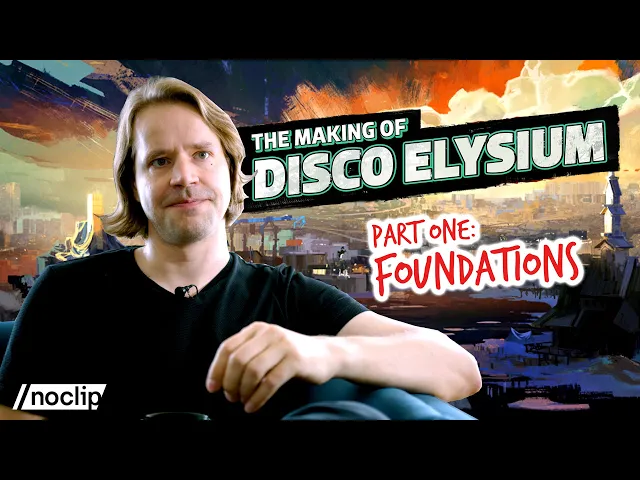
The Making of Disco Elysium - Part One: Foundations
/noclip
0:00 (Ident clicks) (Click) ("Instrument of Surrender"- Sea Power)
0:24 [DANNY O'DWYER] When a great piece of art is made– one that breaks the mold
0:27 of its genre or expresses feelings and ideas that are new and exciting–
0:31 society scrambles to understand how it came to be.
0:34 This is how an unknown group of people from the small,
0:37 Eastern European nation of Estonia
0:38 quickly became some of the most respected game developers in the world
0:42 despite none of them having made a game before.
0:45 But entropy comes for all of us, and over the years
0:48 the bonds that brought these people together were stretched and strained.
0:51 Some puffed out their feathers to get the attention they long desired.
0:54 Some fell quiet, perhaps uncertain
0:56 if the personal cost of making that art was worth paying again.
1:00 In the shadows, others schemed to extract surplus value from the asset.
1:04 While new artists, inspired by this groundbreaking game,
1:08 rushed to be part of its next chapter.
1:10 A chapter that, several years later, has yet to appear.
1:13 This is not a story about what happened after the launch of Disco Elysium.
1:16 At least, not yet.
1:18 This is the story of the moment lightning was captured in a bottle;
1:22 of the time, place, and circumstances that led to the creation
1:25 of one of the most beloved video games of all time.
1:28 A talisman-turned-Monkey Paw that forever changed games
1:32 and the lives of the people who made it.
1:35 To produce this documentary, I spent a week in Estonia's capital, Tallinn,
1:39 with Robert Kurvitz, Helen Hindpere, and Aleksander Rostov.
1:42 I spoke to other developers,
1:44 remotely and in person– some on the record and some off–
1:47 to try and paint a picture of this game's creation
1:49 and to celebrate each individual who participated in its development.
1:53 Because the story of Disco Elysium's development
1:56 has lessons that are worth sharing
1:58 with the games development community:
2:00 what the studio got right, and difficult lessons they learned along the way.
2:03 And so, over the coming weeks, we're going to have episodes
2:06 focused on writing, design, art, and more.
2:09 But to understand how Disco Elysium came to be,
2:12 we have to go back before any lines of code were ever written.
2:15 Where a disorganised bunch of artists,
2:17 searching for acknowledgment and financial stability,
2:20 would find strength in banding together.
2:22 In this first episode, we focus on foundations:
2:26 a very particular set of people, in a particular time,
2:29 in the history of a very particular place...
2:39 (Ambient piano) [ROBERT KURVITZ] I grew up in Mustamäe.
2:45 It translates as "black hill" or "black mount".
2:49 There is no actual mountain.
2:52 It's just flat ground.
2:54 And both of my parents are artists, painters and stuff like that.
2:58 So I was raised by my mum in Mustamäe.
3:01 And then my dad is Raoul Kurvitz.
3:04 He's a famous Estonian artist.
3:06 And a "famous Estonian artist" means that 20,000 people know you
3:10 and 17,000 people hate you.
3:13 (Chuckles) So, because both of my parents were artists,
3:17 I didn't wanna become one.
3:19 I saw how sad my mum was when it wasn't succeeding,
3:23 when the paintings weren't coming out well.
3:25 And I thought, I don't want that kind of stress in my life.
3:30 So I decided instead, the stress you get when the writing isn't coming out well.
3:35 I went to a really wannabe-British
3:38 boarding school called Tallinn English College.
3:41 And then it was a pretty psychotic and then miserable school to go to.
3:45 So I went there for about nine years
3:47 and then I dropped out and I never got any more education.
3:52 And then I became, I guess, a high school dropout.
3:56 And I found a lot of other high school dropouts,
3:58 and we started playing what we thought was Dungeons& Dragons
4:03 but what was actually a knock-off Dungeons& Dragons, basically, from Finland.
4:07 And it wasn't a very good system.
4:09 It was very thin and very minimal.
4:11 But that kind of taught me that pen-and-paper systems should be very minimal.
4:15 And also, it was good that it wasn't very good
4:18 because we immediately wanted to make a better one.
4:21 And so, I got to work on that one.
4:23 So that was the first incarnation of it
4:26 and then we quickly realized that it wasn't cool enough,
4:29 that it needs to be cooler,
4:31 and then, I think over ages 15 to 22, me and a smaller group of players
4:39 started evolving the high fantasy version into, finally, what Elysium was.
4:45 [ALEKSANDER ROSTOV] When I was a young man, I heard these stories,
4:49 whispers around town: the older guys, they had this insanely advanced
4:55 version of the thing they're doing,
4:57 which is steampunky but in a tasteful kind of way,
5:01 called "Elysium"...
5:03 And that they don't even have...
5:05 They have thrown away the Elves and the Dwarves, and...
5:09 Wow!
5:09 What?
5:10 You immediately understand, that if they think of throwing away
5:13 the Elves and the Dwarves, that this is good taste.
5:16 And steampunk, also, just wasn't quite as embarrassing as it is now.
5:20 (Laughter) So, I started off as a fan of that.
5:24 I heard rumors and stories of that.
5:26 [ARGO TUULIK] Me and Robert, we go back all the way to...
5:30 I think 2001 was when I first met Robert.
5:34 I got married in 2007 and around that time,
5:40 the first iteration of ZA/UM cultural movement was also founded.
5:46 Robert, Luigs– by "Luigs" I mean Martin Luiga– myself,
5:50 Jüri [Saks], the guy who concepted the Kineema model and weapons for Disco,
5:57 were just some of the members there.
6:01 [ALEKSANDER] To give a little color to the story:
6:04 Traditions go back a long while in these parts of the world.
6:10 Throughout the 20th Century, there were all of the "isms" and the movements
6:14 and artists banding together to form these groupings.
6:17 I don't know, I think every European country has a movement
6:20 called "The Young [that country]".
6:23 So it's something that you grow up here knowing that this is a wise thing to do,
6:27 if you're a creative person, you find your "gang" and then you form a gang,
6:30 and then you commit art hooliganism against society.
6:34 And so, as teenagers, I don't know...
6:37 Well, punk was a big thing here, the post-Soviet stuff,
6:41 and Vennaskond, the greatest of them all, taught us all Romantic thinking
6:46 and how to, I don't know, see beauty in the world.
6:50 And then there's the Eastern European Bohemian, that wants to dress up like
6:54 a character from Bulgakov's The Master and Margarita
6:58 and drink a lot of very sweet blackcurrant wine.
7:03 So, from this kind of soil, I guess arose this generation of youth
7:08 who did cosplay of being artists when they were young,
7:12 then graduated into being artists.
7:15 (Chuckles) [DANNY] Right.
7:16 Yeah.
7:16 You pretend to be an artist long enough, you become one?
7:19 [ALEKSANDER] Yes, that seems to be the way.
7:22 And you were alive and you were young.
7:24 You had these interesting people to spend time with.
7:27 We visited each other's houses and talked about things.
7:30 We, of course,
7:32 mercilessly criticized the shoddy state of art in our home country
7:37 and perhaps elsewhere in the world, but we had less contact with that.
7:41 And then we did art.
7:44 When we started that blog thing,
7:47 that was the flagship product of the movement, let's say,
7:51 where we wrote down essays and comedic skits,
7:55 and published pictures, paintings and stuff,
8:00 and photographs and paper cuts, and so many things.
8:04 We did that for many years.
8:06 And we were all extremely poor.
8:09 At some point, Robert was so poor that he didn't have a place to live,
8:13 and I was just not-poor-enough that I had a little painting studio
8:18 that the rent was €100, so we split that between us 50/50
8:23 and sometimes we failed to put that together.
8:26 [DANNY] Literally "50/50".
8:27 [ALEKSANDER] Yes.
8:28 €50, 50/50!
8:30 (Chuckles) [ROBERT] I think there was a line about Stalin that I heard one day,
8:34 which is, when he got to about the time he was 30,
8:38 he realized that he had nothing,
8:40 that he was a loser,
8:41 and that he only had the admiration of a small group of friends.
8:46 So there's not a lot of things about the life of Stalin that resonate with me,
8:52 but that age and that respect...
8:55 But I did have the respect of my friends.
8:58 And they were really, really, really cool friends.
9:05 [DANNY] Over the previous decade or so, Robert and a smaller group of friends
9:10 had been exploring Dungeons& Dragons,
9:13 practicing their skills in the art of live storytelling.
9:16 And it's through these stories that the world of Elysium began to emerge.
9:21 [ROBERT] The first one was– this was the first Elysium campaign–
9:25 it was called "Maailma Sügis" in Estonian.
9:28 So in English it's called "World Autumn".
9:32 And it had two players, Martin Luiga, a friend of mine at the time
9:38 and then the later world-builder on Elysium
9:41 and then the contributor to Disco Elysium.
9:45 And then Argo Tuulik played his coach driver.
9:50 So, already you can hear there's a coach there.
9:52 At this time, I think it was steampunkish, maybe,
9:58 Alan Moore's From Hell was a huge inspiration on this.
10:02 It was an amnesiac story.
10:04 I had just read Planescape: Torment and I wanted an amnesiac story.
10:08 And it was a very freeform game
10:10 where Argo and Martin wanted to go to the amusement park in Revachol.
10:16 So that was pretty fun, and from there we realized,
10:19 "Okay, it's now becoming more serious.
10:21 "I can tell stories in it."
10:23 So the next one was also set in Revachol,
10:27 and also the players were Martin and Argo.
10:31 And this one was called "Riget", and this was a Danish name for "Kingdom".
10:35 So the game was a Lord of the Flies type of thing
10:39 with kids going underground to find artefacts or archeological remains
10:45 from the underground catacombs in Revachol.
10:50 And then somehow the catacombs get closed off
10:54 and they can't get to the surface anymore.
10:56 But also we had a lot of worldbuilding there already, and I liked it even more.
10:59 I was even more proud of the result than the World Autumn one,
11:04 and so, where Martin and Argo,
11:06 they thought it was moving in the right direction,
11:09 first building confidence as a writer,
11:11 and then we were building confidence as a team.
11:14 At that time, I thought that was my biggest talent, to be a game master.
11:19 But the problem is, it's written on water.
11:21 You can't get money for it.
11:23 [ARGO] All together,
11:24 I think we're talking sessions from three separate campaigns.
11:29 Three separate campaigns with so many years between them.
11:33 [ROBERT] And then we played the third campaign.
11:37 And the third campaign was called "Torsen and McLaine".
11:40 Arvo played Mack Torson, a cop in Revachol.
11:43 Martin played Chester McLaine, his partner.
11:47 By the time of the Torson and McLaine campaign–
11:50 and this was back overground in Revachol again–
11:53 we were really focused on the city.
11:54 That was supposed to be the cycle or the center of the Elysium locations.
12:00 [ARGO] The identity of Revachol, for example, was pretty much already there.
12:04 Jamrock was pretty much already there.
12:07 Martinaise was new.
12:08 Martinaise was made specifically for Disco Elysium.
12:12 Huge amount of worldbuilding for the Torson and McLaine cycle
12:16 and by extension, not so much Martinaise, but Jamrock and this cop stuff,
12:23 this came from the FX TV series The Shield, with Michael Chickliss.
12:28 Literally, Mack Torson is an amalgamation of yours truly and Michael Chickliss.
12:35 [ROBERT] We'd just watched five or six seasons of The Shield
12:38 which I, to this day, by the way, prefer to The Wire.
12:41 I think it's more fun and more Nietzschean, or more...
12:46 Like, Id-centric.
12:49 So we kind of thought, Okay, this, but in Elysium.
12:52 Like a cop show.
12:54 So it was really, really cool.
12:56 And that, I think, went for about seven play sessions or "episodes".
13:00 And then, by that time, we'd washed the steampunk out of the setting.
13:04 There were plastic telephones now, and things were really '70s looking
13:09 because that cop show creates this '70s feeling.
13:12 That's where we got Communists into it.
13:15 And then, by that time, I was 22 or 23.
13:19 And very poor and very angry.
13:21 So that started seeping into the setting,
13:24 and that's where I think I learned the task
13:28 of putting the player into the shoes of the character.
13:32 It needs to be an immediate hook.
13:34 You need to be immediately plugged into the character.
13:38 And then there needs to be these icons and structures.
13:40 The first scene, where you find yourself as the character, needs to be
13:43 a very personal kind of scene
13:45 where you glue the soul onto the puppet of the character
13:49 and, in each one of these cases, it just became better and better.
13:54 And I think this Harry opening is a kind of end result of all of these tests.
13:59 How to make a player immediately understand the character.
14:03 What ended up happening was, all of these previous versions of the world
14:06 became layers in the world.
14:08 [DANNY] Right...
14:09 [ROBERT] So even the high fantasy stuff became its kind of "Bronze Age".
14:16 And this was a way we were able to...
14:18 And then, at that time, I became super interested in this guy called Hegel.
14:22 This philosopher called Hegel.
14:24 And he's a Christian philosopher but also a philosopher of history.
14:28 And I thought, I have a way now,
14:30 and we had enough content to create layers of history underneath it
14:35 that are convincing, or would feel, or at least trick a reader
14:40 that this is a real world that has thousands of years of history.
14:47 [DANNY] Estonia is a country with thousands of years of history,
14:50 where the modern stage is so clearly influenced
14:53 by the people and events that preceded it.
14:55 While tribes of settlers lived on this land as far back as time stretches,
14:59 it was in the 13th Century that Tallinn emerged as an economic hub,
15:03 the northernmost port of the Hanseatic League,
15:05 which established secure maritime trade across the North and Baltic Seas.
15:10 But this strategic location would continually bring conflict to Estonian land.
15:15 Over the centuries, Danes, Germans,
15:16 Swedes and Russians would squabble for power,
15:19 often leading to extended periods of war, famine, and serfdom.
15:23 Perhaps it's because of that,
15:25 that Estonia has never quite fit in with its neighbors.
15:28 Not quite Scandinavian, not quite Russian.
15:30 Alongside its Baltic neighbors, Latvia and Lithuania,
15:33 Estonia gained independence from the Soviet Union using its voice:
15:37 the so-called "Singing Revolution"
15:39 ending centuries of Russian influence over the territory.
15:42 The modern tale of Estonia is one of this great emergence
15:46 from the rubble of the Soviet Union– a Neoliberal wet dream,
15:50 where privatization and technological investment
15:52 has brought modernity to the 1.3 million or so people who call this land home.
15:57 Well, at least that's the tale...
16:01 [ALEKSANDER] I come from a noble working class family (chuckles).
16:05 My dad...
16:06 What do you call it?
16:08 Did metal work, putting machines together in a factory.
16:11 But another thing my dad did, he did have an interest in the arts.
16:15 So he never became an artist.
16:18 He became a working class hero.
16:20 But he did draw and stuff, and then I picked it up from him as well, I suppose.
16:25 And my mum got me into computers.
16:27 She studied the big, giant computers that are rooms big.
16:31 But later she worked in some government institution, on normal computers
16:36 when I was a kid, so I could play like...
16:39 Ah!
16:39 What did I play?
16:40 Paperboy, and some ancient 3D Tetris in DOS
16:45 and stuff like that.
16:47 That's where the computers and video games come from.
16:50 [DANNY] What was it like playing games in the '90s here, post-Soviet Estonia?
16:53 [ALEKSANDER] Yes.
16:54 It's the karikatuur ("parody") yellow cartridge market.
16:57 We had the pirate Nintendo, called the "Dendy".
17:01 This is like an Eastern Bloc legend.
17:05 But then, of course, PC became big here.
17:07 There was this big...
17:09 And, in general, there's this computerization happening
17:11 and I got myself a 486, the best games to come from 1998.
17:17 Or one year before or after.
17:19 Y'know, the Fallouts and the Thiefs and the...
17:23 Half-Lifes and all the Baldur's Gates and [Sid Meier's] Alpha Centauri and...
17:27 Oh my god!
17:28 Just the most amazing year in gaming
17:30 and maybe in human history (chuckles).
17:32 And the birth of Windows 98!
17:34 The best of the Windows.
17:36 (Laughter) There's a collection of games that are sort of foundational
17:41 for the Eastern European Gamer Experience:
17:45 It's games like Heroes of Might& Magic, II or III.
17:48 Civilization II.
17:49 The best Civilization game.
17:51 Fallouts, of course.
17:52 The Fallouts are just momentous.
17:54 They just broke everyone's brains here.
17:56 It's like, when the Eastern mind tries to make a video game,
18:01 it just wants to make Fallout, basically.
18:03 The American era from the Cold War
18:06 and the apocalypse that happened in the East but didn't happen in the West?
18:10 And...
18:10 I don't know, it's just all so mesmerizingly...
18:14 And it's made for the grimy and serious taste palates.
18:18 You can see, the later Fallouts have become kinda cartoony parodies
18:22 or like these caricatures of the original aesthetics,
18:25 but the first one especially is the most serious game you've ever played
18:29 with a little bit of funky humor in there to make it more palatable.
18:33 So there were these isometric roleplaying games
18:36 and then people tended to have their favourite, and you could...
18:40 they'd express their individuality by which one they, of course, choose.
18:45 You've got the simple beer-chugging guy who says:
18:49 "Baldur's Gate!
18:50 Take the party out and kill some Kobolds and stuff!"
18:53 And then if you're, like, the really cool guys reading poetry and stuff:
18:57 "No, it's gotta be Planescape: Torment of course..."
19:01 [ROBERT] I think, first of all,
19:02 it's important to understand that Estonia was also a...
19:05 It was called a "model Republic"
19:08 or a very successful, and envied, part of the Soviet Union.
19:11 It had one of the best economies here,
19:14 it was the most liberal part of the Soviet Union,
19:17 it was a window to the West.
19:18 It was very close.
19:19 We had Finnish television,
19:20 Levi's jeans before anyone else– even before Moscow had them, sometimes–
19:25 so Soviet Estonia was also, in a way, the Goody Two-Shoes of the Soviet Union.
19:32 Estonians are try-hard people.
19:35 I mean, in the 12th Century, when the Hanseatic League came here,
19:38 there was a huge amount of wealth going through this place, as well.
19:42 So this is not a novel thing, that it's been successful
19:46 as the model post-Soviet Republic as well.
19:50 You could already place your bet on it.
19:52 It's also fuelled by some pretty evil trickery.
19:55 We took away basic citizenship from about 150...
19:59 or maybe even 200,000, it might be, Russian people
20:02 so that they couldn't vote, so that we could turn it more Right.
20:06 But, in a brutal way, it worked.
20:09 We'd had the most Neoliberal, the hardest-hitting Neoliberal reforms.
20:14 We just basically sold everything that wasn't bolted to the door
20:19 and also what was bolted to the ground, and the ground itself,
20:22 and the sky, and everything...
20:24 First of all, also, Estonians were pretty hardcore Communists
20:27 (which they now want to pretend that they weren't)
20:29 and not very nice Communists, too.
20:31 They sent...
20:32 Someone needed to make the lists of people who went to Siberia.
20:35 So I don't have this weakling view of Estonia.
20:39 Estonians would very much like to victimize their place.
20:42 But where it does have a very weakling view is before the Soviet Union started.
20:46 About 200 years ago, this place used to be a full serfdom.
20:50 My grand-grandmother didn't know how to write.
20:53 And we were basically white slaves.
20:56 So, about two centuries ago, things were incredibly bad.
21:01 So it's this very virulent project that's doing surprisingly well,
21:06 the better things are going,
21:09 that I don't really feel part of.
21:12 So I don't really know if I can speak for it,
21:14 and I don't really think the game speaks for it.
21:16 But what I feel the game speaks for, definitely, is being lost in history
21:20 having lost your planetary homeland,
21:23 having lost the Soviet Union,
21:25 and then it, thankfully...
21:28 And the Elysium project itself, if you want a one-line elevator pitch for it,
21:34 then it's basically Soviet Tolkien.
21:37 So, on one end, it's just more about the 1870s in France.
21:43 It's really, really inspired by Zola
21:47 and it's inspired by the time when the Paris Commune was in Paris.
21:51 So what we wanted was not to think about Tallinn when we came up with Revachol,
21:55 that was the entire point of it.
21:56 We were disgusted with Tallinn,
21:58 and you don't play pen-and-paper roleplaying games
22:01 in another reality to continue being in Tallinn.
22:04 But at the same time, there's a name, a vladin name of Tallinn is "Reval"
22:11 which is pretty strangely close to Revachol.
22:14 But, at the same time, Revachol is a French Anarchist,
22:19 so it's taken from that French Anarchist's name, the name of that city.
22:25 So it is and isn't about Tallinn.
22:29 But the ways in which it is about Tallinn and us,
22:34 is that it very directly, or purposefully, wants to be a Soviet work of art.
22:40 It's not newly independent Tallinn or Estonia that it wants to be part of,
22:48 it wants to be a final missive from the Soviet Union.
22:52 I remember the Soviet Union from my childhood and have always...
22:57 this is where I betray my "fatherland" and then get egged on the street–
23:01 but I've always felt more like a Soviet, for better and for worse,
23:06 than an Estonian person.
23:09 And I've felt this part of it, and we all did,
23:12 and that's definitely this kind of planetary Soviet ambition,
23:18 that's in the Elysium project, and that I don't think can completely be reduced
23:23 to '90s Estonia, and stuff like that.
23:28 It follows off of bands like Vennaskond, that's an Estonian band, which we all
23:33 really loved, and which forms the most precious part of the
23:37 Estonian culture– which is a Soviet punk band,
23:40 basically.
23:40 And then also Soviet-Estonian authors and writers.
23:44 Above all, Arvi Sigg, a kind of Estonian [Vladimir] Mayakovsky if you will.
23:50 So our DNA is very much this Soviet-era stuff.
23:56 And then that's, I think, the way in which it is very much...
24:01 That's what I admit is completely in it.
24:04 So, in that way, it is very, very Tallinn-centric.
24:11 [DANNY] Not every Estonian has a nostalgic warm-spot for the Soviet Union.
24:15 But it's fair to say,
24:17 progress has left some sections of Estonian society behind.
24:20 In the years following independence, organized crime and violence escalated
24:23 as different parties vied to fill the new power vacuum.
24:27 This period of "Cowboy Capitalism" was the
24:29 original sin of this new Neoliberal Estonia.
24:32 Today, the majority of Estonians vote in Parliamentary elections online,
24:36 from the comfort of their homes;
24:37 buses and major cities are free for most residents;
24:40 parking is paid online, and the streets are clean.
24:42 But you do get the feeling,
24:44 especially when talking to the more Bohemian Estonian,
24:46 that much cultural bathwater was lost when the Soviet baby was tossed out.
24:51 Aleksander and Helen grew up in Tallinn during this fractious period,
24:55 a generation of Estonians who witnessed firsthand
24:58 the destruction of the old hegemony and the rise of another...
25:03 [HELEN HINDPERE] Okay, so this is what inspired Artemitep's Boxing Club.
25:07 It used to be called "Artemitep's Boxing Club", but the name has changed.
25:11 I don't know what has happened to Artemitep, but it's just "Boxing Club" now.
25:16 But yeah, it was the center of action in this neighborhood.
25:20 It was the main place where you could get drugs.
25:22 (Laughter) So I grew up just a few houses from here,
25:27 and when I was a child I think there was three times
25:31 when someone's homemade bomb just blew up here?
25:36 And it's almost like a normal thing to happen,
25:39 so I was like, "Someday my house's probably gonna blow up as well."
25:42 But, y'know...
25:43 I didn't know...
25:43 [ALEKSANDER] They're short houses, too.
25:45 [HELEN] I did not realize that it's uncommon.
25:47 [ALEKSANDER] It's where the lowlives live.
25:50 It was like a dormitory for the very financially deprived.
25:55 So it's like a famous hotspot of drugs and "men of bad deeds".
26:03 [DANNY] And boxing.
26:05 [ALEKSANDER] And boxing.
26:07 To vent out some of the bad deeds in a more amicable setting
26:12 with a referee or something (chuckles).
26:14 [HELEN] I think this was back in maybe 2010.
26:17 So I had a blog, they had a blog.
26:20 It was obviously because it was 2010 and it was the coolest thing to have.
26:23 If you were doing anything, you just had to have a blog.
26:27 I was a teenager back then, I think I was 15, 16.
26:32 I had realized that I wanted to become a writer.
26:34 I was like, "How do I become a writer?
26:36 Just start writing?" So I set myself those writing
26:40 exercises and I would use my blog for that.
26:43 So there would be poems, some short fiction.
26:48 But also a lot of scenes from everyday life.
26:51 And I think it was actually [Martin] Luiga
26:54 who found my blog and commented on it.
26:57 And it was like, "Oh, your writing is amazing.
27:01 Who are you?
27:02 What's happening?" And I went over to their
27:06 blog and discovered that Robert was involved.
27:10 'Cos Robert had a band and I was listening to it actually (laughs).
27:13 But I didn't know that he had a blog as well, so I was a fan.
27:17 And I remember that, at some point, even before I had met any of them,
27:21 Luiga sent me a Word document that was a draft
27:26 for Robert's novel, Sacred and Terrible Air.
27:29 And it was summer, and I would read it, and I was like, "Oh my god.
27:33 "It's the best thing I've read in the Estonian language."
27:36 It's pure poetry.
27:37 I'm like, "Oh wow."
27:39 Even before I had met Robert, I got his book,
27:43 and it was a PDF that I had printed out.
27:46 [ROBERT] Mm-hm.
27:46 [HELEN] And I would just read it on those A4 printouts.
27:49 And it was the coolest thing ever.
27:51 I was like, "Oh my god, what is this thing?"
27:53 "I wanna get to know those people.
27:55 I wanna get closer."
27:56 It was...
27:57 Yeah.
27:58 [ROBERT] I heard that some Russians...
28:00 they've done a Russian translation which I hear is...
28:03 I get more positive feedback from people to it.
28:05 And I haven't read any of them, of course.
28:07 I heard that some people are printing it in Russia.
28:10 Which, I don't know if it's legal.
28:12 I'm not a lawyer.
28:14 I'm not a lawyer-guy.
28:15 But it doesn't seem very legal.
28:17 But, then again, who cares at this point?
28:19 (Laughter) The least of the illegal things happening with that IP!
28:25 (Laughter) (Slow, ambient piano)
28:32 [DANNY] Over the years, Robert, Argo, and Martin
28:35 had added historical and narrative layers to the world of Elysium
28:38 and Robert– responsible for much of that work, and pursuing a career in writing–
28:42 decided to write his first novel,
28:44 Sacred and Terrible Air, in the world of Elysium.
28:47 He was inspired by the music of Swedish band, Kent,
28:49 to tell a dark story, evocative of Scandinavian noir.
28:53 [ROBERT] I spent about five years with it,
28:55 and then it came out and it wasn't a huge hit (chuckles).
29:02 Which was very dispiriting at the time.
29:04 It didn't sell a lot of copies.
29:07 Because it was in Estonian.
29:10 I don't understand how I expected to sell a lot of copies,
29:13 but I thought some kind of miracle was supposed to happen.
29:17 [HELEN] I was trying to become...
29:19 (laughs) an Estonian novelist.
29:20 Which is a terrible idea, but I had not discovered it yet.
29:24 It's a terrible idea mostly because it's, like, 1 million people here.
29:29 A bestseller sells, like, 3,000 copies?
29:33 Maybe 10,000 if you're, like, big,
29:36 but the numbers are so small.
29:38 And I think most books are self-published and it's, like, 500 copies.
29:42 So it's, yeah, a lot of work but almost no audience,
29:47 just your Facebook friends list if you're doing good.
29:51 [ROBERT] I expected to sell about 10,000 copies, I think.
29:54 And I sold 1,500 or something like that.
29:57 And then we made about 4,000 copies of the book and 2,000 were sent into the...
30:03 What's it called?
30:04 It's called "paberihunt".
30:06 "Paper wolf" (laughs).
30:07 [DANNY] Shredder?
30:08 [ROBERT] Shredder, yeah.
30:09 [DANNY] Paper wolf is a much better...
30:11 [ROBERT] Yeah.
30:11 The rest were shredded.
30:13 I didn't even know that they were shredded.
30:16 By the way, now they would sell...
30:17 We would've been able to sell the other 2,500 of them too,
30:21 but someone had an itchy shredder finger.
30:26 Although I was very worried about how I'm gonna pay rent,
30:30 I was still full of confidence about the world.
30:34 And I just thought that maybe it needs another angle.
30:37 It needs to be done in games, probably.
30:40 So, after the failure of that, I got an expensive Alienware laptop
30:44 with the little money that I had.
30:47 Which, to me, seemed like the most debauched item that I could possibly own
30:53 with LED lights on it.
30:55 I bought myself an Ouroboros,
30:57 a Razer Ouroboros mouse with the last money I'd had.
31:00 And then I was like...
31:01 I let everyone know that I'm not a novelist anymore,
31:04 and that I'm trying to make video games.
31:06 And I thought the first thing was I'm just gonna become a journalist.
31:09 A video game journalist.
31:11 I'm just gonna write for Rock Paper Shotgun.
31:13 or something.
31:14 I didn't tell them that I was gonna do that, but...
31:17 So I went to Rostov and I was like:
31:19 "Okay.
31:20 I think we can turn the Torson and McLaine
31:24 adventure"– which Rostov knew about by that time–
31:27 "I think we can turn it into an isometric game."
31:32 Because, Rostov by that time, had developed this beautiful style.
31:38 And then we had used it for illustrations for my novel.
31:43 And I understood that Revachol is an ornate and French-y enough place,
31:48 so that you could view it top-down and it could have this kind of art style,
31:54 and that Rostov would probably hit it out of the park.
31:57 So the setting was really, the idea of it, was custom-made
32:03 for a pre-rendered background, I think.
32:07 Because then we knew that we could punch above our weight class, or...
32:12 we could make it look really, really, really pretty
32:15 with Rostov's abilities of treating pre-rendered surfaces.
32:19 And he was onboard.
32:21 And then I went to Jüri Saks.
32:23 Jüri Saks had also been part of these very early Evermere games.
32:30 He's a genius of graphical design, in Estonia.
32:34 And he's very picky about the projects he works with
32:38 and he was my parallel classmate and a great, great friend of mine.
32:42 And he drew like God Himself, y'know?
32:47 And he's very picky about projects,
32:49 but somehow I was able to get him
32:52 onboard for making the industrial design for Elysium.
32:55 In the first three months after that,
32:58 we just worked on the Kineema, the cop car,
33:02 and we had different versions, and then we came up with Kineema.
33:05 And it was like, "Ah!
33:06 That's perfect." And weapons design, and then later computers.
33:11 These radio computers that the game has.
33:14 [ALEKSANDER] We sort of developed it over a couple of paintings.
33:17 One was of the Eminent Domain.
33:20 There's all these woodshack houses with a giant motorway going over them.
33:27 The little people, and then Modern Capitalism building ruthless paths over them,
33:32 which are these wood houses which are kind of modelled
33:34 on the Kalamaja stuff here in Tallinn.
33:37 Anyway, so we had an understanding of how it should be,
33:39 until we started researching how to make this into a game.
33:42 [ROBERT] I would say it was actually, in hindsight,
33:45 an incredibly fruitful four-month concepting phase
33:49 where finally all of the ideas we had were realized on paper, as concept art,
33:55 and we put together this proposition for a game called The Return,
34:00 which was supposed to be this giant police procedural in Elysium,
34:06 and even an expanded version of Torson and McLaine.
34:09 [DANNY] With combat and everything?
34:10 [ROBERT] With combat, and everything
34:12 yeah, at that time, I think.
34:13 Pillars of Eternity was just coming out, and we played it.
34:17 We were like, "Okay, that's very cool.
34:19 We can have combat, and stuff."
34:20 And it's cops, they have some reason to shoot.
34:23 "Reason to shoot"– an important thing to have in a setting in a story.
34:28 So we put this whole thing together.
34:30 So this is, I would say, the kind of...
34:32 essentially, the concept of Disco Elysium.
34:36 [ARGO] Robert and Luigs first came by my place
34:40 and they said: "Now, things are getting exciting.
34:43 "We are actually waiting to hear back from an investor."
34:46 2016, I had this first serious sit-down with Robert where he said:
34:50 "Okay.
34:50 Now we have money, do you wanna come and work for us?"
34:53 [ROBERT] I remember when I first got wind that
34:57 there might be a possibility to get money.
35:00 Because, in games...
35:02 We always wanted to make a game, but that just felt impossible...
35:04 [DANNY] Right.
35:05 [ROBERT] Money-wise.
35:06 Kender had the investment idea to get money from
35:11 an Estonian investor called Margus Linnamäe,
35:15 one of the best-known rich...
35:17 (Chuckles) "One of the best-known rich people in Estonia."
35:21 Which is kind of selling him short.
35:23 Kaur had that connection,
35:24 and then it took about a year to get the investment done.
35:29 Y'know, kudos goes to Kaur for that connection, 'cos probably, without it,
35:34 we would never have gotten the money.
35:36 So he, rightfully, should be known
35:39 as the person who got Disco Elysium the investment money.
35:44 It was a hard sell, even by Kaur, to Margus.
35:51 And I don't know, to this day, why he gave us that money.
35:55 But I'm glad he did.
35:59 (Echo ambience rings out)
36:03 ["Whirling-In-Rags, 8 AM"- Sea Power]
36:07 [DANNY] With an initial investment somewhere in the range of €700,000
36:11 Robert and fellow ZA/UM member Kaur Kender got
36:13 an office and started to build a team.
36:15 A team of likeminded Estonian artists, writers,
36:18 and engineers– none of whom had ever worked on a commercial game before.
36:22 In the next episode, we focus on the building.
36:25 How a selection of programmers, writers, musicians, and artists
36:28 turned a dilapidated hippie squat in central Tallinn
36:31 into the studio that built Disco Elysium.
36:34 As ever, if you're a NoClip Early Access Patron
36:36 you can watch that episode right now, a week ahead of its public release.
36:39 We also have bonus scenes from my filming in Estonia for all of our Patrons,
36:44 too.
36:44 And thank you for supporting our efforts to document video game history.
36:48 See you next time.
36:50 ["Whirling-In-Rags, 8 AM" continues]
38:39 (Ident clicks) (Click)