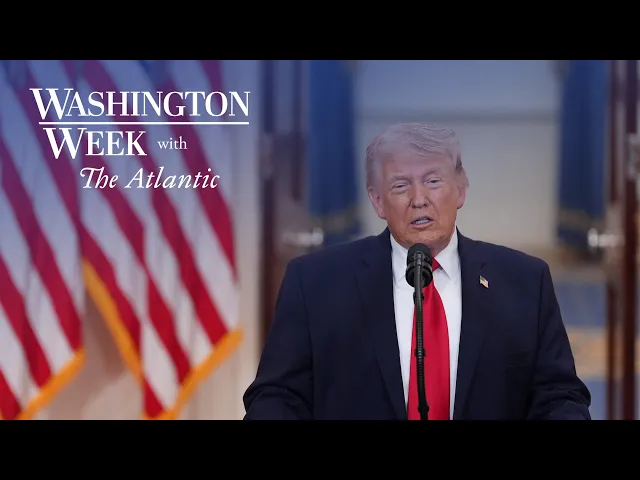
Trump says Iran war wrapping up, but address leaves more questions than answers
Washington Week PBS
0:00 President Trump addressed the nation this week in what
0:02 he framed as a progress report on the Iran war.
0:05 In his telling, a quick detour to the Middle East was necessary.
0:09 The world is safer because of it, and the American economy will be just fine.
0:14 But in reality, there were more questions
0:16 than answers after the president's 20 minute address,
0:19 especially as he vows to bomb on.
0:22 There's a lot to unpack and joining me tonight
0:25 Idris Ali is a national security correspondent at Reuters.
0:28 Peter Baker is the chief White House correspondent for The New York Times.
0:33 Susan Glasser is staff writer at The New Yorker,
0:37 and Michelle Price is a White House reporter at The Associated Press.
0:40 Thank you all for joining me.
0:42 Um, before we get to the president's speech, Idris,
0:44 there was some breaking news just as we were coming to air,
0:48 an F-15 fighter pilot, uh, fighter jet pilot was rescued alive by the US
0:54 military after the plane went down over Iran.
0:57 First of all, what do we know about the incident and also what does that say
1:00 about maybe Iran's capabilities if it was re s po n s ible for this, you know,
1:05 firstly, what we know right now is that two seater F-15 jet was shot over Iran.
1:10 We don't know who was responsible,
1:12 but I think it is likely that Iran was responsible in some way, shape or form.
1:15 We don't know the fate of the second pilot yet,
1:17 but I think what broadly it shows is that a war is brutal,
1:21 unpredictable, and what President Trump and Secretary Hecket have been saying,
1:25 which is, you know, Iran has been destroyed militarily.
1:27 Their capabilities, their air defenses, just isn't true, you know.
1:30 Iran has a plethora of air defense systems,
1:32 something as simple as a manPad actually can bring down a fighter jet.
1:35 So I think it really raises questions about what the president,
1:38 Secretary Hecket have been saying,
1:39 and really risk for the thousands of, uh, you know,
1:41 US personnel who are flying in and around Iran every day.
1:45 Yes, Susan, we, as we showed in the open,
1:47 the president is trying to set a time frame for getting out of Iran.
1:50 That already there were questions about how realistic that is,
1:53 and now on top of that with this incident,
1:56 um, do you think it's possible that we could wrap this war up in 2 to 3 weeks.
1:59 Well, again, I mean,
2:00 part of the reason that I think the American public is suggesting
2:04 in polls by an overwhelming margin they're very skeptical about the war.
2:08 You've seen a very negative reaction from the markets.
2:10 The reason is because while Trump said 2 to 3 weeks he
2:14 did not offer any kind of a sense of a realistic plan.
2:17 In fact, he actually suggested that the most
2:20 serious economic consequence of the war,
2:22 which is the effective closing of the Strait of Hormuz.
2:24 He basically said that he may just walk
2:26 away from it and leave European and Asian partners
2:30 who rely upon energy imported through the Strait
2:33 that he would just leave that problem to them.
2:35 That's not really a realistic scenario
2:38 for winning as anyone would conventionally define it.
2:40 And so I think not only has Trump left the goals of this operation hazy,
2:44 but I think he's been not only untruthful but amazingly
2:48 untruthful with the American people and with the world,
2:51 both about what's already happened over the last month
2:54 and about what he's trying to do with this war.
2:57 The state with the speech now Wednesday night, primetime address Peter, um,
3:00 why did the White House feel that now was the time to deliver this speech?
3:05 What was the objective behind it?
3:06 And do you think it was effective?
3:08 Yes, that's a good question.
3:09 The thing about it, it's always better for a president in a time
3:12 of war to go to the public and explain what he's trying to do,
3:14 to explain the goals,
3:16 to explain why it's worth American treasure and lives to take this action,
3:19 but it felt like a day one speech, not a day 32 speech, right?
3:24 It did not feel like a speech a month
3:26 into the rule saying where we're going to go from here.
3:29 It's and I think that it left a lot of people confused.
3:32 On the first day of the war, he told us that regime change was the goal.
3:37 He said Iranians, it's time for you to take over your country.
3:41 He says on Wednesday night, regime change was never my goal.
3:44 He told us that the nuclear program was obliterated and now he
3:47 says we need to obliterate it again, so forth and so on.
3:50 We've been through this, but he didn't outline a plan, a concrete plan,
3:54 or an understanding of what he wants out of this war.
3:57 He said at one point he wanted unconditional surrender.
4:00 OK, but now he's negotiating.
4:01 What do you negotiate?
4:02 You can negotiate conditions.
4:03 So it's, it's all over the map,
4:05 and I don't know that it satisfied the Republicans
4:08 who wanted him to get out there and talk,
4:10 who were very nervous about the impact on the economy
4:12 and on their political prospects in the fall.
4:14 I mean, gas prices hit a record the day before this speech was delivered.
4:17 Do you think that had a big factor was a big factor there.
4:21 Well, he's hearing from his people around
4:22 him and obviously from Republicans on the Hill
4:24 is that the public isn't for this, and I don't see why we're doing it,
4:28 and you need to explain why it's important to them,
4:30 and I don't know that he sold that case.
4:32 Well, and I mean, I think that's a really important point because
4:35 people are not only not used to the American president, uh, you know,
4:40 really not speaking to them at a moment of such enormous international gravity,
4:44 but let's just say for a second here,
4:47 19 minutes long, that address was from the White House.
4:51 It really was basically a 19 minute long
4:54 true social post instead of a meaningful strategy
4:57 for why he's taken such a consequential decision
5:00 that has plunged the global economy into turmoil.
5:02 I mean, literally people are not being able
5:05 to go to school 5 days a week in Bangladesh.
5:08 In South Korea, they're working from home because
5:10 Donald Trump did this, and yet in 19 minutes,
5:13 what did he offer us like essentially platitudes from his social media posting.
5:17 America is winning.
5:18 We've never been doing better than before.
5:20 That's not a strategy.
5:21 It's actually insulting to people to talk like this, I think,
5:24 in a time of conflict, and Michel,
5:26 one of the things that we've been talking about throughout
5:29 the course of this conflict is the Strait of Hormuz,
5:31 that passage, that crucial passageway um,
5:33 especially for oil tankers getting in and out of that region.
5:37 What, if anything, did the president say as far
5:40 as whether or not that passage would be reopened, who would control it?
5:43 So there are those lingering questions that we keep asking.
5:46 I mean, it depends on what day of the week it is and what time of day it is,
5:49 because the answer keeps changing, you know,
5:50 in the speech in the days leading up to it,
5:52 the president has said it's not for us,
5:54 it's for those who use it, who rely on it.
5:56 This morning he's suggesting that maybe the US could
5:59 be very easily go take the Strait of Hormuz,
6:01 that it would only go on a little bit longer,
6:03 that that it would bring great wealth to the US if we took it,
6:06 and the president has been expressing privately in a video that the White
6:09 House put up this week and then that was taken down.
6:12 Some, uh, you know, he's expressed a desire
6:14 to stay and try to get some of this oil,
6:16 and said, but he understands that there isn't patience in the US to stay,
6:20 and you can see he's kind of feeling out whether he might be able to prolong
6:24 this, but the question of whether this will wrap up in 2 or 3 weeks.
6:27 It actually isn't up to just him, right?
6:29 Iran has this choke point.
6:30 They have leverage now, and it's,
6:32 there's two parties here that decide when this ends.
6:35 Um, actually we have a, we have the president here saying that one
6:38 of the things that you know has
6:40 been a concern is obviously the financial markets,
6:43 um, and the president sort of framed the way out economically.
6:47 Here's what he had to say.
6:50 to those countries that can't get fuel,
6:52 many of which refuses to get involved in the decapitation of Iran.
6:56 We had to do it ourselves.
6:59 I have a suggestion.
7:00 Number one, buy oil from the United States of America.
7:03 We have plenty.
7:04 We have so much.
7:05 And number 2, build up some delayed courage, should have done it before,
7:09 should have done it with us as we asked.
7:12 Go to the strait and just take it, protect it, use it for yourselves.
7:18 Peter, the relationship with allies over the course of this uh
7:22 this conflict has been rocky, to say the least.
7:25 Obviously messaging to them, especially there.
7:27 What's the president looking to get out of this?
7:29 Well, it was surprising he didn't go further actually in the bellicosity
7:32 we expected in that speech toward allies and particularly toward NATO.
7:36 He's been threatening to even get out of NATO,
7:38 out of all this in effect what has happened
7:41 was it's a it's something it's a self-fulfilling prophecy, right?
7:44 He has said NATO is obsolete.
7:46 They won't come to our aid.
7:47 He then goes to war without consulting them, without asking them their opinion,
7:51 without asking them if they would do something if
7:52 they thought it was a good idea or not.
7:54 And then when they say, no, it's your war,
7:56 we don't particularly want to be part of this.
7:58 See, I told you all, I was right all along.
8:00 Now, he has backed off of the the the threat at the moment,
8:04 but it does feel like that the alliance basically is all but over.
8:07 It's in everything but name only.
8:09 Yes, there's still on NATO, but if you're a NATO,
8:11 do you believe that the United States is a full-fledged partner with you,
8:14 or do you think that it's going off on its
8:17 own and Europe is thinking the United States is going off.
8:19 Well, and Secretary General Mark Rutte of NATO is
8:21 coming to Washington next week to talk to President Trump.
8:24 Clearly they are concerned, and he's been a Trump whisperer.
8:27 He's been into the sometimes the consternation
8:29 of his European colleagues who think he's gone too far.
8:32 Maybe he'll be able to smooth things over in some way,
8:35 but I think that this is still a fundamental
8:37 break here that's not going to be repaired.
8:38 Yeah, Theresa, I want to go back to the military portion of this.
8:42 Obviously there have been concerns,
8:44 questions about how well this military operation's been going.
8:46 Who's calling the shots?
8:47 Interestingly, this week, um, the Army Chief of Staff,
8:51 Randy George was fired by Secretary Hegseth, first of all,
8:55 is that an unusual move to see in the middle of a war,
8:58 and what does it say about the military operation?
9:01 I think it's extraordinary to fire the head of the army,
9:03 the largest branch in the military,
9:05 during a war and not related to the war itself, right?
9:07 He did nothing wrong about within the war
9:10 and so I think it's extraordinary raises real questions.
9:13 There are thousands of US military, specifically army soldiers in the Middle
9:17 East actually manning air defense systems
9:19 on the defensive side and airborne troopers from the 82nd Airborne Division,
9:22 and I think if you're someone who's deployed, you're looking sort of at the TV
9:27 in the Middle East and saying, what is going on?
9:29 Who are the people that I'm following.
9:31 And, you know, it just really raises a lot of questions.
9:33 And, you know, the military is sort of like a freight train moving.
9:36 It's really tough to stop when it starts moving and, and, and I
9:39 think the momentum right now is towards some sort of, you know,
9:42 action potentially on the ground,
9:44 and I think not having a leader like Randy George,
9:46 I think really raises questions.
9:47 I mean, you mentioned the 82nd Airborne division.
9:49 They would be deploying any at any moment now.
9:52 So what happens if we're done in 2 to 3 weeks,
9:55 they pack up and they come back home.
9:56 How does that work?
9:57 You know, I think as a as a president,
9:59 when you have sent troops to the Middle East and other parts of the world,
10:02 there's sort of this sunk cost fallacy, right?
10:04 You think that you have sent so many troops, now you have to do something,
10:07 and I think Trump is one of those people who may look at it this way,
10:09 say, look, I've sent so many troops,
10:10 Marines, 82nd Airborne Division paratroopers.
10:12 I should do something,
10:14 and I think it's going to be really tough to stop him from doing something,
10:17 just give him the cost of moving so many people so far.
10:20 Yes, Susan, and one of the things that we've
10:21 talked about quite a bit is Israel's role.
10:23 First of all, obviously this was a war
10:25 waged by Israel and the United States together,
10:27 but Prime Minister Benjamin Netanyahu really
10:30 pushing the president toward this decision.
10:32 Is there a world in which Israel continues its war in Iran
10:38 alone if the US were to scale back or withdraw completely,
10:42 and also if you could talk a little bit about its offensive in Lebanon as well.
10:45 Well, that's exactly right.
10:46 I'm glad you brought up the offens ive
10:48 in Lebanon because what it shows is that Israel,
10:50 you know, of course has its own very
10:53 imminent security concerns around everything concerning Iran, right?
10:56 You know, so if this is a war of choice for the United States,
11:00 it's much more existential.
11:01 at least in terms of the framing for Israel,
11:04 for the Israeli public, and what's happening here,
11:07 this is not the first time Prime Minister Netanyahu
11:09 is using this conflict as an opportunity to go after,
11:14 you know, not just around itself, but its proxy Hezboll a h in Lebanon.
11:18 In Lebanon, this is not the first time that Israel has gone to war in Lebanon.
11:23 In fact, it's done it over and over and over again.
11:25 The question on everybody's mind is whether there's going
11:28 to be a full-fledged Israeli ground assault in southern Lebanon.
11:32 We are hearing indications that that is certainly a possibility.
11:35 Seen reporting suggesting that Israel plans to take, in effect,
11:39 a large swath of territory in Lebanon
11:42 to increase essentially what you might call
11:44 their strategic death to increase the kind
11:46 of safe zone that they feel that they need.
11:49 I do think that the basic assumption here that both Netanyahu
11:53 and Trump had going into this conflict was about is Iran's weakness,
11:58 that this was the moment to strike because they believed that Iran's
12:02 proxies had been weakened ever since the conflict after October 7th.
12:06 They believed also that Iran itself had been
12:09 weakened after their initial round of airstrikes last summer.
12:13 In some ways, that's the original mistake of the conflict is
12:17 believing that Iran was so weak that it would capitulate quickly,
12:20 it would be like Venez ue la all over again.
12:23 Absolutely.
12:24 What are you all hearing about security guarantees for the region too,
12:28 especially those Gulf allies that have gotten hit
12:31 in the crossfire despite the fact that they
12:33 said initially they didn't want to, did not want to take part in the war.
12:35 They didn't even want the US to use its bases to launch its war.
12:39 Now they're very much kind of pulled in.
12:41 Susan, what are you hearing as far
12:43 as their interest in having long term security guarantees,
12:46 and the US possibly leaving this fight and them having
12:49 to kind of lick their wounds and pick up the pieces.
12:51 Well, that's exactly right.
12:52 Whatever the range of opinion was among Gulf Arabs before the conflict.
12:57 At this point there are many of them saying
12:59 absolutely you've got to finish the job that you started,
13:03 otherwise you risk leaving us in a much
13:06 more perilous political situation and strategic situation.
13:09 This goes to the point as well about sunk costs.
13:14 Donald Trump unleashed the conflict without properly
13:17 taking into account the consequences of it.
13:19 Now you have a global economic catastrophe and a regional security catastrophe.
13:24 I believe 9 different countries, including Israel,
13:26 have been struck by Iran since the US began the war, right?
13:31 So all of the neighbors are feeling the military heat.
13:34 Both Donald Trump and his Secretary of Defense Pete Hegseth have said
13:38 publicly that they failed to anticipate that that Iran would hit the neighbors.
13:43 So now the neighbors are saying absolutely you've got to finish this job.
13:47 But let's also remember on some level,
13:48 the US is there fighting arguably for the security interests of the Gulf Arab
13:54 states and of Israel as much or more than for the US interests itself.
13:58 Yeah, taking that into account, Michelle, you know,
14:01 we've talked so much about how the president
14:04 was surrounded by yes men and women,
14:06 people who kind of go along with what he would like.
14:09 How much of this is the product of just not having people pushing back,
14:14 um, in his inner circle, um,
14:15 the proper advis or s in place to be able to kind of flesh out some
14:20 of the um the conditions and the, the risks
14:22 that were involved in a military operation of this nature.
14:24 I mean, that's one of the ongoing questions we
14:26 have on a whole host of subjects with the president.
14:27 You know, there's been some reporting that the briefings
14:29 he's been getting are just like highlight reels of explosions.
14:32 Um, you know, I think that there is high confidence in General Keane
14:36 and that he is a straight shooter and would give the president real information,
14:39 real information on risks, but we don't have great detail on if
14:43 he is the one giving the briefings every day,
14:45 what information the president is getting and if he is the one
14:48 glossing things over to make them look rosier than they are,
14:50 or if that's what he's being fed,
14:52 but one of the things I keep hearing is that one
14:54 of the people who's been most frank with him as Treasury Secretary Veset.
14:58 um, and obviously with the economy taking a hit now, um,
15:02 does the, is the president getting real
15:06 and realistic advice on where the country could go.
15:09 I mean, judging by the address on Wednesday night where he
15:13 was talking about essentially the American economy being in good shape,
15:16 you know, the polls don't show that and economic indicators don't show that.
15:20 And so who is kind of talking to him about the economy,
15:23 or does he feel like he knows best when it comes to the economy.
15:25 It's kind of the last person in the room is always the thing with Donald Trump,
15:29 right, who's giving the last piece of information,
15:31 but in terms of the economic piece of this, there
15:34 is a real awareness that this is a big political,
15:36 a domestic political problem staring them down the face
15:39 that even if let's say the war wraps up next week.
15:43 This is not going to be solved economically immediately.
15:45 It is the repercussions of this are going
15:48 to continue on and on, and they are aware
15:49 that that's why you hear him speak about maybe
15:51 2 to 3 weeks we'd like to wrap this up.
15:53 At the same time, there is this awareness that he has
15:56 made all these promises about the reasons that we went to start
16:00 this conflict and that if it did wrap up a lot
16:03 of those objectives shifting as they are have not actually been achieved,
16:06 and he's kind of stuck between a rock and a hard place on his promises here.