The Most Loved Antiques Roadshow Treasures Worth Thousands | Antiques Roadshow UK
BBC Antiques Roadshow
0:00 Oh, my dear, speechless.
0:02 Really?
0:03 Yes.
0:04 It's beautiful, isn't it?
0:06 Look at the gleaming and the gleam of gold there.
0:09 This is actually a brooch but it broke, so I use it as a necklace.
0:13 But I will have it repaired one day.
0:15 It's worth it, I think.
0:16 They're rather fascinating, aren't they?
0:18 Were they your great-grandmother's?
0:20 They were my great-grandmother's, yes, and came down to me.
0:23 From Germany?
0:25 From Germany, yes.
0:26 I think what's significant about this jewellery
0:28 is that it's made of filigree and granulation,
0:31 which is typical of all types of folk jewellery,
0:35 from the Mediterranean up to the north countries and Denmark and Scandinavia.
0:40 The bracelet itself is a later addition,
0:42 because the colour of the gold is different and the phrasing of the metal.
0:45 Ja, I wondered why.
0:47 So… And yet, there are holes here for stitching,
0:50 or at least some kind of textile.
0:52 And it's my idea that this was once a hair bracelet,
0:55 that there was tightly woven lock of hair supporting this bracelet.
0:59 Around it?!
1:00 Around it.
1:00 And this is what we very often find,
1:02 that of course this is perishable and wears out.
1:05 And yet, a gold clasp remains.
1:07 And so, they string it on to, perfectly sensibly, a later gold bracelet.
1:12 But hair I'm pretty certain that it was, actually.
1:14 Oh, that's interesting.
1:14 It's an idea we're totally at odds with in the 20th
1:17 century but… It must have been strong hair.
1:19 Well, I think it was.
1:20 I think it really was.
1:21 Well, good Teutonic hair, you see.
1:23 That's what we want.
1:24 But anyway.
1:25 They're a marvellous survival.
1:27 But oddly enough, having opened your little Pandora's box of jewellery here,
1:31 it's not the jewellery that you have in the case that's interested me,
1:34 but it's the necklace you've got round your neck.
1:36 Can you take that off?
1:37 Yes.
1:37 Let's have a really good look.
1:39 I thought it belongs to one…- You thought it became part of it?
1:44 Yes.
1:44 Yes, I think it's not actually part.
1:46 Because it's similar.
1:47 The clasp, if you look at it, it's similar to…- Well,
1:51 it's decorated again with these tiny granules of gold,
1:54 which… Gold is the most mysterious commodity
1:57 because you can solder granules of the tiniest,
2:01 tiniest, dust-like proportions to the surface of gold
2:04 and give it this very interesting texture.
2:06 And that's been going on since very ancient times.
2:09 And these have erroneously been called muff chains.
2:13 They're not muff chains.
2:14 Because they were long, it was assumed that a muff would hang on it
2:17 and you'd put your hands through it…- Oh, I see!
2:19 ..and it's quite nice to be able to sort of demolish
2:20 that terminology once and for all because they simply are not muff chains.
2:25 They're simply there for decoration.
2:26 It dates from about 1840.
2:28 And it's this one that's really disproportionately valuable.
2:32 Because complicated gold jewellery, not easy to wear in the 20th century.
2:36 And these two, fascinating as they are, they're worth low hundreds of pounds.
2:42 Say £350, £450 for the clasp alone and with the bracelet, £500.
2:50 But this one, put it down on your little inventory for £2,000.
2:57 Surprised?
2:58 Yes.
2:59 Good.
3:00 Well, I remember my father buying it, along with a lot of mess silver.
3:03 He was in the Royal Scots Fusiliers,
3:06 and the regiment was going to India and my father retired.
3:10 That was in 1935, I think.
3:13 And he bought this and several other pieces, which I didn't keep when he died.
3:18 I sold them because, quite honestly,
3:20 insurances and everything else was too much.
3:22 But I've always loved this.
3:24 I'm not surprised, actually, because looking at it very quickly,
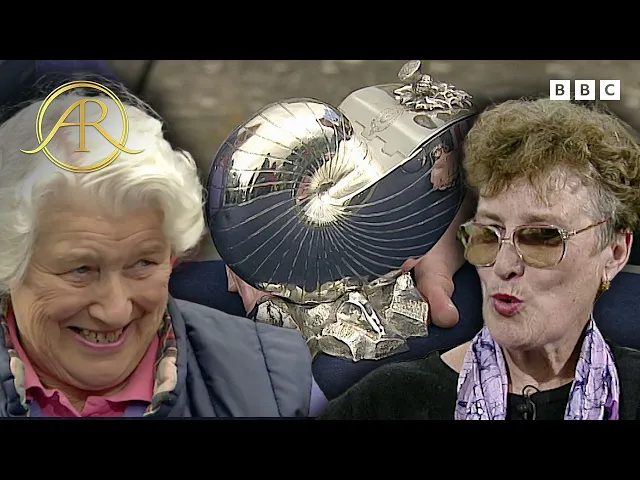
3:27 my initial reaction is a spoon warmer.
3:30 Absolutely.
3:31 Then you get a big surprise when you open the lid.
3:34 This is it, because… Now, a money box?
3:37 Yes, a swear box on the table.
3:39 Oh, a swear box?!
3:40 Yes!
3:41 Oh, isn't that…?
3:41 And anybody who swore had to put something in there.
3:44 Do you know what they had to put in?
3:45 No, I don't.
3:45 Well, I suppose earlier, you could have put a sovereign in.
3:48 Absolutely, yes.
3:48 And that would soon add up.
3:49 I don't know what date it is or how old it is, actually.
3:52 Well, first of all, of course, it does straightaway beg the question,
3:56 is it original or not, the fact that it is a swear box?
3:59 Well, this is what I'd like to know.
4:00 It's… And here's another surprise, actually,
4:03 because normally if you get a spoon warmer of this form,
4:05 of which there are many around, they're electroplated.
4:08 Yes.
4:09 And that's silver.
4:11 This is silver.
4:12 But there's another surprise because it's Irish silver.
4:16 Really?!
4:16 So what is a Scottish regiment doing with a piece of Irish…- I wouldn't know.
4:21 Well, the date of this… Here we are– it's Dublin 1866.
4:26 Right.
4:27 There has to be a reason for that.
4:28 But I know, definitely it was the swear box.
4:31 And actually the maker there… Actually, the maker, funnily enough,
4:34 is this mark over here, which is the "JS".
4:37 But we've got the name West appearing underneath there.
4:40 And this is something they did in Dublin.
4:42 You'd get the maker as we've got there,
4:44 and then you'd get the retailer putting his stamp on.
4:47 Right.
4:47 Little lock.
4:48 Of course, being money inside, obviously it has to be locked up.
4:51 No key, I'm afraid.
4:53 It should be pretty easy to find a key It'll be a very basic key for that.
4:58 But interestingly, it's marked also, you can see, in the lid there.
5:02 Yes.
5:02 Now, that confirms that the lid is original to the nautilus shell.
5:08 It's lovely the way that they've done the flush hinge there as well.
5:11 Yes, I think it's lovely.
5:12 Because had this been a spoon warmer,
5:14 either it would have been left open…- Right.
5:18 Some do have lids, but they have a slot cut at the front for the spoon.
5:24 So this convinces me… That it's a swear box.
5:28 That it was made as a swear box.
5:30 Yes.
5:31 So, fascinating object.
5:33 I have to say, it's a very difficult object to put a value on.
5:36 Have you got it insured or anything?
5:38 Yes, it's… Well, I mean, it's in the household insurance.
5:41 I haven't…- Oh, it's not specified?
5:44 No.
5:45 I suggest you perhaps insure it for somewhere around £5,000.
5:48 Really?
5:49 Yes.
5:50 I bought it six years ago in Stow.
5:54 And I was a little concerned when I got it home to notice
5:57 that the drawers seemed to be made out of recycled pieces of timber.
6:02 Really?
6:03 And I wonder whether it's entirely original.
6:06 Let's have a look.
6:07 I mean, I've seen… Nice oak lining…- The underside.
6:11 Oh!
6:12 Right!
6:12 Now I see what you mean.
6:14 Well, you should see the second drawer is even more interesting.
6:17 In as much as it's more brightly coloured.
6:21 That's fantastic.
6:23 That is fantastic.
6:25 The other one?
6:28 Very similar.
6:29 Oh, right.
6:30 I tell you what, I'm going to put this one on top of that one.
6:34 Well, let me allay your fears first of all.
6:36 There's nothing wrong with this.
6:38 These pieces of furniture, particularly in the country,
6:42 were made on large estates.
6:44 And this was where they would have stored wood that was not used.
6:48 Whether or not it was carved,
6:50 it was cut for a purpose and then simply not used and kept in the workshop.
6:55 And then one day, somebody was asked to make
6:57 a little chest of drawers for one purpose or another,
6:59 in this case, most likely a house on the estate or a servant's bedroom.
7:03 "And what shall we use for the lining?" "Use some
7:05 of that old stuff we've got in the corner there,
7:07 you know." "Well, it's got carving." "That won't matter.
7:10 No one will see." And so they used these boards,
7:13 which in this case were prepared, were made for panelling in a room.
7:22 And if this was made in 1740, these panels were 150 years old.
7:28 These panels are 1500, 1550– 16th century.
7:34 Difficult to be precise.
7:36 Either Tudor or early Elizabethan.
7:39 And they are wonderful.
7:40 I've seen, obviously, pieces of furniture with similar carving
7:44 on and I've seen sometimes some decorations, (INDISTINCT).
7:48 We know that they used to paint a lot
7:51 of furniture in the 1540s through to the 1580s.
7:54 But never have I seen the pigment protected, as it were.
7:59 I've never seen it as pure as this.
8:02 This is like the day it was painted.
8:05 Here you can see the thickness.
8:06 It's a sort of tempera.
8:09 It's a wonderful texture.
8:11 And that's never, never really been corroded by anything.
8:15 Just never been touched.
8:17 So these were stacked up for 150 years and then bunged into a little chest.
8:22 And you can see where they've chamfered the edges off to make it fit.
8:26 Absolutely stunning.
8:27 Imagine, you know, a panelled room.
8:30 These are from a panelled room, I'm sure.
8:32 It's not a Tudor rose, is it?
8:34 Well, yes, yes, absolutely.
8:35 Almost a stylised…- A stylised Tudor rose.
8:38 And this is a sort of almost a guilloche moulding,
8:42 a guilloche banding pattern there.
8:44 I think they are wonderful!
8:46 Wonderful!
8:47 But what do you do now?
8:48 I mean, sort of… Sort of put them on the wall and… Maybe
8:52 you should protect… Maybe you just leave them as they are, I don't know.
8:55 Difficult to keep showing your friends every time they come round.
8:58 It is, yes.
8:58 How much did you pay for the chest?
9:00 £1,000.
9:02 Well, it's worth £1,000.
9:03 It's a little fruitwood chest of drawers.
9:05 I mean, it's certainly improved on that in six years.
9:09 But these are a bonus.
9:11 I suppose that panel is worth about £1,000.
9:15 And that one £1,000.
9:17 You surprise me.
9:19 It's very exciting!
9:20 Very exciting.
9:23 Wow!
9:24 I say, what a marvellous brooch.
9:26 My goodness me.
9:28 Is it a family one?
9:29 Yes, it came from my great-grandmother to my nana
9:33 then my mum and then it's passed down.
9:35 When do you think it was made?
9:36 I haven't got a clue.
9:38 Come on, have a go.
9:40 Great-grandmother, so 18-something?
9:42 No, absolutely not 18 at all.
9:44 This is actually a 20th-century brooch,
9:45 so maybe the story's got a little bit sort of embroidered.
9:49 And the point about it is that it's a 20th-century design.
9:53 It's a very art deco design, a very Odeon-style object.
9:57 And if one looks at it quite carefully, it reminds you of a visit to one
10:01 of those enormous cinemas with the decoration around the ceiling.
10:04 What's even more special about it is is
10:06 that the diamonds used in its manufacture are modern cut.
10:10 And what's frowned upon when you find a jewel like this is to find older-cut
10:14 diamonds that have been used for jewellery
10:16 in the past included in such an object.
10:19 And this is absolutely not the case.
10:20 These long diamonds here are what we called baguette diamonds.
10:24 And they're used to great effect for a rather geometrical design that actually,
10:28 in this instance, owes its origins a bit to Mexican design.
10:31 And here in the middle, we've got rather a substantial brilliant-cut diamond.
10:36 So it is a diamond…?
10:37 Oh, it is a diamond.
10:38 We didn't think it was…- You didn't think it was a diamond?
10:41 No.
10:41 No?
10:41 Goodness!
10:42 No, no.
10:42 It's quite a good thing.
10:44 Curiously enough, with diamonds,
10:45 if you want to make an immediate judgement as to whether a diamond is a diamond,
10:48 it's the imperfections in it that tell you instantly that it is.
10:52 Deep in the diamond, almost imperceptible without a very strong lens,
10:56 is a black deposit, which is a piece of carbon that's not crystallised.
11:01 Diamonds are simply crystallised carbon.
11:03 It's an element, expressing itself in this particular way because
11:06 of intense heat and pressure many millions of years ago.
11:10 There are some problems with it that I noticed as I turned it over.
11:13 It's out of true.
11:14 Had that damage been more critical then we would have been in serious trouble.
11:18 But we're not really.
11:19 And it needs cleaning and a little bit of adjustment.
11:23 And you know the direction to which this is all leading, don't you?
11:26 That this is a really substantially good, valuable object.
11:31 If there's a chance of putting a name to it,
11:33 a maker, then that would add to it even more.
11:36 But you have to brace yourself,
11:38 strap yourself into the seat because we've got a really, really good one here.
11:42 And if you went into a West End shop to buy such an object again,
11:46 I think it's possible that they would ask you £12,000 for it.
11:50 Good God!
11:52 Dear me.
11:52 I didn't think it was that val… We didn't think these were diamonds.
11:55 No, well, they are diamonds.
11:56 They're all diamonds.
11:57 And you've got a very valuable brooch.
11:59 Thank you.
12:00 Thanks very much for bringing it.
12:01 Thank you very much for looking at it.
12:04 Thank you.
12:04 This wood has been cut with one of those really rough two-man saws.
12:10 And this panelling has stayed together for 300 years.
12:14 Yes.
12:16 If a picture's on panel, it makes an enormous difference.
12:19 You can almost date the picture from the back.
12:21 And this is a wonderful panel.
12:23 If every picture tells a tale, please tell me.
12:25 [Man] Well, some years ago, my father and I,
12:28 we were refurbishing a room in our Tudor house,
12:32 and there was a Victorian fireplace which we took out,
12:35 which revealed a Tudor fireplace.
12:38 And above that was layers and layers of wallpaper.
12:41 So we decided to start scraping it off
12:44 and, er…- So the wallpaper was stuck to this?
12:47 Yes.
12:48 It's obviously a smart 17th-century house.
12:52 And it's wonderful.
12:53 I mean, the red brick glows.
12:55 These houses did glow then.
12:58 It's a fair bet to assume that this is a real house, it's not a fantasy house.
13:02 And this, I'm sure, is by an English painter not a Dutch painter.
13:08 About, say about 1700, 1710, 1720.
13:12 The panelling tells us that, the whole way it's put together.
13:16 We can trace the history of this sort of painting very easily.
13:21 And the reason, as you can see,
13:23 the reason I wanted to show the back of the panelling
13:26 is there's not a split… barely a split on this panel.
13:29 And the reason is this is seasoned wood, 20-year-old wood.
13:32 So it doesn't move.
13:34 Good lesson for builders today.
13:36 Wonderful.
13:36 Well, I just wondered if… To me and my mother,
13:39 we think that this is out of position compared with the landscape,
13:43 which looks quite normal.
13:45 And it seems to me as though they've
13:47 put the landscape in and then as an afterthought, they've put the building.
13:52 Well, had you thought that really the landscape that we know
13:56 today in England is basically an invention of the 18th century.
14:00 This artist is very happy putting in these abstract shapes.
14:05 I mean, this is a wonderful abstract painting as well.
14:07 And this formality of gardens is something that comes from Europe,
14:14 imposing an architectural statement on the landscape.
14:19 In fact, in Britain now,
14:21 because of Capability Brown and Humphry Repton, we do exactly the opposite.
14:24 We garden to the landscape.
14:26 We like to garden as though it's natural.
14:29 But there's another thing, which is very interesting.
14:32 You said this picture was over the mantelpiece.
14:35 That's right.
14:35 One of the interesting things about the fashion
14:38 of having your house painted was that they replaced portraits.
14:44 So it was actually exactly where it should have been for the fashion of the day.
14:51 I think it's wonderful.
14:53 And I think it's very interesting.
14:54 I mean, I've never seen such a complete British painting of this period, anyway.
15:02 It's very difficult to price something like
15:04 this, but I think at least £10,000 to £15,000.
15:07 It's a wonderful object.
15:09 Thank you.
15:10 Thanks very much.
15:11 Oh, my dear, speechless.
15:13 I'm speechless