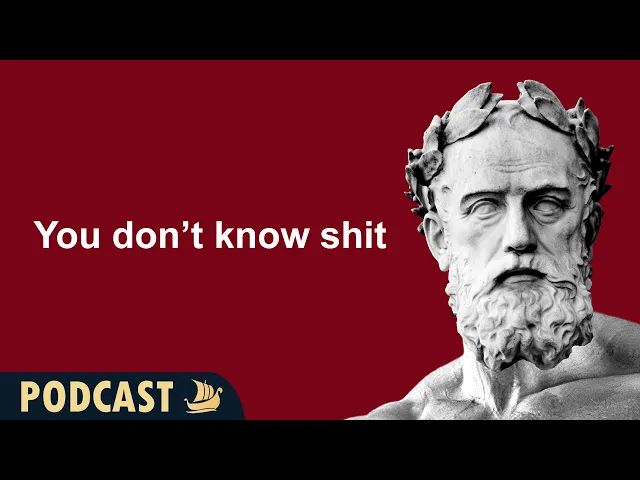
Why Skepticism Is Crucial Today | The Wisdom of Xenophanes | Ep. 004
Einzelgänger
0:00 It ain't what you don't know that gets you in trouble.
0:03 It's what you know for sure that just ain't so.
0:07 Mark Twain.
0:08 Is there anything more annoying than people who doubt everything?
0:14 You know, the types that constantly question what people say,
0:18 who refuse to just go along with the story.
0:20 These people are precisely the ones to whom the internet meme,
0:24 you must be fun at parties, applies.
0:27 In all likelihood, these individuals are skeptics.
0:30 Their philosophical stance in life is to doubt what others take
0:35 for granted and to question whether their own beliefs are truly valid.
0:39 Such people are generally irritating, tiresome, and smug.
0:43 No, I'm just generalizing here,
0:46 but I know the annoyance or even anger that arises when your perfectly
0:50 crafted story or beautiful theory gets
0:53 ruined by someone pointing out that, well,
0:56 there are some problems with accepting what you claim to be the truth as truth.
1:03 Now and then, this skeptical intervention, so to speak,
1:06 barges into what was meant to be
1:08 just a light-hearted conversation or harmless gossip.
1:11 Imagine, for example,
1:12 a group of friends sitting in a bar discussing a recent betrayal,
1:17 throwing all kinds of truisms and prejudices on the table
1:20 just to explain why the ex-husband in question
1:23 left a seemingly perfect marriage for a 20-year-old bar
1:28 girl in Thailand and what a complete jerk he is.
1:32 And they're obviously enjoying the conversation.
1:35 But then the skeptic of the bunch basically schools
1:39 them by saying that although their theories could be true,
1:43 there's always another side to the story
1:45 and lots of details they just don't know about.
1:48 So basically, they don't know what the heck they're talking about.
1:53 But skepticism can cut much deeper than this.
1:57 A skeptic can attack and dismantle an entire worldview.
2:02 Just imagine a civilization living in harmony under one faith.
2:07 Pastapharianism, the worship of his newly appendage,
2:10 the flying spaghetti monster.
2:12 Everything is running smoothly.
2:14 The Pastapharian religion is present in virtually
2:18 all areas of life, including schools,
2:21 workplaces, politics, public spaces, and of course,
2:24 churches, which are ubiquitous and well attended.
2:27 It functions as social cement and has
2:31 given people purpose for many generations now.
2:35 A religious skeptic grabs the open mic at a local church
2:39 and begins to question what everyone has taken for granted for many generations.
2:44 This flying spaghetti monster, he says, has anyone actually ever seen the guy?
2:52 How can you be sure he's not a macaroni monster or a lasagna monster?
2:57 And those beer volcanoes and stripper factories
2:59 this prophet uh Bobby promised us in the afterlife.
3:03 Have you ever seen pictures of it?
3:06 How do you know for sure they exist?
3:09 Of course he's met with opposition.
3:12 Who dares to challenge the great noodle in the sky?
3:16 The saucy master creation of heaven and earth.
3:18 Who dares to oppose a wellfunctioning system of belief,
3:22 the very fabric of a civilization, risking chaos and collapse?
3:26 Well, that's the skeptic for you.
3:29 Skeptics can be annoying, but they are essential to our progress
3:34 as a species and to our pursuit of the truth.
3:38 This episode won't be about philosophical skepticism as a whole,
3:41 which I hope to explore in the future,
3:44 but about a man who is often considered the first skeptic in Western history.
3:49 We're talking about a prescratic philosopher named Xenophanes.
3:52 In this episode, we'll explore his life and ideas and how they can
3:58 help us cultivate inner peace amid
4:01 the noise of modern media and information overload.
4:04 This is Journey of Ideas.
4:06 My name is Tavon.
4:07 also known as Eelganger.
4:08 This is not an AI voice.
4:10 I'm a real person and I'm taking you on a long trip.
4:14 We're exploring the ideas of the many great thinkers of history
4:18 as well as the times and places in which they lived.
4:22 Right now, we're at the very beginning of Western philosophy.
4:26 The episode is available as an audio podcast on Spotify,
4:30 Substack, Apple, and several other platforms.
4:32 To stay updated on all my content,
4:35 subscribe to my newsletter on Substack or journeyof ideas.com.
4:42 I hope you'll enjoy the episode.
4:47 We'll begin with the birth of skepticism focusing on Xenophanes,
4:52 a prescratic philosopher, his ideas, and the influence he had.
4:56 After that, we'll examine today's situation,
4:58 followed by a practical part on how to apply skepticism in our lives.
5:03 Feel free to skip parts that don't interest you.
5:06 Now, set sail for the ancient Greek colony of Ionia,
5:10 where we'll visit the city of Kolifon,
5:13 the birthplace of the philosopher Xenophanes.
5:17 To understand why skepticism arose, we have to consider the typical worldviews
5:22 of the ancient Greeks during the time of Xenophanes.
5:26 How did they see the world?
5:28 What did they believe in?
5:30 The ancient Greeks were a religious bunch.
5:33 They had many gods and many of them we know.
5:38 Zeus, Poseidon, Aphroditi, Hades who governed the world.
5:41 The Greeks worshiped these gods in temples,
5:44 brought them offerings, and believed their fate depended on them.
5:48 And these gods played parts in many stories.
5:52 Now, one day, a troublemaker from Kolafon dared
5:55 to ridicule his fellow Greeks and their religion.
5:59 His name was Xenophanes,
6:01 and even though he is regarded as one of the first philosophers,
6:04 he wasn't quite the typical bookish scholarly type.
6:07 Synophanes was a poet who originated from Kolafon,
6:11 but as the stories go, was mainly on the road.
6:16 Senophanes clearly did not buy the idea
6:19 of humanlike gods as described by Homer and Hessot.
6:23 He found the whole notion that these gods looked and behaved like humans,
6:29 Greeks to be precise, pretty ridiculous.
6:32 Like, why would the creators of the universe look like Greeks?
6:36 And why are they born if they're gods?
6:39 Moreover, why would they have all
6:42 these horrible human characteristics such as stealing,
6:45 betraying, and killing each other?
6:48 These so-called gods behave just like the average Greek,
6:52 but then thousands of times as powerful and with their egos turned up 10,000%.
6:57 This Zeus fellow is more like a roided
7:00 up grandpa with a superiority complex, isn't it?
7:04 Xenophony suspected that the Greek gods of his time were simply
7:08 products of culture shaped according to the people who worshiped them.
7:13 Quite bluntly, he stated,
7:15 "Ethiopians say that their gods are snub-nosed and black.
7:20 Thracians that theirs are blue-eyed and red-haired." End quote.
7:25 We can observe this trend today as well
7:29 as Jesus is often depicted differently by various cultures.
7:33 In China, he looks Chinese.
7:35 In Africa, he looks African.
7:37 And in the American Midwest, you can bet he is white and blue-eyed.
7:42 So, Xenophanes's observation was spot-on, in my opinion,
7:46 even though it's not always the case.
7:49 We also see gods depicted as animals or animallike beings in, for example,
7:54 Egyptian or Indian mythology.
7:57 So imagine Xenophanes traveling from city to city,
8:01 roasting his religious fellow Greeks.
8:04 He probably collected a fair share of haters throughout his life.
8:08 I just picture him bargaining into a Greek tavern,
8:11 taking the stage, reciting one of his poems like this one.
8:15 Homer and Hiad have attributed to the gods all sorts of things that are
8:21 matters of reproach and censure among men
8:24 as they sang of numerous illicit divine deeds,
8:29 theft, adultery, and mutual deceit.
8:32 End quote.
8:33 Unfortunately, for the atheist among us, Xenophanes wasn't one.
8:38 Despite his criticism of the anthropomorphic gods,
8:41 he had his own idea of the divine which
8:45 tend to point to an early form of monotheism.
8:49 I quote, "One god greatest among gods and men,
8:53 not at all like mortals in body or in thought."
8:57 What exactly he meant by this is much debated,
9:00 as are many other aspects of his worldview.
9:03 His theories about the sea, the moon,
9:06 the stars, and other natural phenomena are interesting.
9:09 For example, he claimed that the sea is a source
9:12 of water and wind and that stars originate from burning clouds.
9:17 His attempts to explain natural phenomena
9:19 through reason rather than mythology earned
9:22 him a place among thinkers such as Thales and Aximander and others.
9:27 If you're interested in Xenophanes's views on natural phenomena,
9:31 there are plenty of resources to draw from which I've listed on Substack.
9:36 I would like to focus on his ideas on knowledge.
9:39 Many consider Xenophanes to be the first skeptic,
9:43 not just because he criticized the gods,
9:46 but also because he reflected on knowledge,
9:49 on what we can and cannot know in general,
9:53 which according to some scholars makes him a global skeptic.
9:57 Let's imagine him in that tavern again reciting the following poem.
10:01 And of course the clear and certain truth.
10:05 No man has seen nor will there be anyone who
10:09 knows about the gods and what I say about all things.
10:12 For even if in the best case one happened
10:15 to speak just of what has been brought to pass, still he himself would not know.
10:21 But opinion is allotted to all.
10:24 End quote.
10:25 Simply put, all is belief.
10:28 All is opinions.
10:30 No one can really know the truth.
10:33 All things, the reality in general is unknowable by us.
10:37 And even if someone spoke the truth, they could never verify that it was true.
10:43 And so it seems Xenophanes asks us to be humble in terms of the truth.
10:49 But wait a minute, I hear you think, aren't there absolute facts?
10:55 For example, can't we say with absolute certainty
10:59 that on a sunny day, the sky is blue?
11:03 Synophanes would say probably that it seems true from our own perspective.
11:07 The sky appears blue on a sunny day,
11:11 but that doesn't mean it's an absolute truth.
11:13 It may be the truth.
11:15 And even if it were, there's no way of knowing for sure.
11:20 We're limited to our human perception.
11:24 For some people, such skepticism is quite displeasing because it
11:29 means that whatever you're convinced of may not be true.
11:34 So, whatever information you've adopted as truth,
11:36 such as I broke up with my ex because he's
11:40 an[ __] or my wife was just a narcissist and that's that.
11:45 The skeptic would not immediately accept it as the truth.
11:49 However, to you gaslighters out there,
11:52 that doesn't mean an opinion or belief can
11:55 always be dismissed as nonsense or that some
11:59 views and beliefs aren't more plausible than others
12:02 or likely to be true based on sound evidence.
12:06 Here is what Xenophanes said about this.
12:09 The gods did not reveal from the beginning all things to us,
12:14 but in the course of time through seeking we may learn and know things better.
12:20 End quote.
12:21 Xenophanes was inviting us to inquire,
12:24 to seek, to question, to understand things better.
12:28 Even though we may never know the truth, we can approach it by conducting
12:34 a thoughtful investigation and critical reflection.
12:37 The goal is not to reach an absolute unfalsifiable truth,
12:42 but to at least get a bit closer to it, to form the best opinions and beliefs
12:48 as possible based on the best evidence available.
12:52 Many people today have it completely backwards.
12:55 They claim to own the truth, often based on poor or non-existent evidence.
13:01 We see many self-proclaimed experts
13:03 running around today confidently making assertions
13:06 of truth that can easily be debunked by more substantial evidence.
13:11 Bold claims of truth dominate today's
13:14 discourse without humility or taking into account
13:17 our limits of knowledge which is the opposite of what xenophanes preached.
13:23 Now that we know more about Xenophanes,
13:25 I would like to elaborate further on his attitude
13:28 toward knowledge as it remains relevant today.
13:31 I believe it could even change one's attitude toward today's
13:35 tsunami of information and fake news that often causes anxiety,
13:40 anger, and sometimes despair.
13:43 So, I would like to leave ancient Greece for now,
13:46 make a trip to today's day and age,
13:48 and take Xenophanes's early skepticism to see how we can apply it.
13:54 We're in the 2020s now.
13:57 Worldwide, adelic little harbor cities on the coast
14:00 have been replaced by vast skylines.
14:03 We see giant seapports, welcoming container ships full of stuff,
14:07 mainly bought and sold online at a click of a mouse.
14:12 Technological advancements caused the emergence of the information age,
14:15 which has made our lives much easier in many ways, but also more cluttered.
14:21 We live in an era of information wars,
14:24 numerous online media outlets, influencers, and echo chambers.
14:29 Of course, Xenophanes wasn't familiar with these things.
14:32 However, I would like to demonstrate that his reasoning
14:36 can still be applied to what we're dealing with.
14:40 unprecedented amounts of information,
14:42 much of it misinformation and so-called fake news,
14:46 which often evokes emotions in people such as anxiety and anger.
14:52 As mentioned, Xenophanes was critical of what
14:55 people in his time accepted as truth.
14:57 Whether it was Pythagoras's concept of reincarnation, which he ridiculed,
15:02 or the human-like gods described by Homer and Hassiad,
15:06 interestingly, he noticed specific trends regarding
15:09 what people tend to accept as truth.
15:13 For example, Xenophanes observed that people tend to believe
15:17 in what feels familiar and comprehensible to them,
15:20 what fits within their frame of reference.
15:23 I mean, what a coincidence that Greek gods,
15:27 these superior beings, resemble the Greeks.
15:30 And how come that Ethiopian gods look like, well, Ethiopians?
15:35 Hence, Xenophanes argued that cows would probably believe
15:40 that the gods look like cows and horses would assert
15:44 that they look like horses if these animals were
15:47 intelligent enough to grasp the concept of the divine.
15:52 Senophanes also noticed that people's beliefs
15:54 about the gods were suspiciously convenient.
15:57 After all, there's nothing wrong with my lying, cheating, stealing,
16:02 and killing other people if the gods are behaving in the same way, isn't it?
16:08 So, it's almost as if people accept a truth not because it's well researched,
16:13 but because it feels familiar and comforting,
16:16 because it confirms what they already believe or simply because
16:21 it's the version of reality they want to be true.
16:25 It's funny sometimes when you look at two opposing media outlets,
16:30 say Fox News and MSNBC, reporting on the same issue.
16:34 They come up with two entirely different stories.
16:38 Fox will say that the Conservatives owned the libs,
16:42 while MSNBC will announce the complete meltdown of the Conservatives.
16:46 How can such completely opposite versions of the truth exist?
16:51 And more importantly in this case,
16:53 why do some people embrace the story by Fox News
16:57 as truth and others the story by MSNBC as truth?
17:02 Could it be out of convenience or personal preference?
17:06 After all, isn't it generally more pleasant to believe
17:10 that the good guys are more or less
17:14 like yourself and that your values are the correct
17:18 values and that your behavior is the proper behavior?
17:21 And if so, wouldn't you rather accept
17:24 a truth that aligns with your current beliefs?
17:28 Now, the problem is that people often seem so
17:32 overtaken by their preferences that they are willing to accept
17:36 a truth even when someone with half a brain can
17:39 see its nonsense because it's what they want to hear.
17:43 In today's diverse media landscape,
17:46 a great way to generate views is to select an audience,
17:50 clearly convey what they want to hear, and reinforce it.
17:54 Influencers, a relatively recent form of media, are all too familiar with this.
18:00 Many are masters at crafting messages,
18:03 often sensational and ragebait, customized to serve the audience's preferences.
18:08 In many cases, the audience eats it up
18:12 without the slightest critical thinking or any doubts.
18:15 Fake news?
18:16 Who cares?
18:17 as long as it aligns with my preferred view
18:21 of the world or as long as it feeds my anger.
18:26 And thus people allow themselves to be brainwashed by some
18:30 shady influencer claiming to speak facts while his only source is.
18:35 Trust me, bro, I don't have to explain how dangerous this can be,
18:41 especially when highly dubious beliefs begin to radicalize people.
18:45 Here's where the concept of echo chambers comes in.
18:49 Remember what Xenophanes wrote about seeking
18:51 to understand things better or in other
18:53 words coming closer to the truth even though we can never know it.
18:57 The people inside these echo chambers may think they
19:01 have the truth but their approach to seeking is stifled.
19:05 Group think and the isolated nature of these spaces expose
19:09 them only to information that confirms what they already believe.
19:15 reinforcing conviction rather than bringing them any closer to the truth.
19:20 Being part of an echo chamber is almost like being in a cult.
19:25 Authority figures claim to possess the truth, dogmas, and us against them.
19:31 Members parrot each other,
19:33 correct and exclude those who don't follow the narrative,
19:37 and generally believe that outside information cannot be trusted.
19:41 This is obviously not the skeptic's way.
19:46 On the contrary, luckily, we have an army of well-intentioned people who
19:52 go to battle with a monster called misinformation.
19:56 Fact checkers.
19:56 In a way, fact checkers are skeptics.
20:00 They doubt information posing as truth,
20:03 do research, look for proof and inconsistencies,
20:06 and then confront that information,
20:09 debunking what they deem inaccurate based on their factchecking.
20:13 But Xenophanes, if he lived today,
20:16 would probably argue that even fact checkers can never be
20:20 entirely sure that what they have found is the real truth.
20:24 They may be closer to it thanks to careful research and reason,
20:28 but they shouldn't fall into the same trap
20:32 as those who spread misinformation as fact because as Senophony said,
20:36 opinion is allotted to all.
20:38 And if you follow Xenophanes, you would even doubt that claim.
20:43 Fact-checking, or rather truth seeking, can even make matters worse.
20:49 Some self-styled truth seekers aren't very bright.
20:53 You know, people who are skeptical of the mainstream media,
20:56 but then go do their own research.
20:59 And possibly due to a lack of critical
21:01 thinking or an inability to deal with complexities,
21:05 they begin embracing these wild conspiracy theories so
21:08 ridiculous that they would be better off watching Newsmax.
21:13 A typical case of skepticism gone wrong.
21:17 Now, being a skeptic may seem a bit frustrating, doesn't it?
21:22 I mean, how satisfying is it to just accept something,
21:25 preferably something you tend to agree with, as truth, and be done with it?
21:31 The libs are morons, period.
21:33 Android is better than Apple.
21:35 That's a fact.
21:37 People are only as faithful as their options, and that's that.
21:41 Truth then becomes a bit like fast food lacking
21:45 in nutrients readily available and it satisfies the appetite.
21:49 Life becomes so simple when everything makes sense contrary
21:54 to that of the skeptic for whom nothing makes sense.
21:59 However, I would like to explore the argument
22:02 that skepticism when done right is actually a relatively
22:06 calm approach to today's flood of information
22:09 and that Xenophanes's idea that people only have opinions,
22:14 not actual knowledge is no reason for despair.
22:17 But don't take my word for it, of course.
22:21 Ready?
22:21 Let's get into it.
22:23 Xenophanes didn't write a book on how to be a skeptic.
22:28 At least not that we know of.
22:30 Nor are there signs that he saw his way of thinking as a path to inner peace.
22:35 But those who followed in his footsteps,
22:38 nurturing the seeds of skepticism planted by Xenophanes
22:41 developed it into essentially a way of life.
22:45 I'm specifically referring to Pyro of Ellis
22:48 and his later interpreter, Sexus Empiricus.
22:51 philosophers will hopefully explore someday.
22:54 Yet, I still think that the core of what
22:58 Xenophanes left us about his way of thinking,
23:01 the idea that we can understand things better by seeking,
23:05 yet we can never know the truth is in itself enough to see
23:10 how the skeptical approach can lead to a sense of peace of mind.
23:14 What I'm about to share is more
23:17 of an experimental application of xenophones skepticism in daily life,
23:21 exploring why it matters and how it could be beneficial.
23:25 I'll let you be the judge of whether it makes sense.
23:29 We started this episode by saying that skeptics can be annoying.
23:33 They don't just take something at face value.
23:36 They don't just accept something as truth.
23:39 They will always doubt what's being said.
23:42 And when debating them, they'll poke holes in your arguments or ask
23:47 you critical questions that shake your belief system.
23:50 Being that skeptical, irritating,
23:52 probably uninvited guest to your nephew's birthday
23:55 party seems an exhausting way to live.
23:59 But the skeptical attitude could actually be a pathway to inner peace,
24:04 especially in the information age where we're bombarded every day with news,
24:10 opinion, influencers telling you the facts,
24:14 podcast discussions, with specialists.
24:16 There's an unprecedented amount of triggers for the mind.
24:21 For many, being confronted with, let's say, 50 different versions of the truth
24:27 becomes pretty much an emotional roller coaster.
24:30 At one moment, migrants are the problem, then it's Russia,
24:35 then it's trans people, then it's Islam, and then it's fascism.
24:41 The problems lie in what we do with that information.
24:46 Do we ascend?
24:48 Meaning, do we engage with it, adopt it as a fact?
24:52 Do we then ruminate and worry about the information we just ascented to?
24:57 Do we share the information with others?
24:59 And when we adopt the information as facts,
25:02 do we then attack those who contradict those facts?
25:06 Are we becoming increasingly angry, fearful,
25:09 and pessimistic about the world due to the vast amount
25:13 of information we consume after spending a night doom scrolling?
25:17 Do we feel that the world is about to collapse
25:21 and everything beyond our front doors is a war zone?
25:24 Do we go out and physically harm a bunch of people?
25:28 In many cases, letting ourselves be emotionally controlled by the flood
25:33 waves of information is a horrible way to live.
25:37 And the saddest thing of all is
25:39 that it's primarily based on incomplete understandings of reality.
25:43 There's always another side to the story, things we don't see or understand
25:49 and complexities that go beyond human perception.
25:53 as Xenophanes claimed, "But for certain truth,
25:57 no man has known it, nor shall he know it,
26:00 neither of the gods, nor yet of all the things of which I speak." End quote.
26:07 We're angry at interpretations,
26:10 anxious about portrayals, and depressed about depictions,
26:14 but not about what things really are,
26:18 which, according to Xenophanes, we cannot know.
26:21 Xenophanes's wisdom suggests that as we learn to know things better,
26:26 we must also remember that despite our efforts to understand the world,
26:31 we can never truly know anything for sure,
26:34 which of course also includes our own views of the world.
26:39 For some people, the uncertainty that comes with this can be terrifying.
26:43 But we can also see it as a reason not to worry or get
26:48 angry since any facts that disturb us
26:51 emotionally are most likely not entirely accurate.
26:55 By staying skeptical,
26:57 we prevent ourselves from being burdened by the weight of truth.
27:02 We can use information to gain a better understanding of things,
27:06 but with a critical eye and reservations.
27:10 We don't attach to any of it,
27:12 let alone it being a reason for angrily defending it,
27:15 resenting those who disagree or hiding in fear.
27:19 As later skeptic Pyro argued, reality is so unstable and indeterminate that we
27:25 can't even grasp it with our senses and opinions.
27:29 So why defense something that isn't set in stone so fiercely?
27:34 That doesn't mean that looking for the truth is bad
27:38 or that reporting on something or engaging in a debate is useless.
27:43 It's beneficial to gain a better understanding and to continue asking questions,
27:48 digging deeper, gathering more evidence, and sharing vital information.
27:53 However, a skeptic should approach it with reservations,
27:57 recognizing that even well-informed opinions
28:00 and beliefs are not necessarily the truth.
28:03 And even if they were, we would never know for sure.
28:07 It also doesn't mean we shouldn't stand for something.
28:11 If after our thorough investigation,
28:13 we conclude that certain information is at least close to the truth,
28:19 we can take a stance,
28:21 but again with reservations and a willingness to update our views at any time.
28:27 So, a skeptic raising her eyebrow to virtually any information she is
28:32 confronted with isn't necessarily a way to be annoying or look smart,
28:37 but rather to withhold from adopting
28:39 and engaging with information posing as factual.
28:42 the tool she has at her disposal.
28:45 A razor sharp awareness that we can't know anything
28:49 for sure and we should not be too quick to assume,
28:53 to judge, to attack, to argue, and so forth.
28:57 And the willingness to look deeper before taking a stance.
29:01 I would say it's almost a form of mindfulness, the art of being mindful that no
29:08 matter how convincing something sounds or looks,
29:11 it could very well be true, but we'll never know.
29:15 Skepticism can also be beneficial when
29:18 interacting with people with whom we disagree.
29:21 Instead of getting angry at their differing views,
29:24 we could soften up by reminding ourselves
29:27 that our own views are likely not entirely accurate.
29:31 We could even regard such conversations
29:34 as opportunities for inquiry to investigate opposing
29:37 opinions and their sources and see if
29:40 there's common ground or anything to learn.
29:43 And often when someone is busy pontificating their truth,
29:47 you don't owe them agreement, disagreement, or even engagement.
29:52 Sometimes the wisest answer is a simple grunt.
29:57 The skepticism of xenophanes is a practice of intellectual modesty.
30:02 It's the art of saying, "I believe,
30:05 but maybe I'm wrong." And in a world that worships certainty,
30:09 where so many people have absolute opinions,
30:14 this might be the most radical act of all.
30:20 Thank you for listening.