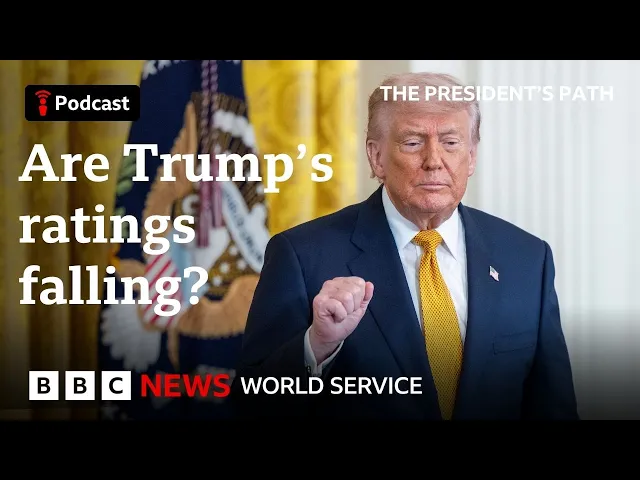
How will Trump's low ratings affect the midterms? - The President's Path podcast, BBC World Service
BBC World Service
0:00 You know, whenever he steps into a race, whenever he steps into the ring,
0:03 he really can change the political dynamic so quickly.
0:05 You know, you have one of the biggest, um,
0:08 one of the biggest tests for this president
0:11 with the upcoming midterms in November.
0:14 The challenge for President Trump is that he has
0:16 kind of a ticking clock with regards to those midterms.
0:26 Hey guys.
0:27 Buenos dias.
0:27 Great to see you both.
0:29 We have, of course myself and Bernd and one of our favorite favorite guests,
0:34 Fin Gomez, a political director at CBS news.
0:36 We should also say fin,
0:38 you're the senior executive director of white House coverage at CBS as well.
0:42 Great to see you again.
0:44 Great to see you.
0:45 And buenos dias.
0:46 Well, you know, it feels like for several weeks
0:49 now we've been talking about the war in Iran.
0:51 And Fen you know this as well,
0:54 obviously that we keep kind of circling back to some
0:57 of the same topics and some of the same messaging from President Trump.
1:01 And this is going to be another week
1:03 where we do that, because we've heard President Trump,
1:06 again, say we've won the war.
1:08 We even heard the secretary of State,
1:10 Marco Rubio, say that Operation Epic Fury is over.
1:13 And yet this this limbo period in terms of negotiations continues.
1:18 Absolutely.
1:19 And I think it's a great frustration to many within the white House,
1:22 uh, as well as those allies close to the president.
1:25 Um, you know, it it all goes back really to that, that massive
1:28 leverage point that Iran has with the Straits of Hormuz.
1:31 And I think that that's something that, you know, they are, uh,
1:34 that's like the massive block here for them trying to get a solution.
1:39 Uh, it is, it is something that's been
1:41 impacting him not only externally, but also at home.
1:45 I mean, you've been seeing that in some of the latest polling.
1:47 He's somewhere in the approval ratings, somewhere along,
1:50 uh, in the low 30s, in the 30s.
1:52 Uh, and he's got, you know, gas prices are, are,
1:55 are, are over 450 a gallon here in the United States.
1:59 And, um, you know, and there's also been an opposition to the war.
2:02 It's very unpopular war in that we and we've seen that in the latest polls,
2:07 not only from CBS, but from other outlets like CNN and others.
2:11 Uh, that as as this continues to drag on past that two month period,
2:15 uh, it, it continues to be, um,
2:18 some, a weight, uh, that's been, that's been sort of holding down,
2:22 um, the domestic perspective, at least of this administration.
2:26 And I think also, I mean,
2:28 detractors of the president will point to this, this last
2:31 week and, and paint kind of a picture of dysfunction.
2:34 They're really even more so than in other cases in this administration,
2:37 kind of a sense of whiplash in that, uh, operation or project freedom,
2:41 rather the, the effort to open up the Strait of Hormuz.
2:45 High level officials, Secretary Hegseth,
2:48 Marco Rubio had spent an entire day kind of laying out what the plan was.
2:53 Uh, and then that very same evening,
2:56 President Trump really suddenly hit the brakes on Project Freedom
3:00 and said it was paused to to allow for negotiations.
3:03 I think, you know, no matter what the administration just does
3:07 to kind of justify that people who are against the war in Iran,
3:12 whether they be Democrats or some of the Republicans
3:14 that have spoken out against kind of the the extended conflict,
3:18 are going to point to that and say, is there a plan here?
3:22 Because this doesn't necessarily seem like one.
3:25 That doesn't mean, of course, that there aren't, you know,
3:27 some real steps forward happening in terms of negotiations.
3:31 We don't have a real view into that.
3:33 We're not privy, of course, to those conversations,
3:35 but from what we're hearing from our colleagues at BBC Persian
3:38 and from our colleagues who are covering the Middle East as well,
3:43 it could be that the Iranians are indeed behind closed doors,
3:47 signaling to President Trump that they do want to make a deal.
3:49 This is what President Trump says time and again.
3:52 He says this pretty much every day, that the Iranians want to make a deal,
3:56 and it's just a question of when they do it.
3:58 But every time I speak to an Iran analyst,
4:01 these key sticking points of would Iran give up its enriched uranium,
4:05 which President Trump claims that the US will get that uranium?
4:08 Will Iran agree to never enrich uranium again?
4:12 Would there be some sort of sunset clause on this?
4:14 We've talked about this on the pod in the past.
4:16 All of these points,
4:17 they see as very unlikely that Iran would give give ground on this.
4:22 That had me wondering if, you know, with President Trump if that might even be
4:26 an impediment for him to reach an agreement with Iran,
4:28 knowing that he is so conscious of not wanting
4:31 any of his detractors to be able to say, well, the deal that President Obama got
4:35 in the JCPoA was better or at least equal.
4:38 He wants to be able to say, I got a better deal.
4:41 Will the Iranians give ground on that?
4:43 It's really not clear.
4:44 President for years, for years has lambasted the JCPoA under Obama back in 2024.
4:51 I mean, this is a central part
4:53 of this of his contrasting message when it came to foreign policy,
4:56 and he absolutely ravaged that.
4:58 So any comparisons or any comparisons where you actually make perhaps, uh,
5:03 elevate this definitely does complicate the exit strategy here,
5:07 uh, for the president and the administration.
5:10 Uh, I would like to add that, uh, even though his, you know,
5:14 his, his polls have sagged over this overall nationally, uh,
5:17 pretty much when you look at his base, if you look at the Republican Party,
5:21 he still has a pretty very strong support coming from from the GOP.
5:26 And I think that that is, uh, going to, uh, I think he's going to withhold that.
5:32 But again, like looking a little bit ahead
5:34 in a few months ahead of time, uh, you know, you have one of the biggest, um,
5:39 one of the biggest tests for this president
5:42 with the upcoming midterms in November.
5:45 I think the challenge for President Trump is that he
5:48 has kind of a ticking clock with regards to those midterms.
5:51 The longer that gas prices stay elevated and people
5:54 feel that he is in some way responsible for that.
5:59 And polls suggest that many people do think
6:01 he's personally responsible for for bringing the, you know,
6:04 gas prices up in the four or $5 a gallon range in the States was not,
6:08 you know, of course, very challenging for a lot of people.
6:11 The longer that is the case, I think the more challenging his messaging
6:15 that this is an excursion, as he calls it,
6:17 that this is a short term kind of trade off
6:20 for Iran not having a nuclear weapon that he's willing to make.
6:23 That becomes much more challenging.
6:26 The other part of that is the Iranians also, though, have a ticking time clock.
6:30 You know, the longer the blockade goes on, the harder their economy takes.
6:33 It.
6:34 The, you know, food, for example,
6:36 there might be kind of internal dissent just based on on food prices alone.
6:41 So it's interesting to see, you know,
6:43 there's those two kind of clocks ticking at the same time.
6:47 And I think really, it just becomes then a question of who who blinks first?
6:52 Well, this is the point that I keep hearing from analysts is,
6:54 you know, this is a question indeed of who blinks first.
6:57 But the Iranians are in a oppressive theocracy,
7:00 and they are able to withstand that pain longer because they are not
7:03 as beholden in the same way
7:05 to that public pressure that President Trump might be.
7:08 President Trump and his administration have
7:10 a very different picture than Congress when it
7:13 comes to whether he needs Congress's approval
7:15 to greenlight his war efforts in Iran.
7:19 And, of course, that 60 day period came and went of when
7:23 after which the president would have had to get approval from Congress.
7:26 And we've seen some pretty creative interpretations from the defense Secretary,
7:30 Pete Hegseth, from the president himself,
7:32 saying, well, I don't need that approval.
7:34 And and, you know, we are in a cease fire right now, so it's not necessary.
7:38 You're going to start to see
7:41 that argument also frustrate Republicans in Congress.
7:44 And I wonder if that will add to some
7:46 of those time pressures that President Trump is facing.
7:49 Looking at these these these poll numbers.
7:51 And the longer this this goes on long.
7:54 And in some analysts as, as has been mentioned,
7:57 have said that gas prices, regardless of sort of the outcome here,
8:01 the immediate outcome, if there is one gas prices still will likely remain
8:05 high for months and through potentially the election in November.
8:09 Uh, remember, affordability was the key issue.
8:13 It was a it was a mantra for the president back in 2024.
8:17 It's a big reason why he won in 2024.
8:20 Uh, and, and going into his first year of his administration, um,
8:24 the low gas prices, uh, that, that we initially saw before the Iraq war.
8:30 Uh, that was something that the president and his allies touted,
8:33 uh, you know, as, as, you know, as, as, as one of their biggest accomplishments,
8:38 if you will, that has been negated because of this.
8:40 And most Americans, they don't really truly care about what's happening
8:45 in Iran specifically or comparatively to what they really care about.
8:50 And that's the cost of living issues that has been so pronounced.
8:54 And so as this continues on, you know,
8:57 this, you know, it's what matters at home.
8:59 It's the pocketbook issues.
9:01 It's those it's those issues that affects their families and their wallets.
9:05 And that's how by any measure, if you look at it,
9:08 cycle after cycle, that is that is a major reason why people vote.
9:12 And I think that going into this midterms, uh,
9:15 that is something that could be a bit of a political buzz saw for Republicans,
9:20 especially congressional Republicans,
9:21 who are already facing historic headwinds, uh,
9:24 in these midterms, uh, that they could,
9:27 uh, potentially lose more seats than it has been predicted or expected.
9:32 And they're just looking at the polling.
9:34 There's kind of a pretty significant enthusiasm
9:37 gap between Democrats and Republicans at the moment.
9:40 I was just looking at one poll shortly before we
9:42 jumped on that showed that more than 70% of Democrats
9:45 polled by the CNN poll think that the midterms are
9:49 extremely important and that they need to get out there.
9:52 That number is kind of in the 50s among Republicans,
9:55 which is a huge problem that also compounds in, you know,
9:58 a lot of the groups that are kind of considered swing voters,
10:02 Latino voters, for example,
10:04 probably the biggest swing vote in the United States.
10:07 They care about those prices and the economy much
10:10 more than any much more than any other issue.
10:13 So I think the enthusiasm gap, plus those swing voters potentially blaming
10:17 Republicans and the administration for those prices,
10:22 that that's kind of a a very perfect storm that they'll have to deal with.
10:28 100%.
10:28 I just want to add.
10:30 Yes.
10:31 Swing voters.
10:31 It's Latino voters, as you said, Hispanics.
10:34 Almost half of Hispanics supported the president in 2024.
10:37 50/50 percent of Hispanic males supported the president in 2024.
10:41 Some historic numbers there by any Republican president.
10:45 Uh, and, uh, it's, it's, it's independent voters.
10:48 It's young voters, uh,
10:50 really key components of that Trump 2024 coalition are starting
10:54 to bleed away from Republican support in this midterm cycle.
10:59 Uh, it's always tough for the party
11:01 that controls the white House in any midterm.
11:03 For the most part, there's been like two incidents in like two,
11:06 two cycles in the last like 40 years where, where it's gone against that trend.
11:10 Uh, but this cycle, it does appear that at least at this point, uh,
11:15 with 180 days out or whatever it might
11:17 be approximately that you are seeing significant, uh,
11:21 the use or significant impact by these, uh,
11:25 by the, the ongoing, uh, Iran situation and others,
11:29 uh, that, you know, that are leaving Republicans
11:32 nervous about their, about their outcome, uh, come November.
11:36 Quickly on, on that point,
11:38 I think it's really notable that President Trump openly
11:41 acknowledges that these midterms might not go the same way.
11:45 Something he says quite often that he doesn't understand why.
11:48 But the midterms always go bad for the party in power.
11:51 It's really rare for him, in general to say publicly that he thinks
11:56 something could go wrong or something has gone wrong,
11:59 or kind of open up that possibility.
12:01 He's his public statements are very consistent and very confident.
12:05 So to actually hear him say that in the Oval Office,
12:09 you know, essentially every time he's asked about it,
12:11 I think shows just kind of the, the, the scope
12:14 of the problem for President Trump
12:16 to come out and publicly acknowledge that this might
12:19 not go the way he wants it to.
12:20 That's not something we hear from him very often at all.
12:24 Yeah.
12:24 And there is a bit of that tension, isn't there,
12:26 between the pull between the white
12:28 House understanding the messaging that President
12:29 Trump might need to deliver and the message he's actually delivering.
12:33 And it was so interesting to, again,
12:34 hear him at the white House say, well, you know, gas.
12:38 We thought I thought it was going to be I
12:40 thought we were going to see $200 a barrel for oil.
12:44 And so gas prices are not as high as they could be.
12:46 We thought the stock market would be way down.
12:48 Well it's up.
12:48 And so things are far better off than we thought.
12:50 And once again, this is, you know,
12:53 very similar to what we saw President Biden struggle
12:55 with as he was heading into the campaign before he dropped out,
12:59 of course, and that the economy was not matching or that the reality
13:02 of the economy was not matching
13:04 those macroeconomic figures that he was looking at.
13:06 But we are now under that six month mark to the midterms,
13:10 and I thought there was some interesting kind of both primaries
13:13 and early tests that we can look at, because until now,
13:16 all of the special elections that have taken place
13:19 since President Trump took office again for the second time,
13:22 have really swung towards the Democrats
13:24 that a lot of Republicans sounding the alarm,
13:26 a lot of Democrats feeling very, very positive about their chances.
13:30 But there was this big prime or these big primary races in Indiana.
13:34 And I'm the one who always brings up Indiana as one
13:37 of those big political defeats for President Trump in December,
13:41 when a number of Republicans in the state
13:44 legislature there decided to vote against redistricting,
13:47 president Trump wanted them to redraw congressional maps.
13:50 They said no.
13:50 And that was a pretty surprising rebuke.
13:53 Well, President Trump and his team and the Maga coalition
13:57 poured millions of dollars into races to challenge with Maga candidates,
14:02 to challenge those senators who had kind of turned their back on him.
14:06 And five of those candidates won.
14:08 And that was seen as a pretty big victory and for some people as well.
14:12 And a sign that President Trump still wields incredible power.
14:15 You know, when he is focused in a race like that.
14:17 Oh, 100%.
14:17 I mean, I would just weigh in like, I think that, you know,
14:21 I think the what happened in Indiana where,
14:24 you know, seven out of those seven, uh,
14:26 Indiana state senators who were on the ballot who dare to defy
14:30 President Trump back in December against his redistricting efforts in the state,
14:34 in the Hoosier State, uh, that, you know, out of those seven,
14:37 at least five have lost and potentially it could be six.
14:41 Um, and the thing is, you know, it it was a big win for the president.
14:45 It was a big win for his political operation.
14:48 Uh, and again, it showed, like you said,
14:49 that he has this enormous amount of sway
14:51 still within the primaries and within the party.
14:55 And, and even though he might, his pulls again,
14:57 might not not be maybe sagging, uh,
15:00 nationally and with other groups with Republicans.
15:03 Uh, he's still, uh, you know, he still holds a lot of sway.
15:06 He still, and he's still, you know, very, very strongly popular with them.
15:10 So I think that that is notable.
15:12 It also, it was a sort of a line is basically saying,
15:16 dare to defy me to other Republicans,
15:19 dare to defy me on these crucial, um, votes or issues that I,
15:22 that I, that I want to, you know, implement.
15:25 It's a political threat.
15:26 I could primary you, I could win those primaries and I could be, you know,
15:30 and so I think that it was a, it was a sort
15:33 of a ringing of a bell for other potential Republicans who may want to, um,
15:37 you know, veer away from that.
15:39 Uh, I do think and then, you know,
15:42 following that Supreme Court ruling from, you know, uh,
15:44 the recent Supreme Court ruling, uh,
15:46 you also have seen on, on the Voting Rights um, Act.
15:51 It's basically allowed for more of these redistricting efforts
15:56 in the southern states that are led by Republicans.
15:58 So you're already seeing and what this does
16:00 and what this could do with, with, with Indiana,
16:03 uh, excuse me, with like some of these other redistricting wins.
16:07 Um, uh, and, and now with what's happening in, in the South, uh,
16:12 he could net more Republican friendly seats
16:15 and that could stave off some of those, uh,
16:18 you know, offset some of those expected losses, uh, in November.
16:22 However, uh, it may not matter because we may have this wave election
16:26 that could overcome any sort of gains
16:29 they've made on those on those redistricting efforts.
16:32 There's also a practical issue here for President
16:34 Trump and that once you're in the white House,
16:37 being in campaign mode is much more difficult.
16:40 There's just the the realities of the job just mean,
16:43 you know, it won't be the same as the campaign.
16:45 And early on this year, the Siouxsie Wiles, the white House chief of staff,
16:50 said that they were going to try and get him out
16:52 there much more often once a week to speak to voters.
16:54 And we really only have kind of begun to see that.
16:58 But I don't think it's really been at the same
17:01 pace as I think many people were expected.
17:03 Of course, he might ramp that up, but like I said,
17:06 there's other issues at hand when you're where you're the president.
17:09 You know, I think it's notable that now
17:11 when he's actually been out there speaking to people,
17:13 I was at an event with him in Florida, uh, recently, uh,
17:17 he was talking about no tax on tips, no tax on Social Security.
17:21 So you're seeing kind of that economic message kind
17:24 of shift to where he very much sees wins, no tax on tips thing in particular.
17:30 I think, uh, he sees that as something that they can kind of bank
17:33 on as a, as a as a positive message for for voters in the near term.
17:38 And I have talked to some top some top advisers in his political operation,
17:43 he said essentially that's their focus is like, you know,
17:46 they're going to get these big tax rebates, right?
17:48 Like roughly around now, people can get their money back.
17:51 They're going to be feel better about the economy.
17:53 Uh, that was their initial sort of strategy.
17:55 And of course, again, the Iran war and rising gas prices complicates that.
17:59 Uh, but they also, there's also
18:01 an expectation that that, that overall, the strategy,
18:04 they're going to have to get more negative, uh, on their Democratic foes.
18:08 Uh, and I think you see a lot more negative ads,
18:11 a lot more critical ads, uh, contrast ads, whatever you want to call them, uh,
18:15 in this, in this next period
18:17 of the election cycle and through, through the fall.
18:21 You know what I'm going to be really interesting
18:23 to watch as well is the primary in Kentucky,
18:26 where Congressman Thomas Massie, um,
18:29 is being primaried by a candidate supported by President Trump.
18:32 And remember, Thomas Massie has been a big
18:34 thorn in President Trump's side, hasn't he?
18:36 When it comes to first, the one big, beautiful bill act,
18:39 and then with the Epstein files pushing for the release of the Epstein files,
18:44 and he's kind of carved out such an interesting space in being able to he says,
18:48 90% of the time I vote with with the Republicans and President Trump.
18:52 But I also have my own ideas.
18:54 I have, you know, I stand up for what I believe in.
18:56 And he has stood fast to that, even
18:59 though he's been under massive pressure from President Trump.
19:02 He's a popular congressman in his district.
19:04 And so I wonder with that full court press if we can call
19:07 it that, that President Trump and the Maga coalition put on in Indiana.
19:12 They're doing the same in Kentucky.
19:14 And I wonder if that works.
19:16 You know, that is, again, a sign that when President Trump is engaged fully,
19:20 when the Maga coalition is, you know, pulling out all the stops, let's say,
19:24 to make sure that they win a race, they could do that in November.
19:27 And that could have a massive impact on, the results of these races,
19:32 especially when you have such gerrymandered districts,
19:35 that the ability for Democrats to really pick
19:37 up that many more seats is pretty limited.
19:41 Great reference to Massie,
19:42 because I think Massie and they've they've, you know, following Indiana,
19:46 they they have that's their that's what they're
19:48 setting their sights on now as Trump political organization.
19:52 I think Chris, to a top, you know, a top,
19:56 um, leader of that of the Trump political organization,
19:59 his former campaign manager in 2024, uh, he, he,
20:02 he put on social, you know, to Massie, you're next.
20:05 I fall on the Indiana successes they had.
20:08 Uh, look, they poured a ton of money, super PAC money.
20:12 Um, it's just a lot of money has been put into Massie's district.
20:17 And to help, uh, his, uh,
20:19 his primary challenger, who was endorsed by President Trump,
20:22 obviously, but following Indiana, I think, you know, in terms of, uh,
20:26 in terms of that success they had there,
20:28 I would be a little nervous if I was if I was a congressman,
20:32 because, you know, they succeeded.
20:33 Well, when it was predicted that in this Hoosier state, the land of Mike pence,
20:37 they would be able to, you know, maybe survive some of this.
20:40 Look, I, I think it's it's going to be a battle in Kentucky for sure.
20:45 Yeah, absolutely.
20:45 You know, and, and we should say that for Democrats,
20:48 they are feeling pretty positive about
20:50 their prospects heading into the midterms.
20:52 But they're aware that President Trump is the ultimate wild card, isn't he?
20:56 You know, whenever he steps into a race, whenever he steps into the ring,
20:59 he really can change the political dynamic so quickly.
21:02 That's one.
21:03 And as I keep saying over and over, it's so important to remember,
21:06 just because President Trump and this war, for example,
21:09 that they are unpopular, that doesn't mean the Democrats are popular.
21:12 Their their overall brand remains, you know, pretty unpopular.
21:17 There are specific candidates who have performed very
21:19 well in in districts or in states, for example,
21:22 you know, Mikie Sherrill and when we look
21:25 at the gubernatorial races and the special elections.
21:27 Mikie Cheryl, and Abigail Spanberger.
21:29 Um, so new Jersey and Virginia, respectively.
21:32 But that being said,
21:33 they have to make sure that they are fielding candidates who can overcome,
21:37 let's say, the, the somewhat negative
21:40 association with the overall Democrats brand.
21:44 I kind of think that's been the the unspoken
21:46 thing since people started talking about the midterms.
21:48 You know, you know, people it seems to me
21:51 in the in a lot of the US media outlets,
21:53 a lot of commentators talk about how there's a segment
21:55 of the Republican Party and the Maga
21:57 base that's dissatisfied with President Trump,
22:00 whether for the Iran war, for example,
22:03 that by no means suggests that those people are going to vote Democrat.
22:08 When it comes down to it, I think, you know,
22:10 the best case scenario for the Democrats and a lot of that situation
22:13 is that some of those people who are less enthused than they were before,
22:17 they just sit this one out and don't vote.
22:20 I mean, that's going back to that enthusiasm gap.
22:22 I mean, if if some Republicans are dissatisfied
22:26 and just don't head out for the midterms.
22:29 And then, you know, down the line for the election.
22:31 And a lot of Democrats feel that they really, really need to.
22:34 That's a huge problem for the Republican Party.
22:37 That enthusiasm gap, again,
22:38 I think is really challenging because it's not insignificant.
22:41 The numbers.
22:42 I mean, a 20 point difference is high.
22:45 President Trump is a formidable campaigner.
22:48 Like when he's on the campaign trail and he's focused on that.
22:51 You know, he, you know, his his his close advisers would say,
22:54 as you all know, that, you know,
22:56 he almost he almost gets this, this, this energy
22:59 from those those raucous crowds of his supporters.
23:02 He's not on the ballot this year.
23:03 That's a great point, Bernie.
23:04 He does.
23:05 Republicans do a lot better when he is on the ballot.
23:08 Um, but I think that towards, you know,
23:12 again, Iran war being the major hurdle here.
23:14 But, you know, later in the summer, perhaps you will see the president more, uh,
23:19 more, you know, rallying and campaigning,
23:21 barnstorming in some of these battleground districts and states.
23:25 Uh, and I think that I think that's a really strong point,
23:29 uh, about Democrats because even though Democrats are, you know,
23:32 uh, have this, you know, this, this, this, this momentum right now,
23:36 and they're predicted to take back at least the House.
23:39 The Senate is in play.
23:41 Well, it's something we're seeing not just in the US but also around the world.
23:44 But, you know, it's going to be something for all
23:46 of us to keep watching in the weeks ahead.
23:48 Um, that's all we have time for.
23:50 But Finn, so good to have you back on.
23:51 Thank you so much for, for being here.
23:53 It's been great to see you both.
23:54 It was it's I love this podcast.
23:56 It's my favorite podcast.
23:57 I, I always love joining.
23:58 Thank you for having me on.
24:00 And you're always welcome, Finn.
24:01 So please come back soon.
24:02 Thank you.
24:10 If you enjoyed this episode of The President's Path,
24:13 then like and subscribe to our YouTube channel.
24:15 We would love to hear from you.
24:16 So please do leave us a comment below or email us on path@bbc.co.uk.