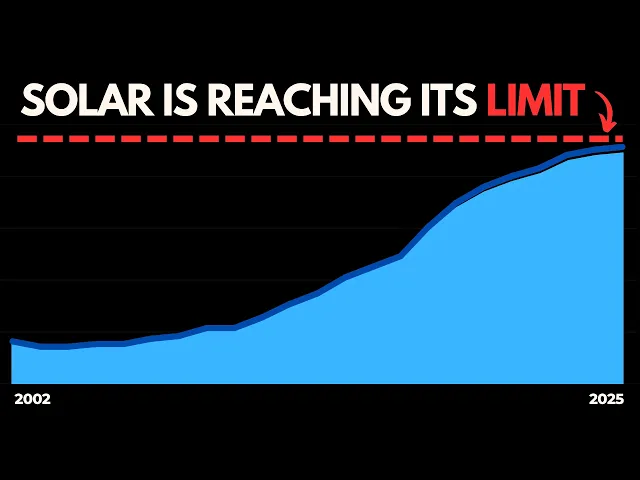
Why solar panels can't be more than 33.7% efficient
Looking Glass Universe
0:00 There is a strict theoretical limit on how good solar can ever be,
0:04 but I think this has actually been a blessing in disguise,
0:08 and it's allowed solar to not only be
0:11 the most important technology we have for beating climate change,
0:14 but also literally the cheapest energy that we have.
0:17 That's why I've partnered with the Charity Sunday,
0:20 who are promoting awareness about how awesome solar really is.
0:24 More about them later.
0:26 But first let's understand exactly how solar works 'cause it's
0:30 surprisingly straightforward and it's also quite obvious what the limitation is.
0:34 Fundamentally, all solar energy does is it
0:38 tries to take light coming from the sun
0:41 and get these electrons to absorb that light
0:45 and use it to flow around this circuit.
0:49 Because flowing electrons are what make electricity,
0:51 and you can use the energy coming from the sun
0:55 to these electrons to do things like boil your kettle,
0:58 make yourself a cup of tea.
1:00 So fundamentally, that's all that solar is trying to do.
1:03 So the way that solar panels try to do this is by using a semiconductor.
1:08 Semiconductors though have really interesting physics because the electrons
1:12 inside of a semiconductor typically can't actually flow,
1:15 and the reason for that is because of the energy of the electrons in here.
1:22 Inside of a semiconductor,
1:24 electrons can have a whole range of energies called the valence band.
1:28 So they could have energy up here or down here, or anywhere in between.
1:34 But the valence band is very constricting because if an electron wanted to flow,
1:39 it would get in the way of its neighbor.
1:43 And so electrons don't generally flow in a semiconductor, but they can.
1:48 If they're given enough energy to jump away from the valence
1:52 band into the conduction band inside of the conduction band,
1:56 the electron is very free to flow around,
1:59 and so the electron would be able to flow around this circuit,
2:03 give its excess energy from the conduction band to this kettle,
2:07 and then go back to where it started.
2:10 So solar energy boils down to being able to move electrons
2:14 from the valence band of energies to the conduction band of energies.
2:18 So as long as you can figure out a way
2:22 to give an electron enough energy to bridge this quantum leap.
2:27 Then you'll be able to make a working solar panel.
2:31 But as you can see, sunlight actually comes in many different colors,
2:36 and that turns out to be a bit of a problem for solar panels.
2:40 Think of it like this.
2:41 If all of these different colored lights were
2:44 shining on these electrons in the valence band,
2:46 which ones would actually be able to get
2:49 enough energy to escape to the conduction band?
2:52 Not all of them.
2:53 These electrons need this exact amount of energy or more
2:57 to be able to get into the conduction band,
3:00 and some of these colors of light won't be able to provide it,
3:03 and that's because of the quantum mechanics of light.
3:06 You see, red light and violet light actually
3:09 have very different amounts of energy per photon.
3:12 The electron with the red light might only get this much energy,
3:17 whereas the photon with the violet light might end up getting.
3:22 That much energy, and this is not an allowed state,
3:26 an electron can't have an energy in between
3:28 the valence band and the conduction band,
3:31 and so this actually just won't happen.
3:33 So what will actually happen is this red light will
3:36 just go right through and be used up for something else,
3:39 whereas this violet light actually did get absorbed usefully
3:44 by this electron that's now able to complete this circuit.
3:48 If the band gap is really big,
3:51 then that means that most of these colors of light
3:55 won't have enough energy in them to get an electron across.
3:59 But if the band gap is really small.
4:02 Then all of these will have enough energy to get electrons across,
4:06 and so all of those different colors of light can be absorbed.
4:10 So it all comes down to the size of the band gap,
4:13 and that is determined by the material that this semiconductor is made out of.
4:19 Like every type of semiconductor has a unique band cap.
4:23 So you might think the obvious thing to do is
4:27 pick a semiconductor with a really tiny band cap, but.
4:31 There's actually a big trade off.
4:33 Let's think about this violet light again.
4:36 So this electron that gets that light will jump all the way to this high energy.
4:43 Remember, it only needed this much energy to get into the conduction band,
4:47 but it actually had more energy and so it's ended
4:50 up at a very high spot inside of the conduction band.
4:53 Now, that could be useful if we could harness.
4:57 All of this electron energy,
4:59 but we actually can't, basically inside of this circuit,
5:02 you can only harness the band gap energy and not
5:06 really any of the extra energy inside of the conduction band.
5:10 So when this electron goes around the circuit,
5:14 it will give this much energy to the kettle,
5:18 but the rest of the energy actually just goes
5:20 to heating up the wire and the solar panel.
5:23 And then it ends up back where it started.
5:26 So in fact, a lot of the violet light was wasted.
5:30 And the problem gets even worse,
5:32 the smaller the band gap is because if the band gap is really small.
5:36 More of the electrons are going to make it across,
5:39 but the amount of energy that they're going
5:42 to be able to usefully use is very small,
5:45 and the wasted energy per electron is much higher now.
5:50 So it's a balance.
5:51 You don't want the band gap to be too small or else each
5:54 of these colors is only gonna give you a little bit of energy,
5:56 but you don't want the band gap to be too big
5:59 because then not many of these colors are gonna be useful.
6:02 So then there must be an optimal band gap.
6:06 In other words, an optimal semiconductor material,
6:08 one that allows us to absorb as many colors as possible,
6:12 especially the colors that the sun mostly shines in, but it
6:16 still lets us minimize the amount of loss per color.
6:20 You can actually do that calculation, and it's called the shockly quasar limit,
6:24 and it finds that the optimal band gap energy is 1.34 electron bolts.
6:33 That probably doesn't mean too much to you,
6:35 but the important thing is if you actually
6:38 found a material with that exact band gap,
6:42 then the theoretical maximum amount of energy that you can
6:47 get from a sun from a solar panel is 33.7% efficiency.
6:54 So the way forward is obvious, right?
6:57 You've gotta find the right semiconductor material.
6:59 Yeah.
7:00 What about silicon?
7:01 Silicon is an extremely common material
7:04 for a semiconductor because it's so abundant on earth.
7:08 In fact, sand is made out of the same
7:12 silicon crystal structure as this solar cell,
7:14 so there is at least as much silicon as there are grains of sand on earth.
7:19 So yeah, that would be kind of ideal.
7:22 But unfortunately the band gap of silicon is, is kind of close.
7:26 It's 1.12 ev.
7:28 In theory, the highest efficiency that you
7:30 could get by using silicon is actually 32%.
7:33 So, you know, kind of close to the limit.
7:37 But in practice, silicon tends to actually have much lower efficiency than that.
7:42 Contrast that with gallium arsenide.
7:44 So Gallium arsenide has a band gap energy of 1.42 ev.
7:51 Which leads to an efficiency of about 32.8%.
7:58 So yeah, extremely close to the limit.
8:00 In fact, way back in the 1990s,
8:03 they were using gallium arsenide solar panels on spacecrafts,
8:07 and they were reaching efficiencies of like 30%.
8:12 So yes, very, very close to the theoretical limit.
8:15 So obviously the way that the industry should have gone is they should
8:19 have bet hard on gallium arsenide since
8:21 it almost saturates the shockly quasar limit.
8:24 But they didn't.
8:25 They went with silicon, and here's why.
8:28 That was a stroke of genius.
8:30 You see, the engineers could have relentlessly focused on efficiency,
8:34 and if you're gonna do that, you wouldn't pick silicon.
8:38 Even now, all these years later, it's still only about 25% efficient,
8:43 but there aren't that many gains to be made by focusing on efficiency.
8:48 The shockly, Quas are limit means that a really hard
8:51 stop on how far you can go just doing that.
8:54 And so instead, engineers decided to focus their energies on something else.
9:00 And that metric that they decided to look at was cost per unit of energy,
9:06 and that has made all the difference.
9:07 Actually, I wanna tell you a funny story about this first.
9:10 So coincidentally, my dad called me this weekend very excited
9:14 to tell me that he was updating his solar panels.
9:17 You see, they had gotten solar panels all the way back in 2011
9:21 because in Australia rooftop solar is extremely popular for the obvious reasons.
9:28 Back in 2011 when they got their solar panels,
9:31 they only got a fairly small system,
9:33 which was standard at the time, so 1.5 kilowatts,
9:37 but now they're upgrading to 6.5 kilowatts because that's the new standard.
9:43 And yet, even though.
9:44 They're getting about four times more power out of the solar cells.
9:49 Now they're actually paying less than they did originally.
9:53 So when you factor in both of those, you find that solar
9:57 has actually become six times cheaper per unit of energy for them.
10:01 And that little anecdote actually matches up pretty
10:04 well with the overall trend in the solar industry.
10:07 By the way, my parents also got a battery and my dad was very
10:11 excited to tell me that they basically
10:13 wouldn't be paying electricity bills at all anymore.
10:16 So even though we're talking about price,
10:18 which you might think doesn't really matter, this price drop has allowed them
10:23 to make their household electricity consumption.
10:26 Net zero.
10:26 That's why this chart is the most exciting story in climate tech right now.
10:31 It shows how the price per unit of energy has dropped dramatically.
10:37 For solar panels, for example,
10:39 the prices has dropped by a factor of 45 since 1990.
10:43 And even if we compare to a much more recent time,
10:47 like 2011 when my parents got their solar panels and there
10:50 was a big push for people to get rooftop solar.
10:53 In Australia, we find that the price has dropped by a factor of eight,
10:58 and solar isn't just confined to rooftops anymore.
11:01 Solar Farms account for about 60% of the market share for solar,
11:06 and those are even more profitable and it's
11:08 being installed everywhere because it's just good business.
11:11 This is why I think solar energy is
11:14 the most exciting type of energy that we have now,
11:16 and if you wanna know more about it, then September 21st is Sunday,
11:21 and there are loads of local events all over the US and around the world,
11:27 like tours of solar farms.
11:28 So to find an event near you, check out the link in the description.
11:32 But let's get back to this chart and why it is that solar
11:36 panels and in particular silicon solar
11:38 panels have dropped in price this dramatically.
11:41 A big part of the answer comes down to the fact that these can be mass produced.
11:46 There are massive factories, especially in China that make many,
11:51 many of these at a time.
11:54 And so they've learned from doing it again and again,
11:58 exactly how to do it as cheaply and efficiently as possible.
12:02 And also the demand for solar panels in China especially has been very strong.
12:07 And so the more that you make a solar panel.
12:11 The more that you learn about how to make it better,
12:14 and so the more you sell, the cheaper it gets.
12:17 That is what's so amazing about solar.
12:19 On the other hand, compare that to something like gas or coal.
12:22 When you make a gas plant,
12:24 you have to make something that's fairly bespoke for the area.
12:28 And so there's a lot of sort of individual design work,
12:31 and it's a big mega project.
12:33 And so there isn't as much learning
12:35 by doing because you're doing it much less often.
12:38 And that's part of the reason why the price of those things
12:42 hasn't really dropped over time too much for gas or coal.
12:45 You need to be mining materials.
12:47 For every what of power that you use.
12:50 Contrast that with solar, where yes, you do at some point have to mine
12:55 for the silicon and the other trace materials in here,
12:58 but it's only once in the 30 year lifespan of this solar
13:03 panel instead of every single time that you use that form of energy.
13:08 And so there's a natural flaw for how cheap coal or gas can ever get,
13:12 and that flaw is determined by the price
13:15 of just extracting the materials themselves.
13:17 Not only that, something like coal has waste all along
13:21 its process that all pollute the earth and cost money.
13:24 Whereas with solar, the sun's energy is free and we have been
13:29 able to make these things cheaper and cheaper because of learning by doing.
13:35 You might say though, yeah,
13:36 it's all well and good that solar energy is cheap, but the sun.
13:41 Isn't always shining, but while researching this video,
13:43 I found out that there are actually great solutions to this problem.
13:47 Even the problem of the sun shining much more in summer than in winter,
13:53 and the solution involves just building more solar panels,
13:56 which we can do since they're very cheap.
13:59 And also using batteries.
14:01 Batteries have also, similarly to Solar gone on their own cost curve.
14:06 That has meant that batteries are becoming more and more affordable.
14:11 If you want more information about how
14:14 solar plus batteries can solve the seasonality problem,
14:17 there's a really great article from Brian Potter that I will link.
14:20 There's one last thing I wanna get off my chest.
14:24 So before researching this video,
14:26 I would casually watch videos about solar energy and, you know,
14:30 people would make stuff about like pite
14:32 solar cells or like multi-layer solar cells, all these exotic designs.
14:36 And I figured that, you know, that was the frontier of solar and that's
14:41 where all the important work was happening.
14:43 In fact, if you layer different types of solar cells on top of each other,
14:46 the new limit is actually 60.
14:49 8.7% efficiency.
14:50 So you know that's way higher than the single junction solar cell limit.
14:56 So you might think that the most exciting thing happening
15:00 in solar energy is all of that crazy, exotic stuff.
15:04 But I'd like to put in a word for the humble silicon solar cell.
15:09 The design has barely changed at all since the original one from the fifties,
15:14 from Bell Labs, and yet.
15:16 Over the intervening decades,
15:18 legions of engineers and manufacturers have taught each
15:21 other how to make it more and more cheaply.
15:25 And so yes, there are exotic solar cells
15:28 that have achieved like 50% efficiency in labs,
15:31 but it is a completely different thing to be
15:34 able to make a solar cell in a lab setting.
15:38 Then being able to scale it out to the masses and solve climate change.
15:42 And I think that that's what Silicon is going to be able to do.