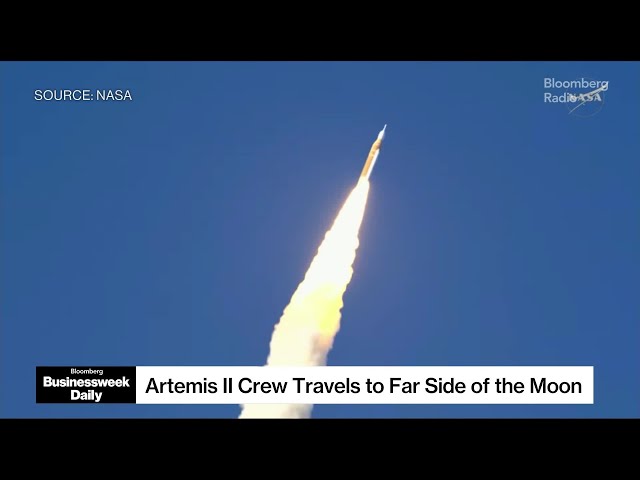
NASA Artemis II Crew Break Distance Record for Space Travel
Bloomberg Podcasts
0:00 I mean, it just goes to show the limits
0:02 that we can continue to push when it comes to space,
0:05 even even now, after we've been to the moon before,
0:08 we can still travel even farther.
0:10 And it's been such a long time since we've done this is more than 50 years.
0:14 The last time we sent humans back to the moon or was in 1972,
0:17 you know, So it's just an exciting time.
0:21 And the fact that we do get to break this milestone in this record
0:24 just is kind of like the cherry on top of the cake.
0:27 You know what's interesting to learn,
0:29 I think about movies we've seen or, you know,
0:31 in terms of space travel and you go
0:34 behind the moon and communications with Earth, right?
0:37 The blackout period, they've got to live through that.
0:39 And it's going to be a pretty long one.
0:40 Walk us through what actually happens,
0:42 and that's expected to happen right around 7 p.m.
0:46 or 7:02 p.m.
0:47 Eastern.
0:48 Walk us through what actually happens.
0:51 Yeah.
0:51 So that the communications blackout I think begins around 645 6:47 p.m.
0:57 Eastern time.
0:58 So that's when they pass between or on the other side of the moon.
1:02 And so the moon will be between
1:04 the capsule and Earth preventing that line of sight.
1:07 And it's a 40 minute blackout period.
1:10 And during that time there in that blackout period,
1:13 they will come their closest approach to the moon, roughly about 4000 miles.
1:18 It's a pretty far distance.
1:19 The moon will look what they've described to be
1:22 the size of a basketball in your outstretched hand.
1:25 Still, it's the closest that any humans have
1:27 gotten to the moon in more than 50 years.
1:29 They'll also reach their furthest distance from Earth during that time,
1:33 also after about 7 p.m.
1:34 Eastern.
1:35 But this is pretty normal.
1:37 I mean, during the Artemus One mission,
1:40 the Uncrewed version of this flight, there was a blackout period.
1:44 During the Apollo missions, there was a blackout period.
1:46 So this is just a normal, normal operating procedure.
1:48 It is kind of an eerie time for us because we can't hear them,
1:53 but everything should be working just fine during that time.
1:56 What's happening on board during this time?
1:59 Yeah.
1:59 So things have already been well underway.
2:02 The official lunar flyby observation period began around 2:45 p.m.
2:08 Eastern.
2:09 And during that time, Orion, the capsule that they're flying in, it's oriented,
2:13 it's Windows, so that it can give them a great view of the moon.
2:17 And they've just been talking nonstop between them and the science
2:22 folks in NASA's mission control about what they've been seeing,
2:26 what they've how they've described,
2:27 how they're describing what the various targets that they are
2:31 that have been deemed really important by the science team.
2:34 And so it's just been great to hear them chatter
2:37 back and forth about how they see it with their eyes,
2:39 the way they've described them.
2:41 They've had these really vivid descriptions of what it looks like,
2:44 how the colors are changing,
2:45 how their eyes are adjusting to the various lighting changes.
2:49 And, you know, their capsule is moving around the moon.
2:52 The trajectory is changing as they're making these observations.
2:56 And so we really need to hear how that changes what
2:58 they see and how it's evolving over that five year period.
3:01 And my understanding, when we talk about the clock ticking
3:04 down and you talked about the blackout period, but toward the end, right,
3:07 there's actually an eclipse that they're going to see.
3:10 Absolutely, Suzanne.
3:11 They really need that happens because they were able to launch on April 1st
3:16 like they did that once they've come around that out of that blackout period,
3:21 they should have an eclipse where the sun will pass behind the moon.
3:25 And just like when we see eclipses here on earth,
3:29 they'll be able to study the sun's atmosphere or its corona,
3:33 which is the, you know, the wispy,
3:35 that wispy atmosphere that you see on the outside
3:38 edges of the moon during an eclipse.
3:41 And yeah, they'll get a very long view of that eclipse
3:44 and also get to see various planets very vividly as well.
3:48 So it's going to be a really spectacular sight.
3:49 So today's just a really jampacked day from, you know,
3:54 a visual perspective for the crew.
3:56 And we will also get to see those images, too.
3:59 And they're going to have some really neat high
4:01 resolution imagery that we'll get when they splashdown down.
4:04 So it's just we're going to continue to get presents for four days to come.
4:08 That's so cool.
4:09 I mean, I mean, somebody in your position
4:11 and even who gets to cover this is awesome.
4:13 But just for us and everybody around the world who's watching this, it's it's
4:16 so cool for for us to learn how do they get back to Earth?
4:19 What happens on the Orion spacecraft that gets them
4:21 back into Earth's orbit and then ultimately helps them splashdown?
4:25 So the reality is they're already on their way back to Earth
4:29 from the the trans lunar injection burn that occurred on Thursday night.
4:35 The burn that put them on route to the moon
4:37 is actually the same burn that brings them back.
4:39 So it's a neat little dance that they do
4:42 with gravity that puts them on the slingshot around the moon.
4:45 But then the earth is in gravity there.
4:48 So the gravity of Earth's moon system eventually pulls them back.
4:51 And so they are basically already on their way home.
4:55 It's just that their way home happens
4:56 to take them around the outside of the moon.
4:59 And so.
5:00 It's just a leisurely, leisurely journey back.
5:03 And then on Friday is when they will re-enter
5:08 Earth's atmosphere and splashdown in the Pacific Ocean underneath parachutes.
5:12 And one of the things when they splashdown that they're going
5:14 to look forward to is actually using a toilet on Earth that works.
5:18 You have a story out there.
5:20 You say the biggest headache has been their toilet.
5:23 You got to talk about it.
5:25 Yeah, absolutely.
5:26 I mean, it's been.
5:27 Look, we're going to have fun, you know,
5:28 And this this mission, it's serious, but also it's fun.
5:32 It's also critical.
5:33 I've just got to say.
5:34 Is it?
5:35 It absolutely is.
5:36 And yes, so unfortunately, you know,
5:38 there have been kind of minor glitches here and there are things that have
5:42 been popping up that have been
5:43 addressed by mission controllers and flight controllers.
5:46 But, yes, it seemed from our perspective, it appears that the toilet is the one
5:50 that seems to be giving them the most grief.
5:52 So right after they launch, there was an error reading on the toilet,
5:56 but they found out it turned out that the pump
5:59 for the toilet just needed to be primed.
6:00 And I guess I'm not familiar with pumps,
6:02 but sometimes you just need to add extra water to prime them and to wet them.
6:06 And so that seemed to do the trick on that first day.
6:09 But then later they they had an issue with a wastewater dump.
6:14 So they actually dumped the contents of the toilet,
6:18 the liquid contents of the toilet overboard periodically.
6:21 And it was not there, which ended prematurely for the space junk.
6:27 Yeah, Yeah, exactly.
6:29 Literally, I love what was really there was
6:32 a blockage and so that blocked and they think
6:34 that ice got into the vent line and was
6:37 blocking the wastewater from being able to dump it.
6:40 So they actually turned the spacecraft to bake in the sun to melt that ice.
6:44 And that seemed to do the trick.
6:47 But then I was just listening to the the the livestream earlier,
6:50 and it sounded like they were no go for the toilet again.
6:53 So it's just, you know, it's just a constant,
6:55 you know, this is a test mission, after all.
6:58 And we're learning things.
7:00 And one of those things is how to properly use the toilet.
7:02 I mean, crucial, important.
7:03 But in the grand scheme of things,
7:05 like there are other things that could be much more problematic.