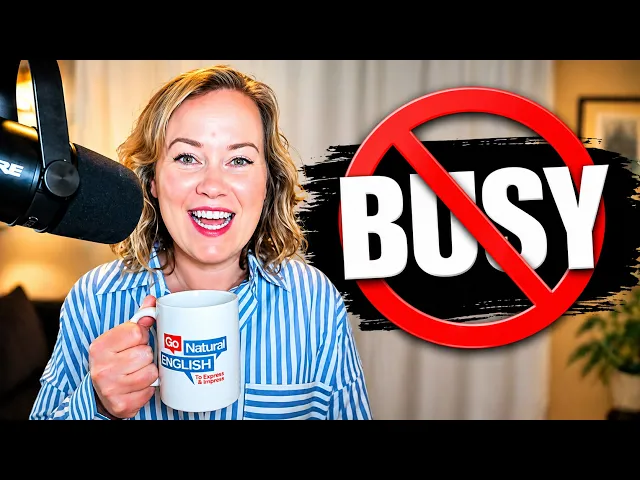
Fluent English Speakers Never Say 'I'm Busy' — Here's What They Say Instead
Go Natural English - Real Life English with Gabby
0:01 Hi naturals, how are you?
0:03 Have you ever been in a conversation and you answered a question like
0:09 how have you been and then said I'm busy and the conversation just died?
0:15 Well, here's the truth.
0:17 Native English speakers almost never answer in this way.
0:22 Instead, they say things like I'm swamped.
0:26 My schedule is packed.
0:28 I've got a lot on my plate.
0:31 And those phrases instantly make you sound more natural,
0:34 more confident, and more fluent.
0:36 So in this video, I am going to share seven
0:41 expressions native speakers use all the time instead of I'm busy.
0:46 And stay until the end because phrase number seven
0:49 is the one native speakers use when they're overwhelmed,
0:53 exhausted, and trying to do 10 different things at once.
0:56 And once you learn it, you're going to hear it everywhere.
1:01 So if you're new here, hi, I'm Gabby from Go Natural English.
1:05 And if you've ever felt like your English is correct,
1:10 but still sounds a little repetitive or textbook-like, this lesson is for you.
1:15 Because I'm busy is not wrong, but if you say it all the time,
1:23 your English can sound flat, basic, very general.
1:27 Think about it, I'm busy.
1:29 could mean a lot of different things.
1:30 It could mean you have too much work, you have no free time, you're stressed,
1:35 you're overwhelmed, your schedule is full,
1:38 you forgot to call someone, or you're just emotionally exhausted.
1:42 So native speakers often try to be more specific, and I'll tell you why.
1:48 And today I'm gonna show you how to be more specific too.
1:52 We'll go through seven phrases.
1:53 when to use them, how to pronounce them naturally,
1:57 and which one to use depending on your situation.
2:00 And make sure that you stay for phrase four because it's one
2:05 of the most useful expressions for work
2:07 and most English learners have never heard it.
2:10 So before we get into better phrases than I'm busy,
2:14 there is something important you need to know
2:17 because when you simply say I'm busy,
2:20 especially depending on the tone of voice you use,
2:24 it can sound like, don't want to talk.
2:27 There may be some times when that's exactly what you mean to say.
2:32 But if you don't want to say, I don't want to talk,
2:37 or I don't want to continue this conversation, that's not what you mean.
2:42 We need to use some other phrases and strategies because in American English,
2:48 I'm busy by itself can feel very short, very closed, even rude.
2:56 Imagine someone comes to your door and is trying to sell you something.
3:01 One way to get them to go away would be to say, sorry, I'm busy.
3:06 So it's a way to say you're not interested
3:10 without being so harsh as to say something so direct, like I'm not interested.
3:16 That is very direct, obviously.
3:18 So for example, imagine someone says, we should get coffee sometime.
3:23 And you answer, I'm really busy.
3:26 The conversation's over and it sounds like you're not interested at all.
3:30 It sounds like you're rejecting the person.
3:32 But both can be true.
3:34 You can be busy, but also want to get coffee with someone.
3:39 So if you want to sound open, friendly,
3:42 and interested, you need to add more detail.
3:45 That's the secret.
3:47 For example, I've had a ton on my plate lately,
3:51 but I'd love to get coffee sometime.
3:53 My schedule is packed this week, but maybe next week?
3:58 I've been swamped with work recently.
4:01 We should catch up soon.
4:03 You know, this exact situation happened with me.
4:06 I was catching up texting with a friend of mine,
4:10 and we want to make plans to grab dinner together.
4:14 but she's busy the next two weeks and then
4:18 I'm busy traveling the next two weeks after that.
4:22 So we're both busy, but we also both expressed interest
4:26 in grabbing a bite to eat a month from now.
4:31 And it's funny, but that is very common, especially in American culture.
4:36 We often plan things out way, way, way in advance.
4:40 All right, so notice the difference.
4:43 you're still explaining that you're busy, but now you sound warm,
4:49 interested and open to continuing the relationship.
4:52 As long as you follow up after saying,
4:56 I'm busy with more details and a suggestion about
5:01 when you might actually get together, then it's all good.
5:06 So Americans do this all the time.
5:08 You might've noticed Even if we don't make a specific plan,
5:12 we often add something like, we should catch up soon.
5:15 Or let's do something next week.
5:18 I'd love to talk more when things calm down.
5:22 So this is not making a specific plan.
5:25 You may actually never get together.
5:27 However, it's just expressing interest in connecting in the future.
5:33 Because the goal is not just to explain that you're busy.
5:36 The goal is to show the other person I still want to connect with you.
5:40 So as you learn these phrases today, remember, don't just replace I'm busy.
5:47 Add a little detail, and if it makes sense,
5:51 suggest another alternative time to get together or to work
5:55 on the project or to have a call, whatever the situation may be.
6:01 And if you want to keep the conversation going, this is so important.
6:05 The invitation for later to keep that invitation open.
6:10 Because this one small change can make
6:12 you sound much more natural and much friendlier.
6:16 And we know that connecting with people and building
6:19 your network is a huge key to success.
6:22 It's not just about having perfect English.
6:25 You want to know how to use English fluently,
6:30 confidently to connect with people.
6:32 Okay, now let's look at the first
6:35 phrase native speakers use when they're completely overwhelmed.
6:40 I'm swamped.
6:43 This means you have way too much to do.
6:46 Not just busy, overwhelmed.
6:49 For example, I'm completely swamped at work right now.
6:55 Sorry, I haven't replied.
6:56 I've been swamped.
6:58 This week has been crazy.
7:00 I'm swamped.
7:02 And hey, as I share these phrases with you,
7:05 These are great examples to repeat after me.
7:08 If you shadow what you hear me say right after I say it,
7:12 that is how you improve your pronunciation.
7:15 And it also helps you to remember these phrases if you say them out loud.
7:19 So if you didn't just repeat after me,
7:22 go back and listen again and say these phrases with me
7:25 as well as the next ones I'm about to share with you.
7:30 So when you say, am swamped, imagine you're underwater.
7:35 It's that feeling.
7:36 I'm just trying to keep my head above water.
7:39 And actually, that is a very common idiom that we use.
7:43 How are you doing?
7:44 I'm so busy.
7:45 I'm just trying to keep my head above water.
7:49 So that's a little bit more advanced,
7:51 but I thought I'd throw it in here just for fun.
7:54 So when you have so much work to do
7:58 that you feel like you can barely breathe, that's I'm swamped.
8:02 And listen to how native speakers say it.
8:05 I'm swamped at work right now.
8:07 Swamped at work sounds like one big word.
8:09 We don't say, am swamped at work right now.
8:14 I sound like a robot, don't I, when I separate all the words.
8:18 So try putting swamped at work together,
8:20 all kind of like one big word, and you'll sound more natural.
8:25 This is creating a chunk of words that go together.
8:29 All right, one last time.
8:32 I'm swamped.
8:34 I've been swamped lately.
8:37 I'm swamped at work right now.
8:39 Good.
8:41 What if you're not overwhelmed?
8:43 You just have too many responsibilities and too many things to do.
8:47 Then the next phrase is even better.
8:50 I love this phrase.
8:51 I've got a lot on my plates.
8:55 This is one of the most common expressions native speakers use,
8:59 especially in professional situations.
9:01 In emails, in meetings, it means you have a lot of responsibilities.
9:06 For example, I'd love to help, but I've got a lot on my plate right now.
9:12 She's got a lot on her plate with work and family.
9:16 I've had a lot on my plate lately.
9:19 So, yes, we're talking about a plate,
9:21 like the thing that you eat meals on, and it's not literally about food.
9:26 We're talking about responsibilities.
9:29 So this has nothing to do with how
9:32 you are eating or what you're having for lunch.
9:35 It's simply a natural phrase to talk about.
9:38 You have a lot of responsibilities.
9:41 When you have a lot of responsibilities, this is the phrase to use.
9:45 And before we get to phrase number three,
9:49 I have something that will help you actually remember these expressions.
9:54 I made a free lesson guide PDF for this video for you
9:59 with all seven phrases plus a few bonus ones that have come up,
10:04 extra examples to build your confidence and to practice more,
10:08 pronunciation notes, practice questions,
10:10 and a mini exercise so you can use these phrases in your real life.
10:17 And you can download it with the link
10:20 below in the description and the pinned comment.
10:23 Best part is once you sign up for this PDF,
10:26 I'll send you future lesson guides too.
10:29 So every new video becomes easier to remember and practice.
10:34 So pause the video, grab the PDF,
10:37 and then come back because the next phrase is one natives
10:42 use all the time when they have absolutely no free time.
10:47 My schedule is packed.
10:50 This means your calendar is completely full.
10:53 To be packed means to be busy.
10:56 It also means to be crowded.
10:59 If you're in a space or an event with a lot of people,
11:03 you might say, wow, it's so packed in here.
11:06 Your schedule or your calendar can also be packed with events,
11:11 meetings, and so on.
11:13 I'd love to meet, but my schedule is pretty packed.
11:16 August is gonna be packed for me.
11:20 Think of a suitcase.
11:21 When it's packed, there's no room left.
11:24 It's hard to squeeze anything more inside.
11:27 And that's exactly what this phrase means.
11:30 No room in your schedule.
11:32 You can also say, I have a packed schedule.
11:37 Repeat after me.
11:38 My schedule's packed.
11:42 I have a packed schedule this week.
11:46 But what if you're not just Busy.
11:48 What if you're exhausted because you're trying
11:50 to do too many things at the same time?
11:54 Then phrase number four is the one you need.
11:59 I've been stretched thin.
12:01 This is a great phrase for when you're trying to do too much.
12:05 For example, I've been really stretched thin lately.
12:09 She's stretched too thin between work, kids and school.
12:14 We're all feeling stretched.
12:17 thin right now.
12:19 This phrase means you don't have enough time,
12:23 energy, attention, or even money for everything.
12:26 With inflation, many people are feeling stretched thin financially these days.
12:32 So you're not just busy, you're exhausted.
12:36 And emotionally, this phrase feels very different from I'm busy.
12:41 I'm busy is very basic and doesn't carry a lot of emotion.
12:45 But this phrase, I'm stretched thin tells people that you've reached your limit.
12:51 So pause and repeat.
12:52 I've been stretched thin.
12:55 And now we're getting to one of my favorite
12:59 expressions because it explains exactly why you disappeared,
13:02 forgot to text someone back or didn't do what you plan to do.
13:07 So this is a very, very useful phrase.
13:10 I got caught up in fill in the blank.
13:16 Use this when you became so over,
13:19 so involved in something and you lost track of time.
13:24 For example, I got caught up in work.
13:27 Sorry, I got caught up in a project.
13:30 I meant to call you back, but I got caught up in a million things.
13:35 This is much more natural than saying I was very busy,
13:40 because now you're explaining exactly what happened.
13:42 So pause and repeat.
13:44 I got caught up in work.
13:47 And notice when you have a phrasal verb like caught up or to catch up,
13:53 we emphasize the preposition up.
13:56 I got caught up in work.
13:59 To get caught up has several different meanings.
14:02 So don't get confused when we mean I'm busy.
14:07 Caught up can mean that you forgot about your other responsibilities.
14:13 I'm sorry I forgot to call you.
14:15 I got caught up in work.
14:18 To catch up also means like if you're chasing someone and you
14:23 run faster and faster because you want to catch up with them.
14:27 To catch up with a friend means to reconnect with them.
14:32 To catch up has a lot of different meanings.
14:35 So let's focus just on this one for now.
14:39 And maybe in another video, we can talk about all the different meanings.
14:43 Let me know if you would like that.
14:45 Another example, practice with me now.
14:48 I got caught up in a project.
14:51 There's one final phrase that native speakers
14:54 use when they're trying to manage work,
14:57 family, stress, errands, and life all at the same time.
15:01 And honestly, if you're an adult,
15:04 this phrase probably describes your life perfectly.
15:07 I've been juggling a lot.
15:10 Do you know what it means to juggle?
15:11 Have you ever seen a clown
15:14 or an entertainer a performer who has multiple objects,
15:17 maybe a bowling pin and a ball and some other random object,
15:21 and they're tossing them all in the air at the same time?
15:25 That's what juggling means.
15:26 So this means that you're trying to manage many things at once.
15:30 For example, I've been juggling work, family, and studying English.
15:36 She's juggling three different jobs at the same time.
15:40 We're all juggling a lot these days.
15:43 I love this expression because it creates such a clear image.
15:47 You're juggling.
15:49 You're trying to keep everything up in the air equally.
15:54 And if one thing falls, everything falls.
15:58 And that's why native speakers use this phrase so often.
16:02 So pause and repeat.
16:04 I've been juggling a lot lately.
16:06 Now, let me show you a quick real life story
16:10 so you know exactly how native speakers use these expressions.
16:14 A few months ago, I had one
16:16 of those weeks where everything happened at the same time.
16:19 I had a deadline, I was traveling, I had family visiting,
16:23 and somehow I also decided it was the perfect time to start a new project.
16:28 Terrible timing.
16:30 By Wednesday, I was completely swamped.
16:34 I had back-to-back meetings all morning, then I got caught up in emails,
16:39 and then I remembered I had promised a friend I would meet her for dinner.
16:45 And honestly, I almost canceled completely.
16:48 I texted her, can we do next week?
16:51 I've got a lot on my plate right now.
16:54 But she said, hey, I understand.
16:56 Even if we can meet just for one hour, that would be great.
17:00 And I went.
17:01 And afterward, I realized something.
17:04 I hadn't just been busy.
17:06 I'd been stretched thin.
17:08 I needed a break.
17:09 But it was so good to see my friend.
17:11 I'm so glad that I went.
17:14 So if that sounds like you right now, you are not alone.
17:19 Let's review.
17:21 Instead of saying, I'm busy, try saying, I'm swamped.
17:26 I've got a lot on my plate.
17:28 My schedule is Now, I uh want you to write a sentence in the comments.
17:42 Which phrase describes your life this week?
17:45 For example, I've been juggling a lot lately because...
17:49 or my schedule is packed this month because...
17:53 The more you use these phrases, the more natural your English will become.
17:59 And as one more final point, I'm curious,
18:01 have you noticed that Americans love to talk about how busy they are?
18:06 It's like a badge of honor.
18:09 And it's much more common here in my experience in the United
18:13 States to emphasize how busy you are all the time,
18:18 because it's kind of equivalent to being successful.
18:21 We don't want to say, I have nothing to do, or I'm just relaxing all the time.
18:26 What do you think about that?
18:28 I would love to know if you can give me your feedback in the comments.
18:33 What do you notice culturally?
18:35 But before you go, there's one more mistake English
18:39 learners make that instantly makes their English sound less natural.
18:44 It's using the same simple words again and again,
18:48 words like good, nice, bad, interesting and thing.
18:51 So in the next video, In next video that's right over here,
18:56 I'm going to show you the five words you need to stop using
19:01 if you want to sound more fluent and exactly what native speakers say instead.
19:05 So click the next video right here.
19:07 I'll also include it in the description and the pinned
19:10 comment in case it doesn't show up right here.
19:13 But this video is five words to stop using to improve.
19:18 your English.
19:19 Because once you stop saying, I'm busy, and stop overusing these five words too,
19:25 your English is going to sound dramatically more natural.
19:29 I'll see you there and bye for now.