The Intelligence Test Where Ants Beat Humans
Be Smart
0:00 Thank you to AnyDesk for supporting PBS.
0:02 Every intelligent animal on Earth has a brain.
0:06 And bigger brains usually mean more intelligence,
0:10 more neurons, more memory, more processing power.
0:14 So you wouldn't expect that ants,
0:16 each with a brain made of just 250,000 neurons,
0:19 could beat humans, with brains of 86 billion neurons, in a problem-solving task.
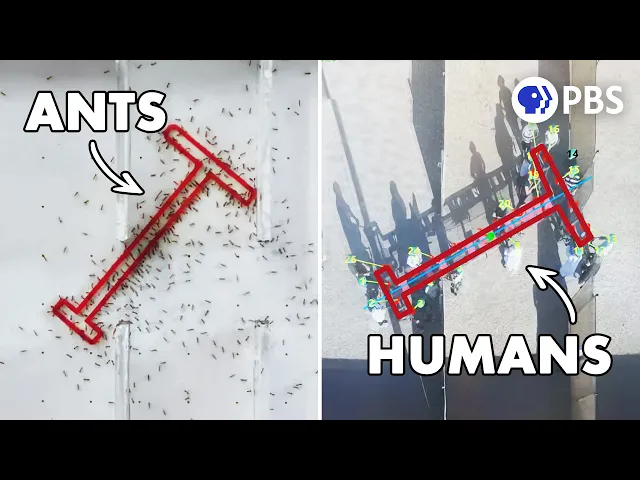
0:25 Except that's exactly what happened when scientists gave them both this.
0:30 It's known as the piano mover's problem.
0:33 To solve this puzzle, this oddly shaped load must be maneuvered
0:36 in a specific way across an obstructed path.
0:39 Individual humans can solve this pretty efficiently.
0:42 Uh-oh, uh-oh.
0:44 Uh-oh, uh-oh.
0:45 Even if it takes a few tries.
0:47 [Camera Operator] We ran into another roadblock.
0:48 What happened?
0:48 I had it, I had it for a second.
0:50 Okay, we're getting somewhere.
0:51 Oh, oh.
0:52 Oh, we did it.
0:53 Take that, ants.
0:54 But give a group of people this puzzle,
0:56 tell 'em they can't talk, and something weird happens.
0:59 The bigger the group gets, the worse they get at solving it.
1:03 But now give that same puzzle to a swarm of ants.
1:06 Surprisingly, the more ants you add, the better they do.
1:10 As a human, this is awkward, because an individual ant is pretty dumb.
1:15 But it turns out that groups of ants
1:16 are capable of solving surprisingly complex problems,
1:20 like building bridges that adapt to traffic,
1:22 or choosing the most efficient path over an obstacle,
1:26 despite the fact that no individual ant understands any of this.
1:31 This is evidence of a different form of intelligence, swarm intelligence.
1:36 And it challenges much of what scientists thought they knew about being smart.
1:41 Because if intelligence usually lives inside a brain,
1:46 where does an ant colony keep its intelligence?
1:49 (inquisitive music) Hey, smart people, Joe here.
1:57 All over nature, we see individual animals come together in tight groups.
2:01 Herds, flocks, hives or schools.
2:05 And without any leader telling the swarm what to do,
2:09 stunning and complex group behaviors emerge.
2:12 It can sometimes feel like the swarm itself is alive,
2:16 like it possesses a mind of its own.
2:18 And many of the most impressive examples are found in social insects like ants.
2:23 Now, when humans play tug of war, something strange happens.
2:27 Individuals in a group typically pull less hard
2:30 than they would if they were playing alone.
2:32 We tend to slack off a bit.
2:34 And the group is less than the sum of its parts.
2:37 But in weaver ants, the opposite is true.
2:40 They use their impressive strength to bend and glue leaves
2:44 into giant enclosed nests high up in the tree tops.
2:47 Their secret, the ants divide labor in a unique way.
2:51 Some act as anchors, while others only pull.
2:55 When researchers measured the forces created,
2:57 each ant on average contributed more pull
3:00 than it could if it were working alone.
3:02 Unlike in human tug of war, the whole is greater than the sum of its parts.
3:08 A phenomenon scientists call super efficiency.
3:12 Now, in the piano mover's puzzle, most humans can solve it after a few tries.
3:16 [Camera Operator] Oh, we hit a roadblock.
3:18 (laughing) Phew.
3:19 [Camera Operator] We did it, okay.
3:20 Pretty unsurprising for the supposedly most intelligent animal on Earth,
3:24 but when more humans are added and individuals
3:27 are prevented from talking or seeing facial cues,
3:30 we seem to resort to selfish movements and pulling,
3:34 which quickly results in worse efficiency compared to people solving it alone.
3:39 What surprised researchers was that not only can
3:42 groups of ants solve the puzzle at all,
3:45 the more ants you add, the more efficient they become.
3:49 In fact, in head-to-head competitions,
3:51 a swarm of just 80 ants can beat a group of 16 people.
3:56 In the wild, there's likely no organism that demonstrates
3:59 this group super efficiency better than army ants.
4:02 Army ants are wandering hunters that live in colonies
4:06 that can easily reach hundreds of thousands of individuals.
4:08 They're almost constantly on the move in search of prey,
4:11 only stopping periodically so the queen can lay more eggs,
4:15 surrounding her in a giant 3D structure made of alive ants.
4:20 But when they are on the hunt, these ants can travel hundreds of meters a day.
4:24 Covering those distances is a challenge when you are the size of a raisin,
4:29 especially in the jungle,
4:30 when a fallen leaf can create an obstacle dozens of times bigger than you are.
4:35 But army ants have a clever solution.
4:37 They build bridges with their own bodies for their comrades to walk on top of.
4:43 Not only do these extend across gaps,
4:46 they also automatically widen when traffic is
4:49 heavy and narrow when traffic is slow.
4:52 Human engineers have yet to build a bridge that can do that.
4:56 So how can these ants achieve such
4:58 complex engineering when each individual is so dumb?
5:04 I'm trying to understand why ant
5:06 colonies are smarter than human societies sometimes.
5:09 And the example I like to give is
5:11 that there is no traffic jams in an ant colony,
5:14 despite them having very, very tiny brains.
5:18 Like Simon, humans have been intrigued by social insects for millennia.
5:22 2,300 years ago, Aristotle reasoned that ants and bees were political animals.
5:28 His term for social creatures, they create and share some larger common good.
5:33 For the next 2,000 years,
5:35 people believed these social animals achieved their goals
5:39 by following the orders of a single leader, like a king or queen,
5:43 which was surely influenced by the fact
5:45 that most humans lived under those political systems.
5:49 But in the 1700s, experiments by a Swiss beekeeper named Francois
5:53 Huber revealed that a hive's actions are not governed by the queen.
5:59 She's just one of many individuals with a specialized task.
6:03 Instead, group behaviors emerge from individual
6:06 members of the colony interacting with each other and interacting
6:10 with their environment according to simple rules.
6:13 Instead of the old idea where one wise
6:16 individual determines the actions of the whole group,
6:19 group behavior emerges from individual actions,
6:23 despite no individual even understanding what the group's goals are.
6:29 The group's problem-solving ability is spread across thousands of insects,
6:33 each following simple rules in response to its local environment.
6:37 What scientists now call swarm intelligence.
6:41 When we say, "Intelligence," when we say,
6:43 "A collective behavior is intelligent," what do we mean by intelligent here?
6:46 We studied it from the point of view of problem solving.
6:49 How does a system solve the problem?
6:51 And the problem for a system is typically
6:53 understood as something that limits its adaptive value.
6:56 I need to reach food because if I don't get that food,
6:59 my adaptive value is gonna drop very quickly because I
7:01 will starve and not be able to survive and reproduce.
7:04 According to this definition,
7:05 if an individual can solve a survival problem better than chance,
7:10 they qualify as having some form of intelligence.
7:13 If a group can solve a problem better than chance
7:16 and without a central leader telling the group what to do,
7:20 that group has swarm intelligence,
7:23 flocks of geese self-assemble into a V shape that slices through the air,
7:27 providing a lift advantage that's more
7:29 efficient than a single goose flying alone,
7:31 despite no individual telling the others what to do.
7:35 That's swarm intelligence.
7:37 Schools of fish dazzle and confuse predators by sensing
7:40 their neighbor's movements and synchronizing their motion in a large group.
7:43 That's swarm intelligence too.
7:45 Even the way as humans, without anyone telling us what to do,
7:48 unconsciously organize into lanes when walking in crowded spaces,
7:53 that is also a form of unplanned emergent swarm intelligence.
7:58 Of course, not all group behavior is swarm intelligence.
8:02 Sometimes animals just hang out, which isn't particularly smart or dumb.
8:07 And sometimes we even see cases of swarm stupidity.
8:11 Ants, for example, follow pheromone trails left
8:13 by scouts in order to locate food.
8:16 But if this system glitches, it can cause what's often called a death spiral,
8:21 where ants will be trapped following
8:23 chemical instincts until they die of starvation.
8:27 Evolution and natural selection reward species
8:29 that can solve problems which help them survive.
8:33 Swarm intelligence does this, but it wasn't until
8:36 recently that scientists figured out how it actually works.
8:40 In the 1980s, computer programmer Craig Reynolds
8:42 argued that we can't claim to truly understand a swarm's behavior until we can
8:48 accurately reproduce it in a computer simulation.
8:50 For his first experiment, he decided to tackle flocking behavior in birds.
8:54 The strategy used by many species to deceive and confuse predators.
8:59 It's a behavior so beautiful and impressive that it led some
9:03 bird watchers to claim it was evidence that birds were telepathic.
9:08 Needless to say, this is not the case.
9:11 Watching birds fly, Craig asked,
9:13 "What are the main rules each bird follows that end up giving rise to the flock?
9:18 What cues do birds use to stay in formation and move in unison?
9:22 What dials can be tuned,
9:24 either by evolution or by swarm members learning to change their behaviors?
9:29 And what happens when those dials are turned?" Craig tested his hypothesis
9:33 by making a computer simulation called BOIDs or the bird-oid algorithm.
9:39 What he found is that flocks form automatically when each
9:43 individual follows simple local rules governing just three different variables.
9:48 First, how badly the birds want to be near other birds.
9:53 Second, how far they want to be from their nearest neighbor to avoid collisions.
9:57 And third, how badly individuals want to fly
10:00 in the same direction as their neighbors.
10:02 He later added a fourth variable, visual range,
10:05 since the better each individual can see,
10:07 the easier it is for large flocks to form.
10:10 But rather than publish this work in a prestigious biology journal,
10:13 Reynolds presented it at a computer graphics conference in Anaheim, California.
10:18 But somehow biologists took notice,
10:21 and his 1987 presentation is now hailed as the birth
10:25 of a new field of scientific study, swarm intelligence.
10:29 Today, Simon applies the tools of time-lapse photography and BOIDs-like
10:33 computer modeling to understand swarm intelligence in army ants.
10:37 As we glimpsed earlier, when these ants encounter an obstacle,
10:40 they have a special trick to keep moving.
10:43 They shorten their path by building bridges with their own bodies.
10:47 Here they're patching a gap between leaves,
10:49 and here they're on a track with an adjustable corner.
10:53 And to most humans, it's obvious that a straight
10:55 line is the shortest path between two points.
10:58 But do ant swarms know this too?
11:01 When Simon introduced this zigzag pathway for the ants to navigate,
11:05 he knew that a bridge from joint A to joint C would be ideal,
11:09 but this gap is too wide for the ants to construct a bridge.
11:13 In response, the ants did something surprisingly intelligent.
11:17 They started filling in the elbow with a small bridge at joint B,
11:21 and then they worked their way down.
11:23 This is a brilliant solution to a rather complex problem.
11:28 But how do they do it?
11:30 What rules do ants follow to decide when
11:32 and where to form and disassemble a bridge?
11:35 (inquisitive music) Careful observation by Simon
11:38 and other scientists revealed the ants' tricks.
11:41 If an ant follows just four simple rules,
11:44 that seems to be enough to create this complex group behavior.
11:48 Rule number one, slow down when the terrain gets rough.
11:52 Rule number two, if the ant in front of you slows down, walk on them.
11:57 It's a bit rude, but it's what they do.
11:59 Rule number three, if you get stepped on, freeze and brace yourself.
12:04 You can even hook legs with a neighbor if needed.
12:06 Rule number four, when you're no longer being stepped
12:10 or pulled on, pause for a moment, then march onward.
12:14 That short pause, the fact that army ants don't crawl outta the bridge
12:18 as soon as they're not being stepped on turns out to be surprisingly important.
12:21 Without it, ant bridges usually disassemble too quickly to really be useful,
12:27 along with physical traits, such as hooked feet, powerful mouth parts,
12:30 plus strong joints and exoskeletons that can withstand heavy foot traffic,
12:35 these four rules are essentially all that army
12:38 ants need to start building living bridges.
12:42 It's estimated that at any moment, 20% of a colony is locked in bridges.
12:47 And since any ant stuck in a bridge isn't available for other tasks,
12:50 this is a costly habit.
12:52 But the advantage it provides to the colony and to the egg-laying
12:56 queen is clearly worth the sacrifice in the eyes of evolution.
13:00 So how did those ants solve the piano mover's problem?
13:05 These ants seem to communicate simply by how hard
13:08 an individual is pushing or pulling in one spot.
13:11 That's one rule.
13:12 And when the ants run into an obstacle,
13:14 they slide along it rather than reversing course and bouncing around randomly.
13:20 That's rule number two.
13:21 Simply by being persistent and responding to force,
13:25 this results in a super efficient method for exploring many possible solutions,
13:30 and allows groups of ants to quickly converge
13:32 on the correct path rather than bouncing around inefficiently.
13:37 So where does an ant colony store its intelligence?
13:41 (upbeat music) It's not kept by any one individual.
13:44 Instead it's spread through thousands of individuals,
13:47 each following simple rules in response to local cues.
13:52 These rules can be figured out through
13:54 careful observation and tested in computer models
13:56 to make sure that we can replicate what
13:58 we think we understand about the natural world.
14:01 And scientists are applying this knowledge to solve human problems.
14:05 Simon's working with city planners to design better
14:08 traffic systems that will create fewer traffic jams,
14:11 and designing a self-assembling robotic conveyor belt system
14:15 for use in construction sites and disaster relief situations.
14:19 When you think about it,
14:20 the human brain itself is a collection of individual neurons,
14:25 no single neuron aware of its purpose or any larger goal,
14:30 just simply responding to local signals.
14:33 But the result is you, the greatest intelligence in the universe,
14:38 at least that we know of.
14:40 Stay curious.
14:42 And thank you to AnyDesk for supporting PBS.
14:44 AnyDesk was created to provide fast, secure, remote access,
14:49 whether you're working from home, on the road,
14:51 or managing systems across multiple locations.
14:53 With AnyDesk, you can remotely access computers and servers directly,
14:57 enabling secure file transfer without relying on consumer cloud storage.
15:01 And if you're working on servers or older
15:03 systems with remote server monitoring and CMS access,
15:06 you can control dashboards and monitor web
15:08 servers directly from your phone or tablet.
15:10 Plus it's available across all major platforms and has backwards compatibility
15:14 with older systems in case your data's running on legacy systems.
15:17 AnyDesk is available for personal use.
15:19 But if your research requires a lot of global coordination,
15:22 AnyDesk offers custom-tailored business plans.
15:25 To learn more about AnyDesks, go to anydesk.com/besmart,
15:29 or check out the link in the description.
15:31 And as always, thank you to everyone who supports the show on Patreon.
15:35 We could not make these videos without your support.
15:38 In a world full of AI slop, we want you to know that "Be Smart" is
15:44 and always will be a handmade product of real human brains.
15:50 Pretty intelligent ones too.
15:52 If you'd like to help us keep making
15:54 this show and join our super intelligent hive mind,
15:57 well, you can check out the link down in the description.
15:59 All over nature, we see.
16:02 (babbling) Uh.
16:05 My phone's ringing.
16:06 I can't talk to you right now.
16:08 There we go, all right.
16:10 (table smacking)