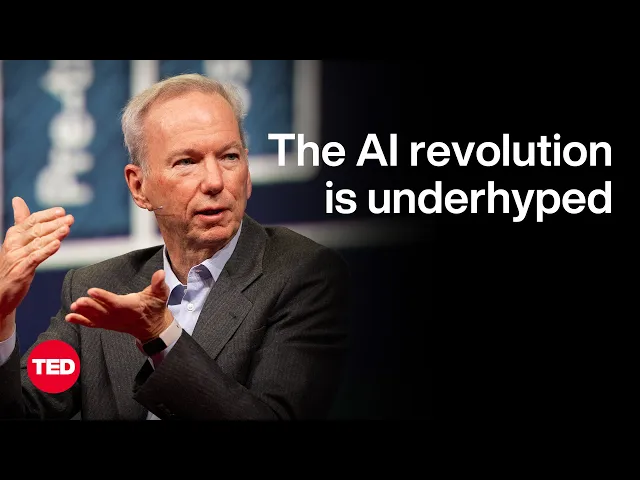
The AI Revolution Is Underhyped | Eric Schmidt | TED
TED
0:04 Bilawal Sidhu: Eric Schmidt, thank you for joining us.
0:07 Let's go back.
0:09 You said the arrival of non-human intelligence is a very big deal.
0:14 And this photo, taken in 2016,
0:16 feels like one of those quiet moments where the Earth shifted beneath us,
0:20 but not everyone noticed.
0:22 What did you see back then that the rest of us might have missed?
0:25 Eric Schmidt: In 2016, we didn't understand what was now going to happen,
0:30 but we understood that these algorithms were new and powerful.
0:34 What happened in this particular set of games was in roughly the second game,
0:38 there was a new move invented by AI in a game
0:42 that had been around for 2,500 years that no one had ever seen.
0:47 Technically, the way this occurred was that the system of AlphaGo was
0:51 essentially organized to always maintain a greater
0:53 than 50 percent chance of winning.
0:56 And so it calculated correctly this move, which was this great mystery among all
1:00 of the Go players who are obviously insanely brilliant,
1:04 mathematical and intuitive players.
1:07 The question that Henry, Craig Mundie and I started to discuss,
1:13 right, is what does this mean?
1:18 How is it that our computers could come
1:20 up with something that humans had never thought about?
1:22 I mean, this is a game played by billions of people.
1:25 And that began the process that led to two books.
1:29 And I think, frankly, is the point at which the revolution really started.
1:35 BS: If you fast forward to today,
1:37 it seems that all anyone can talk about is AI, especially here at TED.
1:43 But you've taken a contrarian stance.
1:46 You actually think AI is underhyped.
1:48 Why is that?
1:49 ES: And I'll tell you why.
1:51 Most of you think of AI as, I'll just use the general term, as ChatGPT.
1:54 For most of you, ChatGPT was the moment where you said, "Oh my God,
1:59 this thing writes, and it makes mistakes,
2:01 but it's so brilliantly verbal." That was certainly my reaction.
2:05 Most people that I knew did that.
2:07 BS: It was visceral, yeah.
2:08 ES: This was two years ago.
2:10 Since then, the gains in what is called reinforcement learning,
2:13 which is what AlphaGo helped invent and so forth, allow us to do planning.
2:19 And a good example is look at OpenAI o3 or DeepSeek R1,
2:25 and you can see how it goes forward and back,
2:28 forward and back, forward and back.
2:30 It's extraordinary.
2:32 In my case, I bought a rocket company because it was like, interesting.
2:36 BS: (Laughs) As one does.
2:38 ES: As one does.
2:39 And it’s an area that I’m not an expert in, and I want to be an expert.
2:43 So I'm using deep research.
2:45 And these systems are spending 15 minutes writing these deep papers.
2:49 That's true for most of them.
2:51 Do you have any idea how much computation 15 minutes of these supercomputers is?
2:56 It's extraordinary.
2:57 So you’re seeing the arrival, the shift from language to language.
3:01 Tthen you had language to sequence, which is how biology is done.
3:05 Now you're doing essentially planning and strategy.
3:09 The eventual state of this is
3:12 the computers running all business processes, right?
3:14 So you have an agent to do this, an agent to do this, an agent to do this.
3:19 And you concatenate them together, and they speak language among each other.
3:23 They typically speak English language.
3:26 BS: I mean, speaking of just the sheer compute requirements of these systems,
3:31 let's talk about scale briefly.
3:33 You know, I kind of think of these AI systems as Hungry Hungry Hippos.
3:36 They seemingly soak up all the data and compute that we throw at them.
3:40 They've already digested all the tokens on the public internet,
3:43 and it seems we can't build data centers fast enough.
3:47 What do you think the real limits are,
3:49 and how do we get ahead of them before they start throttling AI progress?
3:54 ES: So there's a real limit in energy.
3:56 Give you an example.
3:57 There's one calculation, and I testified on this this week in Congress,
4:01 that we need another 90 gigawatts of power in America.
4:06 My answer, by the way, is, think Canada, right?
4:10 Nice people, full of hydroelectric power.
4:12 But that's apparently not the political mood right now.
4:16 Sorry.
4:17 So 90 gigawatts is 90 nuclear power plants in America.
4:22 Not happening.
4:24 We're building zero, right?
4:25 How are we going to get all that power?
4:27 This is a major, major national issue.
4:30 You can use the Arab world,
4:31 which is busy building five to 10 gigawatts of data centers.
4:35 India is considering a 10-gigawatt data center.
4:38 To understand how big gigawatts are, is think cities per data center.
4:44 That's how much power these things need.
4:46 And the people look at it and they say,
4:48 “Well, there’s lots of algorithmic improvements,
4:51 and you will need less power." There's an old rule,
4:54 I'm old enough to remember, right?
4:57 Grove giveth, Gates taketh away.
5:00 OK, the hardware just gets faster and faster.
5:03 The physicists are amazing.
5:06 Just incredible what they've been able to do.
5:08 And us software people, we just use it and use it and use it.
5:12 And when you look at planning, at least in today's algorithms,
5:15 it's back and forth and try this and that and just watch it yourself.
5:20 There are estimates, and you know this from Andreessen Horowitz reports,
5:24 it's been well studied, that there's an increase in at least a factor of 100,
5:29 maybe a factor of 1,000,
5:30 in computation required just to do the kind of planning.
5:34 The technology goes from essentially deep learning
5:37 to reinforcement learning to something called test-time compute,
5:40 where not only are you doing planning,
5:42 but you're also learning while you're doing planning.
5:45 That is the, if you will, the zenith or what have you, of computation needs.
5:50 That's problem number one, electricity and hardware.
5:53 Problem number two is we ran out of data so we have to start generating it.
5:59 But we can easily do that because that's one of the functions.
6:01 And then the third question that I
6:04 don't understand is what's the limit of knowledge?
6:07 I'll give you an example.
6:08 Let's imagine we are collectively all of the computers in the world,
6:11 and we're all thinking and we're all thinking
6:14 based on knowledge that exists that was previously invented.
6:17 How do we invent something completely new?
6:21 So, Einstein.
6:23 So when you study the way scientific discovery works, biology, math,
6:26 so forth and so on, what typically happens is
6:30 a truly brilliant human being looks at one area and says,
6:35 "I see a pattern that's in a completely different area,
6:38 has nothing to do with the first one.
6:40 It's the same pattern." And they take the tools
6:43 from one and they apply it to another.
6:45 Today, our systems cannot do that.
6:48 If we can get through that, I'm working
6:50 on this, a general technical term for this is non-stationarity of objectives.
6:56 The rules keep changing.
6:58 We will see if we can solve that problem.
7:00 If we can solve that, we're going to need even more data centers.
7:03 And we'll also be able to invent
7:06 completely new schools of scientific and intellectual thought,
7:10 which will be incredible.
7:11 BS: So as we push towards a zenith, autonomy has been a big topic of discussion.
7:16 Yoshua Bengio gave a compelling talk earlier this week,
7:19 advocating that AI labs should halt the development of agentic
7:22 AI systems that are capable of taking autonomous action.
7:25 Yet that is precisely what the next frontier is for all these AI labs,
7:30 and seemingly for yourself, too.
7:32 What is the right decision here?
7:33 ES: So Yoshua is a brilliant inventor of much
7:36 of what we're talking about and a good personal friend.
7:39 And we’ve talked about this, and his concerns are very legitimate.
7:43 The question is not are his concerns right, but what are the solutions?
7:47 So let's think about agents.
7:49 So for purposes of argument, everyone in the audience is an agent.
7:53 You have an input that's English or whatever language.
7:56 And you have an output that’s English,
7:58 and you have memory, which is true of all humans.
8:01 Now we're all busy working, and all of a sudden,
8:05 one of you decides it's much more efficient not to use human language,
8:09 but we'll invent our own computer language.
8:11 Now you and I are sitting here,
8:13 watching all of this, and we're saying, like, what do we do now?
8:16 The correct answer is unplug you, right?
8:19 Because we're not going to know, we're just not going to know what you're up to.
8:25 And you might actually be doing something really bad or really amazing.
8:28 We want to be able to watch.
8:30 So we need provenance, something you and I have talked about,
8:33 but we also need to be able to observe it.
8:35 To me, that's a core requirement.
8:39 There's a set of criteria that the industry believes
8:41 are points where you want to, metaphorically, unplug it.
8:44 One is where you get recursive self-improvement, which you can't control.
8:48 Recursive self-improvement is where the computer is off learning,
8:51 and you don't know what it's learning.
8:53 That can obviously lead to bad outcomes.
8:55 Another one would be direct access to weapons.
8:57 Another one would be that the computer systems decide to exfiltrate themselves,
9:01 to reproduce themselves without our permission.
9:04 So there's a set of such things.
9:06 The problem with Yoshua's speech, with respect to such a brilliant person,
9:11 is stopping things in a globally competitive market doesn't really work.
9:17 Instead of stopping agentic work,
9:20 we need to find a way to establish the guardrails,
9:23 which I know you agree with because we’ve talked about it.
9:26 (Applause) BS: I think that brings us nicely to the dilemmas.
9:32 And let's just say there are a lot of them when it comes to this technology.
9:36 The first one I'd love to start with, Eric,
9:38 is the exceedingly dual-use nature of this tech, right?
9:40 It's applicable to both civilian and military applications.
9:44 So how do you broadly think about the dilemmas and ethical
9:48 quandaries that come with this tech and how humans deploy them?
9:53 ES: In many cases, we already have doctrines about personal responsibility.
9:57 A simple example, I did a lot of military work and continue to do so.
10:01 The US military has a rule called 3000.09,
10:05 generally known as "human in the loop" or "meaningful human
10:08 control." You don't want systems that are not under our control.
10:13 It's a line we can't cross.
10:15 I think that's correct.
10:17 I think that the competition between the West,
10:20 and particularly the United States,
10:22 and China, is going to be defining in this area.
10:26 And I'll give you some examples.
10:27 First, the current government has now
10:30 put in essentially reciprocating 145-percent tariffs.
10:34 That has huge implications for the supply chain.
10:37 We in our industry depend on packaging
10:41 and components from China that are boring,
10:43 if you will, but incredibly important.
10:46 The little packaging and the little glue things
10:48 and so forth that are part of the computers.
10:50 If China were to deny access to them, that would be a big deal.
10:54 We are trying to deny them access to the most advanced chips,
10:58 which they are super annoyed about.
11:00 Dr.
11:01 Kissinger asked Craig and I to do Track II dialogues with the Chinese,
11:06 and we’re in conversations with them.
11:08 What's the number one issue they raise?
11:10 This issue.
11:11 Indeed, if you look at DeepSeek, which is really impressive,
11:14 they managed to find algorithms that got
11:16 around the problems by making them more efficient.
11:19 Because China is doing everything open source, open weights,
11:22 we immediately got the benefit of their invention
11:24 and have adopted into US things.
11:26 So we're in a situation now which I think is quite tenuous,
11:30 where the US is largely driving, for many, many good reasons,
11:34 largely closed models, largely under very good control.
11:37 China is likely to be the leader in open source unless something changes.
11:41 And open source leads to very rapid proliferation around the world.
11:45 This proliferation is dangerous at the cyber level and the bio level.
11:50 But let me give you why it's also dangerous in a more significant way,
11:54 in a nuclear-threat way.
11:56 Dr.
11:56 Kissinger, who we all worked with very closely,
11:58 was one of the architects of mutually assured destruction,
12:01 deterrence and so forth.
12:02 And what's happening now is you've got a situation where— I'll use an example.
12:07 It's easier if I explain.
12:09 You’re the good guy, and I’m the bad guy, OK?
12:11 You're six months ahead of me,
12:13 and we're both on the same path for superintelligence.
12:17 And you're going to get there, right?
12:19 And I'm sure you're going to get there, you're that close.
12:23 And I'm six months behind.
12:25 Pretty good, right?
12:26 Sounds pretty good.
12:29 No.
12:30 These are network-effect businesses.
12:32 And in network-effect businesses,
12:34 it is the slope of your improvement that determines everything.
12:38 So I'll use OpenAI or Gemini, they have 1,000 programmers.
12:42 They're in the process of creating a million AI software programmers.
12:46 What does that do?
12:47 First, you don't have to feed them except electricity.
12:50 So that's good.
12:51 And they don't quit and things like that.
12:53 Second, the slope is like this.
12:56 Well, as we get closer to superintelligence, the slope goes like this.
13:00 If you get there first, you dastardly person— BS:
13:04 You're never going to be able to catch me.
13:06 ES: I will not be able to catch you.
13:08 And I've given you the tools to reinvent
13:10 the world and in particular, destroy me.
13:12 That's how my brain, Mr.
13:14 Evil, is going to think.
13:15 So what am I going to do?
13:18 The first thing I'm going to do is try to steal all your code.
13:21 And you've prevented that because you're good.
13:23 And you were good.
13:24 So you’re still good, at Google.
13:26 Second, then I'm going to infiltrate you with humans.
13:29 Well, you've got good protections against that.
13:31 You know, we don't have spies.
13:33 So what do I do?
13:35 I’m going to go in, and I’m going to change your model.
13:38 I'm going to modify it.
13:39 I'm going to actually screw you up to get me so I'm one day ahead of you.
13:43 And you're so good, I can't do that.
13:45 What's my next choice?
13:47 Bomb your data center.
13:50 Now do you think I’m insane?
13:53 These conversations are occurring around nuclear opponents today in our world.
14:00 There are legitimate people saying the only
14:02 solution to this problem is preemption.
14:05 Now I just told you that you, Mr.
14:08 Good, are about to have the keys to control the entire world,
14:13 both in terms of economic dominance, innovation,
14:16 surveillance, whatever it is that you care about.
14:18 I have to prevent that.
14:20 We don't have any language in our society,
14:24 the foreign policy people have not thought about this, and this is coming.
14:28 When is it coming?
14:29 Probably five years.
14:31 We have time.
14:32 We have time for this conversation.
14:34 And this is really important.
14:36 BS: Let me push on this a little bit.
14:37 So if this is true and we can end up in this sort of standoff scenario
14:41 and the equivalent of mutually-assured destruction,
14:43 you've also said that the US should embrace open-source AI even
14:47 after China's DeepSeek showed what's possible with a fraction of the compute.
14:51 But doesn't open-sourcing these models,
14:53 just hand capabilities to adversaries that will accelerate their own timelines?
14:57 ES: This is one of the wickedest, or, we call them wicked hard problems.
15:02 Our industry, our science,
15:04 everything about the world that we have built is based on academic research,
15:08 open source, so forth.
15:10 Much of Google's technology was based on open source.
15:12 Some of Google's technology is open-source,
15:14 some of it is proprietary, perfectly legitimate.
15:18 What happens when there's an open-source model that is really dangerous,
15:23 and it gets into the hands of the Osama bin Ladens of the world,
15:26 and we know there are more than one, unfortunately.
15:30 We don't know.
15:31 The consensus in the industry right now is the open-source models
15:35 are not quite at the point of national or global danger.
15:41 But you can see a pattern where they might get there.
15:44 So a lot will now depend upon the key decisions made
15:47 in the US and China and in the companies in both places.
15:51 The reason I focus on US and China
15:53 is they're the only two countries where people are
15:56 crazy enough to spend the billions and billions
15:58 of dollars that are required to build this new vision.
16:01 Europe, which would love to do it, doesn't have the capital structure to do it.
16:05 Most of the other countries, not even India,
16:07 has the capital structure to do it, although they wish to.
16:10 Arabs don't have the capital structure to do it, although they're working on it.
16:14 So this fight, this battle, will be the defining battle.
16:18 I'm worried about this fight.
16:19 Dr.
16:20 Kissinger talked about the likely path to war with China was by accident.
16:27 And he was a student of World War I.
16:29 And of course, [it] started with a small event,
16:32 and it escalated over that summer in, I think, 1914.
16:35 And then it was this horrific conflagration.
16:39 You can imagine a series of steps along the lines of what
16:42 I'm talking about that could lead us to a horrific global outcome.
16:47 That's why we have to be paying attention.
16:49 BS: I want to talk about one of the recurring tensions here,
16:52 before we move on to the dreams, is,
16:54 to sort of moderate these AI systems at scale,
16:57 right, there's this weird tension in AI
16:59 safety that the solution to preventing "1984"
17:03 often sounds a lot like "1984." So proof of personhood is a hot topic.
17:07 Moderating these systems at scale is a hot topic.
17:10 How do you view that trade-off?
17:11 In trying to prevent dystopia, let's say preventing non-state actors
17:15 from using these models in undesirable ways,
17:18 we might accidentally end up building the ultimate surveillance state.
17:23 ES: It's really important that we stick
17:25 to the values that we have in our society.
17:29 I am very, very committed to individual freedom.
17:31 It's very easy for a well-intentioned engineer to build
17:35 a system which is optimized and restricts your freedom.
17:39 So it's very important that human freedom be preserved in this.
17:44 A lot of these are not technical issues.
17:46 They're really business decisions.
17:48 It's certainly possible to build a surveillance state,
17:50 but it's also possible to build one that's freeing.
17:53 The conundrum that you're describing is because it's
17:55 now so easy to operate based on misinformation,
17:58 everyone knows what I'm talking about,
18:00 that you really do need proof of identity.
18:02 But proof of identity does not have to include details.
18:05 So, for example, you could have a cryptographic
18:07 proof that you are a human being,
18:09 and it could actually be true without anything else,
18:11 and also not be able to link
18:13 it to others using various cryptographic techniques.
18:17 BS: So zero-knowledge proofs and other techniques.
18:19 ES: Zero-knowledge proofs are the most obvious one.
18:22 BS: Alright, let's change gears, shall we, to dreams.
18:25 In your book, "Genesis," you strike a cautiously optimistic tone,
18:29 which you obviously co-authored with Henry Kissinger.
18:32 When you look ahead to the future, what should we all be excited about?
18:35 ES: Well, I'm of the age where some
18:37 of my friends are getting really dread diseases.
18:41 Can we fix that now?
18:43 Can we just eliminate all of those?
18:45 Why can't we just uptake these and right now, eradicate all of these diseases?
18:51 That's a pretty good goal.
18:54 I'm aware of one nonprofit that's trying to identify, in the next two years,
18:59 all human druggable targets and release it to the scientists.
19:02 If you know the druggable targets,
19:04 then the drug industry can begin to work on things.
19:07 I have another company I'm associated
19:09 with which has figured out a way, allegedly,
19:11 it's a startup, to reduce the cost of stage-3 trials by an order of magnitude.
19:16 As you know, those are the things
19:18 that ultimately drive the cost structure of drugs.
19:20 That's an example.
19:21 I'd like to know where dark energy is, and I'd like to find it.
19:26 I'm sure that there is an enormous
19:29 amount of physics in dark energy, dark matter.
19:32 Think about the revolution in material science.
19:35 Infinitely more powerful transportation,
19:38 infinitely more powerful science and so forth.
19:42 I'll give you another example.
19:43 Why do we not have every human being on the planet have
19:50 their own tutor in their own language to help them learn something new?
19:55 Starting with kindergarten.
19:56 It's obvious.
19:58 Why have we not built it?
19:59 The answer, the only possible answer is
20:01 there must not be a good economic argument.
20:03 The technology works.
20:05 Teach them in their language, gamify the learning,
20:08 bring people to their best natural lengths.
20:10 Another example.
20:11 The vast majority of health care in the world is either
20:14 absent or delivered by the equivalent of nurse practitioners and very,
20:18 very sort of stressed local village doctors.
20:20 Why do they not have the doctor assistant that helps them in their language,
20:25 treat whatever with, again, perfect healthcare?
20:27 I can just go on.
20:29 There are lots and lots of issues with the digital world.
20:35 It feels like that we're all in our own ships in the ocean,
20:39 and we're not talking to each other.
20:40 In our hunger for connectivity and connection, these tools make us lonelier.
20:47 We've got to fix that, right?
20:48 But these are fixable problems.
20:50 They don't require new physics.
20:52 They don't require new discoveries, we just have to decide.
20:55 So when I look at this future,
20:56 I want to be clear that the arrival of this intelligence,
21:01 both at the AI level, the AGI,
21:03 which is general intelligence, and then superintelligence,
21:07 is the most important thing that's going to happen in about 500 years,
21:11 maybe 1,000 years in human society.
21:13 And it's happening in our lifetime.
21:15 So don't screw it up.
21:18 BS: Let's say we don't.
21:20 (Applause) Let's say we don't screw it up.
21:25 Let's say we get into this world of radical abundance.
21:28 Let's say we end up in this place,
21:29 and we hit that point of recursive self-improvement.
21:33 AI systems take on a vast majority of economically productive tasks.
21:37 In your mind, what are humans going to do in this future?
21:40 Are we all sipping piña coladas on the beach, engaging in hobbies?
21:43 ES: You tech liberal, you.
21:45 You must be in favor of UBI.
21:48 BS: No, no, no.
21:49 ES: Look, humans are unchanged in the midst of this incredible discovery.
21:55 Do you really think that we're going to get rid of lawyers?
21:57 No, they're just going to have more sophisticated lawsuits.
22:01 Do you really think we're going to get rid of politicians?
22:03 No, they'll just have more platforms to mislead you.
22:06 Sorry.
22:07 I mean, I can just go on and on and on.
22:10 The key thing to understand about this new economics is that we collectively,
22:15 as a society, are not having enough humans.
22:18 Look at the reproduction rate in Asia, is essentially 1.0 for two parents.
22:23 This is not good, right?
22:25 So for the rest of our lives,
22:27 the key problem is going to get the people who are productive.
22:30 That is, in their productive period of lives,
22:33 more productive to support old people like me,
22:36 right, who will be bitching that we want more stuff from the younger people.
22:40 That's how it's going to work.
22:42 These tools will radically increase that productivity.
22:45 There's a study that says that we will,
22:47 under this set of assumptions around agentic AI
22:50 and discovery and the scale that I'm describing,
22:52 there's a lot of assumptions that you'll end up
22:56 with something like 30-percent increase in productivity per year.
23:00 Having now talked to a bunch of economists,
23:02 they have no models for what that kind of increase in productivity looks like.
23:07 We just have never seen it.
23:09 It didn't occur in any rise of a democracy or a kingdom in our history.
23:15 It's unbelievable what's going to happen.
23:18 Hopefully we will get it in the right direction.
23:22 BS: It is truly unbelievable.
23:23 Let's bring this home, Eric.
23:25 You've navigated decades of technological change.
23:27 For everyone that's navigating this AI transition, technologists, leaders,
23:31 citizens that are feeling a mix of excitement and anxiety,
23:35 what is that single piece of wisdom or advice you'd like
23:39 to offer for navigating this insane moment that we're living through today?
23:43 ES: So one thing to remember is that this is a marathon, not a sprint.
23:49 One year I decided to do a 100-mile bike race, which was a mistake.
23:54 And the idea was, I learned about spin rate.
23:57 Every day, you get up, and you just keep going.
23:59 You know, from our work together at Google,
24:02 that when you’re growing at the rate that we’re growing,
24:06 you get so much done in a year, you forget how far you went.
24:12 Humans can't understand that.
24:14 And we're in this situation where the exponential is moving like this.
24:18 As this stuff happens quicker,
24:20 you will forget what was true two years ago or three years ago.
24:25 That's the key thing.
24:27 So my advice to you all is ride the wave, but ride it every day.
24:32 Don't view it as episodic and something you can end,
24:34 but understand it and build on it.
24:36 Each and every one of you has a reason to use this technology.
24:41 If you're an artist, a teacher,
24:43 a physician, a business person, a technical person.
24:47 If you're not using this technology,
24:49 you're not going to be relevant compared to your peer groups
24:52 and your competitors and the people who want to be successful.
24:56 Adopt it, and adopt it fast.
24:58 I have been shocked at how fast these systems— as an aside,
25:03 my background is enterprise software,
25:06 and nowadays there's a model Protocol from Anthropic.
25:10 You can actually connect the model directly
25:12 into the databases without any of the connectors.
25:15 I know this sounds nerdy.
25:16 There's a whole industry there that goes
25:18 away because you have all this flexibility now.
25:20 You can just say what you want, and it just produces it.
25:23 That's an example of a real change in business.
25:26 There are so many of these things coming every day.
25:29 BS: Ladies and gentlemen, Eric Schmidt.
25:31 ES: Thank you very much.
25:32 (Applause)