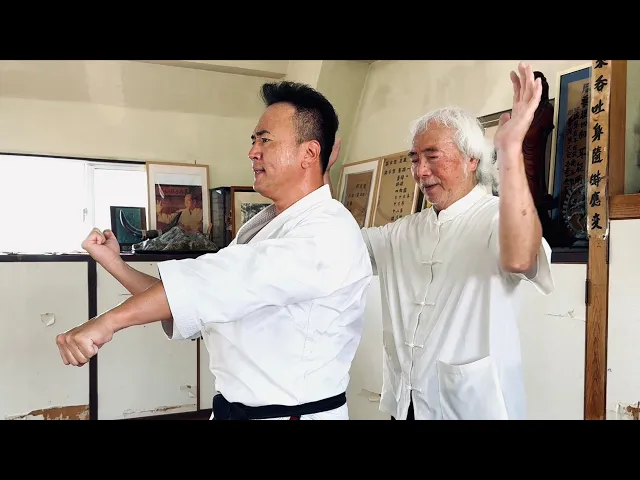
81-Year-Old Karate Master Reveals the Secrets of “Moving Zen” Sanchin!
kuro-obi world
0:05 This is the kata “Sanchin” from Okinawa Gojyu-ryu Karate.
0:10 And the instructor is Meibukan's second-generation soke, Meitatsu Yagi sensei.
0:17 He is now 81 years old.
0:20 This time, Hiyori Kanazawa of Shotokan-ryu "SKIF" will study valuable insights from Meitatsu sensei.
0:28 What exactly is Sanchin?
0:33 By the way, tickets for the Kuro-obi World event
0:36 “Watching Karate Surrounded by Bonsai” on 10/11 are sold out.
0:44 Thank you for your applications!
0:47 See you at the BONSAI Museum!
0:50 Now, back to Okinawa—
0:52 Here comes the second-generation soke of Meibukan, Meitatsu Yagi sensei.
0:57 Let's immediately see the "sanchin" training.
3:38 Hiyori-san, after seeing that training, do you have any questions for Meitatsu sensei?
3:42 You were striking his body with both hands.
3:47 What's the reason for striking the lower body as well?
3:53 First, it's to check his posture and confirm his physique is truly solidly built.
3:59 When I kicked him from behind, it was to check if his buttocks were firm.
4:09 Gojyu-ryu and Uechi-ryu focus on physical conditioning first.
4:12 Shorin-ryu emphasizes speed.
4:16 That's different from us.
4:19 We prioritize “uke.”
4:22 A Goju-ryu characteristic is “kousa-uke”—crossing both hands to block an opponent's attack.
4:29 We practice that.
4:30 Shorin-ryu has no ‘uke’ with hands vertical; all “uke” are done with hands flat.
4:37 But in Gojyu-ryu, we do "uke" with hands vertical.
4:40 We also practice kata to train the body.
4:43 “Even if struck anywhere except the vital points, you will not fall.”
4:46 That is the words of the founder, Chojun Miyagi sensei.
4:51 Therefore, body training is done daily.
4:54 Doing so makes even women quite strong.
4:58 Hiyori-san, what did you feel watching the Sanchin training?
5:04 It felt more terrifying than I expected.
5:09 Naturally, you can't let your guard down during training,
5:12 and you must keep your entire body tense the whole time.
5:15 Seeing the amount of sweat Akihito sensei produces makes that immediately clear.
5:20 It requires intense concentration and is quite a demanding practice.
5:24 In the past, Kihon keiko only taught punches and kicks.
5:27 The policy was to practice only Sanchin kata continuously for three years.
5:31 Meitatsu sensei, please explain the origins of sanchin again.
5:36 Since sanchin is the fundamental kata of Gojyu-ryu, we practice it daily.
5:41 Typically, men remove their jackets and train by having someone strike them from behind.
5:46 Our Goju-ryu teaches that the method of inhaling and exhaling is crucial.
5:53 The way of Gojyu-ryu is the way of breathing.
6:00 That's why we practice sanchin daily while focusing on breathing.
6:12 Sanchin is also a form of zen.
6:17 There are three types of zen:
6:19 za-zen, ritsu-zen, and do-zen.
6:23 Zazen is performed sitting.
6:27 Sanchin is Zen practiced while standing, and it is also moving Zen.
6:36 Za-zen is practiced sitting like this in temples, right?
6:40 You pull your chin in, straighten your back, and meditate.
6:46 You sit in rows, and behind you, a monk walks with a stick called a “keisaku-bo,” checking everyone.
7:02 It's a stick of this length.
7:05 Za-zen usually lasts about 30 minutes, just long enough for a long incense stick to burn out.
7:15 When the incense burns out, the monk strikes a bell to signal the end.
7:23 At first, everyone maintains an upright posture, but gradually they tire and their backs round.
7:35 That's the natural, comfortable posture, but the monk checks from behind.
7:43 If a disciple's back is rounded, the monk stands behind them and taps their right shoulder with the stick.
7:55 The disciple then corrects their posture.
7:57 That is Zen practice.
7:59 In Okinawan karate's sanchin,
8:02 the instructor or senior stands behind the disciples and taps each one's body.
8:09 This serves the same purpose as the stick in Zen at the temple.
8:14 In that sense, sanchin can be called standing Zen.
8:17 Za-zen is seated, ritsu-zen is standing, do-zen is moving.
8:25 That is the purpose of sanchin.
8:35 Regarding breathing techniques, there are four methods:
8:40 The first is to inhale long and exhale short.
8:45 The second is to inhale short and exhale long.
8:51 The third is short inhale, short exhale.
8:56 The fourth is long inhale, long exhale.
9:02 These are the four types.
9:05 Okinawa has the three major karate styles: Gojyu-ryu, Shorin-ryu, and Uechi-ryu.
9:11 Mainland Japan has the four major styles: Goju-ryu, Shotokan, Shito-ryu, and Wado-ryu.
9:16 In Okinawa, Uechi-ryu uses the third breathing method: short inhale, short exhale.
9:25 Gojyu-ryu uses the fourth breathing method: long inhale, long exhale.
9:31 Gojyu-ryu and Uechi-ryu have specific breathing methods, but Shorin-ryu fundamentally does not.
9:39 The basic kata of Shorin-ryu, Nai-hanchi, does not incorporate breathing techniques.
9:48 These four styles represent the four breathing methods.
9:52 The connection between breathing techniques and Zen is the origin of Sanchin.
10:02 Stay tuned for the next installment of the Okinawa series by Hiyori Kanazawa and Akihito Yagi sensei!