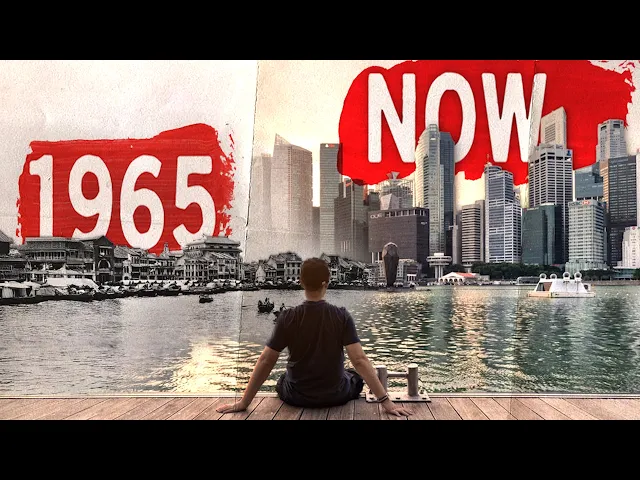
How This Impoverished Country Became The Home of Global Billionaires
How Business Worked
0:00 Singapore is one of the richest countries in the world.
0:02 It has more billionaires per capita than any other nation outside of Monaco,
0:07 the second busiest shipping port on Earth,
0:09 a massive financial center third only to London and New York,
0:13 and a GDP that puts most of its far larger, more populated neighbors to shame.
0:17 What's more is that despite what a lot of people may think,
0:21 it's not like Singapore is just a tax
0:24 haven exclusively benefiting the super rich either.
0:26 Despite its tiny size, immense wealth, and incredibly dense population,
0:31 Singapore has effectively the highest home ownership
0:34 rate of any advanced country on Earth.
0:37 This is all alongside worldleading healthcare,
0:40 education, public transport, public amenities,
0:43 and most importantly for a lot of its residents, unparalleled public safety.
0:48 Now, you probably already knew all of this.
0:51 Singapore's reputation as a magnet for global wealth is not exactly a secret.
0:56 Even if it has come with some major and often overlooked trade-offs,
1:01 but less than a lifetime ago, the story was very different.
1:04 Far from what it is today,
1:06 Singapore was one of the poorest places anywhere on the planet.
1:09 Its people lived in ruins,
1:11 left behind by a consecutive string of occupying forces,
1:15 barely able to feed themselves.
1:18 This desperation bred serious animosity amongst
1:20 the diverse populations stuck living there.
1:23 Civil unrest, crime, disease, and malnutrition were everyday realities.
1:28 The Swampy Peninsula was simply so
1:31 destitute and politically problematic that it became
1:34 the first and so far only nation
1:37 in history to achieve its independence involuntarily.
1:40 Yeah, that's right.
1:41 Almost exactly 60 years ago,
1:44 the newly formed state of Malaysia saw what was going
1:47 on in this city and literally decided to kick them out of the club.
1:52 But since then, the story has changed entirely.
1:55 No population in recorded history has gained more
1:58 wealth more quickly than the people of Singapore,
2:01 who are now 400 times richer than they
2:04 were back when they had independence thrust upon them.
2:07 What happened in between then and now is a valuable
2:10 history lesson that can teach us many of the right things
2:13 and a few of the wrong things about what it
2:16 takes to build a modern economic superpower from the ground up.
2:20 I am calculating in terms of the next generation
2:23 in terms of the next 100 years in terms of eternity.
2:27 So many good reasons to love to love Singapore
2:30 and uh that makes it difficult to to move away.
2:33 Most Singaporeans live in slums around 70% of them.
2:37 People who import and sell K-pops in Singapore are set to face jail and caning.
2:42 And we don't want to wait until it goes out of control.
2:46 Well, essentially Singapore has become a safe haven for the super rich.
2:50 And believe you me, the next thousand years we will be here.
2:55 Thanks to now having some of the longest life expecties in the world,
2:59 there are tens of thousands of Singaporeans still around today
3:02 who have lived through the entire transformation of the country.
3:06 What these people overwhelmingly say is
3:08 that they are immensely proud of their success.
3:11 But getting there involved,
3:13 taking risks most other countries wouldn't be willing to take,
3:16 making sacrifices most other countries wouldn't be able to make,
3:20 all mixed in with simply being in the right place at the right time.
3:24 On that last point, the story really starts in December of 1941.
3:28 And as far as right place, right time goes, this was the complete opposite.
3:33 A few hours earlier, the Japanese had just bombed Pearl Harbor,
3:37 and they knew that they would need access to vital resources like tin,
3:41 rubber, iron, and oil to fight a protracted war in the Pacific.
3:46 Their forces invaded the Malay Peninsula
3:48 from existing territory in Thailand and started
3:50 pushing down towards what was then the British fortress city of Singapore.
3:55 The British Empire knew the same thing that the Japanese Empire did.
4:00 Singapore was a vital position that could easily block naval
4:03 movements in and out of Asia through the Malaca Strait.
4:06 What the Brits didn't expect was that Japanese forces would attack
4:11 down through the dense jungles of Malaya instead of by the ocean.
4:15 Singapore was one of the most heavily defended ports in the world at the time,
4:19 but only from the ocean.
4:21 Nobody thought an invasion by land was even possible with a modern army.
4:25 So, the fortress city didn't even have guns facing out that way.
4:29 By the opening weeks of 1942, British forces were expelled from Singapore,
4:34 and Japan took control not only of the naval base,
4:37 but also the resources up and down the peninsula as well.
4:40 At the time, even Winston Churchill called it
4:44 the worst disaster and largest capitulation in British history.
4:47 The occupation of the city and the people that were left behind
4:51 was brutal and it did lasting damage even after the war was over.
4:56 The Japanese introduced something called banana
4:58 money for use in the occupied territory.
5:00 But these bills were only stamped on one side of crude
5:03 paper and unsurprisingly were printed as the needs of the military required.
5:08 Inflation hit 1 million% in the 3 years under Japanese rule.
5:12 And when the British returned to reclaim their lost outpost,
5:15 they were met with complete devastation.
5:17 The population had been left with no real authority.
5:20 So looting and mob justice had filled the vacuum.
5:24 Unfortunately, it didn't get much better in the years to come.
5:27 The trend of the region at this time
5:29 was decolonization as European powers had been weakened
5:31 from fighting the war and new global organizations
5:34 like the UN promoted everybody's right to self-determination.
5:37 But this put Singapore in a bit of a tough position.
5:40 Before it was a colony, it was only a small trading outpost
5:45 with a permanent population measured in the hundreds.
5:47 Unlike a lot of other ex- colonies that were claiming their independence,
5:50 it didn't have a strong identity to pull people together.
5:54 What's more is that Singapore wasn't like a lot of other colonies
5:58 that were thoroughly exploited exclusively to attract
6:01 wealth from their land and their people.
6:03 Yes, it was still a colonial settlement, not Disneyland,
6:06 but most of the people that lived there
6:09 chose to move there for the opportunities it provided,
6:11 even if there were still steep and immovable hierarchies of power.
6:15 This was a very different experience to most other
6:18 colonies who had an occupying force invade their home.
6:21 Many of its people were basically indifferent to independence,
6:24 especially given the more immediate and pragmatic problem that it relied
6:29 almost entirely on colonial trade coming in and out to support itself.
6:33 Its tiny land mass was not enough to feed its people,
6:36 and it didn't even have sufficient
6:38 supplies of fresh water without outside assistance.
6:41 So instead of a dramatic declaration of independence,
6:44 the handover of Singapore was almost painstakingly slow.
6:47 The first time the country could be considered fully self-governing was a full
6:52 14 years later when the people
6:55 of Singapore elected their own internal parliament.
6:58 The election was won overwhelmingly by the people's action party,
7:01 appointing a man by the name of Lee Kuanu to be the country's prime minister.
7:06 However, even still, the British maintained some control over foreign affairs,
7:10 the military, and peacekeeping amongst the people.
7:13 This was something of a begrudging win-win at the time.
7:17 Singapore could rely on some support still coming from the British.
7:20 And in return, the British got to maintain their strategic position in Asia.
7:24 If you could even call this independence in the first place,
7:27 it didn't last long.
7:29 Anyway, in 1963, under the watchful eye of the British, the regions of Malaya,
7:34 Sabah, Sowak, and Singapore joined together
7:37 to form a federation simply known as Malaysia.
7:40 The hope from the British was that these four states would become
7:44 more self-sufficient when unified and also
7:46 less amunable to the spread of communism.
7:48 It was at this point that any
7:50 official control from the British completely ended,
7:52 although they still maintained a military presence as guests,
7:55 not too dissimilar to how the USA
7:58 maintains military bases all over the world today.
8:01 For Singapore, this merger was another lifeline since it
8:04 could now rely on food and water from mainland Malaysia,
8:07 although it didn't last for long.
8:09 Since Singapore's population was made up primarily of people who had
8:13 moved there for opportunities during the city's time as a colonial port,
8:17 they were ethnically and culturally distinct from the rest of Malaysia.
8:20 The support the city was counting on was limited and slow.
8:24 This was partly because the rest of the country was dealing with its
8:27 own problems at the time and partly because they saw Singapore as a separate,
8:31 lesser group of people.
8:33 Unsurprisingly, more civil unrest broke out amongst
8:35 a group of people who had now been tossed back and forth between various
8:41 disinterested rulers for more than two decades.
8:44 The central Malaysian government saw this unrest,
8:46 but instead of committing resources to dealing with it,
8:49 it just expelled Singapore from the federation.
8:51 So, if you're trying to keep track, in the span of just over 20 years,
8:56 Singapore went from a British colony to Japanese
8:58 military occupation to British military occupation to a semiself-governing
9:03 state under British sovereignty to part of Malaysia
9:06 until it involuntarily became a fully independent nation.
9:10 These are also just the big changes.
9:12 I've skimmed over a lot of smaller details about how poor
9:16 old Singapore became a global hot potato for a little bit there.
9:20 Now, an important tidbit of information for you is that even though its
9:24 eventual independence was involuntary and immediately devastating
9:27 to what remained of the local economy,
9:29 the country still celebrates this day of independence as a national holiday.
9:33 Its expulsion from Malaysia may have marked a low
9:36 point to cap off several decades that weren't
9:39 exactly fantastic to begin with, but at least
9:41 now the city state of Singapore had clarity.
9:44 It simply couldn't rely on any outside powers to save it.
9:47 And so it would have to make do with what it had.
9:50 So what did it have?
9:52 Well, there were really only two things.
9:55 The first was a geographic position that had been coveted for centuries.
9:59 And the second was, well, nothing to lose.
10:03 The desperate state of affairs at the time gave
10:06 the newly independent government the motivation and the political
10:08 will to take a lot of power and start taking equally big swings at the problems.
10:14 The first issue on the chopping block was
10:16 the tensions between the country's ethnically diverse population.
10:19 When an economy is bad,
10:20 humans will inevitably look for someone else to blame it on.
10:24 Another identifiable group of slightly different humans
10:27 is always easier to pin a country's
10:29 problems on, especially when they are competing
10:31 for the same group of scarce resources.
10:33 But the governments, and in particular that prime minister from earlier,
10:37 had a solution to this.
10:39 Housing.
10:39 They used their administrative powers to buy back large tracks of land.
10:43 well, large by Singaporean standards at least.
10:46 They were also able to use their power
10:48 to acquire this land at very generous rates.
10:50 The newly created housing development board then started a massive building
10:54 spree to create enough public housing
10:57 to accommodate the country's entire population.
10:59 This achieved three important things.
11:01 The first was that it created jobs for hundreds
11:04 of thousands of people who otherwise had no opportunities for employment.
11:07 The second was that it moved people out of the slums that had
11:11 been building up across the city
11:13 and into comparatively luxurious modern developments.
11:16 In his memoirs, Prime Minister Lee Kuan Yu
11:18 noted that the best way to align people's interests
11:21 with those of their nation is to make sure
11:23 that they actually share in the ownership of that nation.
11:26 People were more willing to make sacrifices
11:29 for their homeland if they actually have a home.
11:31 My primary preoccupation was to give every citizen
11:34 a stake in the country and its future.
11:37 The third thing this construction boom
11:39 achieved was a little bit more controversial.
11:42 Unity amongst the divided population.
11:43 The slums of the impoverished country were heavily split along racial lines.
11:48 But the new public housing would do exactly the opposite.
11:52 Even to this day, apartments and public buildings must be divided up between
11:57 different ethnic groups so that they are
11:59 all forced to live alongside one another.
12:01 The government summized that tensions were much less
12:04 likely to flare up if these people actually
12:07 interacted with one another day in and day
12:10 out rather than residing in their squalid insulated slums.
12:13 But you might be wondering how this destitute
12:17 country actually paid for all of this development.
12:19 Well, the genius thing is it didn't really need to.
12:23 The land it acquired was purchased very cheaply because back then Singapore was
12:27 not exactly prime real estates and well
12:30 the government wasn't exactly asking twice.
12:33 The workers were very cheap as well.
12:35 A law was also introduced mandating that a fixed
12:38 percentage of their salary would be paid into a savings
12:41 fund which they could use as a down payment
12:43 on one of the public apartments they were constructing.
12:45 This system is still around today forcing Singaporean workers
12:48 to be some of the most prolific savers on the planet.
12:52 The best part was that once the housing
12:54 development board had finished constructing a building,
12:56 it could sell off the apartments
12:58 for a small profit to fund even further construction.
13:00 Now, as inspired as this nation building exercise was,
13:04 it eventually had a limit.
13:06 Building houses may have been a costneutral exercise for the government,
13:10 but the people still needed a source of funds to keep paying for these homes.
13:14 And with the British moving out the last scraps
13:16 of their forces by the end of the 1960s,
13:19 the country would need a new source of foreign income.
13:21 The city was built on facilitating
13:24 and middlemaning trade between colonial empires.
13:27 Colonial empires that were now all but extinct.
13:29 So, the Maverick new government had to take yet another
13:32 risk and bet their entire country's future on attracting a new,
13:36 far more efficient type of global empire, the International Corporation.
13:40 So, it's time to learn how history works.
13:43 to find out how Singapore became the cornerstone of the modern global economy.
13:48 This video is sponsored by Storyblocks.
13:50 If you've ever wondered where we get
13:52 the stock footage that brings these videos to life, the answer is simple.
13:57 We use Storylocks.
13:58 Storylocks is an all-in-one stock media subscription
14:01 that gives you unlimited downloads of highquality footage,
14:05 music, images, sound effects, and even templates.
14:08 What we love about it is that it's all under one predictable subscription cost,
14:14 so you don't have to worry about hidden fees or paying per clip.
14:18 It just lets you focus on creating.
14:20 We've been using Story Blocks for years, and honestly, it has never let us down.
14:25 It has saved us countless hours in editing and given us
14:29 the freedom to experiment with new ideas without worrying about cost or access.
14:33 And because so much of their library comes from real artists,
14:36 the content feels authentic and fresh,
14:38 not the generic stock stuff you might expect.
14:41 If you want to try it out for yourself,
14:44 you can get two extra months free when you sign up for an annual plan.
14:48 Just head over to storyblocks.com/how history
14:50 works to take advantage of the offer.
14:53 Thanks to its short and tenuous history,
14:56 compared to its almost inexplicable modern success,
14:59 Singapore often gets accused of being two things,
15:02 a tax haven and a dictatorship.
15:04 Now, in some respects, these labels are not totally unfair.
15:08 However, understanding the next steps in its national turnaround will
15:12 give you some much needed context beyond the attention-grabbing headlines.
15:15 By the end of the 1960s, the newly independent Singapore had made great progress
15:21 towards digging its people out of absolute poverty,
15:24 but it was still in a precarious position.
15:27 Its tiny land mass combined with a large population and effectively
15:32 no natural resources meant it needed to find something to offer
15:36 to the global economy so that it could in turn rely
15:38 on the global economy to provide it with the bare necessities.
15:42 Fortunately, just a few years earlier, on the other side of the world,
15:46 a small invention would dramatically change the country's fate.
15:50 The first standardized intermodel shipping container
15:53 began entering widespread service in 1956.
15:56 Singapore saw this opportunity to once again capitalize
16:00 on its position as a logical stopover along shipping routes.
16:03 The city took its growing roster of construction workers and used
16:07 them to build out the first container port in Asia.
16:10 Now, I am not going to turn into the old boys
16:13 at Micro by rambling on about ships for the next half an hour,
16:16 but this metal box would eventually go
16:18 on to become the cornerstone of Singapore's economic success.
16:21 But it wasn't the immediate success you might think.
16:25 You see, today Singapore is in an amazing
16:28 position between China and the Suez Canal.
16:30 That means when China wants to ship junk
16:33 to Europe or ship oil from the Middle East,
16:36 the fastest route goes right past Singapore,
16:38 which makes it almost like a truck stop if those trucks
16:41 were carrying tens of millions of dollars worth of cargo each.
16:45 We will get back to the country's
16:47 role as effectively a city-sized service station.
16:50 But back in the mid60s, it didn't mean as much as it did
16:54 today because China wasn't exporting a damn thing.
16:57 So yeah, their fancy new port was not immediately as influential as it is today,
17:02 but it was built just in time for another stroke of good luck.
17:06 I have today ordered to Vietnam the air mobile division and certain other
17:11 forces which will raise our fighting strength
17:13 from 75,000 to 125,000 men almost immediately.
17:17 By the time Singapore was a fully independent nation,
17:23 the Vietnam War had already been going on for a full decade.
17:27 However, it wasn't until 1965, the same year Singapore became independent,
17:31 that the USA committed their own troops to the conflict.
17:34 Now, Singapore was not directly involved in any capacity,
17:37 but it was still in the right place at the right
17:41 time to get in on some good old-fashioned war profitering.
17:44 You see, the American mainland is a long way away from Vietnam.
17:47 So, Singapore became a convenient base of operations outside of the war zone.
17:52 Repair work was carried out on military
17:54 equipments and the country even allowed American
17:56 soldiers to stay in the country when they were on rest and recreation leave.
18:01 Singapore's government liked this for two reasons.
18:03 The first was that it brought money
18:06 into the country right as they desperately needed it.
18:09 Everything from Loheed Martin setting up a maintenance center
18:12 in Shangi all the way down to an offduty marine
18:15 spending a bit of cash on some hanky panky
18:18 was money directly flowing from the USA and into Singapore.
18:22 Cash which it could use in international markets to pay for food,
18:26 water, medicine and materials which it could not make itself.
18:30 The second reason why they were more than happy to help the USA
18:34 was that they were having their own problems with communist sentiments as well.
18:38 Having the US military indirectly deployed there helped to clamp
18:42 down on silly ideas like seizing the means of production.
18:46 In return, America was happy to have this regional
18:48 base because it was tactically advantageous for the Vietnam War,
18:52 but also strategically advantageous for the Cold War.
18:55 By the end of the Vietnam conflict,
18:57 the USA was investing hundreds of millions of dollars into Singapore every year.
19:02 Because by building up its economy, there was a far lower chance that it
19:07 would become another country falling to communism.
19:09 Foreign investment continued well after this particular
19:12 war came to an end because the country had quickly gained a reputation
19:17 for being an easy place to do business.
19:19 As part of his strong-handed initiative to unify divided people,
19:22 another major push by the government of Singapore
19:25 was that all of its people would speak English.
19:27 English was taught in schools.
19:29 All official business was conducted in English and the government
19:32 set up programs to make sure that everybody learned English.
19:35 There were three key motivations for this decision.
19:38 And the first goes back to just
19:41 how divided the country was immediately after independence.
19:44 The population spoke mainly Malay, Hoken, Cantonese, Tiou, Tamil,
19:49 and less than half of them spoke English,
19:52 especially after British forces started leaving.
19:55 With no way of even communicating between these groups,
19:58 it was perhaps unsurprising that they didn't really get along.
20:02 But if everybody spoke English,
20:04 that would go a long way to cutting through those differences.
20:08 The second reason was that there were
20:10 simply fewer communist revolutionaries who spoke English.
20:13 This may sound a bit wild today,
20:15 but back then having a common language that was shared by the west rather
20:19 than the east made it much easier to spread the right kind of idea.
20:23 But the most important reason why they went allin on English, though,
20:26 is that Prime Minister Lee Kuanu saw the way the world was going.
20:30 The USA had become the world's central economic superpower,
20:33 and the British had left behind a network of English-based trade.
20:37 Global business was going to be done in English.
20:40 And if Singapore wanted to be involved in that business,
20:42 its people would need to speak it.
20:44 This idea was so important to him that he
20:47 dedicated an entire chapter to it in his book.
20:49 The simple reason why Singapore first became a logical center of business was
20:54 because it was the easiest place
20:56 in Asia for most businesses to communicate with.
20:59 It also carried over a judicial system almost identical
21:02 to the British system that was already in place.
21:05 This was partially done out of convenience since building a new legal framework
21:10 from scratch was not high on the priority in the early days of struggle,
21:14 but it was also a well-calulated decision.
21:17 A British style legal and court system meant
21:20 international businesses could be fairly confident in making
21:23 contracts and enforcing terms in roughly the same
21:26 way that they would in Europe or America.
21:29 These business conveniences combined with the fact
21:32 that back then the population was still relatively poor
21:35 and demanded low wages which for a growing
21:38 list of international companies was a great opportunity.
21:42 On top of that, Singapore is located
21:45 almost exactly in between the USA and Europe,
21:48 which made conducting finance around the clock
21:51 easy with these overlapping time zones.
21:53 Of course, the final ingredient
21:55 in this soup of international commerce was taxes.
21:58 Singapore does have low taxes on personal income and businesses,
22:02 something that it has maintained for a long time
22:05 to encourage foreign businesses to set up operations within the city.
22:09 Since the 1970s, as a growing financial center,
22:12 businesses saw Singapore as a convenience location where they could
22:16 employ cheap labor and pay low taxes on their profits.
22:19 It was a pretty good deal that attracted a lot
22:21 of investment and created a lot of opportunity for Singaporean workers.
22:25 This is probably why it is a strategy that has been copied
22:29 by other hopeful business hubs like Dubai
22:31 and Rwanda to varying degrees of success.
22:33 But even to this day,
22:35 every time a high-profile global billionaire moves to Singapore,
22:38 it is inevitably accompanied by articles about how the city
22:42 is just one glitzy tax haven for the ultra wealthy.
22:45 However, the numbers tell a slightly different story.
22:49 Singapore does have taxes, a lot of them actually.
22:52 It just has the right kind of taxes for the kind of economy it's running.
22:56 Income taxes and business taxes are low,
22:59 but taxes on property, sales, and cars are quite high.
23:03 Taxes have actually been a very effective tool for Singapore
23:06 to not only raise revenues to fund regular public services,
23:10 but also to shape the behavior of their people.
23:13 For example, the country is tiny and as cars were becoming more popular,
23:18 the government was afraid that the whole
23:21 place would become incredibly congested.
23:23 But instead of just outright banning cars,
23:26 they made them incredibly expensive through various fees and taxes.
23:30 This made people more likely to just use public transport.
23:34 But if they did insist on driving, it made the government a lot of money that it
23:40 could then spend on other projects without taxing businesses or workers.
23:44 For billionaires, paying $2,000 to register one of their cars,
23:48 this is easily worth it if it means lower capital gains and income taxes.
23:53 However, overall, the composite tax rate in Singapore is actually higher than
23:57 it is in the USA as a share of the overall economy, according to the World Bank.
24:02 So, if they really are a tax haven, they kind of suck at the not taxing part.
24:07 The amount of taxes they do raise is actually even
24:10 better when you remember that in a normals site country,
24:13 there is a lot more to build.
24:15 The biggest highway in all of Singapore takes just 15 minutes to drive,
24:19 depending on traffic, and most other government services are
24:22 similarly cheaper thanks to its compact size.
24:25 But taxation alone is far from the government's only source of income.
24:30 Singapore is one of the biggest exporters of fossil fuels anywhere on Earth.
24:34 This is very impressive when you consider the country's small size and even more
24:38 impressive when you realize that it doesn't
24:40 actually have any of its own appreciable oil.
24:43 What it has built though is several
24:46 of the world's largest oil refining complexes.
24:48 Once again, the country had seen an opportunity
24:52 to play the role of a good middleman.
24:55 By the 1980s, oil was flowing in bulk
24:57 from the Middle East and then up into Asia.
25:00 Ships sailing this route had to go through Singapore anyway.
25:04 Instead of shipping unrefined oil all the way to the end user,
25:07 it was more efficient to split the route into two parts.
25:11 Crude oil tankers would just sail from the Middle
25:13 East to Singapore and then back again.
25:15 And then specialized ships would take
25:17 refined hydrocarbons straight to their end user.
25:19 Now, I am not a chemist, so please forgive some details here.
25:24 When you refine crude oil, you separate it into several different end products.
25:28 Butane and propane, then gasoline, then kerosene and diesel,
25:32 and at the very end, there are some nasty, sludgy, heavy oil fuels.
25:36 When companies import fossil fuels,
25:38 they are normally only interested in one of these products.
25:41 So, doing the refining in Singapore lets them pick
25:44 from a centralized marketplace rather than having to do it themselves.
25:48 There is one other advantage to doing so much oil refining in Singapore, too.
25:53 The nasty sludge that's left over once the nice fuels have been
25:57 refined is what is used to power most of the world's ships.
26:00 And nowhere on Earth has more ships passing by every day than Singapore.
26:05 This means that instead of it becoming a waste product that they have to find
26:09 a use for, they can sell it right on the corner of modern trade.
26:14 Today, about 10% of Singapore's entire
26:17 land mass is dedicated just to refineries.
26:20 In an extension of their business friendly mindsets,
26:23 the government back in the 1980s entered into a partnership with oil giants like
26:27 Shell and Exxon to create a series
26:29 of new islands that would house these facilities.
26:32 This would let the country basically play the role
26:35 of a city-sized gas station for ships without putting
26:39 nasty industrial facilities right on the doorstep of its
26:43 people or the international businesses it was trying to attract.
26:47 Singapore also operated its own publicly owned refinery
26:50 which when combined with fees paid by the other
26:54 oil companies gives them another source of income
26:57 that doesn't come from taxing work or business activity.
27:01 A lot of this money also goes into a series of sovereign wealth funds
27:05 that invest the money they save to fund
27:07 large projects and to maintain financial security.
27:09 If you know someone who grew up poor and then eventually
27:13 went on to start a business or land a really good job,
27:16 you have probably seen firsthand how they like to save a lot of money
27:20 so that they never have to worry about not having enough ever again.
27:24 Singapore has exactly the same kind of mentality, but on a national scale.
27:29 Even if most of its citizens weren't alive in the 1960s,
27:33 they were raised by people who were.
27:36 So financial security is a big deal both privately and publicly.
27:40 Privately, Singapore has one of the highest
27:42 saving rates of any country in the world.
27:45 High incomes combined with this fiscal responsibility means that the average
27:50 Singaporean household saves almost half of everything they make.
27:53 That is more than double the rate
27:55 of savings than in most other high income countries.
27:59 publicly.
27:59 This is encouraged through tax advantaged government
28:03 savings accounts and the affforementioned sovereign wealth funds.
28:07 Singapore is one of, if not the most financialized economies in the world.
28:13 That normally comes with significant risks
28:15 of financial crisis turning into economic crisis.
28:18 But thanks to their exceptional savings culture,
28:22 the country has been able to weather several downturns remarkably well,
28:26 including the Asian financial crisis.
28:28 100 years ago, Singapore was a naval fortress.
28:31 Today, it is a financial fortress, except that despite appearances,
28:36 it is also still an actual fortress as well.
28:40 Another hangover from its turbulent history is that Singapore knows what
28:43 it feels like to be bullied by its far larger neighbors.
28:47 Despite all of its financial success, there is still the practical reality
28:51 that without a steady supply of outside resources,
28:55 its people won't have food or water.
28:58 Now, it has dealt with this constant threat in a few ways.
29:01 Over its history, it has tried to maintain
29:04 friendly relationships with the USA and other regional powers,
29:07 even if that meant walking a diplomatic tight rope.
29:10 Today, that job is arguably more difficult than ever.
29:13 On one hand there is China who is responsible for a huge share
29:18 of the trading volume passing through its ports and a major military threat
29:22 and on the other hand there is the USA who maintains major military operations
29:27 in the country as well as being a huge source of continued foreign investment.
29:32 Now in addition to being a good mediator Singapore also has one more
29:37 ace up its sleeve and that is an absolutely enormous military of its own.
29:42 After the British moved their military outs way back in the 1960s,
29:46 the government realized that they would need
29:48 to be able to defend themselves from neighbors
29:50 who could cut them off from resources
29:52 and from dissenting factions within the country itself.
29:56 Just 2 years after independence, the National Service was introduced,
30:01 mandating conscription for able-bodied men over the age of 18,
30:05 something that is still a requirement in the country.
30:07 In the 60 years since, Singapore has never gone to war,
30:11 but it still maintains one of the best
30:13 funded and most capable militaries in the region.
30:16 It has state-of-the-art ships, planes, tanks,
30:18 and submarines with a lot of trained men in reserve ready to use them.
30:23 For such a small country, this has been a major ongoing investment.
30:27 The price it has paid for this ongoing security is
30:31 much more than just a line item on their government budget.
30:35 Military conscription takes citizens out of the workforce
30:39 for 2 years right at the beginning of their careers
30:41 and it also takes a lot of the one
30:44 resource that Singapore is most limited by space.
30:47 Military facilities take up a not insignificant
30:50 portion of the country's total land mass.
30:53 For example, Changi International Airport,
30:56 the one you have probably seen a million Instagram stories about.
30:59 Yeah, well that's just one of three airports crammed into this city.
31:03 There are also two additional airfields dedicated exclusively to military use.
31:08 In addition to Takong Island and other bases,
31:11 as much as 10% of Singapore's usable space has been dedicated to its military.
31:16 Major highways within the city have also been specially designed so
31:20 that they can be converted to military runways if the need ever arose.
31:25 You know, some people think, "Oh, well, you know, we are a small place.
31:30 They can put the screws on us." It's not so easy.
31:33 This strong military has made Singapore a country that thoroughly goes
31:38 in the not worth it category on a list of places to mess with.
31:43 But it doesn't help with another accusation often leveled against the country,
31:47 that it's a dictatorship.
31:49 From the time he was elected in 1959, Lee Kuan Yu served for 31 straight years
31:56 and remained a senior minister after effectively handpicking his replacement.
32:00 The People's Action Party, of which he was the leader,
32:03 has never lost an election, and they have always held a strong majority
32:08 in the only legislative chamber in the country.
32:10 In plain English, the prime minister has
32:13 always had exceptional power over the country.
32:16 Whatever they say goes.
32:17 To make matters worse, the country is highly restrictive
32:21 of public political demonstrations and speeches.
32:23 Fermenting any kind of opposition has always been very difficult.
32:28 Even regular political campaigning is forbidden outside of a very narrow window
32:32 in between when an election is called and when the voting starts.
32:36 Often this time frame is less than 2 weeks.
32:39 The existing prime minister also has
32:42 absolute authority over drawing electoral districts,
32:45 making gerrymandering an inevitability.
32:47 All of this gives the incumbent party a massive advantage,
32:51 which is why some question if these elections
32:54 could really be considered fair at all.
32:57 Policing in Singapore is also very strict,
33:00 bordering on what some would consider punitive.
33:04 People are often given community service or even jail time
33:07 for what would be a minor offense almost anywhere else.
33:11 For example, chewing gum is not illegal, though its sale, manufacturing,
33:16 and import has been banned since 1992 to prevent litter and vandalism.
33:20 But spitting it out on the ground can land you a fine up to around $700.
33:26 It all paints a picture of a one party highly
33:29 militarized police state where government leaders have almost total power.
33:34 But as with most things, the country is a product of its history.
33:38 In the early days following independence,
33:40 political demonstrations were a genuine threat
33:42 to public peace because they often escalated into all-out riots between
33:47 the culturally distinct groups on the island.
33:49 Policing became important for the same reason.
33:51 In such close quarters,
33:53 disturbances to the peace needed to be dealt with swiftly.
33:56 But perhaps the most important historic detail is that it worked.
34:00 The government was given a lot of power.
34:03 But it used that power to radically improve the lives of its people.
34:06 I say without the slightest remorse that we wouldn't be here,
34:11 we would not have made the economic progress
34:15 if we had not intervened on very personal matters.
34:20 who your neighbor is, how you live, the noise you make,
34:26 how you spit, or where you spit or what language you use.
34:31 Had we not done that and done it effectively, we would not be here today.
34:37 The opportunity for blatant cronyism also wasn't as strong anyway because, well,
34:41 when the government first took power, there wasn't any wealth to steal.
34:46 By Lee's own admission,
34:47 the only resource worth anything in Singapore was its people.
34:51 If they didn't do well, he wouldn't do well.
34:54 Talk to almost anybody in the country today,
34:56 and Lee Kuanu is still largely seen as a national hero,
35:00 especially amongst older citizens who lived through the transformation.
35:03 That cult of personality has also transferred over to the party,
35:07 which is slowly becoming less dominant as time goes on.
35:10 The entrenched powers can certainly govern with far
35:13 fewer restrictions than most other full democracies,
35:16 but the dictatorship label is probably a bit of a stretch.
35:20 At most, it's a highly effective weeny tatatorship.
35:23 The country is still far from perfect.
35:26 Like most places, its youth are being squeezed
35:29 by a cost of living greater than their incomes.
35:32 And the meritocratic culture has manifested
35:34 in extremely stiff competition for places in schools,
35:37 jobs, promotions, and relationships.
35:39 But if there was ever a country that exemplified the idea
35:43 of hard times creating strong people who in turn make good times,
35:48 it would surely be Singapore.
35:49 During the same time, on the other side of the planet,
35:53 there was another financial superpower forming.
35:55 Go and watch this video next for a breakdown of Warren
35:59 Buffett's entire investing career without the usual spin that comes with it.
36:03 And don't forget to like and subscribe to keep on learning how history works.