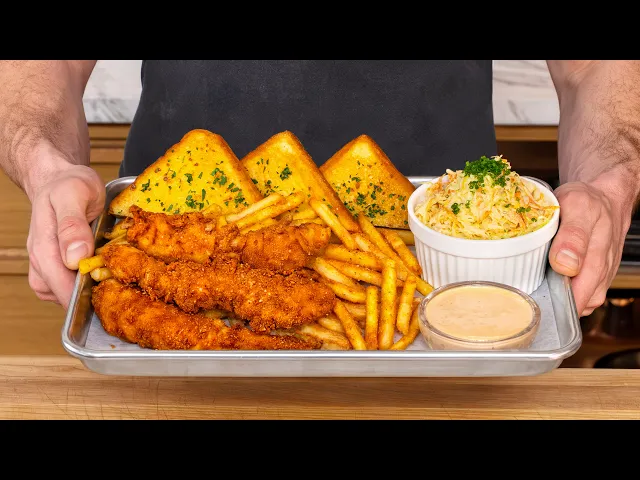
The Ultimate Chicken Tender Plate At Home
Joshua Weissman Recipes
0:00 I'm just gonna outright say it.
0:01 Every chicken tender meal that's out there is mid.
0:03 This one is not.
0:09 Fresh crispy fried chicken that is absolutely maxed out on flavor.
0:13 Kleslaw that you have loving dreams about, not nightmares.
0:17 And more importantly,
0:18 a sauce that you don't rely on, but a sauce that you want on everything.
0:22 That being said, let's make this, shall we?
0:24 We're going to start by marinating our chicken.
0:25 Then we'll prep our sides, sauce, and finally fry and serve.
0:29 Let's just have our marinade done and out of the way.
0:31 It's really, really, really simple.
0:32 2 cups of buttermilk, 1 tbsp plus a teaspoon of kosher salt,
0:37 1 teaspoon of sugar, 1 and 1/2 teaspoons of MSG.
0:40 I would not recommend skipping that.
0:41 2 tesps of garlic powder, half a teaspoon of onion powder.
0:44 You might be tempted to go, "Oh, half a teaspoon.
0:46 I'm going to add more." Listen, you don't know what you're talking about.
0:48 Onion powder, for some reason,
0:50 has some superpower where it makes everything taste only
0:53 like onions if you use too much of it.
0:55 So, got to hold back a little bit on that one.
0:57 Two teaspoons of smoked paprika and one teaspoon of cayenne powder.
1:01 Not a half teaspoon.
1:02 Okay, Annie up.
1:03 I want a little heat.
1:04 All right.
1:04 You're going to whisk that together till thoroughly combined.
1:06 All those spices are nice and evenly distributed.
1:08 Now we essentially have the landing zone for all of our strips cuz you do have
1:12 to do a little bit of prep on tenders that a lot of people forget to do.
1:16 You'll need 2 lbs boneless, skinless chicken tenders.
1:19 So, when it comes to tenders, I got a little secret for you.
1:22 A lot of the time whenever people make a little chicken tender recipe,
1:24 they're like, "Oh, here's a chicken tender." Well, guess what?
1:27 That's a tendon.
1:28 That's going to be really yucky to bite down on because it's chewy.
1:32 It will not melt when you cook it.
1:34 It will just stay exactly like it is.
1:36 And it's like biting into a rubber band.
1:37 So, first you need to look through your tenders
1:39 and find which ones have a tendon in the first place.
1:41 So, this is actually a little bit of a smaller one, right?
1:43 A little harder to get to.
1:44 Really easy.
1:45 Take a sharp knife, dig underneath the tendon.
1:47 Avoid removing too much meat here.
1:49 We just want to kind of pry it out.
1:50 Okay.
1:51 So, I'm kind of running my knife along underneath that tendon,
1:54 providing a little bit sawing just to loosen it.
1:56 The tendon is loose.
1:57 It's flapping around using a paper towel.
2:00 This just helps you grip it.
2:01 You don't have to use a paper towel,
2:02 but you're going to grip that little tendon.
2:04 Right.
2:04 So, I'm holding on to the tendon now.
2:05 And you could just pinch where it's attached,
2:08 but it's actually much easier if you take a fork,
2:10 hook it underneath that, and then gently pull that tendon out.
2:14 Sometimes the tendons will tear the tender into two pieces.
2:18 You're better off doing that than leaving this in there.
2:20 I'm telling you, it will ruin the eating experience.
2:22 Tender.
2:24 Tenden.
2:24 Do it with all of your chicken tenders.
2:26 Anytime you see them, take them out.
2:27 It'll take you like 10 minutes.
2:28 As you complete that process or if they don't have tendons in them,
2:31 place them in your marinade.
2:32 Every single tender.
2:34 You're going to get in there with your hands gently.
2:36 Just massage them.
2:37 They might make unusual noises.
2:38 Don't think about it too much.
2:39 The point is, we want them to be completely enroed, coated in the marinade.
2:44 I don't want one of them sticking to another and creating
2:46 a vacuum where a whole half of a tender isn't getting coated.
2:48 We want all of this coated in the marinade.
2:51 Then you're going to cover this tightly with plastic wrap.
2:53 Ideally, you want to let this rest for like 20 minutes.
2:55 You could bread them right away and it'll work just fine.
2:57 But the flavor penetration really only happens after a full night of marinating.
3:01 So depending on how much time you have.
3:03 If you have the time, make it ahead.
3:04 Make it 2 days ahead.
3:05 Your dredge.
3:06 You never want to overdo with the spices you put in here.
3:08 You put too many, they burn.
3:09 So we want to try to balance maximizing flavor without them burning.
3:12 So first, obviously, two cups of allpurpose flour.
3:16 Josh, what if I want to make it gluten-free?
3:17 I don't know.
3:18 use gluten-free flour.
3:18 It probably will be okay.
3:20 1 tbsp of kosher salt, 1 teaspoon of MSG.
3:22 Again, double MSG always.
3:24 2 tsp of garlic powder, half a teaspoon onion powder,
3:28 1 tsp of fresh ground black pepperc corn,
3:30 1 teasspoon of smoked paprika, 1 tspoon of cayenne.
3:33 We got a lot of 1 teaspoons here.
3:34 And finally, half a teaspoon of dried thyme.
3:37 I actually like to take the dried thyme
3:39 in my fingers and kind of like just grind it up.
3:41 Get it a little bit finer.
3:43 Get any whatever is remaining of the essential
3:45 oils that are in it, if there are any.
3:46 And you're going to whisk that together till thoroughly combined.
3:49 All one substance.
3:50 Not garlic powder over here, thyme over here, flour over here.
3:54 It's all one dredge.
3:57 That's how you know the spices are good.
3:59 What do we do now?
4:00 Fry seasoning.
4:01 You don't have to do this, but think about it.
4:03 Think about the times you're like when you get a really
4:04 good seasoned fry and you pop it in your mouth,
4:06 the crunch, but then the release of that seasoning,
4:09 you melt into your lawn chair or whatever the you're on.
4:12 If you're going to make a fry seasoning, this is the only one for these tenders.
4:15 Two teaspoons of chicken buan powder.
4:18 It could be likum ki.
4:19 It could be nor.
4:20 Whatever you want.
4:20 Just make sure it has MSG in it.
4:22 You could also just replace it with MSG, I guess.
4:24 Two teaspoons of smoked paprika.
4:25 1 teaspoon of cayenne powder.
4:27 1 teaspoon of garlic powder.
4:28 Half a teaspoon of cumin ground.
4:30 Half a teaspoon of fresh ground black pepper.
4:31 2 tespoons of kosher salt.
4:33 There's a lot of seasonings in 1 teaspoon of sugar.
4:35 So, it's a 2:1 salt sugar ratio.
4:37 Right.
4:38 It's not quite as salty as you would think.
4:39 It's actually a little bit sweet.
4:40 And that's what I want.
4:41 A/ teaspoon of dried thyme.
4:43 Whisk that together.
4:44 And you have a beautifully colored fry seasoning.
4:46 I mean, that's going to be good.
4:48 Coles slaw.
4:50 Relax.
4:50 I want to make a kleslaw that everybody desires that you go
4:53 to sleep and you think of this kleslaw crunching between your teeth.
4:56 You might even want to go to sleep with it as your pillow.
4:58 Maybe not that far, but kleslaw that is good.
5:01 So, you start with a head of green cabbage, like a medium smalish one.
5:05 Split that in half.
5:06 Now, you have this half here, right?
5:08 We need to remove the cord.
5:08 There's a couple ways to do that.
5:09 Easiest way to do it.
5:10 Split it in half.
5:11 Again, cut side down.
5:13 You can see the core here where the line is.
5:15 You're going to kind of follow that all the way through.
5:17 This line represents essentially exactly where that core is.
5:20 So, I'm going to cut across like that.
5:22 That's the core.
5:23 You don't have to remove it,
5:24 but like it does create a lot of inconsistency in your sliced cabbage.
5:28 Now, slicing this cabbage can be done one of two ways.
5:30 With a knife or with a finger death trap.
5:33 If you want it really thin and consistent,
5:35 I would use a finger death trap, which is what I will be doing.
5:37 So, you're going to cut this as thinly.
5:39 That was the bowl.
5:40 You're going to cut this as thinly as you possibly can.
5:43 I'm thinking like shaved essentially, right?
5:45 Like very, very, very thin like this.
5:47 Every head is going to be different.
5:49 The thing about cabbage is it produces way
5:51 more sliced cabbage than you could ever possibly need.
5:53 You only need about four cups.
5:55 Whatever's left, just save it in your fridge, roast it,
5:57 serve it, put it in a soup, use it for something else.
5:59 So, ideally, you want to try to dress
6:01 this as closely to you serving your food as possible.
6:04 You ever get kles just watery as?
6:06 So, I have a little trick to prevent
6:08 that from happening as much to your cabbage.
6:10 Specifically, I want you to season it with a generous pinch of salt.
6:13 Toss it with that salt.
6:14 And then I want you to kind of start to massage it.
6:16 Kind of squeeze the cabbage.
6:18 And what you'll notice is all of a sudden,
6:19 wait a minute, this cabbage is getting kind of wet.
6:21 That's what you want.
6:22 Toss again.
6:23 Now, it's really going to start to get juicy here.
6:25 So, this is doing two things.
6:26 It's curing your cabbage.
6:27 So, now your cabbage is seasoned with salt, which is great.
6:29 But more importantly, it's going to start to draw out that moisture.
6:33 You can let this sit for a minute or two.
6:34 It'll draw out even more.
6:36 What you can do is get a separate bowl,
6:38 ring out your cabbage over the sink just to get
6:40 a good amount of liquid out of it, right?
6:42 And place it in the new bowl.
6:43 Now you've essentially sped up the process
6:45 of the cabbage weeping water into your final product.
6:49 So you don't have to worry about that anymore.
6:50 Cabbage goes into the big bowl.
6:52 One large carrot grated.
6:53 Yeah, baby be careful how you grate this cuz sometimes your hand slips.
6:58 That's what your knuckle sounds like when it grates across the top of it.
7:01 So try to be cognizant of that.
7:02 To this you're going to add the zest of one lemon.
7:04 Now, we're going to add half a cup of mayonnaise.
7:06 This can be any mayonnaise, koopy, I don't care.
7:08 Homemade mayo, great.
7:10 One teaspoon of dijon mustard.
7:12 Two teaspoons of sugar, a half teaspoon of MSG.
7:15 You can also omit the MSG.
7:16 It's not a necessity, right?
7:18 Fresh cracked black pepper.
7:19 Pinch of salt to taste.
7:20 2 tbsps of apple cider vinegar.
7:22 You can use either tongs or gloves.
7:24 And you're just going to toss this together
7:25 and dress it until thoroughly and fully coated.
7:28 You can call that done.
7:28 But if you want to add a little bit of flare, right, a little bit of color,
7:31 but also just like nice flavor,
7:33 you can add about one to two tablespoons of thinly sliced chive.
7:37 And then just toss those in there.
7:38 It just adds like a depth of flavor that most kleslaws don't have.
7:42 I'm putting this as optional because it's another thing you got
7:45 to go buy and it's obviously not a traditional kleslaw at that point,
7:47 but tastes really good.
7:49 Just toss that all in there.
7:50 Make sure it's thoroughly combined and your kleslaw is ready.
7:53 I'm tired of the toast that they give you at these chicken tender shops.
7:58 This is Texas, mother.
7:59 Well, actually, you may not be in Texas, but I am.
8:01 So, we have Texas toast.
8:03 To begin, small saucepan, one stick or half a cup of butter, unsalted.
8:11 Heat that to medium heat, and just melt that.
8:13 Your bread choice really matters.
8:15 I want anemic white bread, not homemade bread, the industrial kind.
8:19 You got to trust me.
8:21 Thick cut if you can find it.
8:22 In Texas, we got literal Texas toast white bread.
8:26 It's square, thick, it's soft like a cloud.
8:29 Something like this is what you want.
8:31 Once your butter is melted, cut off the heat.
8:34 You're going to add four cloves of finely chopped garlic.
8:36 Please, fresh garlic for God's sake.
8:38 And then 1 and 1/2 teaspoons of kosher salt.
8:40 Stir that all together.
8:42 Again, the heat is off.
8:42 We're not cooking this any further.
8:44 I just want this to kind of like act almost
8:45 as a tea and gently coax the garlicky flavor in there.
8:49 Now, let that sit for like 20 30 seconds.
8:51 I've got my bread.
8:52 And this portion is very simple.
8:53 Okay, you need yourself a little pastry brush.
8:55 Swirl it through the butter.
8:56 Pick up some of that garlic.
8:57 And I want you to lightly brush each
8:59 slice with your garlic mixture on both sides.
9:02 Don't overdo it because it will absorb quite a lot of butter.
9:04 We just want one thin layer across each piece.
9:07 So, just pop this bad boy into an oven at 375 Fahrenheit for 10 to 12 minutes.
9:12 Now, we do have a sauce, but I believe a good chicken tender needs no sauce.
9:16 The sauce is just a little extra oomph if you want it.
9:18 Now, we all know canes primarily exist because of their sauce,
9:21 not because of their tenders.
9:23 And this sauce is better than their sauce.
9:24 And these tenders are better than their tenders.
9:26 And my shoes better and my hair better.
9:28 All right.
9:28 Okay.
9:29 So, we're going to do one cup of mayo.
9:31 I'd recommend one homemade.
9:32 The second dukes, the third koopy.
9:35 Those are the only three you can use here.
9:37 To that you're going to add 1/4 cup of ketchup.
9:39 2 tbsps of dijon mustard.
9:41 You could also use yellow mustard if you want.
9:43 1 tbsp of warty shersty.
9:45 1 teaspoon of white distilled vinegar.
9:47 Half a teaspoon of garlic powder, not fresh garlic.
9:49 1 teaspoon of MSG.
9:51 And optionally, you can add a tablespoon of Sriracha if you wanted
9:55 a little bit of heat and if you happen to have it,
9:56 but it's not a necessity at all in this flavor.
9:59 Season that lightly to taste with salt, little fresh cracked black pepper,
10:02 and then just whisk that till thoroughly combined.
10:04 See, doesn't that remind you of somebody's sauce?
10:06 But way better.
10:07 Breading this chicken before you even start to identify
10:09 what your dry hand wet hand should be.
10:11 Typically, non-dominant is wet hand, dominant is dry hand.
10:14 So, I'm going to take my wet hand, just kind of dig into this marinade,
10:18 and I want you to, you see how it's kind of running off my fingers?
10:20 I want you to gently just sort of flick it into your dredge.
10:23 Give that a little toss.
10:24 Mix it together.
10:25 And then do that one more time.
10:26 Flick, flick, flick.
10:27 And what you're doing is you're creating little beads of sort of clumpy flour.
10:31 That is the key to the flakiness cuz they're going to flatten
10:34 and then open up when you bread and then fry this.
10:36 So take a chicken tender, drop it in your flour,
10:39 and then just gently kind of press
10:40 and toss until completely and thoroughly coated.
10:43 No bald spots whatsoever.
10:46 It's okay if some areas are lightly coated,
10:47 but generally you want to avoid bald spots.
10:49 You want full coverage on this tender.
10:52 Shake off the excess.
10:53 Pop onto a sheet tray.
10:54 And then repeat with all your tenders.
10:55 You don't have to do one at a time.
10:56 You can probably put two or three at a time.
10:58 I would avoid overcrowding this cuz then you're going to end up
11:00 with like a clumpy flour mess that doesn't have any flour left.
11:04 Texas toast is done.
11:05 Take that out of the oven.
11:06 Look at these beauties.
11:07 It probably smells very good in your kitchen and that's a good sign.
11:10 You're going to finish these off with a little bit of fresh chopped parsley.
11:13 That's optional.
11:13 I think it makes it look extra Texas toasty.
11:16 You're going to serve these warm with your chicken tender meal.
11:19 these for some reason come out a little too early, you can always take them out,
11:22 let them cool down, and then just warm
11:23 them back up wrapped in foil before you serve.
11:25 You could even make this ahead of time and then just rewarm it in the oven.
11:29 French fries.
11:30 I'm not going to make you make your French fries from scratch.
11:32 I'm going to be honest, in this case,
11:34 it's very rarely worth it cuz you're already putting in so much effort here.
11:37 Personally, if it were me,
11:38 I would just find the best bag of frozen French fries you can find.
11:41 These extra crispy Oita fries are fine.
11:43 You already have fry oil that's ready.
11:45 You might as well get some frozen fries so you can double up.
11:47 So before you fry your chicken in a pot
11:49 that's filled with vegetable oil a little over halfway.
11:52 So in this case we have a sixQ pot
11:53 and we've got about 3 quarts of vegetable oil in there.
11:56 Get your frozen fries and in batches you're going to fry them at 350 Fahrenheit.
12:00 Now just let that fry till the bubbles begin to subside.
12:02 They're golden brown and crisp like this.
12:05 All right.
12:05 Once those are dropped.
12:06 If you made the seasoning, hit them with seasoning.
12:09 You want to hit them immediately when they come out from the heat.
12:11 That way the spices actually adhere.
12:13 If you let this cool down completely, they will not adhere.
12:15 They'll just fall right off.
12:16 Trust me.
12:17 Once those are out, you can now fry
12:19 your tendies in batches of three to four tenders.
12:22 We've got 1, two, three.
12:25 Lay away from you.
12:26 And you're just going to let that fry until they're golden brown,
12:28 the bubbling has subsided, and more importantly,
12:30 the internal temperature is 165 Fahrenheit.
12:34 To serve, lay down a generous portion of your French fries,
12:37 as little or as much as you like, followed by your crispy tenders,
12:40 your kleslaw and sauce, ideally in ramicans, and then your toast,
12:42 which has been sliced in half on a bias.
12:45 You can do two slices to a person, three slices to a person.
12:47 Now, if this ain't a three-piece tender meal, I don't know what is.
12:50 People come over to your house to see this, they're already going to be happy.
12:53 But how does it taste?
12:54 Got a beautiful tender here.
12:56 Little dip.
12:58 First of all, you hearing that?
12:59 The crunch that already is something that a lot
13:01 of chicken tender places just don't have.
13:03 They're not crispy.
13:04 They have like a thick chewy breading.
13:06 This is like wispy crispy.
13:07 The seasoning on it so nice.
13:09 Got a little bit of heat and then the sweet richness from the sauce.
13:11 everything you could ever want, but just maxed out on flavor.
13:15 The fries are great, even if they weren't seasoned.
13:17 But man, seasoning on this, not spicy at all,
13:20 but instead there's almost like a smoky sweetness to the spicing on that.
13:23 A little bit of kleslaw.
13:26 Absolutely nobody can compete with this.
13:28 If you don't like kleslaw, this is the one that you might be able
13:31 to get over it cuz it's just so refreshing.
13:33 This still tastes of fresh carrot, of fresh cabbage.
13:35 It's got a good crunch.
13:36 Even the dijon mustard has a little bit of little bit of zing to it.
13:40 But this shockingly,
13:43 I feel so dumb saying this, but the Texas toast might be one of the best parts.
13:47 This, it is so good.
13:48 If you wrap a chicken tender in that and dip it in the sauce, a little colelaw,
13:52 you feel like you've died and have been resuscitated
13:55 back to life in a beautiful land of chicken tender.
13:57 Anyone can make this.
13:58 You can pick and choose what you want to make.
14:00 Maybe you just make the Texas toast in the tenders.
14:02 You have every maxed out element to make
14:04 the perfect chicken tender meal at home.
14:07 It's yours for free.
14:08 the links in the description on the website for the full
14:09 written recipe if you want to print it out.
14:11 Love you so much.
14:12 Subscribe.
14:12 Bye.