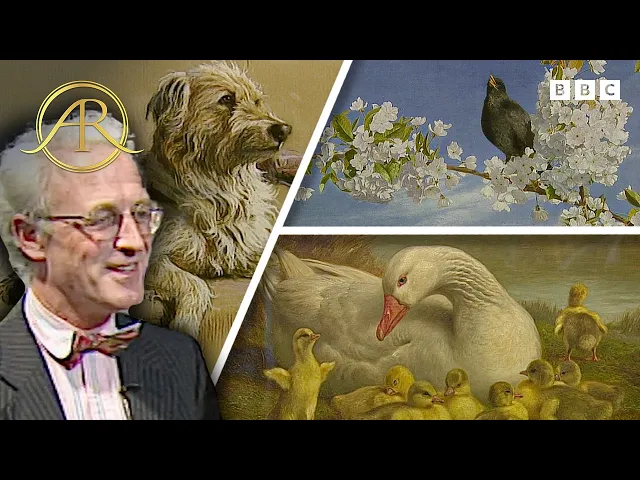
Hidden Animal Portrait Treasures Worth Thousands Revealed | Antiques Roadshow UK
BBC Antiques Roadshow
0:00 This type of animal picture, obviously, is a very popular subject.
0:03 My husband loves it.
0:04 Well, it was obviously quite a famous picture at the time.
0:07 It's by James Bateman.
0:08 You've got it insured, I hope.
0:09 No.
0:09 Well, I think it would do extremely well at auction.
0:12 Right.
0:12 And take the cobwebs off.
0:14 What can you tell me about the picture?
0:17 Just that it was in the family from about the middle 50s.
0:20 My father bought it somewhere.
0:21 Do you know how much he might have paid for it?
0:23 Not a lot.
0:24 Not a lot?
0:25 And he bought it here in Scotland?
0:26 Yes, Glasgow.
0:28 Right, well, it's got a signature here at the bottom,
0:31 which is Albertus Verhoesen.
0:34 He was working really throughout the 19th century.
0:36 And in fact, this one's dated 1852.
0:39 Very much in the style of a number of other artists,
0:41 including Eugène Verboeckhoven,
0:42 who was probably the greatest exponent of these rather nice animal subjects.
0:47 Which, in turn, is out of 17th-century Dutch painting.
0:52 I gather you're a bit bothered by the condition of it.
0:55 Well, it's just a wee bit on the mucky side, shall we say?
1:00 Wee bit on the mucky side.
1:01 Well, it's always a problem, isn't it, this business of restoration.
1:04 You…- We didn't know where to get it done or who to see.
1:06 So I just thought we'd leave it in its original form.
1:09 Well, I think you're probably quite right.
1:11 Without being very, very careful,
1:13 you can do so much damage to these beautifully painted pictures,
1:15 because they're painted in very, very thin glazes, these particular ones.
1:19 And if you take too much off, the whole thing just virtually disappears.
1:23 You'll lose much of the definition.
1:25 And, of course, what's so nice, this cow particularly,
1:28 all the detail on it is so beautifully painted.
1:31 The attention to detail is absolutely wonderful
1:32 and very typical of this school of painting.
1:34 It's on panel, and if you were to put it at auction today,
1:38 it would make somewhere between £1,500 and £2,000.
1:43 Oh!
1:44 Which, you know, is a nice and jolly nice thing and well worth protecting.
1:48 And don't get it scrubbed and cleaned too much,
1:50 because if you do that, it really will ruin it.
1:52 Mother Goose.
1:54 S Carter.
1:56 Now, I know who that is.
1:57 That's Samuel John Carter.
2:00 He's a Norfolk artist.
2:02 He lived in Swaffham.
2:04 And he's an animal painter.
2:06 And he's really particularly known for pictures of dogs and of puppies,
2:12 particularly puppies.
2:13 Can you tell me how you acquired it?
2:15 Did you buy it or…?
2:16 Well, it was left to my father in 1952 by his aunt.
2:23 And then it came to me in 1969.
2:26 Yes.
2:26 Well, I think it's beautifully painted.
2:28 I mean, Samuel Carter's not as famous an artist,
2:32 let's say, as Landseer or somebody like that.
2:34 He's another late-Victorian charming painter of animals.
2:38 But wherever you look, the details are extremely good.
2:41 You know, the eye is good.
2:44 I love the way the little goslings are done.
2:46 And this chap standing up and flapping his wings.
2:50 And also, the landscape is nice.
2:52 The river in the background.
2:54 Lots of detail, there.
2:55 A bit cracked.
2:56 You see the cracking here along this side?
2:59 Little bit cracked in the varnish, but that's not too serious.
3:03 I mean, really, I would recommend having
3:06 this picture cleaned and taking the glass off.
3:10 And the picture's signed as well, down here.
3:14 It's very faint and rather hard to see, but it is signed, isn't it?
3:18 "SJ Carter".
3:19 And there's a date.
3:21 Looks like 1888.
3:23 This type of animal picture obviously is a very popular subject.
3:28 It's very saleable.
3:29 I would say, in a sale, £3,000 to £4,000.
3:34 Should insure it for £5,000.
3:36 £5,000, right.
3:37 A charming thing so thank you for bringing it.
3:39 Thank you.
3:40 Well, we are in the seafood business, and this was given to us by a gentleman
3:45 that was retired and worked for us in our office.
3:48 However, he had a very jealous wife
3:51 and my husband used to take him salmon fishing, and she didn't like this at all.
3:56 And he was due to go salmon fishing up to Scotland, when he was taken ill.
3:59 So my husband went on his own.
4:01 Two days after he'd gone, he collapsed and died.
4:04 And about a few months later, she said,
4:07 "I've got something for you." So this was the painting.
4:10 Was it given as a punishment?
4:12 What happened was, she said, "I actually went and sold it.
4:15 I knew Donald wanted you to have this," but she said, "I went and sold it.
4:18 And I couldn't sleep at night,
4:20 so I had to go and buy it back again." So she went
4:22 and bought it back from the antique dealers and then gave it to Chris.
4:26 What do you feel about this?
4:27 I don't like it.
4:28 I don't like the eyes, I don't like the mouth, the cat.
4:30 My husband loves it.
4:32 Well, it was obviously quite a famous picture at the time.
4:35 It's by James Bateman.
4:37 Because it's called Lobster Sauce.
4:38 Lobster Sauce.
4:39 I knew that, yes.
4:41 And this comes from Germany, really, all sorts of strange animal pictures,
4:49 which are quite cruel, through Edwin Landseer.
4:54 Right.
4:55 The great animal painter.
4:56 Yes, yes, yes.
4:57 In fact, there is a very famous Landseer painting called The Cat's Paw,
5:03 which is the monkey using the cat's paw
5:07 to take the hot chestnuts off the burning stove.
5:09 Oh, right, so it's a similar thing!
5:10 Yes!
5:11 And I think that this picture is very much influenced in that manner.
5:14 I can see that.
5:15 Well, it's sentimental value.
5:16 That's why, you know, we like it.
5:17 Because of the man who gave us it, you know.
5:20 And a wonderful story.
5:22 As for value, I would say between £4,000 and £5,000.
5:27 I'd better tell him.
5:29 He's up in Scotland at the moment, so I'll tell him.
5:31 What, he's after these things in Scotland?
5:33 Yes, salmon fishing.
5:34 Yes.
5:34 You would think he would see enough of them, wouldn't you?
5:37 But, yes, it's his hobby.
5:39 "For lo, the winter is past.
5:41 The rain is over and gone." We go on here.
5:44 "The flowers appear on the earth.
5:46 The time of the singing birds is come." It's wonderful, really.
5:49 It's a wonderful image of spring, this picture.
5:53 I would have read it the other way round.
5:55 That's very contrary of you.
5:57 Yes, I know.
5:58 We've got the message.
6:00 It's a wonderful image of spring.
6:03 Such detail.
6:04 Here's the blackbird and he's singing away.
6:07 Spring's come.
6:08 This is a glorious branch of apple blossom, isn't it?
6:13 Look at the way he's painted it.
6:15 I mean, the detail in here is so fantastic.
6:19 This is actually, now one looks at it,
6:21 a really great example of what's called Pre-Raphaelite painting.
6:26 It's mid-Victorian, painted under the influence of the Pre-Raphaelites.
6:31 That's to say, the painters who painted with very strong colours,
6:35 very minutely, in the most wonderful detail.
6:38 And this is a great example.
6:40 I've been looking at it for some time, wondering who the artist is,
6:43 because there's no evidence of a signature on the front.
6:46 But now I'm looking round the back and I see… I see
6:50 that there is some evidence that actually
6:52 you haven't been dusting terribly well.
6:54 No.
6:54 No, no.
6:55 Only on the front.
6:56 Only on the front.
6:56 Anyway, so it came straight down off the wall.
6:58 And there is this wonderful monogram here.
7:02 "JSR"– it's by John Samuel Raven.
7:05 He was a very interesting artist in the middle of the last century,
7:09 obviously influenced by the Pre-Raphaelites, but not that well known.
7:12 I mean, we only know him really from his works,
7:16 and they're of tremendous quality.
7:19 It's a picture you've inherited?
7:21 Yes.
7:22 I've always remembered it in my parents' house,
7:24 but I can't remember it any further back.
7:26 But it's got Mirwood on the back,
7:28 which was a family home, going back generations.
7:30 Right.
7:30 Well, it's a wonderful thing to have in the family.
7:32 A wonderful thing to be able to enjoy on the wall.
7:35 Now you've got it insured, I hope.
7:38 No.
7:38 You haven't got it insured?
7:40 Well, I think it would do extremely well, actually, at auction.
7:42 Would probably make… ..somewhere between £6,000 and £8,000.
7:46 Should probably insure it for £9,000 or £10,000.
7:49 Right.
7:50 And take the cobwebs off.
7:52 (SHE LAUGHS)- Don't they add to it?!
7:56 One of Cecil Aldin's most appropriately titled books is Dogs of Character.
8:01 And if ever there was a dog of character, this is it.
8:03 Tell me about the dog.
8:05 Well, the dog's name is Giles and it belonged to my husband's grandmother.
8:09 Right.
8:10 And it was a mongrel and it belonged to some gypsies.
8:12 And she fell madly in love with this dog, bought the dog off them.
8:16 Oh, really?
8:16 And she knew Cecil Aldin from hunting and riding because,
8:19 you know, she loved horses as well.
8:22 So she asked him to draw Giles.
8:27 Right.
8:27 And so, he did.
8:28 Giles was obviously a pampered pet because…- He was a very pampered pet.
8:33 Allowed to sit on the furniture.
8:34 What’s the most important thing about Cecil Aldin is
8:37 that he got the best out of his characters.
8:41 And in this case, Cecil Aldin had no problem at all.
8:43 Giles has been… You know, he’s caught the full character of Giles.
8:47 That's right!
8:48 Cecil Aldin was a very interesting artist,
8:50 who was educated at Frank Calderon’s animal painters school,
8:56 along with Lionel Edwards.
8:57 He was very, very keen on his dogs and did a lot of illustrations.
9:00 His own favourite dog was a chap called Cracker.
9:02 Was a wonderful terrier, with a patch on his eye.
9:07 A lot of his illustrations turn up, but it’s very rare to get a work like this.
9:12 And I think here, you can see… This is in pastel.
9:14 It’s very spontaneous, this wonderful, slick style that he has here.
9:19 And it really brings out all the character of the dog.
9:22 He was clearly a rather wild-looking animal.
9:25 His signature down here looks slightly curious,
9:30 and a lot of people don't always read it correctly.
9:31 But it is the "Cecil" and the "A" for the Aldin attached to it.
9:36 He lived in Reading and, in fact, there's a Cecil Aldin Close in Reading today.
9:40 So he's very much Reading's artistic son.
9:44 I think at auction today, it would make somewhere around £10,000.
9:49 Whoa.
9:49 Possibly a little bit more even, because they're very unusual.
9:53 And probably rather more than Giles cost in the first place.
9:59 Yes, I'm sure!