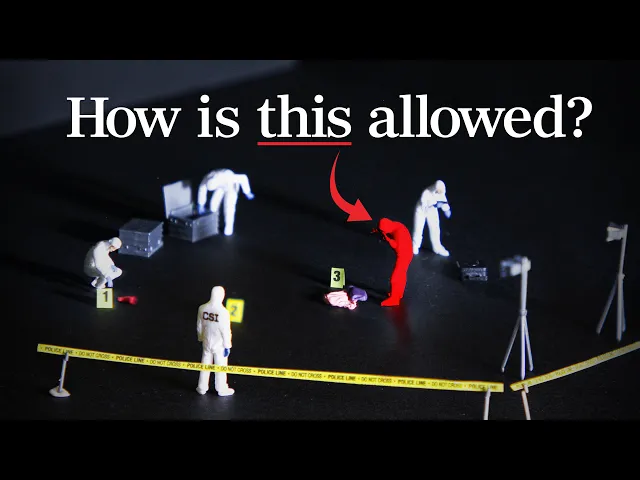
We've Been Using The Wrong Science In Court For 50 years
Veritasium
0:02 (dramatic music)- A man has been found lying
0:04 dead at the side of the road with oozing, elongated wounds to his back.
0:09 To solve the murder, a local official calls all the farmers in the village
0:13 and demands they all bring their tools to the main square.
0:16 In the square, each man is set to lay down his sickle.
0:19 And then something curious starts to happen.
0:23 In the rising heat of the morning,
0:25 flies begin to descend, all landing on a single sickle.
0:29 Its owner buckles, falling to his knees and admits to murder.
0:36 This is from a 1247 book, "The Washing Away of Wrongs" by Song Ci.
0:40 And it's the first writing we have of an empirical approach to forensics.
0:44 But okay, big deal.
0:46 Anyone could have just swapped the sickles or used their neighbor's.
0:50 But forensics today are much more accurate, right?
0:54 Fingerprints support investigations in over 70% of murders
0:58 and DNA evidence in more than 90%.
1:00 But then you also read an article like "Hair
1:03 sample that put men into prison for 28 years,
1:06 turned out to be dog hair."- That is not science.
1:09 That is not justice.
1:10 See, in 2009, the National Academy of Sciences published this 350
1:15 page report stating that, with the exception of nuclear DNA analysis,
1:19 no forensic method has been rigorously shown to consistently
1:23 demonstrate a connection between evidence and a specific individual.
1:26 And they also said that some tests
1:28 do not meet the fundamental requirements of science.
1:31 So we ask people to rank five famous forensic techniques,
1:35 all of which are still being used in court.
1:38 Okay, five forensic techniques here.
1:39 And I just need you to rank them in order
1:41 of accuracy from the least accurate down here to the most accurate.
1:44 So what do you think?
1:45 I don't know if I'm gonna nail these.
1:47 Whoa.
1:47 I dunno.
1:48 I don't know what forensic to put first here.
1:51 Okay, hair.
1:51 What are you thinking?
1:52 I think hair is last, eh?
1:54 I would probably put the hair on the top two.
1:57 I feel like hair would probably be the easiest to,- To fake?
2:00 To fake, if you like.
2:02 I think hair at the bottom,
2:04 because if it's not got the follicle intact, just hair in general.
2:07 Mm.
2:07 Do you think?
2:09 Yeah.
2:10 Yeah.
2:11 (dramatic music)- Hair has always been
2:12 an object of interest for crime scene investigators.
2:15 And before DNA, they would look for the microscopic similarities in the surface
2:19 and the cross section of hairs to try and get a match.
2:22 For example, analyzing how rough the fish scale
2:25 like structure of the surface of the hair is,
2:27 or how the pigment is distributed through the hair shaft.
2:30 [Announcer] The examiner's trained eye can learn many things.
2:33 Is it human hair?
2:35 Of what race?
2:36 Animal hair?
2:36 What family?
2:37 This vital information may help to establish
2:40 guilt or innocence- Between the 1970s and 1999,
2:44 the FBI used this against defendants in 268 cases.
2:49 But when they later reexamined this using DNA as evidence,
2:52 it completely flipped the field on its head,
2:55 and it turned out that even the most experienced FBI examiners would routinely
2:59 claim they had a match between hairs that were from two different people.
3:02 And they sometimes couldn't even tell the difference
3:04 between a human hair and a dog hair.
3:08 (dog barking) Out of those 268 cases that used microscopic hair analysis,
3:12 96% were declared false.
3:15 33 people were already sentenced to death,
3:17 and nine were already executed by the time the errors were found.
3:21 Today, the FBI only uses hair as evidence if it can be supported by DNA testing,
3:26 which is why microscopic hair analysis goes to the bottom of this list.
3:30 What do you think of bite marks?
3:31 On a crime scene?
3:32 On a crime scene?
3:32 Yeah, yeah.
3:32 It's been...
3:33 Dracula, is Dracula there?
3:34 Least accurate is gonna be pretty close to bite marks, I think.
3:38 Midway.
3:39 Midway?
3:39 Last.
3:40 That's last.
3:44 That's not realistic, innit?
3:44 Okay.
3:44 Okay.
3:44 Mm.
3:44 Bite marks at the top.
3:45 The idea behind bite marks is simple.
3:47 If you can use dental records to identify a deceased person,
3:50 surely you can identify a perpetrator by the bite marks left on a victim.
3:54 Since the 1950s, bite mark analysis has been used in thousands of cases.
3:59 But then some experts, like forensic dentist Mary Bush,
4:03 started looking into the method more deeply.
4:05 There was no scientific exploration into bite
4:08 marks before they were used in the court
4:10 of law to say that this was even a feasible technique that you could do.
4:15 One study from the university at Buffalo used a set
4:17 of model teeth to create 89 bite marks in cadavers,
4:21 alongside controlled bite marks made in wax.
4:24 And out of those 89 bite marks made in skin,
4:27 none of them matched the measurements of the ones
4:29 made in wax or the original model teeth.
4:31 In fact, when they compared the bite marks
4:33 in skin to a wider collection of 411 model teeth,
4:37 it wasn't even the original model that made
4:39 the bite mark that was the closest match.
4:42 After 12 studies, their conclusion, bite mark transfer to skin is not reliable.
4:48 Skin isn't a good medium to leave an imprint of someone's bite mark.
4:51 It's soft, it's squishy, and it distorts under pressure.
4:54 But despite all this, there's still been no ban
4:57 and bite mark evidence is still allowed in courts worldwide.
5:01 We asked Dr.
5:01 Bush for a comment and she said that while the scientific
5:04 method is happy to discard an old and disproven theory,
5:08 the justice system prefers consistency in a historical precedent.
5:11 So even the new flurry of evidence wasn't enough to get bite marks out of court.
5:15 In fact, bite marks have been used as evidence as recently as 2025,
5:19 which is why it gets the second worst spot on our list.
5:23 Blood, if you don't have DNA and you're just using
5:25 like kind of the patterns that it leaves along the ground.
5:27 How they splat.
5:28 Right?
5:28 [Gregor] Like the picture, that blood on a crime scene could give you.
5:31 Okay.
5:32 I'm looking, thinking of putting blood at the end, but like, I don't know.
5:34 Okay.
5:34 Put blood at the end.
5:34 Okay.
5:35 I would go blood then- Second.
5:37 Second place.
5:38 Yeah, yeah, yeah, yeah.
5:39 So bloodstain pattern analysis.
5:40 When someone is injured, the way their blood pools and drips
5:43 into the environment is in a distinct pattern.
5:46 And in 2020, "Wired" actually did an episode with a crime
5:49 scene analyst on how these different stains can be interpreted.
5:52 You can use physics and biology to rewind the clock
5:55 and extrapolate where in space the blood must have come from.
5:59 This all started in 1971 when chemist, Herbert Leon MacDonell,
6:03 published "Flight Characteristics and Stain Patterns
6:05 of Human Blood." In this book,
6:07 MacDonell described how you can use the width and length
6:10 of a stain to calculate the angle of impact, and then using trigonometry,
6:14 trace that back to the point of origin of the spatter.
6:18 The book quickly became the foundation of bloodstain pattern analysis,
6:21 and everyone was using it.
6:23 In fact, MacDonell even established a Bloodstain Institute
6:27 where thousands of US police officers would enroll.
6:29 The Supreme Court of Iowa actually
6:31 referred to the practice as relatively uncomplicated.
6:34 So they didn't require proof of its reliability.
6:37 They were happy to go ahead with MacDonell's
6:39 tests that he did alone in his basement.
6:42 And soon enough, bloodstain pattern analysis was
6:45 used in courts all over the states.
6:48 But here's the problem.
6:49 Plotting the flight path of each bloodstain using trigonometry assumes
6:53 the trajectories were straight lines and gives this common origin point,
6:57 which suggests the victim was standing up.
7:00 The issue is, MacDonell and then many
7:02 forensic investigators after him and even "Wired,"
7:04 failed to account for the effects of gravity and drag as obvious as this sounds.
7:09 When you include these in your calculations, the common origin point lowers,
7:13 and you can see that in this example.
7:14 It's more likely that the victim was actually sitting down.
7:19 The first study to measure the baseline reliability
7:21 of bloodstain pattern analysis was only done in 2014.
7:25 That's over 50 years after it started being admitted in court.
7:29 And a large scale study from 2021 found that analysts
7:32 come to different conclusions about a way a stain was made,
7:35 about 8% of the time.
7:36 And that's because the same stain can come from many different mechanisms.
7:39 And the fact that blood differs from person to person,
7:42 depending on how many red blood cells versus the plasma you have.
7:45 Men actually tend to have a 15% higher concentration of blood cells than women,
7:50 which makes their blood more viscous.
7:52 Nowadays, investigators have new software which uses fluid
7:55 dynamics to help them map these complex 3D seams.
7:58 So bloodstain pattern analysis is improving in accuracy,
8:02 which is why it gets this middle spot in our list.
8:04 Okay.
8:05 But surely fingerprints must have a lot of value in identification.
8:09 How unique do you think fingerprints are?
8:11 I think they're pretty accurate.
8:13 They're fingerprints.
8:14 Fingerprints.
8:14 That's probably one.
8:15 That's number one.
8:16 Yeah.
8:16 Okay.
8:16 Okay.
8:16 I mean, yeah, you use fingerprints on your phone,
8:18 you unlock it, you pay stuff, right?
8:20 'Cause fingerprints are unique.
8:21 Even when you have a passport, like they scan you when you enter a country.
8:25 On March 11th, 2004, a terrorist organization operating in Madrid
8:29 set off explosions on four commuter trains.
8:32 The attack killed 193 people and injured thousands more.
8:37 Quickly after, the police found a finger mark on a detonator bag left behind,
8:41 and they matched it to Brandon Mayfield, a lawyer in Oregon.
8:45 There's only one problem, there are no records of Mayfield even leaving the US.
8:50 He doesn't even own a passport.
8:52 So how could he have pulled this off?
8:54 I honestly felt like I was being framed
8:57 because I hadn't been outta the country for over
8:59 10 years,- But despite that, the fingerprint evidence against
9:02 him was considered so damning that Mayfield was incarcerated.
9:06 But this wasn't a glitch.
9:08 It was built into the method from the start.
9:11 (groovy music) In 1890s Kolkata,
9:13 the city's rich career criminals were avoiding jail
9:15 by paying people to serve sentences for them.
9:18 It was a good tactic since, at the time,
9:20 there was no practical way to identify a person.
9:23 So the criminals were getting away with it.
9:25 Three officers, Edward Henry, Azizul Haque and Hem Chandra Bose started taking
9:29 the prints of everyone who came through the station,
9:32 but they quickly ran into a problem.
9:34 When they got a suspect in, how
9:37 could they crosscheck their prints against their own
9:40 database when there were 10 prints per
9:42 person and thousands of people coming through?
9:44 They needed a classification system.
9:47 Haque proposed that they should look at whether a fingerprint has a whorl.
9:51 It's the spiral pattern that a person might have on their fingers.
9:55 And because each of your 10 digits can either have a whorl or not,
9:59 there are a total of two to the power
10:01 of 10 or 1024 ways your whorls can be arranged.
10:05 So the officers just built 1024
10:08 wooden pigeon holes to organize these fingerprints.
10:13 Okay.
10:13 But what if like me, you don't have a whorl?
10:15 Well, two thirds of the population actually don't.
10:18 So the system had to go further.
10:20 Once you have a pigeonhole number,
10:21 you go for additional layers of identification.
10:24 Some of the additional categories that you could
10:26 assign included whether you had a plain arch,
10:28 which was denoted with the letter A, or whether you had a tented arch,
10:32 which was denoted with a T.
10:34 Similarly, you could look at which side of the finger this loop structure is on.
10:38 And with a few more identifiers like
10:40 these, we get a much more in-depth classification,
10:44 one that would go on to be used for the next 100 years.
10:48 Famously, the world's first fingerprint bureau,
10:51 which was established in London in the New Scotland Yard,
10:54 used this fingerprinting system.
10:56 I started in 1988 with Metropolitan Police in forensic services.
11:01 Could you paint a picture of what
11:03 the room would've looked like with all these pigeonholes?
11:06 How big was this space?
11:07 So we're looking at a space of about 30 to 40
11:11 meters in length and about 10 to 20 meters in width.
11:15 The collection at the time was about 3 to 4 million I think.
11:19 That is intense.
11:20 Yeah, that's wow.
11:22 It's a lot of fingerprints.
11:24 Now, today's system takes into account these little details along the ridges.
11:29 It's called friction ridge analysis.
11:31 And well, it's no surprise that combing
11:33 through pigeon holes for these would've taken weeks,
11:35 but online databases today can basically do it in minutes.
11:41 (phone ringing) No way this phone works.
11:44 Hello?
11:45 Howdy, Gregor.
11:46 Just trying to get a hold of you.
11:48 Why are you calling me through this thing?
11:50 (caller speaks faintly) You have no data?
11:52 Just get Saily.
11:53 You know, I travel a lot for filming.
11:54 I actually just got to London.
11:58 I always wanna be able to connect to the internet as soon as I land,
12:02 and with the help of today's sponsor, Saily, it couldn't be easier.
12:06 First, you just scan the QR code and download the Saily app,
12:09 then you search your destination, the UK, for example.
12:12 And next you just pick a data plan.
12:14 And finally, during checkout,
12:15 apply the coupon code Veritasium to get your exclusive 15% discount.
12:20 No more dodgy cafe wifi or unexpected roaming charges.
12:24 All you need to do is just switch
12:25 on your mobile data when you land, and that's it.
12:28 Saily works with all iPhone and Android devices.
12:31 And once an eSIM is installed,
12:33 you can keep adding plans in the app for each new trip.
12:36 And in the rare case that your phone isn't compatible with Saily,
12:39 you can get a full refund at no questions asked.
12:42 I've gone with the Saily Ultra Plan,
12:43 which gets you unlimited data globally with access to airport lounges,
12:47 fast track services, and NordVPN, NordPass, NordLocker and Incogni on top.
12:52 So to stay connected on the go for an affordable price,
12:54 you can scan this QR code,
12:56 download Saily, and get 15% off your plan with the coupon code Veritasium.
13:00 So I wanna thank Saily for sponsoring this part of the video,
13:03 and now back to our case.
13:06 So if all the details are painstakingly placed into these databases,
13:10 then where's the problem?
13:12 How is Brandon Mayfield falsely accused?
13:15 Well, say you have a mark from a scene
13:17 and you wanna run it through the US fingerprint database,
13:20 you can't actually search the database using the whole mark because
13:24 you first need to identify a number of features on the print.
13:28 These are called minutiae.
13:30 It's where the ridge line split or end.
13:33 To even search the database, you need a minimum number of minutiae points.
13:40 It's very efficiently sorted, hundreds of million prints,
13:43 but it cannot make an ID.
13:45 So what it does, it pulls out the most similar ones,
13:49 at least 10, 20 up to 40 in some jurisdiction.
13:54 And then the human examiner has to compare.
13:58 [Gregor] This works in theory,
13:59 but the problem is how these minutiae are identified in the first place.
14:04 What is interesting in my research published scientific reviewed research,
14:09 the same thing one examiner see only three minutiae and one sees 10 minutiae.
14:16 So 10 minutiae is enough to run the database.
14:19 However, if the other are only the three minutiae, they couldn't run it.
14:24 So whether you find a criminal or not depends on the luck of the draw.
14:29 Even if you give the same pair of prints to the same examiner twice,
14:34 10% of the time, they will reach a different decision.
14:38 And these disagreements are from controlled studies where
14:41 the examiners had no context about the crime, but in reality, they often do.
14:46 As many as 42% of the requests that fingerprint
14:49 experts process state whether a suspect has a criminal record.
14:54 In a recent case that I was involved where a firearm was involved and a forensic
15:01 firearm expert had to decide whether a bullet
15:05 was actually fired on the firearm, on the suspect.
15:08 On the former submission form that was given to the forensic scientist,
15:14 it said that it's homicide,
15:17 it said the age of the suspect and the victim, and it even said the race.
15:22 It said the suspect is black, and the person who died the victim was white.
15:28 For over a century, experts have held so much
15:31 trust in fingerprints that in the FBI case for Mayfield,
15:34 the examiners claimed with 100% certainty that that was his mark.
15:39 This likely happened because when another fingerprint
15:41 expert was brought in to verify the match,
15:43 they probably already knew the verdict of the original analyst,
15:47 and they probably also knew the stakes of what a match could mean for the case,
15:52 which made it all the easier to agree with the initial verdict.
15:55 Even the fingerprint expert working for the defense agreed
15:58 that the mark matched Mayfield's fingerprint when in reality,
16:02 it belonged to a man who had links to terrorist organizations in Spain.
16:07 This is the impact of conformity bias.
16:09 So all of this pressure,
16:10 all of this context and intervention in the forensic science,
16:15 I say to the police and the prosecutor, leave the forensic examiners alone.
16:21 Give them independence of mind to make decision based on the relevant
16:26 scientific evidence and do the work rather than telling them about the case.
16:32 Well, if there were issues with all these other techniques,
16:37 why don't we just use,- DNA?
16:39 DNA first?
16:40 Yeah.
16:41 DNA has got to be surely,- DNA should be top.
16:44 It has to be DNA because,- Okay, okay.
16:46 You already know everyone have their own DNA.
16:48 But even DNA analysis can fall prey to the same problems.
16:52 Back in the 80s, you had to do this with a sample
16:55 the size of a dime of blood or saliva.
16:58 But today you can do it with less than a pin hair's worth.
17:00 In fact, just this year a 61-year-old cold
17:03 case was solved with just 0.4 nanograms of DNA.
17:08 But the paradox is, the increasing sensitivity
17:11 of DNA analysis could also be its downfall.
17:15 In 2012, paramedics in California responded
17:18 to a call about a severely intoxicated homeless man.
17:21 They treated him and took him to the hospital, but along the way,
17:25 they also picked up traces of his DNA on their equipment and gloves.
17:29 Then later that night, they responded to a murder of a businessman and they
17:33 accidentally transferred the homeless man's DNA to the victim's fingernails.
17:38 Because of that, the homeless man, Lucas Anderson,
17:40 was charged with murder and he faced the death
17:43 penalty despite being hospitalized at the time the crime occurred.
17:47 He spent five months in jail before charges were finally dropped.
17:51 So this is trace DNA and touch DNA,
17:54 where you can get this kind of DNA transfer that happens.
17:57 I see how that could be abused easily.
17:59 So my DNA could be in a place I've never been before.
18:02 Yeah.
18:02 And if DNA is deposited under the right conditions,
18:05 say a dark dry place, it can persist for hundreds of years.
18:10 And if, for example, somebody touches a door handle, well,
18:14 loads of people are gonna be touching a door handle,
18:17 so you're definitely going to get more than one profile off of there.
18:21 [Gregor] These samples with multiple DNA profiles are called DNA mixtures,
18:25 and they have been found to be
18:26 the most common source of error in DNA interpretation.
18:29 Some people shed more cells than others,
18:33 so the majority of the DNA that you're getting off of that door
18:36 handle may not be from the last person who touched it.
18:38 The problem in interpreting a mixture comes down to how a sample gets analyzed.
18:43 The most common way to do it uses short tandem repeats or STRs.
18:48 DNA is made up of four nucleotides, G, A, T and C.
18:52 And the SDR method looks at how chunks of DNA,
18:55 usually three to five nucleotides long repeat in your genome.
18:59 For example, G-A-T-A, G-A-T-A and so on.
19:02 For one person, they might have G-A-T-A repeat six times,
19:06 whereas another individual might have nine repetitions.
19:10 A standard SDR test will look at around 20
19:13 locations on your genome for where these repeats can occur,
19:16 and it will count how many repeats you have in each location.
19:20 So if you are looking at 20 of these markers
19:23 and you've got one from mom and one from dad,
19:25 you're actually getting 40 different genetic markers coming back.
19:29 So the chances of somebody having the same combination
19:34 of genetic markers as you is around one in a billion.
19:37 Here's what a crime scene sample containing just
19:40 one contributor looks like on an STR test.
19:43 You can see how it's easy to compare this to a sample from a suspect.
19:47 But if the crime scene sample contains DNA from multiple individuals,
19:51 then their profiles will begin to overlap, all with varying signal strengths.
19:56 And the more individuals in the mixture,
19:58 the more difficult these results are to interpret.
20:00 With four or more individuals, it becomes increasingly hard to compare a clean
20:04 DNA profile from a suspect to the mixture.
20:07 And now it's hard to say whether the suspect was actually in the sample.
20:11 You just can't tell which peak belongs to who.
20:13 It's kind of like having five people talk to you at the same time.
20:17 You can hear all the noise, but it's really hard to single one out.
20:21 Now, some labs claim they can reliably
20:23 separate samples of up to five individuals.
20:26 And to test this, the National Institute of Standards
20:29 and Technology ran a controlled study in 2013.
20:33 They've sent out a DNA mixture from a fictional
20:35 crime scene to labs all across the US.
20:38 Their aim to see how different facilities interpret
20:40 the same mixture of four people's DNA profiles.
20:44 69% of the labs got the analysis wrong.
20:47 And despite the sample being deliberately complex,
20:51 only 21% of the labs deemed the mix
20:54 inconclusive and not possible to give a comparison on.
20:57 After NIST published the study,
20:58 new checks have been imposed to address some of the issues,
21:02 but there's still no lower limit on the quality or the quantity
21:05 of a DNA sample that labs are permitted to analyze.
21:08 And labs themselves still decide if something is too mixed or too partial.
21:13 Now, you might think that using the entire sequence genome would be better,
21:17 but that can actually introduce different kinds of problems.
21:20 Now, your analyst has access to hair color, eye color, ethnicity,
21:24 and that could introduce discrimination in the way the sample is being analyzed.
21:28 This is where the guidelines and the guardrails have to come in here.
21:32 What are the genetic markers that are being used for this?
21:36 This is where the really interesting ethical questions come into it.
21:39 People think that DNA is like the silver bullet that will answer everything.
21:44 And it is true.
21:45 DNA evidence is incredibly powerful, it's amazing for identifying individuals,
21:52 but DNA can never be taken out of context.
21:57 Now, the point of this video isn't to bash forensics.
22:00 I think it's still better for us to live
22:01 in a world where forensics exist rather than one where they don't.
22:05 But if we want to keep calling forensics a science, we need to continue the work
22:09 of the people who actually made this video possible,
22:12 who've dedicated their lives to already reassessing the field
22:15 and making it as accurate as it is today.
22:17 Do you think it's fair calling this a forensic science?
22:19 I still think there's science in it because you're
22:22 trying to do the best with the information you have,
22:24 which is often times what science is trying to do is,
22:27 with the information you have,
22:29 this is the conclusions you make until you know something better.
22:44 (gentle music)- Hey, one last thing.
22:46 Last year we launched the official Veritasium game, Elements of Truth.
22:50 It's a trivia game with 800 questions covering science and technology,
22:54 and we on the team get quite competitive.
22:57 So every time we play things get very saucy.
22:59 See, there's this mechanic where you can't only guess an answer,
23:02 you have to put down a number between one and 10
23:04 to gauge how confident you are that your answer is right.
23:08 So it gets very fun very quickly.
23:10 The game is coming out later this year, so if you're interested in pre-ordering,
23:13 you can click the link in the description,
23:14 which will take you to the Elements of Truth website.
23:17 Thank you so much for your support in this project.
23:19 And as always, thanks for watching.