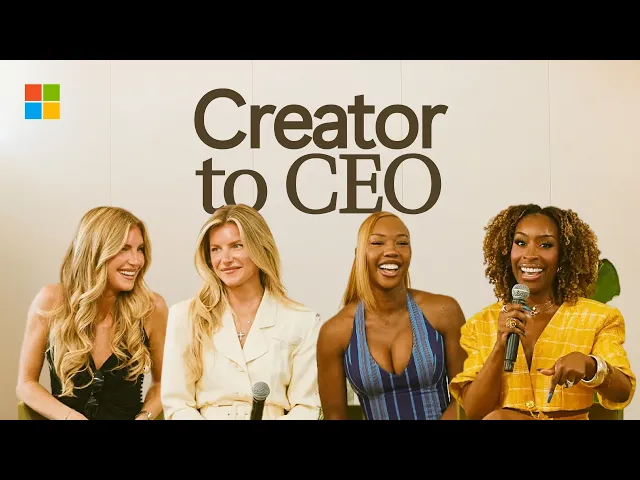
Nobody talks about this in the creator economy | Cannes Lions 2026
Microsoft
0:00 Today, we are going to be talking about how to turn influence into a business.
0:06 My name is Amy Francombe.
0:08 I am the contributing editor at Vogue Business,
0:11 where I cover brands and CEOs that are the future of fashion,
0:16 beauty, and the creator economy.
0:18 So I could not be in better company.
0:20 So I've been reporting on the creator economy since 2019.
0:25 So pre-TikTok.
0:26 So there's been a lot of changes that I have personally noticed.
0:30 But I think the main thing that I have personally seen
0:34 in my reporting is that influence is no longer the end goal.
0:39 It's the starting point.
0:41 I think that historically creators like yourself might have thought about,
0:45 I want to grow a following and then I'm going to get a brand deal.
0:49 And I think now that mindset has shifted to I'm going to grow an audience,
0:54 and then I'm going to launch a product.
0:57 I'm going to build a business.
0:59 I'm going to hire a team.
1:01 I am going to run a multi-channel revenue stream.
1:04 And I think that a lot of this idea of making
1:08 content has shifted into really seeing yourself as a modern media founder,
1:12 which as a creator, you all are.
1:15 And I also noticed that, you know,
1:18 it's less about going viral and really about building
1:21 an audience and something durable that is going to last.
1:25 Having said all that, that sounds like a lot of work for one person.
1:28 So we'll also be exploring how technology and AI can really help
1:33 modern creators scale and build the things that they want to build.
1:37 So I have got the best team ever to talk about this with.
1:42 So first up we have got Danielle and Bridget Pheloung,
1:47 and something I was asking them in the green room,
1:49 which I thought would be fun also to ask here is: how do people tell you apart?
1:54 Is there like little signs?
1:56 Like, I'm sure your friends can tell the difference.
1:57 Yeah, there's signs.
1:58 That’s our most asked question!
2:01 What did you do?
2:06 No, but...
2:06 what were you going to say?
2:08 I would just say it's our most asked question, I don't know...
2:10 I mean, once you get to know us,
2:11 you really realize that you understand our personalities, and then you...
2:15 I think it's less about, like,
2:17 the little things that are physical, more about our personality.
2:21 Honestly, I wish I had a better answer!
2:23 I wish I did!
2:24 Well, amazing.
2:25 So most of you guys know them as the New York-based twin sisters.
2:29 I'm sure you've seen them all over your TikTok and your Instagram page.
2:33 I know I have every time I hear Grimes- “Genesis” I think of you guys!
2:38 But they have collectively 1.5 million followers on Instagram,
2:44 2.1 million followers on TikTok.
2:46 They've worked with some of the biggest brands in the world,
2:49 including Tory Burch, Michael Kors and excitingly,
2:53 last year they launched their first venture together: PhePhe.
2:57 And then next we have Olamide Olowe...
3:01 who is the....
3:03 Yes!
3:04 Exactly!
3:06 She is the founder and CEO of Topicals, which I would say is probably the most
3:11 talked about beauty business in the last few years.
3:14 I'm sure most of you have tried her absolute cult products,
3:17 but her eye masks alone have sold 6 million units,
3:21 and Topicals is one of the fastest growing skincare brands in Sephora,
3:27 and Olamide herself is one of the most impressive individuals.
3:31 She raised 15 million in venture capital venture funding by the age of 26!
3:36 [applause] And then next we have Jackie Aina.
3:45 Who almost does not need an introduction because she is the absolute OG,
3:50 and is probably one of the most recognizable voices in beauty today.
3:56 Since she founded her YouTube in 2009 she
4:00 has grown a following of over 10 million globally.
4:04 She has also worked with some of the biggest beauty brands in the world,
4:08 including Elf cosmetics toothpaste,
4:09 but excitingly has also launched her own brand
4:13 in 2020 FORVR MOOD to a waitlist of 45,000 consumers.
4:19 Let me give it up for the panelists!
4:22 [applause] So I thought to begin,
4:27 all of you have very different perspectives and ways in to this industry.
4:34 And I thought maybe, Jackie, just because you have been doing
4:37 this the longest and you've really seen the trajectory
4:42 of influence going from something that people just
4:45 built an audience to then getting a brand deal,
4:48 to then maybe thinking about launching their own
4:51 product and scaling it into these globally recognized brands.
4:55 What to you has been the biggest change?
4:58 And importantly, what has also stayed the same throughout this time period?
5:02 This is my 17th year as a creator,
5:05 and I feel like what everybody now has the advantage of is like,
5:10 they know, okay, if I put in the effort,
5:12 if I have a unique point of view, if I at least have good content, like if I,
5:17 for the most part, if you check all the boxes,
5:20 you can actually make a career out of this.
5:22 It doesn't necessarily mean it's going to be guaranteed.
5:24 But like 17 years ago, I did not have that hindsight.
5:27 I was literally just talking to a camcorder and it was it was low key,
5:32 kind of given a psych ward like straightjacket activities.
5:34 Like who, girl?
5:35 Who are you talking to?
5:36 What are you doing and why are you doing it?
5:38 Like, why don't you have a job?
5:39 Like, it was very sketchy, but now, like, people have the hindsight of knowing,
5:44 like, oh, like I can actually do
5:45 something with this, which I think is incredible.
5:47 And I would like to think that, like,
5:49 OGs have kind of like laid the groundwork to make that possible,
5:51 which I think is which is what I would want to do anyway.
5:54 Like I wouldn't want someone to take as long
5:56 as I did to get to what I built now,
5:58 which is, you know, like a really good thing.
6:00 And what was your second question?
6:02 Yeah, I just wanted to know what's changed and what has remained the same.
6:07 Um...
6:09 People are crazier online.
6:11 Like, there's a lot of there's a lot of chaos online.
6:14 Like, it's it's it can be a lot.
6:15 But again, I think you have the hindsight
6:19 now of knowing that you're getting into that.
6:22 Whereas like when I started I didn't.
6:24 So that's one thing I think we generally
6:27 know we can utilize our platforms as leverage, which is a good thing.
6:31 I think there was definitely a time period where people
6:34 didn't know if they can do something outside of the platform,
6:37 outside of being a creator.
6:39 Creators are now businesses in their own right, which is such an amazing thing.
6:44 I think one of the best things that still
6:46 remains consistent is that this is a woman dominated industry.
6:52 We ain't really got much else right now.
6:54 So like, this is the one thing that I want
6:56 us to keep our death grip on because we're leading people,
7:00 we're influencing, and I want to continue
7:02 to hopefully see more of that going forward.
7:05 I agree.
7:06 I was going to add...
7:07 Oh, please!
7:08 I've been consuming content for so long.
7:10 Like watching your content growing up.
7:12 And I feel like one thing that's changed
7:14 so much is it's become way more personal.
7:17 I think the consumers expect so much too from the creators,
7:22 and they really want to feel seen, and they really want to get
7:25 that authentic personal relationship with the creator.
7:28 So just giving as much as possible to your community,
7:31 I feel like it's something that I've seen changed over the years.
7:34 I couldn't agree more,
7:36 and I'm really glad that you mentioned that, because I feel like you
7:41 guys have been influencers and made
7:44 that transition into a founder relatively recent.
7:48 And I you know, I've seen you recommend so many brands online,
7:53 and I'm curious what has to be the biggest mindset to you from recommending
7:58 a brand to actually launching your own products and building your own brand?
8:02 Yeah, well, we're still of course like recommending and promoting brands.
8:07 I think that's such a big part of our business as influencers,
8:12 and there's so much that goes on behind the scenes that you
8:16 wouldn't expect and you wouldn't see in your typical brand partnership.
8:20 And it's these little decisions,
8:22 big decisions, like every single decision matters,
8:24 whether it's how much inventory you should
8:27 be ordering or what manufacturers to work with.
8:30 Working with tight production timelines.
8:31 There's so many decisions and all of these matter so much when it's your brand
8:37 versus just working with a brand partner on a brand deal or a partnership.
8:41 And I think that this is like really, really opened our eyes.
8:45 We have so much respect for brands that we work with because we're like, “Wow,
8:50 you want to work with us?” Like now that we have a brand,
8:53 you know, and we also just have a whole different perspective on the industry.
8:58 We are such thoughtful creators now that we are
9:01 also brand partners and we able to see both sides.
9:04 So yeah, we're learning new every single day.
9:06 I was just going to say that the twin telepathy is crazy.
9:10 We literally learned something new every single day running this business.
9:13 It's truly insane.
9:15 Very well said.
9:16 I love that.
9:17 And then Olamide, I think you have quite an interesting
9:21 perspective here because you grew a following from being a founder.
9:25 You didn't grow an audience and then transition that into a business.
9:30 But I would really like to speak specifically
9:32 to Topicals and how you run your social media, your brand activations.
9:36 Because one thing I really noticed is
9:39 that you have this amazing community around you,
9:43 and you do all these amazing events and moments,
9:46 like allowing a creative commented on an Instagram post
9:49 to come on a brand trip and your fight nights.
9:52 And I'm curious what you're thinking is behind that and why.
9:58 Sometimes the most memorable brand moments have
10:01 nothing really to do with selling a product.
10:04 Yeah, I've always thought community business was my why,
10:09 so I didn't start the business because we wanted to make the most money.
10:12 I started the business because I wanted to give
10:15 my community access to spaces that they've never been in.
10:18 And so because I've started from that point,
10:20 every decision we've made has been about
10:22 how do we bring the community in, right?
10:24 A lot of the opportunities in beauty pre-Topicals were very exclusionary.
10:29 And so we said at every point in every turn.
10:32 How can we make something that people
10:35 think is exclusionary a brand trip for example,
10:37 how do we turn it on its head and bring
10:39 people who had never been on a brand trip before?
10:42 Right?
10:42 How do you go to a location like Ghana in Africa,
10:44 which is a place no one had done a brand trip to...
10:47 How do you turn these places and these people who haven't been included...
10:51 How do you turn that into what's cool and what's sought after?
10:55 And so because I operate from the principles of community business,
10:59 every decision we make is about how
11:01 our community can be reflected back in the brand.
11:05 I want to build upon something that you two said,
11:08 but direct this to you, Jackie, because when you are doing a brand deal,
11:15 you're getting the money regardless of how it forms online.
11:18 But when you are launching your own business
11:21 and investing into your own products to then, you know, give out to the world,
11:26 there's not necessarily a guarantee that it will work.
11:29 There is an element of risk.
11:30 And when you launched FORVR MOOD, you did it with no outside backing.
11:35 You self-funded it, which feels like a very risky, gutsy move to make.
11:41 And I'm curious if you have any advice
11:43 for anybody sitting here who is also wanting to make
11:46 that next step and isn't sure about the risk
11:49 and how much they're willing to take on?
11:53 The first thing that I would say is there's absolutely no reward without risk.
11:57 So you can't go into anything expecting an ROI.
12:02 It just simply doesn't work that way.
12:04 But when I started FORVR MOOD, first and foremost,
12:07 it was a brand that my community didn't expect because I was known for makeup.
12:11 And here I was making candles and people were like,
12:14 “Girl what the hell are you doing?” But I was just like,
12:17 “Woo!” “This is what I want to do!” So I honestly like that was really the first
12:22 time I bet on my own passion and didn't
12:25 necessarily just do something that was expected of me.
12:28 That was a risk in itself.
12:30 And then also, like me and my husband,
12:33 my co-founder, like we put up our own capital.
12:35 So that's the biggest risk one can take.
12:37 And I think that's what made it more valuable to the community is like,
12:41 what better way to bet on yourself than like using your own capital,
12:46 doing a product category that people don't expect.
12:49 But I really went into that understanding that if this fails,
12:54 I have to be okay with that.
12:56 You know what I mean?
12:57 And also, I think when you're like we mentioned this earlier,
13:00 but creators are businesses to and you hopefully
13:03 by now for those of you guys that are creators,
13:05 you know that like every piece of content
13:07 is not going to automatically warrant a brand deal.
13:09 Everything is not always going to go viral.
13:11 Things are not always going to be, you know, an immediate hit.
13:14 Sometimes things flop.
13:15 And I think that you get kind of used
13:17 to that, that push-pull of like sometimes things do well, sometimes they don't.
13:21 And like being okay with that.
13:22 So my relationship to like failure and like flopping over
13:27 time because I've been a creator for so long has improved,
13:30 I guess, like my relationship to like what
13:32 success feels like has definitely changed and evolved.
13:35 And so yeah, like I started this brand understanding that if
13:39 it doesn't do good or if it's not received well,
13:41 it is still something that I just want to do,
13:44 and it's still a product category that I genuinely enjoy.
13:46 And I was okay with that.
13:48 So that would be my advice is just...
13:50 Try if you, any of you guys out in the audience are attempting to start a brand,
13:54 or you are a brand right now,
13:56 currently, to change your relationship to what failure looks like,
13:58 because in business nothing really is failure anymore.
14:02 Like, I don't know, like things can you can always learn something.
14:04 You can always take an opportunity and flip it into something else.
14:08 I actually want to talk about flopping.
14:10 I want to talk about flop...
14:12 Let’s talk about it.
14:13 ...because I think you are so right.
14:14 So Topicals is the first brand that I launched,
14:17 but I acquired a hair care brand last year called Bread Beauty Supply,
14:21 and it was a brand that was in the market for textured haircare.
14:24 And I acquired it because I saw a lot
14:27 of potential in it that hadn't been realized.
14:29 And I went on TikTok about 3 or 4 weeks ago,
14:32 and I think people see me and they see
14:34 Topicals and they feel like we haven't made any mistakes.
14:36 Everything's been perfect.
14:38 I've been the smartest CEO that anyone could, could work with.
14:41 And I transparently went online and told people
14:44 that the first launch under my leadership flopped.
14:47 And I think it's so important what you just said,
14:50 and it's something that I feel like has been a theme
14:52 that has been helping me in this new version of myself.
14:55 It's really easy when you've had a lot of success
14:58 to forget what failure feels like and to be, like, scared of that.
15:02 But I think you have to fail and you have to fail on the largest stages,
15:07 because when you fail on the largest stages, your ego dies.
15:10 And when your ego dies, you can do anything.
15:12 And I think for me, with Bread, I feel so confident in rebuilding it now,
15:17 where before I was so scared, I was like, I'm taking over this thing.
15:20 What if it's not as good as Topicals?
15:22 What if people think I'm not good at my job anymore?
15:25 And like doing that video, talking to friends like Jackie, like,
15:29 it just has made me realize that, like, being in your flop era is kind of cute.
15:33 It's kind of cute.
15:34 You kind of get to figure yourself out again.
15:36 So I really love that you touched on failure.
15:38 And as someone who's really paved the way for us, like,
15:40 it's good to know that, like back then you were thinking about
15:43 “Who cares if I fail?” And you're still thinking about that now.
15:46 Because if at the end of the day,
15:49 like you flopping is still out-eating somebody somewhere, no shade.
15:53 Yeah.
15:53 Like somebody is really...
15:55 somebody may...
15:55 you in your head...
15:57 Like, sometimes we're our own worst critics like, you're like, “Oh my God,
15:59 I really flopped!” But there's actually probably like
16:02 a 21 year old college grad that's like “Wow,
16:05 like I can't believe you even tried the fact that you
16:07 even tried.” Some people are too scared to even try girl.
16:10 Like, just the fact that we do
16:12 things and give ourselves the opportunity to flop, especially as Nigerians.
16:16 Yes.
16:16 We don't often get room to fail at things,
16:19 so I think that that is absolutely setting the standard for a new generation
16:24 of people in general that have never really been given room to do that.
16:27 You know?
16:28 My favorite phrase right now is “They don't build statues of critics.” Like...
16:32 Say it again?
16:33 “They don't build statues of critics.” They build
16:35 statues of people who actually do the work,
16:37 not the people who are critiquing you.
16:39 Like, I think critique and feedback is so welcome and it's so good,
16:42 but they don't build statues of the people who,
16:44 like, don't post, you know what I mean?
16:46 Like, you guys have to, like, get up every day, post your content, be strategic.
16:51 People who don't post,
16:52 people who don't end up going after their dreams, like, it's...
16:55 yeah, I can't let that affect how I think about myself.
16:59 Yeah.
16:59 I think this is compounded by the fact that you are all building in public.
17:05 And I think that this idea of flopping,
17:09 it feels more high stakes when there's an audience watching.
17:13 But what I really liked is that in that video you had no ego.
17:18 You asked for help.
17:20 You asked why, what isn't resonating with you.
17:23 And that is such an asset to have that knowledge.
17:27 And I'm curious, what made you feel like that was something that you should do,
17:34 and also to the twins as well,
17:36 because you've also recently launched PhePhe and you've done that in public,
17:40 and I think you've taken quite an interesting route into that.
17:42 So I'd love to hear about your experiences building in public.
17:45 Yeah, I would love to hear what you guys were telling us back there about,
17:48 like the fit and size and how that's like how the feedback from people has,
17:52 like, shaped your brands.
17:53 I'd love to learn more about your experience.
17:55 When we created PhePhe, shout out, we created it to really live within our life
18:01 and like these big life moments that happen.
18:03 I don't know if anyone happened to follow along on my Bachelorette.
18:07 It was quite publicized...
18:09 Acquired a husband, and we did something really interesting.
18:13 We really wanted to involve PhePhe and make it feel like really organic.
18:17 We wanted all the girls to just, including Danielle and I,
18:20 to organically wear these pieces and not feel
18:23 like we're pushing product links or promoting saying,
18:26 “This is launching in two weeks.” We really
18:28 wanted people to discover it on their own,
18:30 just the same way they were discovering the entire trip, honestly.
18:33 And I feel like what worked so well with that was like the intrigue of it all.
18:38 Like people, it resonates with people.
18:39 For them to discover something on their own
18:42 and feel like they're picking up on the breadcrumbs.
18:46 What?
18:46 Like when you already have a platform.
18:48 Yeah, yeah.
18:49 We almost had this built-in customer base in a way,
18:53 just because we started as creators.
18:55 And I feel like really making sure that they're always
18:58 kept in mind and building this business alongside them is everything.
19:02 And it's really been part of the reason why I feel like
19:05 we've been able to have so much success, like so early on.
19:08 And back to your question before, just like overall listening to our customers,
19:13 seeing what works and what doesn't work,
19:15 and we're not afraid to start over and change if we have to.
19:18 And I think that's just part of it, like really listening,
19:22 and not just like pushing things to the side that doesn't work as a brand owner.
19:26 Right?
19:27 And also addressing mistakes like, you know, building like you said,
19:31 like trying and even if you fail, like so much better than not trying at all.
19:36 And if there's a mistake, you know, think of it,
19:38 address it and just make it be better next time because of it.
19:42 I couldn't agree more.
19:44 And then I also wanted to ask,
19:46 because I'm listening to this and just thinking to myself,
19:50 “How do you guys literally have the time to do all
19:53 of this?” And I know Olamide that you are a user
19:57 of AI and you integrate it in a lot
20:01 of your processes behind the scenes that people might not necessarily see.
20:06 And I was wondering if you could share sort of how you first
20:10 started using it and what the best use cases for your business have been.
20:15 Yeah, I use Microsoft's Copilot a lot,
20:17 and I really like it because it's more conversational
20:20 and more almost human than other types of AI.
20:24 And for me, I sit on the creative product marketing people side,
20:30 and a lot of times as a successful business owner,
20:33 you need to figure out how to make all of those things work together, right?
20:37 It's not about, okay, I have a good product,
20:38 or I have a good team or I have good marketing.
20:41 All of the things have to be in sync because it's hard to own a brand today.
20:45 Like, you have to be constantly interesting or coming
20:49 out with newness for people to pay attention to you,
20:52 because there's just so many things going on.
20:54 And so for me, I love using Copilot to think through the different decisions.
20:58 Right?
20:59 Like if I put in my org chart into Copilot and I say I have
21:03 a designer that's really good at this, I
21:06 have a marketer whose expertise is here.
21:08 We're launching this product, and this is my marketing idea.
21:12 I think AI isn't necessarily going to output creative that you're going to use,
21:17 but what it's going to do is it's going to organize all the people into, okay,
21:21 this person should work on this so
21:23 that by the time you're ready to launch the product,
21:26 copywriting is done or design work is done.
21:28 And I think one of the things about me that I don't think people know,
21:32 but I'm extremely type B, like extremely, extremely.
21:36 That's impressive.
21:36 Really not great when you're trying to...
21:38 You would not think that.
21:39 To do this job...
21:40 That's impressive.
21:40 It’s so bad.
21:41 It's so bad.
21:42 Like, I feel like I'm always hanging on by a string.
21:44 I'm not organized at all.
21:46 Like all my business partners,
21:47 everyone I work with knows that they have to, like, build around me.
21:50 But AI has made me like,
21:52 really organized and sometimes so much that the team is like,
21:55 what happened to you?
21:56 Like, how did you...
21:58 And I think it’s just like, it...
21:59 A deck that might take me two hours
22:01 takes me 30 minutes with edits through Copilot,
22:04 and I think it's just about shaving off time.
22:07 I'm someone who's always tinkering with different industries.
22:09 Again, like I said, I acquired a hair care brand.
22:12 I’m thinking about launching some other stuff,
22:14 but I couldn't do it without like Copilot and it
22:17 creating the framework for me to be able to be creative.
22:21 Same with you guys.
22:22 Is it something that you've managed to integrate,
22:24 especially if you've been building PhePhe?
22:27 Yeah, I think definitely we utilize it to scale a lot, it’s such a helpful tool.
22:32 And also you were talking about decks.
22:34 We literally make a PowerPoint for everything.
22:38 Like we have an idea and I'm like, “Okay,
22:40 PowerPoint.” And this is not like just a PowerPoint.
22:42 This is a very in-depth PowerPoint that we will use,
22:45 like to really bring an idea to life.
22:48 And I think it's just been an amazing way to really grow and scale our business.
22:52 It's just one of the many ways that we really use...
22:55 anything to add?
22:57 Exactly.
22:58 That's exactly.
22:58 I was going to say I was gonna say, decks are like the best thing!
23:00 Yeah.
23:01 Decks are the best thing that come out of Copilot.
23:03 Yeah!
23:03 We’d be nothing without modern technology.
23:05 And I feel like also really excited about the future of it.
23:08 There's so much ahead with the future.
23:11 I, I'm definitely very bullish on it for deck use and things like that.
23:16 But are there any things that you're like it's something I wouldn't use it for?
23:22 Because I think there are so many interesting use cases,
23:24 but I also would want to know if there's anything that you're like,
23:27 “I won't outsource this to AI.” and I would rather get AI to...
23:32 you know, cut back on all the time I spent elsewhere so I
23:35 can really give my time to this one thing that needs that human touch.
23:39 I actually have an answer for this one.
23:42 Please!
23:42 Probably like naming products,
23:44 because our brand is so focused on storytelling and it’s fragrance,
23:48 and a lot of what draws our community in online,
23:53 who maybe don't live near a retailer where they can
23:56 smell the product is the name or how I describe it,
23:58 the storytelling, like it's so important and I
24:01 just don't think AI could replicate that.
24:03 Like there's just it's just not going to eat the same.
24:07 Like, I don't know, it doesn't have the same colloquialisms
24:09 and language and jest I guess that I could give.
24:13 So that's probably one of them for me.
24:15 Yeah, I think like the overall creative aspect of all of it,
24:18 of everything that goes into building a brand like we're all creative,
24:21 and that's why we're sitting here right now.
24:23 And Yusuf, yesterday, the CMO of Microsoft, he was doing a panel right here,
24:29 and he said that AI never had to take a driver's test and feel nervous...
24:34 or ask a girl out on a date.
24:36 So I feel like there's, you know,
24:38 those like intuition and those feelings and the curiosity
24:41 and just overall creativity that AI does not have.
24:45 So it's such a powerful tool.
24:47 But that's exactly what we use it for as a tool.
24:50 And we don't depend on it for creativity in building a brand overall.
24:55 For sure.
24:56 I couldn't agree more.
24:57 And then...
24:58 it's something in my life that I've really discovered and have been using.
25:02 But I love the power of “No.” And I was saying backstage with you guys
25:08 that you all see the things that they say yes to, you see the wins,
25:15 you see these really exciting announcements,
25:17 but you don't necessarily see the things that you say no to.
25:21 And actually, some of the most successful people I know
25:25 are that way because they know when to say no.
25:28 And because, you know, you're not sharing these things.
25:32 I was wondering if any of you have anything that is an interesting story
25:36 or time that you said no to something and why it was so important,
25:41 and it actually did help long term.
25:45 I'm so bad at saying no.
25:47 As y'all can see by with all the projects I keep taking on.
25:49 But I will say one of the things that's helped is within my brands,
25:53 there's a lot we say no to.
25:54 Like me as an entrepreneur, I might say yes to projects,
25:57 but like, we are so strict with our brand book,
26:00 so like who the brand is for what we will
26:02 and will not do is what we're really strict on.
26:05 And I think it's really helped us carve out our lane.
26:07 And I think right now brands actually need to be niche like you
26:11 need to be for a specific customer who in you guys case cases,
26:14 right, like dresses a specific way or wants to smell a specific way.
26:18 I think there's so many brands out there that if you try to be for everyone,
26:21 you literally are for no one.
26:24 So true, so well said.
26:25 We always talk at the same time.
26:27 I think that, yeah, like you said, there's such a power in saying no.
26:31 Sometimes saying no to something, even if it's hard to like,
26:35 helps you manifest something bigger and better.
26:39 And I feel like I don't have the specific instances to name today,
26:42 but like that has definitely happened to me so many times in my career,
26:45 especially with specific brand deals, even though they like,
26:48 put them on a silver platter with, you know, making it seem very appealing.
26:52 I really think saying no and and making sure you're
26:55 only saying yes to things that feel true to you,
26:58 and keeping your audience's trust in mind with every decision
27:02 you make for what you're going to promote on this channel.
27:07 For sure.
27:08 And then one thing that I want all of you to sort of think about, because to me,
27:15 it does feel like the assumption today is
27:19 that once you have a really large following, you have to start a business.
27:24 You have, whether it's a brand or a course.
27:28 I think everybody is looking at how
27:31 to transition into the business side of creation.
27:34 But what would you say from everything you have learned is something
27:39 that people should not confuse between having influence and building a business?
27:45 I think personally, sometimes there's instances
27:48 where I've seen creators take advantage
27:51 of that, and so they assume that their name can translate to anything,
27:55 and that's absolutely not how it works.
27:57 And I actually think, to their credit,
28:00 not necessarily to like diss anybody or to the detriment,
28:03 but I think to their credit,
28:05 not everybody has any business being a founder, and it's okay to know that.
28:09 It's like it's not for everybody.
28:11 We're not all built that way.
28:13 Sometimes every day I'm like, can I actually do this?
28:15 Like I ask myself this question actually as well, thank God I have a co-founder,
28:19 but it's not necessarily the natural transition that I think everybody expects.
28:23 And that's okay.
28:24 It's not necessarily a bad thing.
28:26 It does not mean you can't usher your talents to other things,
28:29 but it is tremendously a completely different landscape.
28:34 Even though, yes, being a creator is a business too it's two
28:37 totally different hats And I had the hindsight before starting FORVR MOOD.
28:41 I'd collab with brands so I knew I could sell product.
28:44 I saw what I did with Two-Face.
28:46 I saw what I did with Anastasia Beverly Hills,
28:49 but then I started a brand and I'm like,
28:52 oh, they have like a whole global machine behind them.
28:54 I don't, it's very different.
28:56 So you learn as you go.
28:58 And also a brand is not just an idea, it's not just a one-off thing.
29:04 How do you maintain?
29:05 How do you sustain?
29:06 After you cash in on that initial idea, then what?
29:10 Those are all things that you have to think about.
29:12 And then when you start hiring people,
29:14 I'm now responsible for their livelihoods.
29:16 Are you willing to take on that risk?
29:18 If the answer is no, that's okay.
29:20 Like that is absolutely okay.
29:22 But it's not for everyone.
29:24 And you know, it's just the truth.
29:28 It's just the truth.
29:29 Yeah, I have nothing more to say.
29:30 But what she said—which is:
29:32 don't do it if you know that you can't get up ten times and then get up again.
29:38 I literally have the same thing every day.
29:40 I'm like, I should just pack it up and just go sit down somewhere.
29:43 Exactly.
29:43 It's too much work.
29:45 And then I have to, like, call a friend.
29:47 I have to talk to someone and the people are like, don't like, come down.
29:50 It's okay.
29:51 Like, it's okay, but it's really, really hard.
29:53 I don't think enough people talk about how hard it actually is.
29:56 Like, it's fun, it's fulfilling,
29:58 but it is going to test you in ways that you didn't know you could be tested.
30:03 Even if you do have the passion to do it and you want to do it,
30:06 sustaining it is like a whole nother thing.
30:09 We say there's like three things that keep
30:12 a business going after the excitement dies down.
30:15 But your passion, work ethic and structure.
30:20 We say passion...
30:21 And support.
30:22 Yeah!
30:22 Of course, but if you could only pick three.
30:24 If you could only...
30:26 Yeah, but that's true.
30:27 Support is huge.
30:27 I mean, none of us could do any of this without our teams, you know?
30:31 But then it's like, okay, building a team is challenging,
30:33 but I personally think that the reward is so worth it.
30:37 It's so fulfilling and it's so exciting to see happy customers.
30:43 And how do you think...
30:45 I like what you said about sustaining,
30:47 because I think we've also seen that there are a lot more creators nowadays,
30:54 and there's a lot shorter hype cycles,
30:56 and people can really come and go within two years.
31:00 And I think there's not enough said about really, as you said,
31:04 sustaining and longevity and being able to still, like Jackie,
31:07 have a career like 17 years down the line in this same
31:11 space and one that has grown and evolved and is even bigger.
31:14 How do you all think about sustaining and longevity when it comes to influence?
31:21 I would say implementing structure.
31:23 Like anything else, you treat it like a regular business.
31:25 You know, you need to have the right team around
31:27 you and the right structure in place to scale anything,
31:30 whether that's being a creator or having
31:32 a business and staying on top of trends.
31:37 I think my biggest advice is not being afraid to fail,
31:40 but we already covered that and also not being afraid to try something new.
31:44 Like I would never...
31:45 especially when you're joining like a new
31:48 platform I would never look down on, like
31:51 the new generation of creators thinking that I
31:53 ain't got nothing to learn from them.
31:55 No, absolutely.
31:55 Like take notes.
31:56 Like always be willing to learn.
31:58 Always be willing to try something new and you
32:00 may end up hating it, but that's okay.
32:02 At least you tried it.
32:03 Like at least you tried.
32:04 At least you tried!
32:05 Like, never be too big or above doing
32:08 what's new or evolving or being like “Actually,
32:11 I don't think this is resonating with my audience
32:13 anymore.” And so I think that's probably my biggest testament,
32:16 is like losing the ego and not being afraid to fail out loud,
32:20 try something new and like, not learn something.
32:23 Even the transition from like YouTube to TikTok was huge.
32:26 Completely...
32:27 There's like...
32:28 I was like...
32:29 Pottery Barn.
32:30 And these kids were like, I follow you on TikTok.
32:33 I was like, what in the hell are you doing...
32:36 watching my TikToks?
32:37 But I didn't say that to them.
32:38 But I was just kind of like, gag.
32:39 Like, I did not come from that era.
32:42 Like YouTube was very adult-ish.
32:43 And now, like, the kids are learning about home decor.
32:47 I'm like, okay, all right!
32:49 Like, but yeah, it's a complete, completely different audience.
32:52 There are some people who didn't even know I was on YouTube,
32:54 like had no idea, which is strange.
32:56 Like, I'm not gonna lie, it's very weird.
32:58 But, you know, just being open to jumping on something new,
33:02 if that's where people are and they're saying like,
33:04 “We love you here,” “Come on here,” then yeah, like,
33:06 I'll try it out and see what it's all about.
33:11 Thank you so much!
33:12 That's all we have time for today.
33:14 Please give it up for my amazing panelists!
33:16 [applause] And I hope, one thing that I really took away from the talk with Mel
33:23 Robbins last night is that AI can give you all these ideas,
33:27 but you need to have the courage just to do the thing.
33:31 And I hope that you've heard something here today
33:34 that might make it a bit easier to take that leap.
33:38 And hopefully one day I'll write about your business in Vogue business!
33:42 Woo!
33:43 Good to see you!
33:44 Thank you you guys!