Simple yet 5000 years missed ?
Mathologer
0:06 Welcome to another Matholger video.
0:07 When it comes to mathematics,
0:09 most people think that all the really good and simple
0:12 stuff has already been discovered a long, long time ago.
0:15 Right?
0:15 Triangles, Pythagoras,
0:16 all this stuff has been picked over for thousands of years.
0:20 How can anything truly nice and easy have gone unnoticed until now?
0:24 Well, not so!
0:25 Let me tell you about a wonderful little discovery
0:28 about triangles that was only made 10 years ago.
0:32 Here we go.
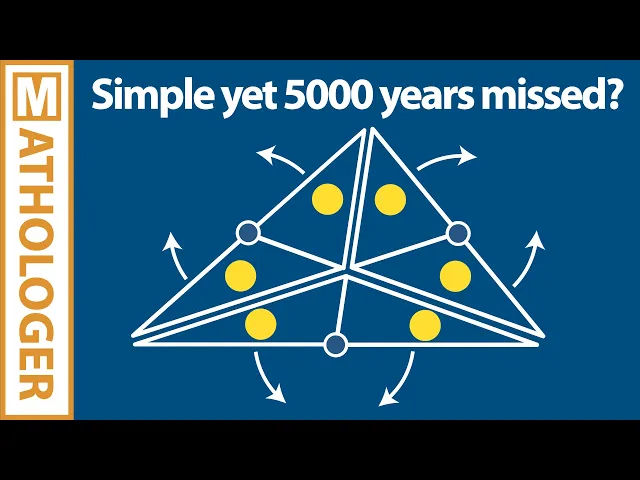
0:33 Start with any triangle.
0:34 Mark the midpoints of the sides.
0:37 And draw in the three medians of the triangle that end in these midpoints.
0:42 These guys here.
0:43 And looks are not deceiving.
0:45 The three medians always intersect in a point.
0:48 And so the medians chop the triangle into six smaller triangles,
0:53 usually all different in shape and size.
0:55 This fact has been known since time immemorial and mathematicians
0:59 have been staring at this diagram for just as long.
1:03 Now highlight two neighbouring triangles, those two.
1:06 Insert a hinge right there at that midpoint.
1:10 Fold up.
1:11 Nice.
1:12 Let’s do the same with these two triangles here.
1:16 Actually, wait, before I fold things up a second time,
1:20 can you already guess where all this is going?
1:23 Yes?
1:24 No?
1:24 Well, if we fold things up now we get EXACTLY the same triangle as before.
1:30 Have a look.
1:31 And now you can definitely guess what comes next, right?
1:35 Yes, put in a hinge, fold up and you get the same new triangle a third time.
1:42 Tada, and that’s the new discovery.
1:45 Very simple and very beautiful, isn’t it?
1:47 Well, there is a bit more.
1:49 Let’s call the new triangle the folded triangle.
1:52 The common side of the red and blue up there,
1:55 that’s a median of the folded triangle.
1:58 Right?
1:58 Pretty obvious.
1:59 And, there is the second median.
2:02 And the third.
2:03 Okay, now fold up the folded triangle.
2:08 Great.
2:09 Now compare this new folded folded triangle to the original triangle.
2:19 Notice anything special?
2:20 Yes, the folded folded triangle is just
2:23 a scaled down version of the original triangle.
2:26 Interesting and very beautiful isn’t it.
2:29 And it really looks like this was only
2:32 discovered for the first time 10 years ago.
2:35 Amazing, right?
2:35 But of course as with most mathematics,
2:37 a lot more beauty is hiding in the `why’.
2:40 And so, let me also show you why all this works.
2:44 Lot’s of nice AHA moments ahead and so make sure to stick around.
2:53 Actually we’ll prove more than just the medians meeting in the controid.
2:58 We’ll also show that the centroid splits every
3:01 median into a long and a short part.
3:04 and that the long blue part is always
3:07 exactly double the length of the short green part.
3:10 There.
3:10 The blue is exactly twice as long as the green.
3:13 Again, that’s true for any median,
3:15 the blue is always twice as long as the green part.
3:18 There blue is twice as long as the green.
3:20 And again, blue is twice as long as the green.
3:23 Here is a nice way to see why all this is the case.
3:27 Scaling our triangle down by a factor of 3 gives this little triangle.
3:33 And, you’ve probably all seen this before,
3:35 we can now tile the large triangle with copies of the little triangle like this.
3:40 Okay.
3:40 Here is one of the medians of the little grey triangle at the bottom.
3:46 From the tiling it’s clear that if we extend this median
3:49 up we end up with the median of another little triangle.
3:52 That one here.
3:54 There extend.
3:54 And extending further we get the median of the little triangle at the very top.
4:01 And now of course, together the medians of the three
4:06 little triangles form the median of the large
4:09 triangle AND this median passes through the special
4:11 point right in the middle of the tiling,
4:13 AND the blue part of the median is twice as long as the green part.
4:18 AND, of course, the same is true for all three medians.
4:22 Easy:) Okay, so medians all meet in the point right at the center
4:26 of the tiling and are all cut by this point in the ratio of 1:2.
4:31 Proof complete.
4:31 Super nifty, right?
4:33 Actually with these two properties under out belt,
4:37 it’s very easy to now also prove that the three
4:41 ways of folding give the same folded triangle and that, furthermore,
4:44 the folded folded triangle is a scaled down version of the original triangle.
4:50 Here we go.
4:52 If these three parts really all fold up into the same triangle,
4:56 then obviously all three parts, red, green and blue have to have the same area,
5:01 exactly one third of the area of the original triangle.
5:04 Let’s first see why that is true.
5:07 Easy, The area formula for triangles is 1/2 base times height.
5:12 Well then, the blue triangle and the original triangle have the same base.
5:16 And because of the 1:2 ratio in which the medians are cut by the centroid,
5:22 it’s clear that the blue triangle’s height is 1/3 that of the original triangle.
5:27 And, therefore, also the area of the blue triangle has
5:31 to be exactly 1/3 of the area of the original triangle.
5:34 And of course the same is true for the red triangle, and the green triangle.
5:38 Nice.
5:38 Have you ever done any origami before?
5:41 For example, have you ever folded a paper crane?
5:45 Well when you unfold the crane you get this interesting
5:49 crease pattern which really is the blueprint for the crane design.
5:54 Similarly, our median intersection pattern is a blueprint
5:57 for everything that happens in our triangle folding adventure.
6:00 Everything that we come across in terms of little triangles,
6:04 distances and angles is present in this blueprint.
6:07 Let’s have a closer look.
6:08 Let’s first highlight the angles around the centroid.
6:12 These two opposite angles are the same.
6:16 So are these.
6:17 and these and so on.
6:20 Okay, now any other angle visible in this diagram
6:25 is composed of the angles in the middle.
6:29 For example, let’s take one of the angles at the bottom.
6:33 Put in a parallel to the bottom line through the centroid And so the angle
6:38 we are interested in is equal to the orange angle plus the green angle.
6:44 Another example, this angle here.
6:47 After drawing this parallel here it’s clear that our angle
6:52 is equal to the grey angle plus the blue angle.
6:56 Doing this angle chasing for the whole diagram gives this.
7:00 Pretty spectacular, hmm?
7:01 Reminds me a little bit of an Australian aboriginal dot painting.
7:07 Okay, get ready for an AHA moment.
7:12 Let’s do the folding.
7:15 Okay, these are the three folded up triangles.
7:19 They all look the same.
7:20 But to be sure that they really are, let’s check the angles at the vertices.
7:26 There all the same and the same.
7:29 And since we already checked that all three triangles also have the same area,
7:34 we can be sure that all three triangles are congruent,
7:37 that all three triangles are the same.
7:43 Okay, now let’s fold a second time We
7:49 already know that these triangles are all the same.
7:52 But we still need to check that this folded
7:54 folded triangle is similar to the original triangle.
7:57 For this we have to check that corresponding angles are the same.
8:03 Beauuuutiiiiiful:) Proof complete:) Now,
8:09 let me just show you the folding action again in a slightly different way.
8:20 As you’ll see, in a way,
8:22 folding a triangle is really just turning it inside out,
8:25 with a bit of scaling down thrown into the mix.
8:28 And then folding again turns things inside out
8:36 again and returns us to the original triangle.
8:49 We are back to where we started from.
8:59 So, folding is really just a nifty way of turning a triangle inside out.
9:03 Here are a couple more interesting observations.
9:06 First, isosceles triangles always fold into isosceles triangles.
9:10 and an equilateral triangle folds into another equilateral triangle.
9:22 What about right triangles.
9:26 Well let’s see.
9:29 Folding a right triangles does not give a right triangle.
9:37 However, since folding turns triangles inside out we can still
9:40 find the right angles in the middle of the folded triangle.
9:44 There are the right angles.
9:45 I can see some of you serious triangle lovers bouncing up and down
9:50 in your seats:) Being well versed in the ways of the triangle,
9:53 you will have immediately spotted another way of seeing pretty much
9:56 at a glance why the three folded triangles are the same.
9:59 Here is that second proof that quite a fwe
10:01 of you will have come up with on your own.
10:05 This one just takes a couple of seconds.
10:08 Color in the long median parts like this.
10:11 Let’s fold So two of the sides of this folded
10:15 triangle coincide with two of the coloured parts yellow and orange.
10:20 What can we say about the remaining black side at the bottom?
10:24 let’s unfold again.
10:26 Well, we know that this green segment is half as long as the blue.
10:30 Right, remember that?
10:31 But then the remaining side of the folded triangle consists of two copies
10:35 of the green and so the remaining side is as long as the blue side.
10:40 nice.
10:40 And so the different sides of this folded triangle are
10:43 just the three coloured long median parts of the original triangles.
10:46 Since this is the same for all three folded triangles, all have to be the same.
10:51 How nice is that:) Finally,
10:53 here is the article by Lee Sallows about his discovery
10:57 in the December 2014 issue of the Mathematics Magazine.
11:01 Just one page:) And so it really is still possible even today after thousands
11:06 of years of triangle spotting to discover
11:08 new simple and beautiful mathematics in this area.
11:11 And that’s all for today’s mini Mathologer.
11:13 Flat out with work at uni work at the moment
11:16 and so didn’t have time for a Kurosawa length Mathologer video.
11:19 Still a very nice topic I think and I hope you enjoyed it:) Oh,
11:23 and by the way, which of the two proofs do you prefer and why?
11:26 The dot painting leisurely one which really takes
11:28 in a lot the sights off the beaten track?
11:31 Or the one-glance one at the end that goes straight for the kill?
11:48 Let me know in the comments:)