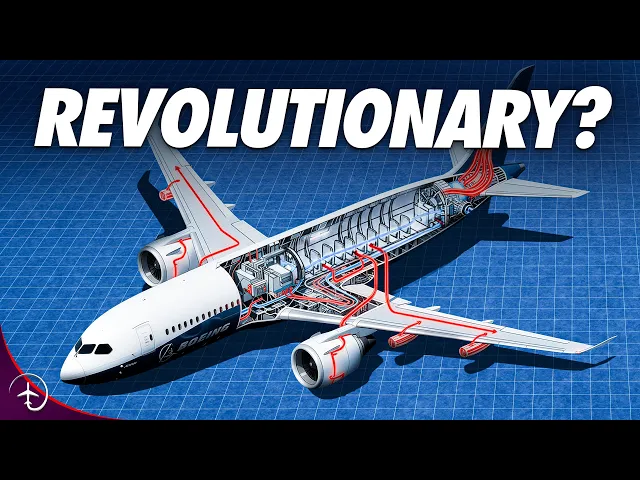
Why Don’t ALL Airliners Do THIS?
Mentour Now!
0:01 Are we ignoring an obvious solution to cabin and cockpit smoke events,
0:05 like the ones caused by bird strikes and other internal failures?
0:10 We have now made several videos, both here and on the Mentour Pilot channel,
0:15 looking at how oil ingested into the compressor stages
0:18 and bleed air ducts of the engines can cause
0:21 smoke to fill up the passenger cabin and cockpit
0:24 of Boeing 737 MAXes as well as Airbus A320 neos.
0:28 And if that happens, close to the ground especially,
0:32 it has the potential of increasing pilot workload
0:35 dramatically at a very critical time of flight.
0:39 Now I want to be very clear here, these are quite rare events and engine
0:44 and aircraft manufacturers are already busy working
0:47 on software changes that will make these events
0:50 much easier for us pilots to handle, but what if there is a better way?
0:56 Well Ben and I have discussed this issue while demonstrating
0:59 it in a simulator and what we've mentioned almost in passing
1:04 in those discussions is that there is currently one aircraft
1:08 that cannot suffer from this particular problem and that's the Boeing 787.
1:15 So I will now let Ben explain why that is and what we can learn from it.
1:20 Over to you Ben.
1:22 Thanks Petter.
1:23 And you're absolutely right.
1:24 The designers of the Boeing 787 took a very
1:28 unique approach to the way in which air is compressed
1:30 and then sent to the cabin for air conditioning and pressurization
1:33 as well as the various other systems throughout the aircraft.
1:38 Now to understand this better,
1:40 let's first look at how a regular airliner supplies air to the various systems.
1:45 Now imagine it's a cold morning and you're a passenger
1:48 at your nearest major international airport and in front of you,
1:52 a massive wide-body airliner is pushing back from the gate and starting engines.
1:57 Once the engines have started,
1:59 conditioned air flows through the vents into the cabin and systems
2:02 quietly come online to protect the wings and the engines from ice.
2:07 To most people on board,
2:08 it feels invisible because it's simply part of how flying works.
2:12 However all of these systems, the air conditioning, the pressurization,
2:16 anti-ice, they all operate from compressed air from the engines.
2:20 This compressed air is then bled
2:21 from the engine at certain points of the compressor
2:25 stages and is then piped throughout the plane
2:27 and it's been done this way for decades.
2:30 The plumbing that makes it all happen has
2:32 been refined and optimized over time so it
2:35 works reliably and it's so deeply embedded in aircraft
2:39 design that it simply fades into the background.
2:42 So what's different about the 787?
2:45 Well, when Boeing designed this jet, also known as the Dreamliner,
2:49 they made a decision that quietly broke with that tradition.
2:52 Instead of trying to refine the plumbing even more,
2:55 they just removed it, or at least most of it.
2:59 Boeing decided that the 787 would not rely
3:02 on engine bleed air to pressurize the cabin,
3:05 heat the wings or start its engines.
3:07 Instead, the aircraft would achieve all of this by using electricity,
3:13 lots of electricity.
3:14 It was a radical choice that reshaped how the 787 works from the inside
3:19 out and one that questioned whether or not bleed air is worth it.
3:23 But the fact that Airbus did not follow Boeing's example and stuck with regular
3:28 bleed air systems for their newer
3:30 A350 shows that the answer wasn't exactly conclusive.
3:34 Now to understand why all of this matters,
3:37 let's start with what bleed air actually is and why
3:41 today every airliner except the 787 depends on it.
3:45 In a turbofan engine, air is drawn in through the inlet,
3:48 through the fan and then the portion of air
3:51 that's driven through the core is squeezed or compressed through
3:55 multiple stages of compression before it's eventually sent
3:58 to the combusting chamber to be mixed with fuel and ignited.
4:02 Now as the air is progressively
4:05 compressed through the multiple compressor stages,
4:07 it gets hot, it gets dense and therefore, it's full of energy.
4:12 And early in the jet age,
4:13 engineers realized they could tap into that energy to power the aircraft itself.
4:18 You see, by extracting or bleeding a portion of that air
4:22 from one or two stages of the engine's compressor,
4:25 an engine can pressurize and air condition the cabin
4:29 without needing other complex infrastructure for that particular purpose.
4:33 Now, after the air is bled from the compressor section,
4:36 it gets routed to the various systems that depend on it.
4:39 For example, the bleed air that will air condition and pressurize the aircraft
4:43 is directed through ducts and vents
4:45 to something called an air conditioning pack.
4:48 Now, these packs contain compressors,
4:50 heat exchangers and turbines that bring the hot,
4:53 dense air down to the right temperature
4:55 and pressure before it gets sent into the cabin.
4:58 However, as I mentioned earlier,
5:00 that's not the only thing that engine bleed air is used for.
5:03 The air that isn't used for air conditioning
5:05 and pressurization is still super hot and that hot air
5:09 is used to heat up the leading edges
5:11 of the wings and the engine inlets to prevent ice buildup.
5:14 It can also be used to spin air driven starters to bring the engines
5:18 to life and support a variety
5:20 of secondary pneumatic functions throughout the aircraft.
5:23 From a design perspective, it's an elegant solution.
5:26 Then engines are already compressing air anyway,
5:28 so borrowing some of that energy avoids the need for heavy generators,
5:32 powerful electrical systems or new technologies.
5:35 Bleed air made early jet liners simpler,
5:38 lighter and easier to certify at a time when electrical
5:41 power was limited and reliability was one of the top priorities.
5:46 And that's why bleed air became the standard architecture across the jet age.
5:50 From early narrow-bodies to the long haul wide-bodies,
5:53 it was proven, it was well understood and it was dependable.
5:57 However, there's no such thing as a free lunch and you're
6:01 not getting all of that work from the engine for free.
6:04 In the cruise, bleed air extraction can account
6:06 for a good percentage of an engine's total
6:09 fuel burn depending on how heavily the environmental
6:12 control system and the anti-ice systems are being used.
6:15 And that's because despite the improvements made
6:18 on bleed air systems over the years, they do come with a caveat.
6:21 Every kilo of air taken from the compressor is air that doesn't get
6:26 sent to the combustion chamber to be mixed with fuel and then burn,
6:29 which effectively robs a bit of power from the engine.
6:33 Then there's the hardware required to make all of this possible.
6:36 Bleed air is extremely hot, often well into 200 degrees Celsius,
6:40 which means that every component that carries it has to survive
6:44 these extreme temperatures for tens of thousands of flight hours.
6:48 This requires thick wall ducting,
6:50 it requires high temperature seals, titanium components, insulation blankets,
6:55 pressure regulators, shutoff valves and leak detection systems
6:59 routed throughout the fuselage and wings.
7:01 Each of these parts adds weight.
7:03 Each junction adds a potential failure point and all of it has to be inspected,
7:08 monitored and maintained throughout the aircraft's life.
7:12 Now, before we get into the specifics of the 787, take a look at this...
7:17 This is Opera, a browser that has made my life a lot easier.
7:22 Researching an incident used to be a bit of a mess.
7:25 I was constantly switching between tabs,
7:27 losing my place, forgetting which document had which detail.
7:32 But Opera streamlines everything.
7:34 Let me show you.
7:36 Opera lets me split my screen into two,
7:38 three or even four ways with a simple drag and drop.
7:42 So when I'm working, I can have the accident report,
7:45 flight data, a technical diagram and my notes all visible at once.
7:50 And it makes connecting the dots so much easier.
7:53 And instead of having Google Calendar and Gmail buried in tabs,
7:57 Opera's sidebar lets me add them right here.
8:00 With one click, I can access either of those without disrupting my workflow.
8:05 And I also spent some time customizing the entire look with Opera's themes.
8:09 And now I have a setup that really feels like it's mine.
8:12 You can change everything from animated backgrounds
8:14 to UI colors and even the browser sounds.
8:18 But the best feature is Opera AI.
8:20 It's built right into the browser and is free without an account.
8:24 So if I want to quickly understand
8:26 what happened with a certain flight, for example,
8:28 I just pull up a web page and ask, no need to copy links or upload files.
8:33 It automatically analyzes the page and gives me a summary.
8:37 Opera is completely free to download.
8:39 So you've got nothing to lose.
8:41 And the link is in the description below.
8:43 Thanks Opera for sponsoring this video.
8:45 Now, let's get back to the 787.
8:48 Now, for decades, the efficiency losses and the complexity
8:52 of bleed air systems were simply accepted.
8:55 Fuel was relatively cheap.
8:57 Electrical systems weren't powerful enough to replace
8:59 pneumatics and bleed air worked well enough, even if it did have its drawbacks.
9:04 By the early 2000s, though, that balance was beginning to shift.
9:09 Engines were becoming dramatically more efficient.
9:12 Electrical generation and electronics were advancing quickly.
9:15 And airlines were demanding step change improvements in fuel burn,
9:20 maintenance costs, and passenger comfort.
9:22 And it was around this time that Boeing began designing
9:25 its first clean sheet airliner of the 21st century and asked:
9:30 what if the engines didn't need to supply air to the airplane at all,
9:34 but instead used electricity.
9:36 The reason they asked this question was because
9:39 when something in the bleed air system goes wrong,
9:42 the consequences aren't always trivial.
9:44 A bleed leak isn't just a nuisance warning light.
9:48 Hot air escaping where it doesn't belong can damage structure,
9:51 wiring, or nearby systems.
9:53 As a result, we pilots treat bleed faults very seriously.
9:57 And in some cases, a bleed issue can
9:59 force an aircraft to descend or even divert,
10:02 even though the engines themselves are working perfectly normally.
10:05 Again, airliners accepted these limitations for decades
10:09 because bleed air was familiar and dependable.
10:12 Maintenance crews understood it, procedures were well established,
10:15 and the operational costs were simply baked into the economics of flying.
10:20 However, as fuel prices rose and margins tightened,
10:23 that inefficiency became harder to ignore.
10:26 And later on, another issue came into the picture because
10:29 cabin air on traditional airliners is drawn directly from the engines.
10:34 Failures of engine oil seals, even relatively minor ones,
10:38 can allow traces of oil to enter the bleed air supply,
10:41 and that's really not good.
10:43 However, sometimes it's not just traces of oil,
10:45 but actually several gallons of engine oil,
10:47 which brings us to the LRD activation that Petter
10:51 spoke about in the beginning of the video.
10:53 Now, I'm not going to go into a lot of detail
10:55 on this system here since Petter already explained it in a previous video,
10:59 but briefly, the LRD stands for Load Reduction Device.
11:04 It's a function that several newer engines have
11:06 to help mitigate the effects of severe engine damage,
11:09 such as losing a fan blade after a bird strike, for example.
11:12 Such a blade loss would cause an imbalance in the fan,
11:15 especially in newer engines that have fewer wider blades,
11:19 meaning that each blade represents a bigger
11:22 percentage of the fan's spinning weight.
11:24 So, when there is such an imbalance,
11:26 the LRD system activates and kind of releases the fan section.
11:31 The LRD does this by enabling the fan
11:33 to be partially mechanically disconnected from the turbo machinery,
11:37 and this reduces the severity of the vibration
11:40 transmitted from the damaged engine to the airframe.
11:43 However, the release of the fan also releases most of the engine's oil,
11:47 and much of that oil is then free to move through
11:51 the compressor stages and make its way to the bleed air system.
11:54 By that point, the oil is vaporized by the high temperatures
11:57 and turned into acrid white smoke that becomes incredibly dangerous to breathe.
12:02 Now, there are software solutions for this.
12:05 The engines already have vibration sensors which could
12:07 send a signal to close the bleed valves,
12:10 stopping this vaporized oil from entering the air conditioning system.
12:14 But getting rid of the bleed air system
12:16 altogether would obviously make a much more definitive solution.
12:20 Now, obviously, jets have had complex electrical systems since the beginning,
12:24 and each new generation of aircraft relied a little
12:27 bit more on electricity than the one before it.
12:30 And this is simply because electrical systems offer a level
12:33 of precision and control that pneumatic and mechanical systems just can't match.
12:38 Electrical motors just draw power only when they need it,
12:41 and electrical loads can be monitored,
12:43 prioritized, shared or redistributed instantly.
12:46 And as solid state electronics have improved,
12:49 electrical systems have become lighter and have
12:52 fewer parts and are therefore more reliable
12:54 and far easier to integrate into complex aircraft
12:58 architectures than sprawling networks of ducts and valves.
13:02 And eventually, this trend reached a tipping point.
13:05 Aircraft like the Airbus A320 and the Boeing 777,
13:09 although still relying heavily on bleed air,
13:11 featured far more capable electrical systems
13:14 than anything that came before them.
13:16 At the same time, engines have become dramatically more efficient.
13:20 Extremely high bypass turbo fans squeeze more thrust from every kilo of fuel,
13:25 which makes any non-thrust energy extraction,
13:28 like bleed air, increasingly noticeable.
13:31 And while fuel and maintenance costs have continued to rise,
13:34 the cost and weight of electrical hardware have fallen dramatically.
13:38 Advances in consumer electronics have filtered into commercial aviation,
13:43 like solid state converters that can handle higher voltages,
13:47 and monitoring systems make it possible
13:49 to detect problems long before they become failures.
13:53 For Boeing, designing the 787 from a clean sheet offered an opportunity.
13:58 For the first time, their engineers would not be constrained by legacy layouts,
14:02 existing ducting runs or decades of incremental compromises.
14:06 Instead, they could step back and ask what
14:09 would this aircraft look like if electricity and not
14:12 bleed air became the primary way energy flowed
14:15 from the engines to pretty much anything else.
14:19 Well, each 787 engine is fitted with two
14:22 massive generators mounted directly to the engine gearbox.
14:26 Cleverly, these are both generators and motors that can be
14:30 used to start the engine on the ground or in flight.
14:33 And, of course, each one is capable of producing a lot of power.
14:37 So that means there's two generators per engine,
14:40 which is really rare in the airliner world.
14:42 And let us know in the comments below if you know
14:45 of any other jets with more than one generator per engine.
14:48 But in addition to the four generators in its two engines,
14:51 the 787 has two more generators on its auxiliary power unit or APU,
14:56 which is right at the back of the fuselage.
14:58 If a 787 runs all of its generators at full capacity,
15:02 it will produce a whopping 1.4 megawatts of power,
15:06 which is enough to power almost 500 homes.
15:10 And the biggest change this enables is the totally new cabin control system.
15:14 On the 787, air from the cabin is drawn in through
15:17 dedicated inlets on the fuselage
15:19 and compressed by massive electric air compressors,
15:23 which raise the air pressure to produce a cabin altitude of around
15:26 6,000 or 7,000 feet before sending
15:28 it through the familiar air conditioning packs,
15:31 where temperature and humidity are controlled before the air enters the cabin.
15:36 Wing ice protection follows the same philosophy.
15:39 On most other airliners, bleed air is routed into the leading edges
15:43 of the wings to keep ice from forming.
15:45 On the 787 though, those leading edges are
15:48 protected using electrical heating elements embedded within the structure,
15:51 kind of like the ones you see in your car
15:54 window to melt frost and snow on a cold winter's morning.
15:57 This eliminates long runs of hot ducting through the wing and gives
16:01 the system fine grain control over exactly where and when the heat is applied,
16:06 while also eliminating a source of maintenance headaches.
16:09 And given the extra electrical power,
16:11 Boeing also gave the 787 brakes that are powered electrically,
16:16 not hydraulically, which is another first.
16:19 However, none of this comes for free, of course.
16:22 To make this architecture work,
16:24 Boeing had to design an electrical system unlike anything
16:27 that's ever been flown on a commercial airliner before.
16:30 The 787 uses double the voltage of previous aircraft,
16:34 going from 115 volts to 235.
16:38 And they also added multiple layers of redundancy,
16:40 extensive power conversion and sophisticated control logic to manage the loads,
16:45 prioritize essential systems and shed non-critical ones if necessary.
16:50 So this means that Boeing replaced miles of hot
16:53 pneumatic ducting with miles of heavy electrical cabling,
16:56 power electronics and cooling systems for the electronics.
17:00 The airplane effectively trades thermal complexity for electrical
17:04 complexity and one set of engineering challenges for another.
17:08 But the payoff can be big.
17:10 Boeing estimated that they could cut fuel
17:12 burn by 2 to 3% compared to traditional bleed air systems and they could do it
17:17 while lowering maintenance cost and increasing dispatch reliability.
17:21 That's because in addition to saving weight,
17:24 electrical systems draw power only when they're commanded.
17:28 They can be monitored continuously,
17:29 adjusted dynamically and integrated tightly with the aircraft's automation.
17:34 And that's why Boeing decided to take this development risk.
17:38 But soon after this, Airbus looked at the same
17:41 problem when they developed their A350 and said,
17:44 "Nah, we'll stick to bleed air thanks." But why?
17:48 Airbus didn't think the idea was unworkable,
17:50 but instead they just concluded that at the aircraft
17:54 level the benefits simply didn't justify the cost and risk.
17:58 Well, not yet.
18:00 From Airbus's perspective,
18:01 eliminating bleed air didn't remove energy extraction from the engines,
18:06 it just changed the form.
18:08 You weren't getting rid of the penalty, you were moving it somewhere else.
18:11 Airbus engineers concluded that once you accounted
18:14 for the weight of additional generators, power electronics,
18:17 cooling systems, redundancy and wiring,
18:19 the overall efficiency gain of a bleedless architecture was modest at best.
18:25 Real?
18:26 Yes, but too small to be worth the bother.
18:29 And those gains had to be balanced against
18:31 a very real increase in system complexity and development risk.
18:36 The A350 program was already ambitious.
18:39 Airbus was introducing an all-new composite fuselage,
18:42 built using a more complex method than what Boeing
18:45 were using in the composite fuselage of the 787.
18:48 The A350 also had a new wing,
18:51 new systems architecture and the most powerful civil turbofan ever built
18:55 at the time in the form of the Rolls-Royce Trent XWB.
18:59 So piling a completely new electrical philosophy on top
19:03 of all of that would have added another major unknown,
19:06 with consequences for certification, schedule and reliability.
19:10 So instead, Airbus chose a more conservative path,
19:13 but one they were confident in.
19:15 So rather than eliminating bleed air, they just focused on making it better.
19:20 The A350 retains a conventional bleed air architecture,
19:23 but it's a totally clean sheet design that takes
19:26 advantage of technical improvements and miniaturization of materials.
19:30 They also eliminated the need for complex and expensive lithium-ion batteries,
19:35 a necessity of the 787's bleedless design that caused so
19:39 many headaches for Boeing when the jet was first introduced.
19:42 At the same time, Airbus really embraced electrification,
19:45 where it delivered the clearest benefit with the least risk.
19:49 They simplified its hydraulic architecture,
19:51 relying more heavily on electrically powered actuators for backup control,
19:55 and used electrical actuators in the hydraulic system.
19:59 And these actuators are so powerful in fact
20:01 that the A350's flight crew could control the plane,
20:04 even in the event of a total hydraulic loss.
20:07 And by the time the A350 entered service,
20:09 engine technology advanced even further.
20:12 The Trent XWB was optimized from the outset
20:15 to work with the Airbus bleed air system,
20:17 reducing inefficiencies so that the marginal penalty of bleed extraction
20:21 made it even harder to justify redesigning the entire aircraft.
20:26 From Airbus's perspective,
20:27 the question wasn't whether bleedless aeroplanes could work.
20:31 Boeing had already proven that.
20:33 The question instead was whether it was
20:35 the smartest place to spend engineering risk
20:37 and program capital when similar aircraft level
20:40 performance could be achieved in other ways.
20:42 And in hindsight, that decision did pay off.
20:45 The A350 entered service with fewer system level surprises,
20:49 excellent dispatch reliability, and fuel burn that matched its competition.
20:53 Airlines got an aircraft that delivered the promised
20:56 efficiency gains without introducing a fundamentally new operational philosophy.
21:01 Boeing and Airbus looked at the same
21:03 technological moment and made opposite choices.
21:06 And both were kind of right.
21:08 The 787 proved that a largely bleedless architecture is indeed viable,
21:12 efficient and scalable.
21:14 It pushed the industry forward and forced everyone
21:16 to rethink assumptions that had gone unchallenged for decades.
21:20 Whilst the A350 proved that you could achieve nearly the same end
21:24 result without taking that leap
21:25 by refining existing systems and electrifying selectively.
21:29 However, is this awkward conclusion the final word of the story?
21:33 Well, maybe not.
21:35 More recently, Airbus has been working on solutions for micro-hybridization
21:39 or electrification of aircraft systems for future aircraft designs.
21:44 Some of this work is because such designs would make
21:46 sense for aircraft that use alternative means of propulsion, like hydrogen.
21:50 But more broadly, this works put more emphasis on developing even better,
21:55 more efficient and lighter batteries and other
21:58 electrical systems which would benefit conventional aircraft.
22:01 So, one way or another, there's more to come from this story.
22:04 Ultimately, the real legacy of the 787 isn't that it eliminated bleed air,
22:09 it's that it made the industry ask whether it still deserved to be there at all.
22:14 But what do you think?
22:15 Will the next Airbus or Boeing aircraft use bleed air?
22:18 Let us know in the comments below.
22:20 I'm Ben Watts.
22:21 You're watching Mentour Now!
22:23 Have an amazing week and I'll see you next time.