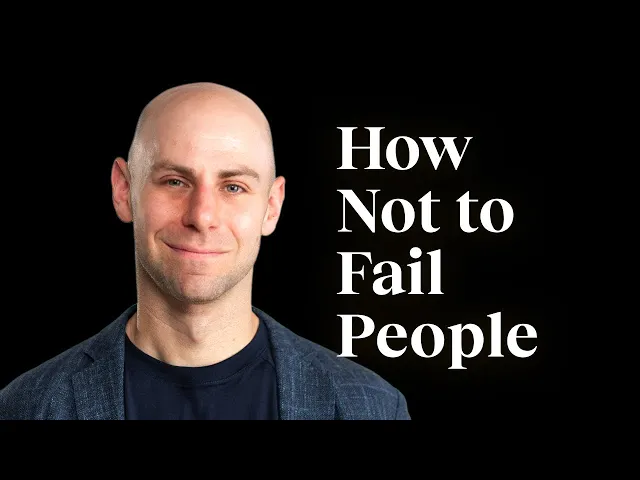
Adam Grant's #1 phrase to unlock potential | Big Think+
Big Think
0:00 We live in a world that's obsessed with raw talent.
0:03 We admire child prodigies in music,
0:06 natural athletes in sports, geniuses in school,
0:11 but focusing on where people start causes us
0:13 to overlook the distance that they're capable of traveling.
0:17 (upbeat orchestral music) (ocean whooshing) I'm Adam Grant.
0:21 I'm an organizational psychologist at Wharton
0:22 and the author of, "Hidden Potential:
0:24 The Science of Achieving Greater Things." (bright
0:33 music) I got interested in this topic
0:36 personally because I started out as a springboard diver with zero talent.
0:41 I was told that I walked like Frankenstein,
0:43 that my coach's grandmother could jump higher than me.
0:46 I couldn't even touch my toes without bending my knees.
0:50 Clearly the wrong sport for me.
0:51 If I had judged my potential by that starting ability, I would've quit.
0:55 With an extraordinary coach and a lot of effort, I ended up becoming a Junior
1:00 Olympic national qualifier and an All-American diver.
1:03 I ended up actually exceeding what I thought was my potential.
1:07 That happened to me again when I started out trying to teach as a professor.
1:12 The comments from students were brutal.
1:14 I remember one student writing that I was so nervous
1:17 I was causing them to physically shake in their seats.
1:20 Another student wrote that I reminded them of a Muppet,
1:23 and didn't even tell me which Muppet.
1:24 But we should be looking for the answer.
1:28 I was not an effective teacher.
1:30 I was too anxious.
1:31 But once again, I had some coaches who really believed in me
1:35 and I put a lot of effort into studying my teaching,
1:37 into watching great teachers, and trying to figure out how I could
1:40 become a little bit more effective in the classroom, and I made radical changes.
1:44 Lo and behold, the feedback was night and day different.
1:49 I care deeply about this topic of potential because
1:52 we all have more capability for growth than we realize,
1:55 and if we focus just on early talent and on initial performance,
1:58 we're going to miss out on the progress that we're capable of achieving.
2:03 One of my greatest disappointments in life
2:05 has been seeing people squander their potential.
2:08 We constantly underestimate our own capacities,
2:12 and we're also vulnerable to underestimating
2:15 what other people are capable of achieving.
2:18 The measure of a leader's success is how
2:20 much the groups they're in charge of ultimately accomplish.
2:24 That means that if you fail to help people realize their potential,
2:28 you are failing as a leader.
2:31 When I work with leaders, I tend to see them fall into one
2:34 of two traps when it comes to developing their people.
2:36 One is that they're cheerleaders and the other is that they're critics.
2:41 If you're a cheerleader,
2:43 you recognize people's best selves and you try to harness their strengths,
2:46 but there's good empirical evidence to suggest
2:49 that when we become too comfortable with our strengths,
2:51 we start to use them as a crutch.
2:53 And they can even become career derailers.
2:56 So if one of your strengths, for example, is charisma,
2:58 you are at risk for under-preparing when it comes to leading a meeting
3:02 or giving a speech because you're
3:04 so good at improvising and speaking extemporaneously,
3:07 you may not do your homework.
3:09 I don't think you just want to be a cheerleader because you
3:11 are in danger of letting people turn their own strengths into weaknesses.
3:17 I think the problem with critics is they often deflate the people around them.
3:21 If you're constantly telling people what they're doing wrong,
3:23 people get discouraged really quickly.
3:25 Their motivation starts to falter.
3:27 At some point, they begin to doubt whether they have any potential at all.
3:32 I think the best leaders are neither cheerleaders nor critics.
3:35 They're actually coaches.
3:38 They see people's potential and they try
3:40 to help them become a better version of themselves.
3:44 They allow people to recognize their strengths
3:46 but not get complacent around them.
3:49 They allow people to see their weaknesses but not get discouraged by them.
3:53 And they remind people, "Yes, you might be pretty good today,
3:56 but you're capable of becoming even greater tomorrow."
3:59 And that energizes people to want to become better
4:02 as opposed to being comfortable with where they are
4:05 or completely incapable of growing from where they're stuck.
4:11 (bright music) To help people realize their potential,
4:16 every coach needs to be comfortable delivering feedback.
4:19 (bright music) A lot of leaders end up
4:24 waiting till performance reviews to deliver the unvarnished truth.
4:28 That comes as a surprise then to their direct reports,
4:31 who, for the last six months, thought everything was fine.
4:35 If you deliver a message during a performance review
4:37 that comes as a surprise to anybody on your team, you have failed at leadership.
4:42 You have failed to give the feedback in real
4:44 time so that they can learn from it, adapt, and make an effort at improving.
4:48 The longer you wait,
4:49 the harder it gets to encourage people to change and the less
4:52 likely they are to even believe your message in the first place.
4:57 As a leader, I want to build the person up as opposed to tearing them down.
5:02 A lot of us instinctively try to do that by serving up the feedback sandwich.
5:05 Let me take a compliment, a piece of criticism,
5:09 and then another compliment and that way I
5:11 can sandwich my critique between two slices of praise.
5:15 Well, guess what?
5:16 Empirically, the feedback sandwich does not taste as good as it looks.
5:20 If the person you're serving it to is anxious at all,
5:24 they're not even going to hear the praise.
5:25 They're just waiting for the other shoe to drop.
5:28 If they're pretty confident,
5:29 they're going to fall victim to primacy effects and recency effects.
5:33 So they're going to remember the first compliment and the last compliment,
5:36 and what happened in the middle is just going to get erased from their memory.
5:40 What's much more effective is to start off by clearly
5:44 segmenting your domains of praise from your domains of constructive criticism.
5:48 So I would go into this conversation and say,
5:50 "I want to tell you a couple of things you're doing
5:53 well and a couple of things that you could work on improving.
5:56 Do you have a preference for which we do first?" I'm not only clearly
6:00 segmenting the praise from the criticism so
6:02 that they can realize those are separate things.
6:04 I'm also then making this a two-way
6:07 conversation as opposed to a one-way monologue.
6:11 One of the biggest mistakes that leaders
6:12 make when they give feedback is they spend
6:14 too much time judging the person and not
6:16 enough time trying to focus on behavior change.
6:19 When you start to tell people what they do wrong consistently,
6:23 what makes them ineffective or incompetent, you invite their ego to show up.
6:27 Nothing is going to get through.
6:30 If you can tell people one or two things that they could do better,
6:33 instead of trying to prove themselves,
6:35 they're much more open to figuring out how they can improve themselves.
6:39 A study published on this a few years back showed that you can make people
6:43 significantly more open to constructive criticism just
6:46 by saying about 19 words before you deliver it:
6:49 "I'm giving you these comments because I have very high expectations and I'm
6:53 confident you can reach them," and you should do that in your own words.
6:57 That completely changes the tone of the conversation.
6:59 "I'm not attacking you, I'm not judging you.
7:02 I'm here to coach you and help you grow." It turns out it is
7:06 surprisingly easy to hear a hard truth
7:08 from someone who wants to help you succeed.
7:11 And if I want to reinforce that further and take myself off the pedestal,
7:14 I'll conclude by saying, "Is there anything I can do better?
7:18 Is there something you want me to know about how
7:20 I can work more effectively with you?" And that way
7:23 we're building a foundation for a better collaboration as opposed
7:26 to me just telling you what you need to change.
7:29 Just like in a marriage,
7:30 that would probably not work very well if you tell your spouse,
7:33 "It's not me, it's you." As a leader or manager, the same principle applies.
7:38 If you show a willingness to grow,
7:40 the other person is a lot more excited about trying to grow with you.
7:45 (upbeat piano music)- [Announcer] Get smarter faster
7:47 with videos from the world's biggest thinkers.
7:54 To learn even more from the world's biggest thinkers,
7:57 get Big Think Plus for your business.