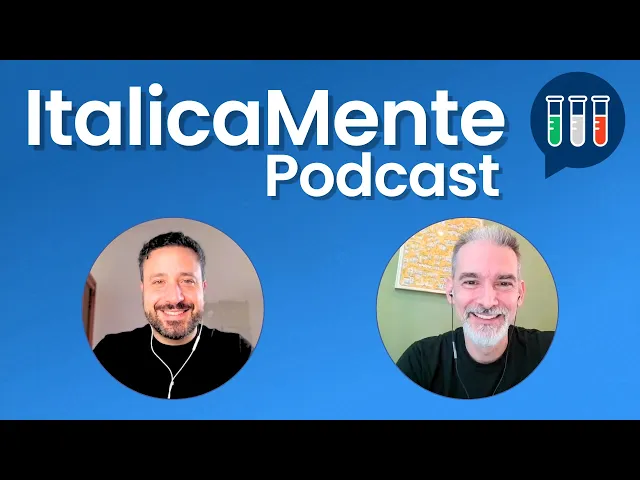
ItalicaMente Podcast 01 - Poliglottismo
Luca Lampariello
0:00 ItalicaMente, your new family.
0:12 Good morning everyone, I'm with the legendary, mythical Stefano.
0:16 Stefano, how are you today?
0:18 Hi Luca, hi everyone, very well, thanks, and you?
0:21 Great, and we are at the first episode of a long series,
0:25 a long and fantastic series of the podcast Italica Mente.
0:29 ItalicaMente.
0:32 I'm so glad that we can finally collaborate with Stefano.
0:36 I'm working with Stefano, a person of absolute worldwide value and caliber.
0:41 Tell me about it!
0:43 I'm thrilled too.
0:44 So, what are we talking about today in this first episode, Luca?
0:48 Exactly, let's get straight to the point and drop the mutual flattery.
0:53 Today's topic is a serious as well as fascinating one: polyglotism.
0:59 Meaning, how languages have changed our lives and perception of the world.
1:04 And I'm very curious to know what Stefano thinks about it.
1:10 Look, speaking many languages can actually change your life.
1:16 As for me, I feel above all that on a personal level it has...
1:20 It has really enriched me as a person, you know?
1:25 Many people say, we hear it often,
1:29 when talking about polyglotism, that acquiring a foreign language...
1:33 allows you to also acquire, as some say, a new personality, a new soul.
1:41 I wouldn't put it in those terms, honestly.
1:45 But certainly...
1:46 a new point of view from which to observe the world and other people, yes.
1:51 And I feel that knowing new ways to look at the world,
1:56 and therefore also new cultures, has made me more...
2:03 inclined to accept differences, to accept new experiences, to be more tolerant.
2:14 Even if maybe this also depends a bit on age,
2:19 meaning that as I matured maybe this happened,
2:22 but I find it's mostly because of the possibility to see...
2:27 to see the world through different lenses.
2:31 What do you think about it?
2:34 Beautiful!
2:34 Speaking of lenses, I like to use this metaphor,
2:38 besides the fact that I agree completely on everything as usual.
2:42 I like to talk about prisms, about light,
2:45 about the breakdown of light in terms of languages and personality.
2:52 In fact, very often, in my opinion it's a stereotype.
2:56 Especially people who don't know what it
2:59 truly means to speak many languages think: "You have more personalities,
3:03 you have more souls." In reality, the soul,
3:06 the personality, the person always remains the same.
3:09 What changes is the way in which we express them.
3:13 That's why I really like the image of the prism,
3:17 the light that hits the prism and breaks it down into main colors.
3:21 I like to think that languages allow to break down
3:26 everyone's personality and to show the various sides of everyone's personality.
3:32 So in my specific case, but also in yours, there is the Italian Luca,
3:40 born in Italy, the one you see and observe now, hands and gestures included...
3:46 We'll talk about it during the podcast, in other episodes...
3:49 but there's also the American Luca,
3:54 who in theory was born in New York and has never been there,
3:58 the French one, the Spanish one,
4:01 and it's beautiful because apart from the change
4:04 of voice and timbre, there's also...
4:06 I feel I express different sides of my personality.
4:10 So I really like the prism,
4:11 the idea is to show these different sides of my personality.
4:15 And then I agree with you, dear Stefano,
4:19 that speaking many languages helps you understand that we are all different,
4:25 but we are all the same at the same time.
4:29 We all want the same things, but express them through different cultural codes.
4:35 So, the more languages you know, people you meet, countries you visit,
4:39 the more you understand and have a more complete picture of humanity.
4:43 To me, this is one of the most beautiful things about polyglotism.
4:47 Beautiful, I would like to add a very concrete case, which is...
4:52 the way in which some languages express the idea of having,
4:58 possessing something, objects, a car, a house, etc.
5:03 In languages like ours, Italian, the verb "to have" exists, right?
5:07 Instead, in many other languages, some of which you also know,
5:12 the idea of having something is expressed in a completely different way.
5:19 One says rather "on me exists" or "by me exists" something,
5:25 or "as far as I'm concerned a car exists" or "a house exists" etc.
5:31 So...
5:31 Seeing this new way of expressing the idea of having,
5:35 possessing, which in reality doesn't exist, also made me understand...
5:40 from a certain point of view, how much we actually possess nothing at all.
5:46 The things we "have", in quotes.
5:50 They actually exist on their own,
5:51 and we are lucky to be able to say they're ours,
5:54 but they are not truly 100% ours.
6:00 I don't know if I managed to make you understand the concept a bit,
6:06 but it served me well as a concept of open-mindedness, to understand the world.
6:13 Absolutely, in fact, when they say that language and culture are one thing,
6:18 they are one, two parts of the same ball of yarn.
6:23 Because there are languages spoken in certain geographical areas of the world,
6:29 where perhaps meteorological aspects, to talk about another aspect...
6:35 don't exist, like in Italy we see snow "once in a blue moon" in Rome,
6:40 a typical expression.
6:42 Oh, there's snow!
6:44 Actually, In my 45 years I've seen 3 popes and it snowed 3 times,
6:51 so the math adds up.
6:53 Anyway, apart from this, what I wanted to say
6:56 is that in some languages, surely in Suomi,
7:00 that is Finnish, there are descriptions of meteorological
7:04 aspects like snow that maybe don't exist in Italian.
7:09 In English, for example, in England there are 50 ways to call rain.
7:14 Which we don't have in Italy, we have "pioggia", "pioggerellina", but anyway,
7:19 apart from these two or three words, we don't have many.
7:23 So it's beautiful and very true that languages and culture are interconnected,
7:28 they are part of one, I call it the famous ball of yarn, indistinguishable.
7:37 Beautiful, and by the way I wanted
7:40 to add that what you describe about have/be exists,
7:43 and for example in Russian you say "by me exists", you don't say "I have".
7:48 Exactly, like Finnish, Japanese, other languages I have encountered.
7:52 Finnish, Japanese and other languages.
7:53 Ok, well, apart from the fact that polyglotism therefore changes your life.
7:59 The lens through which you see the world changes, it becomes more colorful,
8:04 but there's also another more concrete
8:07 aspect in language learning: the profession.
8:09 Very often people learn languages, for example, if they have to move abroad,
8:14 if they have to use them in work contexts, in the office.
8:19 However, in our case, yours and mine,
8:22 languages are not only a tool to understand the world,
8:25 but also a tool to make a living,
8:28 to make ends meet, or better yet, to give value...
8:32 to one's own person, which in my opinion is the most important thing.
8:39 Sure, we don't want to live in a hut,
8:41 so we must gather some cash before the end...
8:44 of the month.
8:45 However, we have the huge luck of working with what we adore.
8:48 And in your case, Stefano, tell us a bit...
8:52 What happened in your career and existential trajectory?
8:56 Yes, practically I have spent my entire
9:00 professional career working with foreign languages.
9:05 I started out as a translator.
9:08 Then I started teaching languages online.
9:11 Now I work as a designer of online language courses.
9:17 So truly, my entire professional career has always had to do with languages,
9:21 and from a certain point of view,
9:26 I've always had the impression that without foreign languages
9:30 I wouldn't have known what to do professionally in life.
9:34 So I am very, very happy to be able to work with what I love most,
9:41 with one of the things I love most in the world, namely foreign languages.
9:47 Beautiful, for me it's the same thing.
9:48 I don't know what I'd have done
9:50 in life if I hadn't started working with languages.
9:53 Indeed, as a matter of fact, Mine was a career underway towards engineering,
10:00 underway towards, let's say, a scientific career, scientific subjects,
10:05 because my father wanted me to follow in his footsteps and become an engineer,
10:10 slash mathematician, dash mathematician.
10:12 But after finishing my university career,
10:14 I found myself in Paris due to various circumstances,
10:18 because my girlfriend at the time basically wanted
10:24 me to move to Paris to be with her.
10:28 Maybe it's a bit unfair to say that she forced me.
10:32 I went there on my own, but we...
10:35 agreed to live together in Paris.
10:37 And in this chambre de bonne, this small little room on the eighth floor
10:44 in a building in the 9th arrondissement, snow was falling.
10:49 Speaking of snow, there you do see it often and not "once in a blue moon".
10:52 And at that moment I was looking for a job as an engineer and I asked myself:
10:57 "is this really what I want?" Because in the end,
11:01 yes, my father wanted me to work with numbers,
11:04 but deep down I really wanted to work with words.
11:09 Destiny helped me because an email arrived from a Hungarian guy
11:13 who had seen my videos that I started publishing back in 2008,
11:18 and he asked me if I wanted to become an Italian teacher.
11:22 And that changed my career,
11:25 my existential trajectory, because I immediately said yes,
11:29 I became a language coach and then
11:32 I created the Smart Language Learning Academy, which is the academy I run now.
11:37 So I must say that languages have not only changed my vision of the world,
11:44 but my career in general.
11:46 And in this regard Steve Jobs gave a beautiful speech maybe 20,
11:52 15 years ago, which maybe you've seen too,
11:55 an opening speech for the academic year,
11:58 I believe, at Stanford, saying "follow your heart,
12:01 listen to your inner voice and do not let the background noise muddy the waters.
12:09 And concentrate on what you really want to do because work is 80% of your life.
12:14 If you do something you adore, then things change radically." So,
12:21 in this sense I must say that on one hand we were lucky,
12:26 but in my opinion, on the other hand we had
12:29 the courage to follow our hearts rather than what society,
12:34 friends, relatives and acquaintances dictated.
12:37 This is a fundamental point.
12:41 And then Stefano, there's a last point we want to address today,
12:45 which is the personal one.
12:46 We talked about the existential and philosophical,
12:49 we talked about the professional, meaning the concrete.
12:56 But let's also talk about what happened to us in life.
12:59 There are so many things, that if you want we can do a 7-hour podcast,
13:03 a marathon solely on everything that happened to us
13:06 in life because of or thanks to the languages we speak.
13:10 But Stefano, I wanted to know from you, maybe one anecdote among many,
13:15 how did your social life, emotional life, and everything related to it change?
13:20 Yes, look, without wasting too much time now talking about all
13:24 the friendships born thanks to the fact that I spoke other people's language,
13:29 because we said it in other contexts,
13:32 but let's emphasize how speaking the same language, someone's mother tongue,
13:36 truly allows you to connect on a much, much deeper level.
13:39 And therefore truly friendships that lasted years and years and that were
13:50 very deep thanks to the fact of speaking the same language.
13:57 On the other hand, I live in Brussels, as you know,
14:00 and here in Brussels exists this "expat bubble",
14:04 where people always speak English.
14:07 Instead, I had the pleasure of learning French,
14:11 and therefore then connecting also with Belgian people,
14:16 because Belgians also exist, even though in Brussels it's hard to find them.
14:22 But apart from all this, how could I not
14:25 mention the episode that changed my life, in my opinion,
14:29 for the better naturally, when I had started studying Finnish on my own,
14:36 that is by myself, on my own.
14:40 Hear how many different ways...
14:43 to say the same thing.
14:45 On my own, and a few months later I saw
14:48 from afar a person I knew was Finnish, and I asked myself:
14:56 "Should I go talk to her, go practice my somewhat broken Finnish,
15:01 or not?" I didn't know whether to go or not.
15:06 Thank heaven, that day I had the courage to go
15:10 talk to her, and that girl today is my wife.
15:17 So, saying that studying Finnish changed my life would be an understatement.
15:24 Let's say, it's a euphemism.
15:28 Therefore, much of who I am and what I have today I owe to this thing,
15:33 and to the fact of having had the courage to go talk to someone.
15:41 Therefore, guys, remember: Go talk to people,
15:44 because only something positive can come out of it, in my opinion.
15:51 Luca, what can you tell us?
15:54 It's very true, beautiful.
15:57 Well, from what you said, we can already infer two things.
16:00 One, as the famous Kató Lomb used to say, the Hungarian polyglot,
16:05 translator and interpreter, languages are something worth learning even poorly.
16:11 Even if you know three words, it makes a huge difference when you say something.
16:18 In some cultures, just knowing three words changes everything.
16:21 Maybe in France a bit less because people expect you to speak French,
16:27 but if you go to Sri Lanka and speak Sinhalese,
16:31 you change the world of the people next to and around you.
16:35 And the second thing is that it's always worth talking to someone.
16:39 As you said, when you see someone, there are those three seconds:
16:41 "do I go or not?" If you think too
16:43 much- true in any situation- you lose the moment.
16:46 But if you go, it can literally change your life as Stefano told us.
16:51 As for me, I also wanted to talk about an episode,
16:55 let's say interesting, which is my "date" or my "appuntamento galante".
17:00 I don't know if in Italian there's a word to replace "date",
17:05 which is a word with one syllable practically,
17:08 but I would say an "appuntamento galante", let's say.
17:11 Because I had met the one who would then become my girlfriend for several years,
17:15 a Polish girl, in Krakow.
17:20 We had exchanged various messages over several months,
17:24 but I was using Google Translate to make my life easier and she
17:29 was particularly impressed by the use and mastery of my accents, etc, etc.
17:35 However, we had to thank Google Translate.
17:38 But then, when it comes to people in person, it's a whole other thing.
17:42 It's not like I could stay with Google Translate to communicate.
17:46 However, I already had a B1 level, in my opinion sufficient to survive.
17:50 And so, when I finally saw her, we met in Krakow,
17:54 I still remember, in Kazimierz, the Jewish quarter, we sat down and she caught
18:01 me by surprise because she didn't want to speak English.
18:04 English is our lifeline when we haven't mastered a foreign language yet,
18:10 and so I told myself this is my safe shelter,
18:15 and I start by asking her if she wants to have the conversation in English.
18:20 But she caught me by surprise and said "No, no, no, no, but you speak Polish...
18:26 very well, why speak English?" Because
18:28 she herself didn't feel confident speaking English.
18:31 And so I had to speak for eight hours, because then we stayed together a lot,
18:36 all night, super romantic, but it was a beastly effort.
18:41 Especially at the beginning, I tried to find strategies, tactics,
18:44 tricks to be able to escape some
18:50 difficult conversational hurdles that were particularly hard.
18:55 Consider that she wouldn't slow down.
18:57 She always considered me as a native speaker and almost never noticed my...
19:02 language problems, so in the end I still managed to escape.
19:08 But just to tell you,
19:10 it's just one of the many episodes for which it is worth learning a language.
19:15 But learning a language means learning many
19:18 lessons of humility from the world, from ourselves,
19:23 because you have to put yourself in situations
19:26 where you step out of your comfort zone,
19:28 always, every time you learn a language.
19:31 I like to think, and then I conclude:
19:35 I like to think that it's true that maybe speaking
19:39 multiple languages doesn't change your personality, but to some extent,
19:44 it's almost like reliving one's own life several times,
19:48 because if you think about it, you have to reface a series of situations
19:53 you faced and of which you don't even remember...
19:56 the moments when you didn't, for example, have self-confidence,
20:00 you have to reface them in a foreign language.
20:03 For example asking for, buying a train ticket
20:06 at the ticket office in the station for the first time,
20:09 go to the supermarket, go to the doctor,
20:12 the bank, have a date, go to the cinema, talk about the cinema after,
20:16 talk about a movie after having gone to the cinema.
20:19 I think that what in English is called fluency,
20:23 that is speaking a language, mastering a language,
20:27 is the result not only of study,
20:29 but also of facing many situations and overcoming them.
20:31 But there's always a certain...
20:33 embarrassment, let's say, at the beginning,
20:36 because it's as if you started from scratch, as if you had to relearn, right?
20:42 To be with others, to face social situations
20:46 that instead in our mother tongue are absolutely normal.
20:50 So it's normal to also have,
20:52 and here I'm already making a connection to an upcoming episode,
21:00 it's normal to also sometimes have fear of making mistakes,
21:03 fear of speaking, fear of exposing oneself.
21:07 We will talk about this in another episode.
21:11 Exactly, exactly.
21:17 So to conclude, today we talked about three aspects
21:20 of polyglotism that are important and that have changed our lives.
21:27 One is a more philosophical aspect: that is,
21:30 how learning many languages opens us to the world and broadens our horizons.
21:35 Two is the more concrete aspect of work,
21:39 because not only can you use languages for work
21:42 and multiply the possibilities of a personal career,
21:45 but languages could also become your actual job, as in our case.
21:50 And three: the myriad of experiences, friendships, loves,
21:55 experiences in general that can bloom like
21:58 flowers from the garden of language learning.
22:01 Wow, we must close on this image, Luca.
22:05 Let's conclude like this.
22:07 We close on this poetic image.
22:09 This podcast came out a bit longer than usual,
22:12 but Stefano and I will try our best
22:15 to restrain ourselves to avoid it lasting 4 hours,
22:18 every episode lasting 4 hours.
22:19 We'll do our best!
22:20 Guys, have a good day and we'll talk,
22:23 basically see you at episode number 2, 3, 4, etc, etc.
22:28 Bye!
22:28 Bye bye!