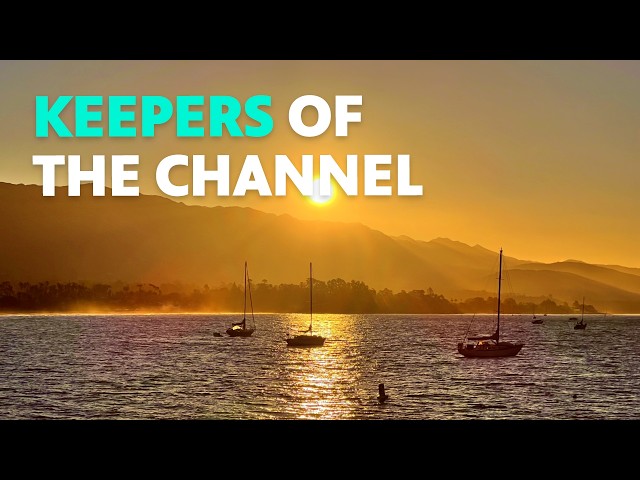
Preserving Ocean Life on the California Coast
PBS SoCal
0:00 {\an8}[music] -Our plan for the day is we're going
0:05 to motor out of the harbor, up the coast.
0:08 Conditions today look pretty good.
0:09 We're sneaking in before a storm system that's building through the weekend.
0:12 They actually say that if you learn
0:14 to sail and boat in the Santa Barbara Channel,
0:16 you're pretty set for boating in a lot of places in the world,
0:19 just because the weather can change so quickly.
0:20 We're very fortunate to have a very seaworthy vessel here
0:23 that can handle the channel and its potential for wind or swell.
0:28 Harbor patrol.
0:29 That's their new boat.
0:30 It goes a lot faster than our boat.
0:33 We're heading out today to conduct some boat-based surveys of our MPAs,
0:38 our marine protected areas.
0:40 Specifically, we're just looking at what kinds of human activity are taking
0:43 place in the areas adjacent to our MPAs and in the MPAs themselves.
0:48 -What is an MPA?
0:50 -Marine protected area is an area where we limit any extractive activities.
0:57 That includes take of any organisms, algae, fish, invertebrates.
1:02 The idea is that you let the whole ecosystem recover.
1:06 In California, we're really fortunate we have a network of protected areas,
1:10 124 MPAs along the coast.
1:13 The idea is that a lot
1:15 of these organisms do something called broadcast spawning.
1:18 If we have areas set aside where they are not removed,
1:22 they can get bigger and produce more offspring,
1:25 and help populate areas both inside the MPA and also outside.
1:31 -Santa Barbara Channelkeeper is a local nonprofit.
1:35 We work to protect and restore the Santa Barbara Channel and its watersheds.
1:40 We work from Point Conception all the way down to the Ventura River.
1:44 We work from the ridges of the Santa Ynez
1:46 Mountains all the way out to the Northern Channel Islands.
1:50 -Here we are.
1:51 We've entered into the eastern side of the Campus Point MPA.
1:54 There's a lot of fishing effort right up to the border of the MPA.
1:58 That's our local lobster fisherman taking
2:01 advantage of the movement of the lobsters.
2:05 I saw a man on shore.
2:07 It looked like he might have been fishing.
2:08 We got closer to shore to check out and see what he's doing.
2:11 He is fishing, so we're going to take note in our survey form.
2:16 -How do you know you're in an MPA?
2:18 Are there buoys?
2:19 There's no floating signs or anything.
2:21 How do you know you've entered one?
2:22 -I know.
2:23 That's a great question.
2:24 As the boater or the fisherperson,
2:26 it's up to you to know the regulations where you're fishing.
2:31 We have this lovely chart plotter, like Google Maps in your cars.
2:35 It shows the MPAs.
2:38 If you're a fisherman, there's apps I have on my phone that can
2:41 show you where you are in relation to the MPA,
2:43 and then the regulations for that MPA.
2:46 -On the land, we're very familiar with national parks.
2:49 Yellowstone was established in the 1870s.
2:54 For protecting the ocean environment, we're behind.
2:58 We really started working on that in the 1970s.
3:01 Particularly in the Santa Barbara area,
3:03 we're seeing some really positive results of the marine
3:05 protected areas that have been set in place.
3:07 We're not looking to shut down the entire Santa Barbara Channel for fisheries.
3:12 We're looking for ways to create balance that lets
3:14 them still be able to continue their livelihood.
3:20 -We're in Santa Barbara Harbor.
3:21 Right at the pier.
3:23 This is the Saturday Fisherman's Market.
3:25 We sell locally sustainably sourced fish right
3:27 here from the Channel Islands and beyond.
3:29 A whole bunch of sustainable and delicious, and nutritious seafood supplies.
3:33 All about the local seafood economy,
3:35 supporting the blue economy here in Santa Barbara,
3:37 and really showcasing the resources that are found and caught
3:41 right off the coast to bring a delicious meal to you.
3:44 -How do you clean it?
3:46 -You can either gut it,
3:47 or you can just cut the head off and then fillet it real quick.
3:50 You can have them fillet it for you.
3:52 I wouldn't pay $3 a fish for that.
3:54 -Yes, I know.
3:55 -It's all local hook and line rockfish.
3:57 We've got different species of the rockfish, and then we've got some rock sole.
4:01 Sold out of Mackerel first thing,
4:02 one of our most popular items here at the market.
4:05 We distribute from San Francisco to Los Angeles, all out of this harbor.
4:10 We're keeping the local fishing alive.
4:14 We're battling farm-raised fish.
4:17 We're battling fish from overseas.
4:18 We're battling fish from Mexico.
4:20 Everyone's trying to push out the little guys,
4:22 but here we are, and we're keeping that dream alive.
4:29 -How are the MPAs working out for you?
4:31 I say MPA, you think what?
4:34 -For me, they don't bother me.
4:36 Most fishermen have a different opinion.
4:39 I think that it's keeping the fisheries alive.
4:42 I actually think that they are helping
4:44 in the sense that we're giving the fish a break,
4:47 and we're getting the spillover.
4:49 I really do believe that we're getting spillover out of them.
4:51 -Spillover meaning the fish reproduce in the MPA,
4:55 leave the MPAs, and you're good to catch them.
4:57 -Absolutely.
4:58 I'm not against that.
4:59 Now, keep expanding, keep growing, and you make half the island close.
5:04 I might have a different opinion.
5:06 -Would you like to?
5:08 -There are mixed emotions about that.
5:11 MPAs, they were designed to close areas for a few years,
5:17 do some study on it, reopen it, and maybe close another area.
5:21 As far as the MPAs now, they've shut them down,
5:26 and there hasn't been fishing there since the MPA started.
5:31 -Does that affect you?
5:33 -In different fisheries.
5:36 The near-shore stuff, it definitely affects all the fishermen.
5:40 There's an abundance of sea life there that's not
5:43 tapped into, where it's been closed for so long.
5:48 The number of fishermen in this state when I
5:51 first started fishing was over 20,000 licensed commercial fishermen.
5:55 Now, it's less than 6,000.
5:58 -I'm saying that conservation of the marine environment is a good idea,
6:04 but it can be done in conjunction with well-regulated,
6:09 sustainably managed fisheries.
6:12 The two aren't incompatible.
6:14 We have an internationally award-winning network of MPAs in California,
6:19 and they contribute to the abundance of fish between
6:23 MPAs because they end up being repositories of spawning potential.
6:27 There should be a recognition of that reality.
6:31 We are durably regulated, and there's no need for California, of all places,
6:36 to dramatically expand the amount of protected areas when
6:40 the areas that we fish in are well protected.
6:44 -I think that there's also been a bit
6:46 of a tradition of thinking about oceans as vast.
6:49 We can't do any kind of damage to them.
6:51 It's taken a while, and it's taken a lot of really great people
6:56 to explore the ocean and start educating
6:58 that the oceans are deserving of protection too.
7:00 Particularly when we think about the importance of oceans for human populations,
7:04 it's something that does deserve greater attention.
7:09 -Thanks for watching.
7:10 If this story helped you see things from a different angle,
7:13 tell us what you think in the comments.
7:15 Stick around for the next video.
7:17 I think you're going to love it.