The two deep failures of modern liberalism | Fareed’s Take
CNN
0:00 Two recent events on opposite sides of the Atlantic point to the same problem.
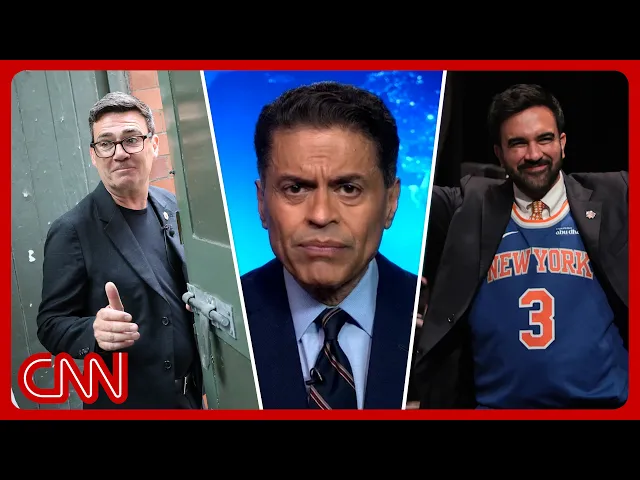
0:04 In the United Kingdom, the man widely expected to replace the stately
0:09 Sir Kir Starmer as prime minister is Andy Burn,
0:13 who touts businessfriendly socialism as his credo.
0:17 In New York, Democratic primary elections
0:20 produce striking victories for Democratic socialists,
0:24 suggesting that the insurgent left has found a way to turn protest into power.
0:30 A caveat, the left is not marching uniformly towards socialism.
0:34 Many primaries outside New York City were won by moderate Democrats.
0:39 In a swing district just outside the city,
0:42 the combat veteran Kate Connelly won handily.
0:45 But a certain kind of liberalism is losing energy,
0:50 confidence, and connection to the people it claims to represent.
0:55 In his book, The Revolutionary Center:
0:57 A Brilliant New Intellectual History of Liberalism
1:00 from the Enlightenment to the Present,
1:03 Adrienne Woolridge reminds us that liberalism was
1:06 once the most radical force in politics.
1:10 It attacked inherited privilege, monopoly, power,
1:14 censorship, aristocracy, clerical authority, and closed guilds.
1:18 It was not the ideology of the establishment.
1:21 It was the battering ram against the establishment.
1:25 Today, liberalism has become identified with power.
1:30 Great universities, foundations, media organizations,
1:33 corporations, bureaucracies of all kinds.
1:36 Woolridge argues that this has produced two deep failures.
1:41 The first is passivity.
1:44 Modern liberalism, certainly since the 1990s,
1:47 has celebrated free markets and free people.
1:50 In practice, this has meant deregulating both economic life and personal
1:55 life and then treating the consequences as the price of freedom.
2:00 In markets, this has allowed corporate consolidation to run wild.
2:04 In personal life, liberals have become reluctant
2:08 to say that certain behaviors are socially destructive.
2:12 The result is liberal fatalism.
2:14 People camp out on city streets addicted and mentally ill,
2:19 and liberals often just describe this as a housing problem.
2:23 Millions suffer from obesity related illnesses,
2:26 and liberals are more comfortable blaming food deserts than taking
2:29 on the companies that hook their customers on processed food.
2:33 Social media companies do the same with their consumers attention.
2:38 Woolrich calls for a revival of liberal paternalism.
2:42 The phrase great on modern years, but a liberal society should celebrate
2:48 individual rights and also demand individual responsibility.
2:51 It should understand that freedom can be destroyed
2:54 not only by the state but also by addiction,
2:57 monopoly, crime, ignorance, and dependence.
2:59 This is not an argument for socialism.
3:02 It's an argument for truer liberalism.
3:05 Liberals should love markets not because they allow
3:08 the strong to dominate or inequality to grow,
3:12 but because genuine competition allows the little guy to challenge the strong.
3:17 A healthy market is not one in which four
3:20 companies quietly divide up an industry and use lawyers,
3:24 lobbyists, and algorithms to keep challenggers out.
3:27 It's one in which new entrance can rise.
3:30 Consumers can choose, workers can move, and incumbents can fail.
3:36 The second failure Woolridge identifies is more
3:40 uncomfortable because it concerns liberals own status.
3:45 Liberalism believes in meritocracy.
3:46 Historically, this was one of its noblest causes.
3:49 It argued that people should rise by talent and effort,
3:54 not birth, race, cast, or class.
3:56 But over time, the meritocratic elite has hardened into its own aristocracy.
4:03 Elite liberals support social justice,
4:06 but do little to dismantle legacy admissions.
4:09 They want the poor to move up the ladder, but not if that requires building more
4:14 housing in the leafy neighborhoods where they live.
4:17 They praise individual merit but have created a vast diversity bureaucracy
4:22 that too often judges people by group identity rather than individual character.
4:27 Nowhere is this clearer than K to2 education.
4:31 A genuinely liberal politics would start
4:34 with the child and it would attack any institution,
4:38 union, bureaucracy, school board,
4:40 university department that feeds its own power while failing America's children.
4:46 This is where democratic socialists and right-wing populists gain their power.
4:51 They understand that people want someone to fight for them.
4:54 They may offer bad answers.
4:56 The left with class warfare, protectionism,
4:58 and state control, and the right with protectionism,
5:02 ethnic resentment, and racial nostalgia,
5:04 but they sound like outsiders willing to take on entrenched privilege.
5:09 And they offer protection in a world where freedom seems to mean chaos.
5:14 The way out of liberalism's crisis is not to abandon liberalism.
5:18 It's to recover its radical spirit.
5:20 Liberals should once again be the people who hate monopoly,
5:25 inherited advantage, closed systems, and rigged games.
5:29 They should champion real competition,
5:32 real meritocracy, and real equality of opportunity.
5:35 They should take on corporate power when it crushes markets,
5:39 government power when it protects insiders,
5:42 and cultural power when it creates bureaucracies
5:45 that substitute group identity for individual dignity.
5:48 As Woolridge argues,
5:50 the center cannot be merely a midpoint between left and right.
5:55 It has to be revolutionary in its own way.
5:59 Liberalism's great promise was never that people
6:01 would be left alone to decay in freedom.
6:04 It was that people would be given the tools,
6:07 rules, and responsibilities necessary to flourish.
6:11 Liberalism began as a revolt against encrusted power.
6:15 It will survive only if it becomes one again.
6:19 What I wonder about is the degree to which we have become tribalized.
6:24 So I give you an an example.
6:26 You know, one of the things I have argued
6:28 for a while is this is not about economics.
6:31 It's really about these deep cultural changes.
6:33 And how do I know this?
6:36 Because rather than economics informing people's politics,
6:39 it's actually the opposite.
6:40 It's politics that informs their economics.
6:42 What do I mean?
6:43 If you look in 2016,
6:46 most Republicans felt that the economy in 2016, the Obama economy was terrible.
6:54 When Trump gets elected, they've changed their minds.
6:56 They think the same economy is doing fantastically.
6:58 And Democrats think exactly the opposite.
7:01 The Democrats all thought the Obama economy was great
7:05 and by January 21st they thought the Trump economy was terrible.
7:10 Right?
7:10 So rather than economics shaping their politics,
7:13 it's politics that is shaping their view of economics.
7:17 And it's become a situation where your tribe is right no matter what.
7:21 It's almost like rooting for a sports team.
7:24 You know the sign of your virtue and loyalty is when you
7:29 are when you are sticking with your side even when they are
7:33 screwing up right it's easy to be a Bears fan if they
7:36 were winning it's easy to be a Mets fan if they were
7:39 winning the true test is are you a Mets fan when they
7:42 lose so in that environment even if you and I are right
7:47 that you know they this this thing seems to have had its
7:52 play will people actually see that what they voted for is not working.
7:58 And I ask you this because we are at a moment where
8:02 75% of the country basically thinks the Iran war was a bad idea.
8:06 But that doesn't seem to translate into any real loss
8:11 of Republican support for Donald Trump, whose idea it was.
8:14 Yeah.
8:15 First, um this is literally true.
8:16 My Mets hat is in my room right over there.
8:19 I will be wearing it tomorrow despite the fact that they're absolutely terrible.
8:23 Uh, you know, I I bank on a couple things.
8:27 First, what you're describing is the overpoliticization of American life.
8:32 And my view is we're overpoliticized and undermoralized.
8:35 We talk too much about politics and we use
8:38 politics as a social therapy to cure our loneliness.
8:40 Politics seems to offer you a team, but it doesn't really offer community.
8:43 It seems to offer you righteous action, but you're just tweeting.
8:47 And I have a feeling that this obsession with politics,
8:51 which sh is left and right, it's just going to seem boring after a while.
8:55 Donald Trump is a genius at getting us to pay attention to him,
8:59 but it's just going to seem boring and we
9:01 will enter a more uh less political time.
9:03 I think we'll also enter a time when optimism does sell.
9:06 And I am not a fan of Mandani's policies, but the guy smiles when he talks.
9:11 Yeah.
9:12 And that's a big deal.
9:13 And he is seems to be having a good time.
9:15 me is a total vibe shift from Donald Trump.
9:17 And I don't know whether we'll have an ideological vibe shift.
9:20 I really think we're going to have a cultural vibe shift.
9:22 Finally, I count on two things.
9:25 Uh both of which you've written a lot about.
9:28 America and liberalism, the belief system.
9:30 Your last book was about liberalism really as a way of life.
9:34 And when I think of liberalism as a way of life,
9:36 and you can talk about it more than I,
9:38 but I think of a story I read in a memoir uh over the year,
9:42 a memoir by Viola Davis, which I highly recommend, the great great memoir.
9:46 And Viola Davis, the actress, grew up very,
9:48 very poor, like dirt poor, dirt poor.
9:51 Uh, and she was in high school and the teacher, she's in drama class.
9:55 And the teacher says to the whole classroom,
9:57 "Who wants to be an actor when you grow up?" Every hand goes up.
10:01 And then the teacher says, "You realize there are auditions and there
10:04 are failures and there's poverty and you lose,
10:07 you get humiliated all the time and all the hands start
10:10 going down and finally there's only one hand in the air.
10:14 It's Viola Davis's hand." And she writes in this memoir,
10:18 "When you've had your heat shut off, you've gone to bed hungry,
10:21 you're not scared when somebody tells you life
10:23 is going to be hard." And she says,
10:25 "My dreams were bigger than my fear." And I think that's woven into the DNA
10:31 of America to the immigrant people who came
10:34 here and my family too a little earlier.
10:36 And um I think it's woven into liberalism
10:39 that what Viola Davis just expressed to me that's liberalism.
10:43 You can start from nothing.
10:44 You have freedom.
10:45 You have ladders.
10:46 If you want it and you have the hunger in your heart,
10:50 you can become Viola Davis.