Understanding Poisson's Ratio
The Efficient Engineer
0:00 Hello everyone, and welcome to another video on the Efficient Engineer channel!
0:04 In this video we're going to take a look
0:07 at a really interesting material property, Poisson's ratio.
0:13 Poisson's ratio is such an important material property because it
0:16 gives us key information about how different materials deform under loading.
0:21 Let's get right into it!
0:24 We can start with a quick example, the rubber band.
0:28 If you take a rubber band and stretch it along its length,
0:31 its length will obviously increase.
0:32 But it is also quite intuitive that at the same time the band will get thinner.
0:39 Poisson's ratio can tell us how much thinner the band is going to get.
0:46 What about for a generic lump of material?
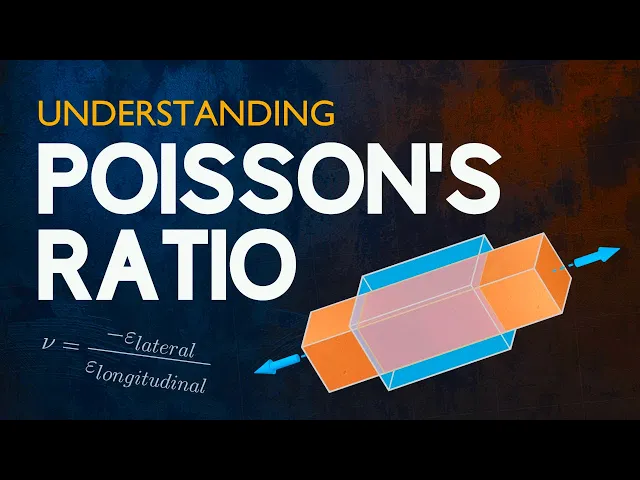
0:47 Take this little orange cuboid- if we apply a compressive force to it,
0:52 it will expand in the directions which are perpendicular
0:55 to the direction in which we are applying the load.
0:59 We call the direction along which
1:00 the load is applied the longitudinal direction,
1:02 and we call the perpendicular directions the lateral directions.
1:09 If we reverse the direction of the force to apply a tensile load,
1:13 the cuboid will obviously extend in the longitudinal direction,
1:16 and it will contract in the lateral directions.
1:21 The key concept here is that when you
1:23 apply a load to a material in one direction,
1:25 the material will also deform in the lateral directions.
1:29 Poisson's ratio is the parameter that tells us how
1:32 much the material will deform in the lateral directions.
1:38 To define Poisson's ratio more precisely,
1:40 let's take a closer look at the case where a tensile force is applied.
1:45 First let's give names to the various parameters involved.
1:49 Lx, Ly and Lz are their original dimensions
1:52 of our cuboid along the X, Y and A axes.
1:57 Delta Lx, Delta Ly and Delta Lz are the changes
2:00 in these dimensions after the load has been applied.
2:05 They are shown as being divided by two because
2:07 the change in dimension occurs on both sides of the object.
2:12 Next we can write out the strains in all three directions.
2:15 As a quick reminder strain is a measure of deformation,
2:18 and it is defined as the change in length divided by the original length.
2:22 It is denoted using the Greek letter
2:24 epsilon and is usually expressed as a percentage.
2:29 When we apply our longitudinal load,
2:31 it turns out that the resulting strains in the lateral directions are equal.
2:35 And here's the interesting part- they are
2:38 proportional to the strain in the longitudinal direction.
2:41 The ratio between the longitudinal strain
2:43 and the lateral strain is actually a material constant.
2:48 You might have guessed it by now,
2:49 but we denote this material constant with the Greek letter nu,
2:53 and we call it Poisson's ratio.
2:56 By the way, Poisson's ratio is named after this guy, Siméon Denis Poisson,
3:02 the famous French mathematician who formally defined
3:04 the ratio in a note published in 1827.
3:09 You might be wondering why a minus sign slipped into the equation.
3:14 Remember that by convention tensile strains
3:15 are positive and compressive strains are negative.
3:19 The minus sign is just there so that for the typical case
3:21 where the lateral strains are opposite in sign to the longitudinal strains,
3:25 we get a positive Poisson's ratio.
3:28 Now is probably a good time to mention that this equation
3:31 and the concepts described in this video only apply for isotropic materials,
3:35 which are materials which have the same properties in all directions.
3:40 We are also assuming that the materials are deforming within the elastic region.
3:43 Things get a bit more complicated when plastic deformation is involved.
3:49 Anyway to summarise, Poisson's ratio is a dimensionless material property
3:52 which tells us how much a given material
3:55 will contract in the lateral directions when
3:57 we pull on it in a longitudinal direction.
4:02 Now that we know what Poisson's ratio is,
4:03 we can look at some typical values for different materials.
4:08 Without getting too deep into the math behind it,
4:10 it's useful to know that the theoretical range of possible
4:13 values for Poisson's ratio goes from -1 to 0.5.
4:18 In practice, most real materials have a Poisson's
4:20 ratio of somewhere between 0 and 0.5.
4:24 Most metals have a Poisson ratio of around 0.3.
4:28 Here are some typical values for a few selected materials.
4:38 Now let's look at how different values of Poisson's
4:41 ratio affect how a material deforms under loading.
4:46 We'll keep things simple and consider a two-dimensional case.
4:50 Most materials have Poisson's ratios between zero and 0.5.
4:55 When a tensile force is applied,
4:56 these materials contract in the lateral directions
4:59 as we have already seen with our orange cuboid.
5:04 Materials with a Poisson's ratio of zero are interesting.
5:08 When a longitudinal tensile force is applied
5:10 there is no deformation in the lateral directions.
5:14 One material that behaves in this way is cork,
5:17 which has Poisson's ratio close to zero.
5:20 This property makes it a very useful material for certain applications.
5:23 A great example is the cork in a bottle of wine.
5:27 Because it doesn't expand laterally when compressed, as you can see here,
5:30 it can easily be inserted into the neck of a bottle.
5:33 A material with a larger Poisson's ratio would be much more difficult to insert,
5:37 as it would expand in the lateral directions when compressed.
5:44 Finally we have materials with negative Poisson's ratios.
5:47 These are known as auxetic materials.
5:50 They expand laterally when pulled,
5:52 and contract laterally when compressed, which seems counter-intuitive.
5:55 These are mostly engineered materials, like special foams,
5:59 rather than materials occurring naturally in nature.
6:03 This animation should give you an idea of how
6:05 it is possible to get negative Poisson's ratios.
6:08 You can see that as the material is compressed,
6:10 both its longitudinal and lateral dimensions are reduced.
6:14 For a typical material with a Poisson's ratio larger than zero,
6:17 you would expect the lateral dimensions
6:19 to increase when the material is compressed.
6:24 Because it tells us how a material deforms,
6:26 Poisson's ratio is a very important parameter in continuum
6:29 mechanics for determining how a body responds to applied stresses.
6:34 Let's look at a simple case of uniaxial stress, the tensile test.
6:39 It is easy enough to determine the strains acting
6:41 on a small piece of the specimen under test.
6:44 The applied stress is a normal stress in the X direction, sigma X.
6:48 The strain in the longitudinal X direction is simply given by Hooke's law,
6:53 as sigma X divided by the Young's modulus E.
6:56 Even though there are no stresses acting in the lateral Y and Z directions,
7:01 there will be strains in these directions,
7:03 as the material is contracting laterally.
7:05 The strains in the lateral directions are obtained
7:08 by multiplying the longitudinal strain by Poisson's ratio.
7:12 This is just using the definition of Poisson's ratio which we covered earlier.
7:15 But what if we look at a more complex case where we have tri-axial stress,
7:21 with different stresses in all three directions?
7:24 In this case we can't just use Hooke's
7:27 law to determine the strain in the X direction,
7:29 because it will also be affected by the strains in the Y and Z directions.
7:34 The simple version of Hookes law for uniaxial stress no longer applies because
7:38 the strains in one direction will depend
7:41 on the stresses applied in all three directions.
7:44 We can use Hooke's law in combination with the equation for Poisson's ratio,
7:48 and the principle of superposition,
7:50 to obtain the equation for strain in the X direction.
7:59 We can re-arrange this equation into a more practical form, like so,
8:06 and then apply the same process to obtain
8:08 equations for strains in the Y and Z directions.
8:12 These equations form what is known as the Generalized Hooke's Law,
8:15 and can be used to determine deformations for a case of tri-axial stress.
8:21 There is one last case I would like to mention,
8:24 which is materials with a Poisson ratio of 0.5,
8:26 the maximum value in the theoretical range we discussed earlier in the video.
8:31 Let's return to our cuboid to introduce the concept of volumetric strain.
8:36 Volumetric strain is a measure of the change in volume of an object under load.
8:41 I'm sure it will come as no surprise
8:43 that it is closely linked to Poisso'ns ratio.
8:47 We can calculate the volumetric strain
8:49 by summing the strains in all three directions.
8:53 Let's use the equations from the Generalized Hooke's Law
8:56 we just covered to expand the equation for volumetric strain.
9:01 We can then re-arrange the terms to end up with the following equation.
9:07 You might notice that something interesting happens to the volumetric
9:10 strain when Poisson's ratio is equal to 0.5.
9:13 We end up with a volumetric strain equal to zero.
9:16 This means that for materials with a Poisson's ratio of 0.5
9:20 the volume of the material remains constant as it deforms.
9:24 These are known as incompressible materials.
9:27 Rubber is an example of an incompressible material.
9:32 And that's it!
9:34 We've reached the end of our review of Poisson's ratio.
9:37 If you enjoyed watching,
9:38 please remember to like and subscribe for more engineering videos!