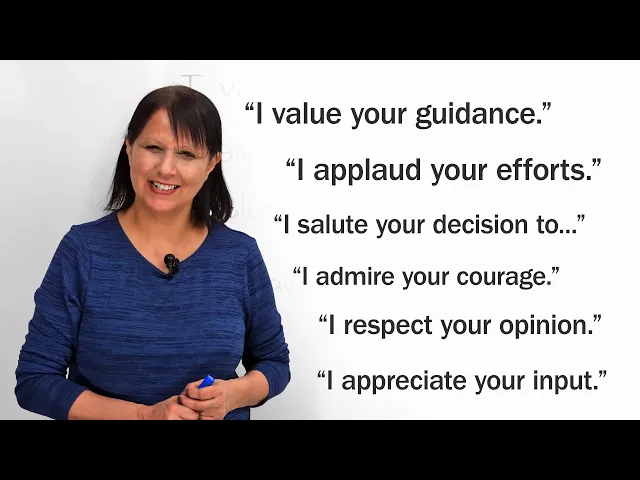
The Vocabulary of Respect: 40 Ways to Improve Your English & Our World
Learn English with Rebecca · engVid
0:00 Hi, I'm Rebecca from engVid,
0:01 and this is a very special lesson for me and I hope for you as well.
0:07 In this lesson, I want to give you the vocabulary of respect.
0:13 What does that mean?
0:14 I want to show you several words that you
0:18 can use to express your feelings of gratitude or thankfulness
0:23 to someone or some people who you know have helped
0:28 you and who have been kind to you, and so on.
0:33 Now, you can always show your thanks and your gratitude
0:37 to someone by simply saying "thanks" or "thank you", right?
0:42 We can use these very basic words, and you should.
0:45 That's absolutely fine.
0:47 However, it can be even more meaningful to have
0:51 some more words to follow up with after
0:55 that or to find other ways in which to express
0:59 these very important feelings and ideas to someone else.
1:04 Now, the vocabulary that we're going to look
1:07 at today can be used in your personal
1:09 life or in your professional life because we
1:13 need to express this in all kinds of situations,
1:17 whether it's to the people who are near and dear to us, our family, our friends,
1:21 and so on, or whether it's to people we work with, our colleagues, our managers.
1:26 We need to show and establish a kind of relationship
1:31 where we express to others the gratitude and the good
1:36 feelings that we have for things that they have done
1:39 for us or for things or for who they are.
1:43 So, I'm going to give you the vocabulary to do that.
1:46 We're going to do that with six main verbs,
1:49 and then we're going to look at lots of other expressions
1:53 and collocations that you can combine these verbs with to express these ideas.
1:59 Okay?
2:00 So, I hope this lesson will interest you and that you will
2:04 start to use this to express some very important feelings to others.
2:08 All right.
2:09 So, let's begin here with one of the most commonly used words,
2:14 and that is this one, "appreciate".
2:18 Okay?
2:19 So, that's a verb that many students do use.
2:22 I see that in emails and so
2:24 on, and many people will write something like, "Thanks.
2:28 I appreciate it." So, what does it mean to appreciate something?
2:33 It means that you are...
2:35 You realize that it's important, you realize that it's relevant,
2:40 and you recognize that it's special and you
2:43 want to thank someone a little bit more, and so you appreciate that.
2:48 Okay?
2:48 You say, "I appreciate it." Now, you could simply say, "Thank you.
2:53 I appreciate it", if you already described what it is
2:57 that the other person did for you that you appreciate,
3:01 that you understand, has value, has importance.
3:05 Or you can go further with your...
3:09 And I'm going to give you the vocabulary so that you can be really precise,
3:13 and that's part of having a more educated vocabulary,
3:17 a more advanced vocabulary, is being able to describe exactly what
3:22 it is that you're showing your appreciation for.
3:26 So, let's look at some possibilities.
3:29 And you could actually start to include
3:31 this when you're speaking or in an email.
3:35 All right?
3:35 So, let's look at that.
3:37 So, first of all, let's look at the pronunciation of this word.
3:42 Okay?
3:42 It's written like this, but it's pronounced like this, "ah-pree-shee-ate".
3:50 Say it after me, "ah-pree-shee-ate", "ah-pree-shee-ate".
3:55 The stress is on "ah-pree-shee-ate", so the stress is here.
4:00 Okay?
4:01 "Ah-pree-shee-ate", "I ah-pree-shee-ate that", "I ah-pree-shee-ate it".
4:06 Okay?
4:07 Next.
4:08 If we're going to be more specific, then we could say something like this, "I
4:13 ah-pree-shee-ate your help." That's a sentence by itself.
4:19 "I ah-pree-shee-ate your assistance." "Assistance" is just
4:22 a little more formal or business-like word for "help".
4:26 Same thing.
4:28 "I ah-pree-shee-ate your time." Somebody spent time to help you,
4:33 to explain something to you, to advise you, to guide you, so you could add that.
4:40 Or, "I ah-pree-shee-ate your input" or your contribution, okay?
4:47 When somebody gave something to you,
4:49 that added to something that you were working on, a project, a report,
4:54 or something like that, and they gave you their thoughts,
4:57 their ideas, or their information,
4:59 or they took part in it, then that's their input, what they put in.
5:05 Or, what they contributed, okay?
5:09 Alright.
5:10 Next.
5:11 "I ah-pree-shee-ate your generosity" or "I ah-pree-shee-ate your donation".
5:18 Now, "donation" mean...
5:21 Usually refers to money, but it doesn't have to.
5:26 So, if somebody gave money, you could say, "I ah-pree-shee-ate your donation",
5:30 but sometimes people don't just donate money, they can also donate other things.
5:35 They could donate furniture, they could donate old clothes,
5:38 they can donate food, alright?
5:40 That's fine.
5:41 So, then you would say, "I ah-pree-shee-ate your donation",
5:44 something that you gave free without making anybody pay, or your generosity.
5:51 Generosity is the quality of being generous,
5:55 of somebody who gives with all their heart or gives very easily and openly,
6:01 and this doesn't have to mean only for physical things.
6:06 It can also be just for help, for advice,
6:10 for guidance, for leadership, all kinds of things.
6:13 They were generous in many ways, okay?
6:16 So, this is what you could use in that context.
6:20 Let's look at some more specific things that you could say to thank someone.
6:26 "I ah-pree-shee-ate your advice." "I ah-pree-shee-ate your ideas.
6:33 They really helped me to find a solution
6:37 to my problem." Or "I ah-pree-shee-ate your suggestions", okay?
6:43 Or recommendations, and so on.
6:47 Next, if you did something and then you asked someone
6:50 to look over it and tell you what they thought,
6:53 and then they did, you could say "I ah-pree-shee-ate your feedback", okay?
6:58 They gave you their thoughts on how it was,
7:02 or "I ah-pree-shee-ate your comments", okay?
7:08 Next, here we come to some other areas, okay?
7:11 These are now describing not things that somebody did,
7:15 but qualities that they have.
7:17 For example, "I ah-pree-shee-ate your kindness." "I
7:23 ah-pree-shee-ate your thoughtfulness." You thought about something beforehand.
7:28 You thought, oh, you read an article and you realized, oh,
7:31 I was looking for that information and you forwarded it to me,
7:36 or something like that, okay?
7:39 "I ah-pree-shee-ate your honesty." Somebody told
7:43 you exactly how they felt about something,
7:45 they told you what would help you, what would not help you,
7:49 or told you the truth about something else.
7:52 That's important in life,
7:53 to have people around you who are honest with you, okay?
7:57 So, these are just some of the many words
8:01 you could use just with this one verb, "appreciate", okay?
8:07 Now, we are going to cover other verbs, not just "appreciate",
8:11 because if in every email you write to someone,
8:15 "I appreciate", "I appreciate", there's nothing wrong.
8:18 It's probably the most common one that we use,
8:21 but there are many other verbs, okay?
8:23 And we're going to look at these, "I value",
8:28 "I admire", "I respect", "I applaud", and "I salute".
8:35 And on the next board, I'm going to explain to you exactly what those mean,
8:39 and several ways in which you can use some
8:42 more of these very respectful words to show your respect,
8:46 your appreciation, and your gratitude,
8:48 and your thankfulness for what someone else did.
8:52 And this is a wonderful way to not
8:55 only make your relationships deeper and better,
8:59 but also to make the world around you and your environment at home,
9:04 or with friends, or at work into a much more peaceful and harmonious place.
9:10 Now, let's look at five more words that you can use
9:13 to show your appreciation of what someone has done for you, okay?
9:17 So, these words are "respect", "value", "admire", "salute", and "applaud".
9:26 What do you think would happen if you started to communicate like this?
9:31 What if you started to use this kind of vocabulary with your family,
9:35 with your friends, with your colleagues?
9:38 Do you think that it would make the world a slightly better place?
9:41 I think so.
9:43 I try to use this kind of vocabulary
9:45 in my writing when I talk to people I care about,
9:48 and I care about most people in the world, okay?
9:52 So, I think it will help you to deepen your relationships,
9:56 and also to express more of what you have in your heart
10:00 or in your mind about what someone has done for you, okay?
10:04 So, let's look at these words a little more carefully.
10:07 So, we could say, "I respect something." So,
10:10 what does it mean to respect something?
10:12 It means you have a high opinion of that.
10:15 You appreciate that.
10:17 All of these words basically mean appreciation,
10:20 but in slightly different ways, okay?
10:24 So, here we could say, "I respect your opinion." I respect your feelings.
10:32 You can also respect people, of course.
10:36 "I respect your parents." "I respect your family." "I
10:39 respect your team." If you're working in an office.
10:43 "I respect the work that your department does." It means a lot.
10:48 It's very important for me, or it's very important for our company, okay?
10:53 Or for our success.
10:55 Things like that.
10:57 Okay, let's look at some more.
10:59 "I value." "Value" is like "appreciate", maybe a little bit higher, even.
11:05 I value it.
11:06 I consider it very important, very worthy.
11:10 It's valuable to me, okay?
11:13 Just like a diamond ring could have value to somebody, the same way,
11:18 kindness and help that someone has given you or advice that someone
11:23 has given you can also be of value to you, okay?
11:26 So, then you could say, "I value your judgment." What is judgment?
11:33 Your ability to understand what's right and wrong, what's good or bad, okay?
11:39 This is judgment.
11:41 "I value your guidance." You're helping me.
11:45 I was new in this company.
11:46 I didn't know what to do.
11:48 You told me you could do this, you should be aware of this, you could try this.
11:53 This somebody was guiding you,
11:55 somebody was helping to show you the right way forward, okay?
11:59 So, this is guidance.
12:01 You could also say to someone,
12:04 "I appreciate our friendship." "I appreciate our relationship." Okay?
12:10 Again, as I said, some of these you can
12:12 use in the work context and some outside of work.
12:15 We have a life outside of work as well, which is very important to us,
12:19 and it's important to also express to those who are closest to us regularly
12:25 how much we appreciate who they are and how much they mean to us, okay?
12:30 Don't wait to do that.
12:33 Do it.
12:33 Do it regularly.
12:34 It will make such a big difference,
12:36 not only for you, but also for those around you,
12:40 and then as you communicate like that, people
12:42 will also communicate with you that way.
12:44 But don't worry about that.
12:46 We can only do the right thing.
12:48 Okay.
12:49 Next, "I admire".
12:52 "I admire your courage." So, what does it mean to admire something?
12:57 You're like, "Wow, look at that.
12:59 How did you do that?" Like somebody who, I don't know,
13:02 climbed Mount Everest or did something like that, which
13:06 was very amazing for that person to have achieved.
13:11 You say, "I admire that.
13:12 It was so inspiring.
13:14 I wish I could do something like that." That's
13:16 when we talk about "I admire that", okay?
13:19 So, you could say, "I admire your courage.
13:22 You weren't afraid.
13:23 You were brave, even when you were faced with this difficult situation.
13:28 I admire your strength.
13:30 You were strong, okay?
13:32 Even when hard times came along.
13:35 Even when there were difficulties.
13:37 Even when there were challenges.
13:39 You stayed strong.
13:40 You stayed optimistic." You could say, "I admire your optimism.
13:46 You stayed positive.
13:47 You believed that good things were going
13:49 to come." Or, "I admire your determination.
13:54 You had decided that you were going to achieve this goal, and you kept going.
13:59 You didn't give up, even though it was hard." This is to be determined,
14:04 to have determination.
14:06 Or, "I admire your patience.
14:09 It took time to receive your goal, to achieve your goal.
14:14 It took time to receive an answer from someone, but you didn't give up.
14:20 You were patient.
14:22 You waited.
14:23 I admire your patience in that case." Okay?
14:28 Now, we have two other lovely words, "I salute".
14:31 So, "salute" is like this, right?
14:33 They do this in the army to show respect to a higher official or in any
14:39 kind of situation like that, but we don't
14:41 only have to use it in those situations.
14:44 All right?
14:45 We can also use it in general to express what?
14:49 That, "Wow, I look up to you.
14:51 I respect you.
14:52 I salute you." You can say that.
14:55 If somebody did something or said something really amazing, you can say,
14:59 "I salute you." That means you're showing your respect
15:03 towards that person or whatever their actions or achievements were.
15:07 So, you could also say, "I salute your decision.
15:11 I salute your vision." Somebody has a view that's bigger,
15:17 some ideas or innovations which are going to change the world,
15:21 which are going to improve things for others.
15:24 This is a vision that someone has.
15:27 Or, "I salute your compassion,
15:30 your caring for other people around the world." Okay?
15:35 From your heart, understanding what they're going through, helping them.
15:40 Or, "I salute your wisdom." Okay?
15:44 How wise somebody is.
15:46 Not just your intelligence, but your wisdom.
15:50 Knowing, understanding the difference between right and wrong,
15:54 and so many other things.
15:56 Okay?
15:56 So, that's why we talk about wise people, wise elders, and so on.
16:02 Next, "I applaud." So, what does it mean to applaud?
16:05 Like this, right?
16:06 Like what you do after a concert or a show or something,
16:11 you applaud or you clap.
16:13 So, this is called applauding physically when we go to a concert or something.
16:19 But when we say, "I applaud your performance",
16:22 it also means the same thing like "I appreciate it",
16:26 because when an audience claps, what are they trying to show?
16:30 They're trying to show that they appreciate what they've just heard,
16:34 what somebody just performed.
16:36 Right?
16:37 But you could also say that to your colleague.
16:40 Let's suppose that your colleague did a fantastic
16:43 job at a presentation and got the contract.
16:46 Okay?
16:46 Got a new client.
16:47 You could say, "I applaud your performance." It's a way of saying,
16:51 "I think you did a fantastic job.
16:53 You did a great job.
16:55 I applaud you.
16:57 I applaud your performance.
17:00 I applaud your creativity in coming up with these ideas,
17:04 in creating these solutions." Okay?
17:07 "Your creativity.
17:09 I applaud your efforts, your hard work." Or, "I applaud your talent.
17:16 You are so talented.
17:17 You have such amazing abilities that you show again and again." All right?
17:23 So, look at the very,
17:24 very many ways in which we can compliment and express our gratitude
17:29 to other people for the many things that they have done.
17:32 And when you look around,
17:34 you can probably find someone or some people in your life,
17:38 either at home or at work or somewhere else,
17:41 who you can express your appreciation to.
17:44 So, I hope that this lesson has given
17:47 you some of the vocabulary that you can do...
17:49 Use to express those ideas.
17:52 All right?
17:53 So, perhaps in the comments, you could write something to express
17:59 your appreciation for different people in your life.
18:03 What would you say?
18:04 What would you say to your parents?
18:06 What would you say to your siblings,
18:08 your brothers, sisters, your friends, your manager?
18:12 Perhaps there's a manager who's been extremely helpful.
18:15 It doesn't always have to be just a family member or a friend.
18:18 Who would you like to thank?
18:19 How would you do that?
18:21 Use some of this vocabulary.
18:23 Tell someone today or write to someone today, use some of this vocabulary,
18:27 and you'll start to see so much change
18:30 and positive change in your relationship and in your satisfaction,
18:35 not only in your career, but also in life in general.
18:38 Okay?
18:39 I wish you the very best.
18:41 Thanks very much.
18:42 And I would like to appreciate...
18:44 To show my appreciation and express my appreciation
18:49 to you to tell you thank you for watching,
18:53 thank you for caring enough about improving
18:56 your English to make your life better,
18:58 to make your career better, to help your family more.
19:01 All right?
19:02 So, thank you very much.
19:04 I appreciate your watching.
19:06 Thank you, and all the best.
19:07 Bye for now.