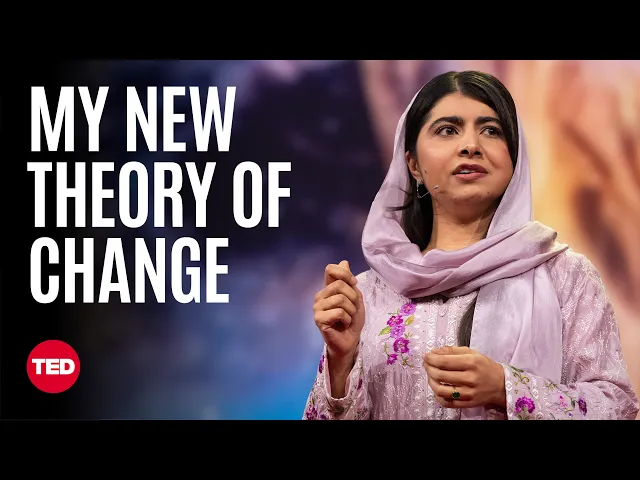
What I Got Wrong About Changing the World | Malala Yousafzai | TED
TED
0:04 When I was a child, I thought changing the world was simple.
0:09 I would tell the people in charge all of my problems, and they would fix them.
0:15 I know how naive this sounds now,
0:18 but at nine or 10 years old it made sense to me.
0:22 I lived in a remote mountainous region of Pakistan.
0:26 The prime minister was more than 100 miles away from me in the capital city.
0:30 He couldn't see the trash polluting our rivers
0:33 or our broken school bus or hospitals with outdated equipment.
0:38 I was sure that our leaders could solve all
0:42 of these problems if only I could get their attention.
0:48 At age 11, I faced the biggest, most devastating problem of my life.
0:55 The Taliban took control of my town and decreed
0:59 that girls could no longer go to school.
1:03 I knew what life would be like for me without an education.
1:07 Marriage in my teens, two or three children by the time I was just 20.
1:12 It meant I would have no choice, no control of my future.
1:18 If I was ever going to get people's attention, this was the moment.
1:23 I decided to become an activist.
1:26 I gave interviews at protests, I spoke on television,
1:31 I wrote a blog for the BBC and I appeared in a “New York Times” documentary.
1:36 I did everything I could to reach to our leaders and ask for their help.
1:43 Simply for the crime of speaking out, the Taliban tried to kill me,
1:52 shooting me in the face at point-blank range.
1:57 I was 15 years old.
2:01 But with the help of many doctors and even more prayers, I survived.
2:07 Millions of people heard my story.
2:09 Presidents and prime ministers all over the world wanted to meet me.
2:13 I was finally in the rooms where decisions were made,
2:18 and I could bring attention to girls like me
2:21 who did not have the opportunity to be in school.
2:25 And that's when I realized that changing the world
2:29 wasn't as simple as pointing out the problems.
2:33 You had to argue for every policy change and budget increase,
2:37 and you might have to get the support of as many people as possible.
2:41 And you might have to advocate for months
2:44 or even years to take one step forward.
2:49 Eventually, I came to believe that change was slow but steady,
2:57 incremental, but thankfully inevitable.
3:01 My foundation had been hope and optimism.
3:06 Faith that people would do the right thing.
3:10 Trust that when leaders said they cared
3:13 about making our lives better, they meant it.
3:17 Even if it took longer than I wished.
3:22 But then in a single day, my belief in progress shattered.
3:30 It was August 2021.
3:36 I was in the hospital, recovering from one last surgery to repair
3:40 the facial paralysis I suffered after the attack.
3:45 I picked up my phone and saw: The Taliban had taken control of Afghanistan.
3:54 I was stunned.
3:56 Shattered.
3:58 Terrified.
4:00 Angry.
4:02 How could I continue to have faith that things would improve?
4:06 How could anyone believe that leaders were
4:09 committed to girls' education when they handed over
4:12 an entire country to the men who pointed
4:15 a gun at my head and pulled the trigger?
4:22 From the recovery room, I called Afghan women I knew,
4:26 activists who were working around the country.
4:30 They were frightened, too.
4:33 On TV, experts and politicians were saying that the Taliban had changed.
4:39 That this new version of the Taliban
4:41 wouldn't ban girls from school or oppress women.
4:45 The Afghans I spoke with didn't believe it.
4:49 And they were right.
4:52 Today in Afghanistan, girls are not allowed to attend school past sixth grade.
4:59 It is a crime.
5:02 Women, who five years ago were doctors, politicians, engineers and artists,
5:08 are not allowed to go to university or pursue a career.
5:13 A woman speaking in public is a crime.
5:17 But do you know what is not considered a crime?
5:21 This year, in 2026, the Taliban decreed that it
5:27 is legal for men to beat their wives and daughters.
5:33 The Taliban have imposed a system of segregation and domination,
5:39 a gender apartheid on millions of women and girls.
5:46 For years, I thought the purpose of my life was to serve girls.
5:53 After Afghanistan, the optimism I had as an 11-year-old activist was gone.
6:00 But I couldn't walk away.
6:03 Because I knew exactly what Afghan girls were going through.
6:08 When I saw pictures of little girls
6:10 standing outside the locked gates of their schools,
6:13 I could not stop thinking about them.
6:17 I know many of us feel overwhelmed and lost today,
6:23 like the obstacles are too big and there's little we can do to fix the problem.
6:29 But there's a lot I have learned over the past few years,
6:33 and I want to share with you how
6:36 to keep fighting for change when you have lost hope.
6:41 First, you have to start with something.
6:47 While I couldn't undo the catastrophe that had just happened in Afghanistan,
6:51 I knew I had to get out of my hospital bed and find a way to help.
6:57 I started by supporting underground schools because
7:00 the Afghan girls are not giving up on learning,
7:04 even if it means risking their lives.
7:06 Across the country today, they are listening to lessons on the radio,
7:12 discreetly passing cassette tapes and books to each
7:15 other and trying to keep studying in secret.
7:19 It is far from the education that they deserve, but it's a start.
7:26 The second thing I learned is the importance of working with others.
7:32 And that has led me to some unexpected places,
7:35 like movie theaters and football fields.
7:39 I have produced two films about Afghanistan—
7:43 "Bread and Roses" and “Champions of the Golden
7:46 Valley”— stories of Afghan men and women
7:50 who are resisting the Taliban's oppression.
7:53 And I have joined the campaign of [the] Afghan women’s national
7:58 football team to push FIFA to allow them to compete in exile.
8:04 The Taliban are erasing...
8:07 (Applause) The Taliban are erasing women from public life.
8:16 But I am here to do the opposite of what the Taliban want.
8:20 That is why I am taking every opportunity to show Afghan women speaking,
8:27 singing, kicking a ball and standing up for their rights.
8:31 (Applause) Because the artists and athletes that I
8:41 work with help connect the world to the women
8:44 and girls who are living through this crisis
8:46 and to the belief that every life carries equal worth.
8:54 My final lesson: stay ambitious.
9:00 I know it might sound foolish to be
9:02 setting high goals when you are losing a battle.
9:07 But the bigger the fight, the bolder you have to be.
9:13 What is happening in Afghanistan is a wake-up call for all of us.
9:19 Because the Taliban's cruelty against women and girls did not begin in 2021.
9:25 They tried to silence me a decade earlier in Pakistan,
9:29 and before I was even born,
9:32 they were stopping girls from school in parts of Afghanistan.
9:37 Yet we have no international laws against gender apartheid,
9:43 no way to hold the perpetrators and their sympathizers accountable.
9:49 That is why Afghan women are campaigning to add
9:53 these abuses to the UN’s Crimes Against Humanity treaty.
9:59 And I have joined this movement to ensure
10:02 that we change things for women and girls everywhere.
10:06 (Applause) It is a big goal.
10:16 I know it may take many years to see the Taliban brought to justice,
10:21 but I will keep fighting so that these crimes are
10:25 not committed against another generation of girls anywhere in the world.
10:30 (Applause) When I think about the 11-year-old girl I once was,
10:41 I want her to be proud of who I am today.
10:44 I want her to know that although changing the world is
10:48 not as simple as she thought, I will not give up.
10:53 Here is the truth: I don't have all the answers on how to change the world,
10:59 and I don't believe anyone else does either.
11:02 If I have learned anything, it is that progress is never guaranteed.
11:08 There isn't one speech or one story,
11:10 one moment or one person that can bend the arc of history on their own.
11:17 But if we start with something, work together and stay ambitious,
11:24 hope stops being a thing we wait to feel and becomes something we create.
11:29 Thank you.
11:31 (Cheers and applause) Thank you so much.
11:38 Thank you.
11:39 (Applause)