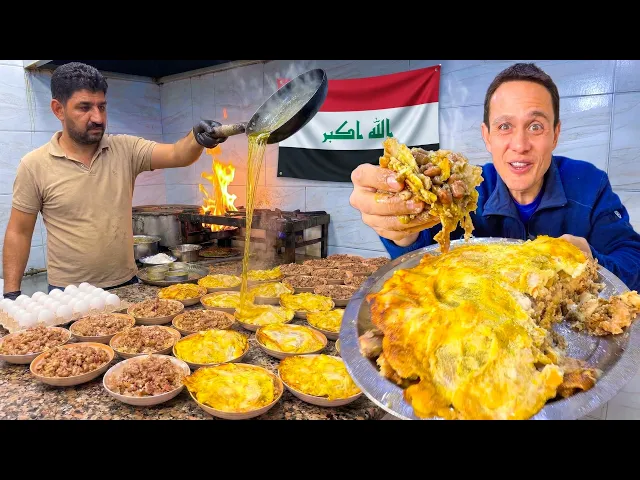
Iraq’s $2 Breakfast That Fuels 20 Million Pilgrims!!
Mark Wiens Abroad
0:00 I'm about to eat the most famous Iraqi kebabs in Karbala.
0:03 And along with trying one of the best kebabs I've ever had in my life.
0:08 That kebab just melts in your mouth.
0:10 We'll find [music] out why over 20 million pilgrims visit Karbala every year.
0:17 You could just stand in here in awe.
0:26 Try some of the local street food.
0:30 And later on we'll find out what it's like to visit the ancient city of Babylon.
0:35 But first, what is Iraq's breakfast of champions?
0:39 And this is the spot for a special breakfast dish this morning.
0:43 So we're at a local restaurant and we came
0:45 here to eat a dish which is called Bagillid Belbihan.
0:49 Belbihan.
0:50 And it's a local, especially a breakfast dish in Iraq.
0:53 They have the You can hear the raging fire going in the background.
0:56 It's like a jet flame that they cook it on.
0:58 We're going to see how they prepare it.
1:01 The fire is absolutely blazing.
1:04 Okay, so it all begins with bread.
1:06 Oh, he chucks it into the soup.
1:08 And that's like a a broth from fava beans.
1:11 This is quite a dish and it's quite incredible, impressive to see it being made.
1:15 But he takes the whole uh sheets of bread.
1:18 He dunks them into fava bean juice.
1:20 It's like the broth of fava beans.
1:22 He soaks them.
1:23 Then he puts it into your bowl and kind of does a hand
1:25 massage and squeezes it and breaks it up saturated with the fava bean juice.
1:29 Then he adds on the fava beans on top of that.
1:32 Then he heats up some molten ghee, so like uh butter.
1:36 He heats up the butter, the ghee,
1:38 until it's molten hot and then he pours that on.
1:41 And then after that he cooks an omelet and puts an omelet on top.
1:45 Oh, now he's making like 10 in a row.
1:55 Wow, that's a hot fire.
2:00 Woah.
2:02 Flip over the egg.
2:06 Got to the omelet.
2:09 Wow, that is so hot.
2:15 What a dish and it's quite a a quite a more omelet goes on top.
2:20 But just sizzling on my Look at that that omelet is boiling.
2:23 This one is ours.
2:26 Oh, we got extra omelet.
2:28 Yes.
2:29 Wow.
2:30 Shukran.
2:31 I think that one is ours.
2:35 So we're sitting down.
2:35 This is a very popular breakfast spot breakfast dish and it
2:39 looks so hearty and I've never seen this exact procedure done before.
2:43 I love how they soak the bread in the bean juice.
2:45 Served with onions, served with the are these the orange lemons?
2:49 The orange lemons?
2:49 And they use I guess you add so much
2:51 that they even give you a juicer on your table.
2:54 Okay.
2:55 Muhammad, how should we start?
2:58 Oh, first squeeze on.
2:59 Oh, amazing.
3:01 I love the Iraqi lemon orange hybrids.
3:05 It's like the sourness of lemon plus the fragrance of an orange.
3:10 So reach down.
3:11 Oh, I'm going to go more mostly for that bread and fava beans first.
3:17 Oh, it's like fully saturated.
3:19 The bread is just broken down into like juiciness with the fava beans.
3:33 Oh.
3:36 The starchiness of the beans.
3:40 The bread has absorbed all that broth.
3:43 The bean broth and then you really taste the scorch of that ghee on top that's
3:47 just been heated to such a hot level that it just like scorches it scorches it,
3:53 and that brings out the flavor.
3:55 That's very good.
3:56 Very good.
3:57 Then you can mix it with the omelet.
3:58 You can chase with the onions.
4:00 Let's see what Muhammad does.
4:02 Oh, he adds some of the onions to the bite,
4:04 and then that gives you like that refreshing touch.
4:07 Okay, for this one, I'll grab some of the omelet to pair with that.
4:11 Omelet with the onion.
4:13 Oh.
4:23 Mhm.
4:27 That's good.
4:28 Saturated in the ghee and oil.
4:33 So hearty.
4:34 This is the type of dish that will give you energy for the entire day.
4:38 So, we're adding on another thing.
4:39 Chef never heard of it, but it's called betony or lamb's ear.
4:42 It's an herb, and it has this almost chamomile aroma to it, but it's not.
4:47 It's betony or lamb's ear.
4:49 And that's also supposed to aid in the digestion of the the fava beans.
4:52 That's going to another variation to try.
4:55 Okay, let's try it with the the lamb's ear.
4:58 Anything that's called lamb's ear, I'm happy to try.
5:04 Even though it's an herb.
5:09 Yeah, it gives you like this kind of bright floral flavor.
5:15 Very good, yeah.
5:16 That gives it a different a different herbal touch.
5:24 Very good.
5:25 What a breakfast.
5:26 Yeah, that is seriously good dish.
5:32 And I love how creamy those fava beans are.
5:39 Shukran.
5:42 That's the pro move.
5:43 Follow with the onion.
5:45 Muhammad hooking it up.
5:49 It's a breakfast of champions.
6:05 It is great and a very popular place.
6:08 It's packed now.
6:12 And then with every good Iraqi meal, you've got to finish with tea.
6:18 It's an absolute must and strong Iraqi tea as well.
6:22 Oh, it's so soothing.
6:24 What a breakfast.
6:24 I loved it.
6:25 It's such a good dish.
6:26 It's simple, but it's tasty and it's so filling.
6:34 Shukran.
6:36 Shukran.
6:37 Very good.
6:37 Shukran.
6:39 And again, the owner absolutely refused to take our payment.
6:44 Such a nice guy.
6:46 Top service.
6:47 Top breakfast.
6:48 For the breakfast of champions when you're in Karbala, this is the spot.
6:54 [music] And we're on our way to visit the shrine of Imam Hussein,
7:07 which is the center point of Karbala.
7:10 It's a pilgrimage destination.
7:12 People come from all over the world to visit and to pay respect to Imam Hussein
7:18 and that's also why Karbala is known as being
7:22 one of the holiest cities in Shia Islam.
7:25 And we're just getting our first glimpse
7:26 of the shrine with the golden dome shimmering, shining in the morning light.
7:32 And as we approach, there's just more and more people.
7:35 And one of the cool things is they have a lot of guys with push carts,
7:37 so you can hire them to push you all the way to to shrine.
7:40 Transportation because it's all pretty much foot traffic here.
7:45 This whole area, there's a grand bazaar surrounding it with shopping,
7:50 with food, and then the entire area's home to two different shrines,
7:54 but the main one is Imam Hussein who
7:56 was actually the grandson of the Prophet Muhammad,
7:59 and he was the son of Imam Ali who uh we
8:03 visited yesterday in Najaf where you can visit the shrine in Najaf.
8:08 And just this entire area you can feel the the energy
8:13 and the buzz people all the time 24 hours a day.
8:17 The mosaic and the architecture,
8:19 the colors really impressive everywhere you look.
8:24 So, we've arrived kind of to the center.
8:26 There's actually two shrines here,
8:28 uh but it's one of the main pilgrimage destinations,
8:31 one of the biggest pilgrimage destinations in the world.
8:41 Wow, I'll step inside.
8:43 It's already incredible.
8:46 The architecture and arches,
8:48 the turquoise and all the geometric patterns and shapes.
8:56 So, you step inside and it's kind of the outer before you get to the shrine,
9:00 the outer area of worship.
9:03 And just you could just stand in here.
9:06 The geometric [music] patterns and Islamic calligraphy.
9:12 The chandeliers, it's impressive, breathtaking.
9:17 Wow.
9:23 [music] Oh, here's the shrine.
9:33 And now here's the shrine of Imam [music]
9:39 Inside the mausoleum is absolutely breathtaking.
9:43 And again, like I mentioned yesterday at Najaf,
9:45 no matter what you believe or what religion you are,
9:48 it's a place of spirituality.
9:50 It's a place that will move you.
9:53 This There's also a lot of significance here because of the Battle of Karbala.
9:58 He was also a symbol of human rights and a fight for justice.
10:12 Also, within the shrine, actually just outside the shrine,
10:15 there's a central kitchen where they serve free meals.
10:18 And actually, a lot of people offer meals
10:22 to people all the time throughout the year, especially during the festivals.
10:26 And so, they have a dining room on the other side,
10:28 but then this is the takeaway station in the dining room.
10:30 I think we're not able to film there,
10:32 so we decided to get a takeaway and try the complimentary meal from the shrine,
10:37 which is going to be really special.
10:39 Got the the whole meal combination comes with a piece of bread, a bread,
10:44 a roll, plus the main dish, and then also a soda on the side.
10:47 And ready for the the reveal of the main dish of the day.
10:51 Okay, it's like a fish.
10:53 Fish today.
10:53 Fish with rice.
10:54 The kind man who helped us and got us the meal,
10:56 he was saying that every day it's a different menu.
10:58 It's Today we got it's like a fried fish with rice.
11:01 All right.
11:06 [laughter] Oh, that fish is really good.
11:10 Yeah.
11:11 Nice and salty with that batter around it.
11:14 Probably turmeric making it yellow.
11:16 Then all that flavor absorbs into the rice as well.
11:21 It's not only a meal, but it's a meal that's blessed at the shrine,
11:25 and it's a meal that symbolizes the Iraqi
11:27 hospitality and sharing what you have with everyone.
11:34 So, throughout the lanes of the bazaar surrounding the shrine,
11:38 there's market where you can buy just about
11:39 everything and there's a lot of fast food snacks.
11:41 People coming on the go, something to eat, fast food.
11:45 Uh so, I decided to try this falafel stall here.
11:48 Actually, he has a bunch of different fast foods,
11:49 but I'm going to try his falafel.
11:52 Okay, so he grabs the grabs the bread.
11:55 First in goes some of the the salad.
11:59 Drops in a falafel.
12:01 Oh, some of that the fries as well.
12:04 Some more salad.
12:05 Maybe we got to get that the sauce.
12:07 Yes.
12:10 Amba sauce.
12:10 Okay, shukran.
12:13 So, it's served in the Iraqi samoon bread with the falafel and the amba sauce,
12:16 which is um it's a mango sauce, which is very popular to eat with falafel.
12:21 And then there's also some pickles here.
12:22 I'll go for some pickles.
12:24 And then you got the salad,
12:25 you got the falafel down here, the fries and everything.
12:36 I love the Iraqi amba sauce.
12:38 That sour mango with the spices.
12:40 It's so good.
12:41 Has this almost like bitter complexity to it with this sweetness.
12:45 Okay.
12:46 But, you know all the falafel is stuck down in the bottom there.
12:49 You got to get to the falafel.
12:54 Now, I got a nice bite of the falafel with the fries in there.
12:56 Well, Iraqi falafel is usually chickpeas.
12:59 Yeah, it's got a taste that crispiness, that crumbliness of the chickpeas,
13:02 but it's that amba sauce that really makes it for me.
13:10 And the Iraqi bread, too.
13:11 The samoon bread is really good.
13:14 It's kind of thick and chewy.
13:16 So, it really holds a lot.
13:18 Yeah, it's affordable, it's tasty.
13:20 It's filling.
13:22 Really good.
13:23 Oh, and he has firewood burning.
13:25 The tea stall.
13:27 Oh, that fire would feel great.
13:28 Okay.
13:29 Shukran.
13:32 Oh, the fire feels really nice.
13:34 But, right next to where I ate the falafel,
13:35 he has a tea stall and he's burning logs there keeping the the tea hot.
13:41 Again, after every meal, you need a cup of tea.
13:45 Oh, it's good.
13:46 Love it.
13:47 I love the tea culture, the hospitality that goes with it.
13:51 Oh, man.
13:52 Shukran.
13:53 Thank you very much.
13:54 Shukran.
13:54 Shukran.
13:55 Oh, man.
13:55 He was so nice as well.
13:56 Again, he wouldn't let us pay for the tea.
14:01 And that's some quality strong tea.
14:07 [music] I wasn't going to leave Karbala without
14:08 trying a legendary iconic restaurant for kebabs.
14:11 So, we're going to try kebabs quickly for lunch
14:14 and then after that we're going to head on to Babylon.
14:18 We made it to the legendary Al Sayed Kebab.
14:21 This is one of the most famous kebab shops in all of Karbala.
14:25 And you just look at the cabinet full of lamb, full of sheep.
14:29 And then they have a whole another cabinet full of the sheep
14:31 organs as well with the caul fat, with the liver.
14:33 And then there's just people hanging out all over.
14:35 There's grills going, there's tea stalls.
14:38 This is a kebab paradise.
14:40 Yeah, it's action-packed energy.
14:42 All the organs, the liver, the caul fat is ready.
14:44 That's going to be served on a tray.
14:45 And then on the other side is where they're making the minced meat kebabs.
14:48 But, this is the organ section.
14:50 All the fresh liver.
14:51 This is all lamb?
14:53 All lamb.
14:54 Sheep liver.
14:56 Okay.
14:56 Liver goes on.
14:57 Caul fat goes on.
15:00 Oh, that caul fat is just scorching in the fire.
15:04 Very good.
15:05 Very good.
15:06 It's good?
15:08 Very good.
15:10 Hello.
15:10 How are you?
15:11 Very good.
15:11 Thank you.
15:12 So, they're making all the bread.
15:14 Everything is made fresh.
15:16 Look at him.
15:17 He slaps out that bread onto the pillow, into the tanoor.
15:22 Okay.
15:23 Shukran.
15:24 Check run.
15:25 Welcome.
15:26 Thank you.
15:26 Okay, and now we move over to the kebabs.
15:30 Look at this mountain.
15:31 Everything is They're getting ready to serve kebabs by the masses.
15:34 Now the kebab master.
15:36 So once they mix up that Yes, hello.
15:39 Check run.
15:40 Check run.
15:40 Thank you very much.
15:45 You can see that mix of meat is quite fatty as well.
15:49 Quite a heavy amount.
15:50 Yes.
15:50 It's meat and beef.
15:52 Meat and beef?
15:52 Oh.
15:55 Oh, all the lambs are just stacked up.
16:00 Wow.
16:01 Okay.
16:03 An insanely hot fire.
16:05 Burn off your hands.
16:07 You have to have iron hands, man.
16:10 Oh, that fire is raging hot.
16:12 And those kebabs, yeah, they're just slicing up.
16:14 They have all the lamb is just lined up.
16:17 They're grinding them fresh with a lot of fat
16:19 and then making the kebabs directly on the hot coals.
16:22 And then it They They serve it with with all the all the condiments,
16:26 with the parsley, with the lemon oranges, with the tomatoes, charred tomatoes.
16:31 Oh, and the tomatoes.
16:33 Chopping the tomatoes.
16:35 The juiciness of the tomatoes that has to be served at the kebab.
16:38 Here's the man, the friendly man in charge
16:40 of serving up the roasted chilies and roasted onions.
16:43 Okay.
16:44 Check run.
16:47 This place is action packed again.
16:49 A massive sized bread.
16:52 You could hide behind her.
16:54 It's almost like a mask of bread.
16:56 Huge bread, freshly baked.
16:58 The kebabs served on the tray.
17:00 Can't wait to try this.
17:01 This is Oh, this is pure meat happiness and overjoy.
17:05 Oh, I love how the bread is thin and crispy.
17:08 I'll go in for the kebab first.
17:09 Oh.
17:10 Oh, you can see how juicy it is, how crumbly it is.
17:14 Kebab goes in the center.
17:15 You got to add in some of that juicy tomato.
17:18 Oh, the Iraqi way of eating kebabs is some of the best.
17:20 Then you add in a little bit of the parsley.
17:23 You add in a piece of the onion.
17:26 And then from there you can also squeeze it the lemon orange,
17:27 but first let's try it on its own first.
17:42 Oh, wow.
17:45 That kebab just melts in your mouth.
17:49 It actually requires no chewing.
17:51 It just collapses and crumbles with the fatty flavor of the lamb and the beef.
17:57 I think he said it's a mixture of lamb and beef.
18:00 That char of the fire so it's crispy on the outside.
18:03 The juicy acidity of the tomato and the crunch of the onion.
18:06 And then the bread is so good.
18:07 It has that crispiness as well.
18:09 Iraqi kebabs are just mind-blowingly tasty.
18:19 The juice of the tomato just goes down your goes down your hand.
18:23 That's how juicy the tomatoes are.
18:33 The sheep liver.
18:34 Oh.
18:35 And again, the same procedure.
18:37 Every bite needs to be dressed in tomatoes and parsley.
18:43 Little squeeze of the the lemon orange.
19:00 The taste of freshness, the sweetness of that liver.
19:05 Again, grilled over flames so it's really hot fire.
19:09 So it scorches on outside keeping the inside moist and juicy.
19:13 Not dried out at all.
19:15 Cooked perfectly.
19:16 Really clean flavor.
19:19 I sprinkled on some salt on the end as well.
19:21 That also brings out the flavor.
19:27 You're going to get juicy, that's for sure.
19:30 The juiciness of the tomato.
19:32 We can also taste with some of the pickles as well.
19:36 I love how in Iraq the rich meats are also
19:41 always served with something to balance acidity from pickles or lemons,
19:47 onions, parsley, tomato.
19:50 It all goes together in a perfect harmony.
19:52 Now we have to try the fat.
19:55 Oh, this one's not actually the caul fat though.
19:57 I think they they changed me.
20:01 I think which time grilling the caul fat,
20:02 but now he's he gave us like some of the pure lamb fat.
20:06 These are like the chunks the chunks of lamb fat.
20:09 I think we got to go for this one pure.
20:19 Yeah.
20:20 I don't think there's any more pure lamb flavor than the flavor of the fat.
20:25 That is the pinnacle of lamb eating.
20:29 The fat.
20:30 It's so rich.
20:31 It's so like juicy and liquidy.
20:37 That definitely needs to be followed by some onion.
20:43 Everything here though is superb.
20:52 Look at the way that just the crispiness on the top,
20:55 the caramelization, that fat crispifying, the juicy interior.
21:02 Oh, when you squeeze it in your hands you can
21:03 actually see like a lamb fat like like oozing out.
21:27 That's just pure kebab happiness.
21:33 Ah, and it happened again.
21:35 The owners, they refused to take payment.
21:38 Uh, they're so friendly, so hospitable.
21:40 What a spot.
21:41 And this place is without a doubt one of the great kebab restaurants of Karbala,
21:46 a place you have to come when you're here.
21:48 It is so good.
21:49 Okay, but from here, we're jumping into the car.
21:52 We have about, uh, I think it's about an hour drive,
21:54 and we're on our way to Babylon.
22:10 I actually fell asleep in the car after that kebab, but welcome to Babylon.
22:14 [music] We've made it to the ancient city of Babylon and the famous Ishtar Gate,
22:20 but this is a replica behind me of the Ishtar Gate.
22:22 I think the original gate is now at a museum in Berlin.
22:26 So, this is just a replica,
22:28 but the Ishtar Gate with its signature mud bricks painted in bright blue.
22:34 Yeah, hello.
22:35 Mr.
22:35 Muhammad will be our guide today at in Babylon.
22:38 Okay, thank you.
22:40 This is a new gate, not original.
22:42 Okay.
22:42 We will see original one up of the site and the other one like this.
22:46 Now in Germany.
22:47 Why in Germany?
22:48 German came to Babylon in 1902 like expedition for excavation.
22:53 So, they took many monuments from Babylon.
22:55 They took a huge gate like this one.
22:57 It is called Ishtar Gate.
22:59 So, there was Iraqi archaeologist called Taha Baqir decided to build
23:04 this one here in 1958 and finished of the job
23:07 here in 1962 to be nice symbol and to remember
23:11 generation that something like this in Germany that they have.
23:15 So we will see original one up on the side.
23:18 Okay.
23:18 I know the original was even bigger than
23:20 this and it's not even the original location,
23:23 but here we are entering into Babylon.
23:28 The city of Babylon actually dates back some 6,000 years ago,
23:32 but mainly what's still preserved today
23:35 or the ruins that are today uh were built around 600 BC when Babylon was at its
23:40 peak uh under the reign of King Nebuchadnezzar.
23:44 And right here, this is an original
23:46 arch built during the time of King Nebuchadnezzar.
23:49 Um but actually the city went way lower here and this is the top of an arch,
23:54 but then Saddam Hussein he actually did renovations above it.
23:58 So you can see these are newer bricks, which of course was very controversial,
24:03 but you can see these original 2,600-year-old
24:07 mud-baked bricks held together by the asphalt.
24:12 Wow.
24:13 And this is a city that uh is probably one of the most well-known,
24:19 most famous cities in all of ancient cities of uh Mesopotamia.
24:24 You can see on the new bricks, these are Saddam Hussein he was also
24:30 copied King Nebuchadnezzar and stamped the bricks.
24:34 So these are Saddam Hussein's bricks.
24:36 The South Wing Palace they are going to build 600 home and five main courtyard.
24:44 Uh the roof by cedar wood and the decoration
24:48 of the walls in that time were ceramic.
24:51 Some of these are now in Germany.
24:53 We will go now to take right direction to see
24:56 if maze and to see what it was in ancient time.
24:59 So, you can see original foundation in new construction 1980.
25:05 Uh they follow the old foundation to make a high wall above the original site.
25:09 Okay.
25:10 So, here you can really clearly see the original the original
25:13 Babylonian bricks and the new the new bricks added that contrast.
25:18 So, we are going through the maze to see storage or cellar underground.
25:25 They say it.
25:25 Maybe it was the place of the garden, but we have another things to talk.
25:30 We are just entering into a a brick tunnel a mud brick tunnel here.
25:36 The cameras of the office and you can see Okay.
25:39 foundation of the wall here.
25:41 The office and we're heading into the the labyrinth or the maze.
25:48 Wow, it really is a a maze back here.
25:50 You could get lost.
25:52 A labyrinth of little narrow alleys of mud brick.
25:59 Wow.
26:00 You can see label.
26:04 And next we're going to go down to see something very special.
26:08 In the history of Babylon we have a famous subject.
26:12 It's called the Garden of Babylon.
26:14 I mean the Hanging Gardens which was one of the seven wonders in the world.
26:18 But where is it today?
26:19 No one knows exactly.
26:21 And it hasn't been proven,
26:23 but it potentially was the site of the the Hanging Gardens of Babylon,
26:27 an ancient wonder of the world.
26:29 And it was down down here.
26:32 And up there.
26:34 The Hanging Gardens of Babylon.
26:37 And now we're coming into this really high archway down here.
26:42 And the significance of this was that first
26:45 of all it was a storage room for goods and for uh grain and for things is
26:50 to store because it's really cool and it's dark.
26:53 So, these are all just dark like prisoner cellar rooms.
27:00 And there's 14 of them that go down down this hallway.
27:03 And so, yeah, within this it's like a dungeon's dark storage room.
27:09 And Babylon is also an important city mentioned and it is the city where Daniel,
27:17 as well as Shadrach, Meshach, and Abednego,
27:20 they were held in captive in the city of Babylon.
27:23 So, Daniel from the lion's den when he was held in captive,
27:25 this is potentially the place where he was held in uh a dark storage room,
27:34 uh which is fortified.
27:36 And also, King Nebuchadnezzar ordered Shadrach, Meshach,
27:39 and Abednego to be thrown into the fiery furnace.
27:42 So, this place has a lot of meaning, a lot of history.
27:50 As soon as you enter into the throne room,
27:51 you can hear your voice kind of echoing,
27:53 but this is one of the most important rooms in Babylon.
27:56 This is where the kings ruled, the throne was here,
27:59 and if you can imagine in its heyday,
28:02 this was decorated with cedars of Lebanon as well as ceramic tiles.
28:07 And one of the most fascinating stories from the Bible,
28:11 from the Old Testament, when Daniel was captive in Babylon,
28:16 uh and King Nebuchadnezzar had dreams and Daniel
28:20 interpreted his dreams right here within this throne hall.
28:25 That is actually unbelievable to think about.
28:30 And yeah, you can actually go up onto the the platform here
28:34 where the king of Babylon would
28:37 sit where Daniel interpreted King Nebuchadnezzar's dreams.
28:48 Now, we're just getting a view over the outer palace
28:50 of Babylon and there's more palace another palace in the distance.
28:55 Yeah, you can see the the ruins the all the mud bricks and just over there
29:00 Babylon was formerly on the Euphrates River
29:04 but the Euphrates River has changed course a number
29:07 of times so it's not here anymore but just the the Hilla River and then
29:12 it also in the distance you can see
29:14 the Saddam Hussein Palace which has been abandoned.
29:18 And now we're getting our first view of the lion of Babylon
29:23 and it is 2,600 years old made from black basalt stone.
29:29 It is a Mesopotamian lion defeating an enemy and it's a symbol of the dominance
29:36 and the power of Babylon and it's become one
29:39 of the most iconic statues and symbols of Iraq.
29:46 And now we're coming to the main road the main
29:48 entrance of Babylon and the significance this is still the original
29:52 road with made from mud bricks and asphalt built
29:56 by the Babylonians and you can see the construction and this leads
30:00 to the main gate of Ishtar the original Ishtar gate which
30:04 we're going to see soon but the significance of this road
30:07 is that everyone who came to Babylon passed through
30:09 this road from Daniel to ancient kings to Alexander the Great.
30:17 Everyone has walked this road.
30:21 Wow, that's surreal.
30:24 So to be able to walk on this road is truly an honor.
30:34 That symbolizes the name of the palace?
30:38 With Ishtar Gate.
30:39 Of Ishtar Gate symbolizing the name of the palace
30:42 Babylon And the other one with Ishtar Gate in cuneiform.
30:48 So now we're at the location of the actual the real Ishtar Gate.
30:53 Again, it was a huge gate and it was covered
30:56 in blue bright blue ceramic tiles depicting two different animals one
31:01 of a bull and the other animal which they're not quite sure
31:05 what it is but many people think it was actually a dinosaur.
31:09 At the back side of the Ishtar Gate where you can really
31:11 clearly see the two different animals the bull and potentially the dinosaur.
31:18 But they're really clear here and original.
31:22 That is incredible.
31:26 That was a fascinating tour of the ancient Babylon and it's
31:33 a city with so much history so much complexity and still so
31:36 much more to be discovered but I never thought I'd say
31:39 this but goodbye from Babylon and I hope you enjoyed this video.
31:46 Uh be sure to stay tuned for the next video.
31:47 We're traveling around Iraq eating some of the best food
31:50 and visiting a lot of the historical sites as well.
31:53 So be sure to stay tuned for the next video and goodbye from Babylon.
31:56 I'll see you on the next video.