The Ruling That Just Changed Every US Election
DeFranco News Clips
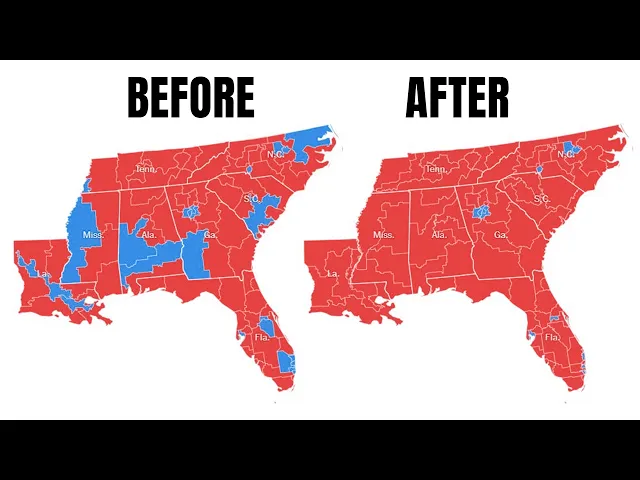
0:00 the Supreme Court just effectively gutted what
0:01 was left of the Voting Rights Act,
0:02 while also potentially giving Republicans nearly 20 more
0:04 seats in the House for all future elections.
0:07 Because this morning, the Supreme Court ruled 6 to 3 along
0:09 ideological lines to strike down Louisiana's congressional map,
0:12 arguing that it amounted to an illegal racial gerrymander.
0:14 notably, this case was started back in 2022,
0:17 when black voters and civil rights group sued Louisiana over a post
0:20 2020 census voting map that had only outlined one Majority-black district.
0:23 Despite the fact that one third of the state's population is black.
0:26 any of these groups arguing that the map
0:28 violated section two of the Historic Voting Rights Act,
0:30 which bans gerrymandering that undermines the power of minority voters?
0:33 you know, there are two ways that racial gerrymandering is done,
0:35 either by one concentrating targeted voters or that they
0:37 compose the majority in just one district, when it really should maybe be two,
0:40 or 2 dividing up large groups
0:42 of minority voters among multiple districts to prevent
0:44 them from really ever having a majority of the vote in any single boundary.
0:47 this also requires states to be very careful when drawing maps, right?
0:50 They need to consider race to a certain degree in order to ensure
0:53 that minority voters have a say in electing the candidates of their choosing.
0:56 but maps that are drawn to explicitly
0:58 along racial lines violate the Equal Protection
1:00 Clause of the 14th Amendment and the 15th
1:02 Amendment's ban on racial discrimination and voting.
1:03 and at least until today, courts have used section two to strike
1:06 down district maps that weaken minority voting power,
1:08 even without proof that maps were
1:10 intentionally designed to discriminate against minority groups.
1:12 That's been the standard for, for decades.
1:13 And so under that logic, a federal court ruled in favor
1:15 of the plaintiffs in Louisiana and ordered the state
1:17 legislature to draw a new map
1:19 that added a second majority black congressional district.
1:21 so.
1:21 As a result, lawmakers created a map
1:22 that allowed voters to elect Representative Cleo Fields,
1:24 a black Democrat, to flip the new district.
1:26 then at the same time, the Republican controlled legislature drew the district
1:29 lines in a very janky way, they did it in part so it could create the majority
1:32 black district while it's still protecting the seats of key Republicans,
1:35 including House speaker Mike Johnson and House Majority Leader Steve Scalise.
1:38 and so as a result, a group
1:40 of self-described non-black voters backed by powerful conservative groups
1:42 filed a lawsuit claiming that the new map
1:45 was itself a racial gerrymander because lawmakers had relied
1:47 too much on race when they drew with lawyers for the plaintiffs arguing in court
1:50 that the wonky shape was clear evidence that race
1:52 had been the main factor in drawing the district.
1:54 then its decision today, the Supreme Court ruled that Louisiana's
1:57 map was an unconstitutional racial gerrymander.
1:59 this ruling.
2:00 It goes way beyond just Louisiana.
2:01 Because of the court was considering section two more broadly,
2:04 decision effectively undercuts decades of precedent aimed at ensuring
2:06 minority voters have an equal opportunity to participate in elections.
2:10 because like I noted earlier, for the last 40 years,
2:11 district maps could be struck down if they diluted minority voting power,
2:14 regardless of intent.
2:15 in the majority opinion you had
2:17 Justice Samuel Alito writing the challengers must
2:18 show that a state intentionally drew
2:20 district lines to discriminate against minority voters.
2:23 then also with this, you had Justice Kagan hitting back in her dissent, wrote,
2:25 which she actually read from the bench in a rare
2:27 move to show just how much she disagreed with the majority.
2:30 then it you had Kagan arguing that in practice,
2:32 the decision makes it nearly impossible to consider race
2:34 at all when drawing up voting maps and claiming
2:36 that the court's decision will set back the foundational
2:38 right Congress granted of racial equality and electoral opportunity.
2:41 now, all that said, very notably,
2:43 the court did not strike down section two entirely,
2:45 which was a very real concern for many advocates.
2:47 but still, you have experts saying it.
2:49 This ruling effectively guts the VRA and makes it entirely toothless.
2:52 and you've had many kind of expecting this since for the last decade,
2:54 the Supreme Court's been chipping away at key parts
2:56 of the law them slowly weakening it bit by bit.
2:58 And in their dissent, you with the liberal justices arguing that today's
3:01 decision removes the last remaining pillar that gave real
3:04 power to historic law that has dramatically helped
3:06 increase minority representation in both state and federal offices.
3:09 but right now, the big question on everyone's
3:10 mind is what will this mean for elections?
3:12 and what we do know for a fact
3:14 that this is going to be incredibly consequential.
3:15 One of the big unknowns is how long it's
3:17 going to take before we actually see the impacts.
3:19 Because many majority minority districts across
3:20 the country have been redrawn over
3:22 the last four decades to comply with section two of the VRA,
3:25 though most are currently concentrated in the South.
3:27 but now states can challenge those maps based on the new Supreme Court ruling.
3:29 so as a result we can see new maps
3:31 with fewer districts where minority voters form a majority.
3:33 because those districts are more likely to elect Democrats.
3:36 Splitting them up could shift those seats towards Republicans.
3:38 we're not talking about a few districts here or there.
3:40 I mean, one analysis found that by gutting section two,
3:42 the Supreme Court could effectively give Republicans
3:44 as many as 19 more seats in the House.
3:45 and you can bet your ass that Republicans have already
3:47 been contingency planning for this outcome for a while now.
3:49 one of the questions is whether they could pull this off before the midterms.
3:52 and while many states they can't swing changes
3:54 to their maps right now because the primaries have already happened,
3:56 there are still plenty of others that could take action.
3:58 I mean, for one, Louisiana's likely going to have
4:00 to redraw maps before the midterms because of this ruling.
4:02 though notably, the state attorney general
4:04 said she would defer to the legislature,
4:05 which she believes is enough time to act before November.
4:08 but then beyond that, yeah.
4:09 The New York Times reporting that there are several other
4:11 states that still have time to redraw their maps, including Alabama,
4:14 Georgia, South Carolina, Maryland, Missouri,
4:15 Tennessee and Florida all of those states,
4:17 with the exception of Maryland, are controlled by Republican legislatures.
4:20 we are now literally already seeing movement on this front.
4:22 Just hours after the Supreme Court decision was released,
4:24 both chambers of the Florida Legislature approved a new map
4:26 that could give Republicans as many as four new seats.
4:28 right.
4:29 A huge victory for Ron DeSantis,
4:30 who's led the redistricting campaign and used the likely dismantling
4:33 of section two as the main justification for his effort.
4:35 also the governor of Mississippi,
4:36 he's vowed to call lawmakers or a special session to redraw
4:38 the state's map after the Supreme Court made its decision.
4:41 and in a statement today,
4:41 with Alabama's attorney general promising the state would act quickly
4:44 to ensure that our congressional maps reflect the will of the people,
4:47 not a racial quota system.
4:48 The Constitution forbids.
4:49 that it's just to start all over the country.
4:51 We are seeing Republican leaders calling
4:52 for Bible states to act before the midterms.
4:54 right, but also, even if some states
4:56 they can't get together new maps before November,
4:57 It's really just a matter of time.
4:59 Very likely.
4:59 They'll have them ready by 2028.
5:01 so the implications here for future elections.
5:03 It's very scary for anyone that was
5:04 kind of hoping to have a representative democracy.
5:06 very likely we're just going to see states gerrymandering like crazy for power.
5:10 Because as we've seen with other things,
5:12 if some states do it, then others have to respond.
5:14 And it's just it just keeps going.